Handled With Care
As schools for students with autism move from makeshift or retrofitted quarters to new buildings tailored to their specific programs, architects and educators focus on what makes the best places for learning.


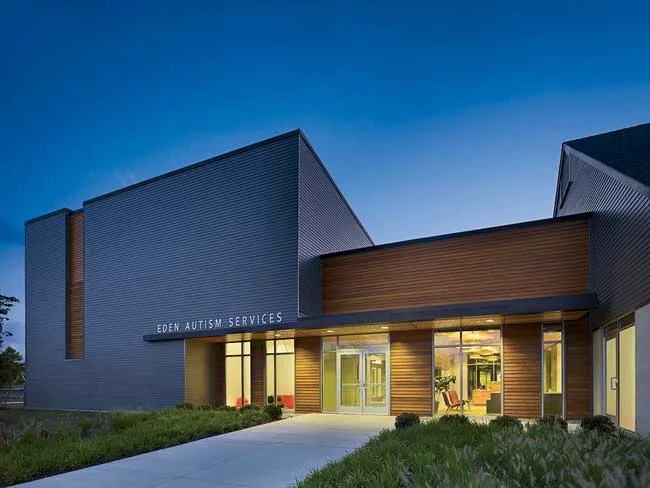

Back in 1975, when the Eden Institute was founded in a New Jersey church basement to serve children with autism, the disorder was considered relatively rare, then estimated at a nationwide rate of 1 in 10,000 births. But by the time Eden settled into its new facility last year, the prevalence of autism, as reported by the Centers for Disease Control, had risen exponentially to 1 in 88.
With increased diagnoses, autism-specific schools multiplied. The umbrella definition, as autism expert John Brown points out, altered the 'size and nature of the pool' to include not only profoundly autistic and severely incapacitated people requiring hospitalization, but also higher-functioning groups in need of special learning environments.
Many first-generation programs that began in humble, makeshift, or retrofitted quarters have recently created new facilities from the ground up'among them CFD's Ridge Campus, as well as REED Academy and Eden, both in New Jersey. These projects have given institutional leaders and their architects the chance to zero in on what makes good design for students with autism.
But just as ASD's causes, mechanisms, and cures are not yet well understood, architecture's potential in this context remains semi-hazy. Educational philosophies (and design goals) diverge, most notably on essential questions of whether to tone down, 'sanitize,' or largely eliminate auditory, visual, and other sensory stimuli'or to expose autistic students to more challenging 'real world' conditions.
The argument for 'sensory diets' is to shelter ASD students from stimuli that might trigger traumatic responses or simply make it difficult for them to focus. So the idea is to create safe, calm environments, free of distractions that could cause pain or anxiety and derail learning. Recommended measures have included muted colors; ultra-simplified detailing; meticulous soundproofing; avoidance of direct fluorescent lighting, sharp angles, or abrupt transitions; and, in general, consistency rather than variety.
But advocates of the 'real world' approach point out that people with ASD often have difficulty generalizing, or transferring a skill learned in one setting to another (even something as mundane as using a restroom). And so, the argument goes, coddling these students in sensory-controlled 'bubbles' hinders their integration into society.
The latter philosophy, rooted in a behavioral approach, underlies REED Academy's new home, a 25,300-square-foot, bowed-roof structure in a suburban office park. Regarding sensory input, 'we don't intentionally mute or reduce it to prevent 'distraction.' That's not real life,' stresses Leah Fanning, the principal of REED, which, like the other examples in this article, is a private nonprofit, receiving referrals and funding from public-school sources.
Brown, now a professor with Hunter College's Autism Center, was REED's executive director when the project began. Working closely with WXY Architecture + Urban Design, he envisioned simulating conditions of the outside world to help students 'engage it, live in it, relate to other people, and find employment there.' So instead of banning direct fluorescent lights or maintaining lockstep uniformity, he advocated mixing 'every type of lighting fixture you'd find at a typical workplace.' He favored diverse finishes and colors, and mismatched bathroom fixtures to familiarize students with everything from automatic faucets to air hand dryers and towel dispensers.
Ultimately, however, the budget was cut deeply (to $175 per square foot) and the building completed with suppliers' remainders, sacrificing ambitious variations in finishes and fixtures. Nonetheless, the strength of the spatial and programmatic concepts remains.
An irregular R in plan, the one-story building centers around an airy, light-filled multi-use gymnasium with clear glass walls and a high bow truss above. Wrapping around and extending beyond this space are long, meandering corridors, with classrooms on one side and quirky nooks on the other. Circulation is purposely serpentine, punctuated by treats, such as a mockup grocery store with a real cash register and checkout, in the alcoves en route. The goal is to promote independence and social interaction among the 32 students, aged 3 to 16. (Transparencies, sightlines, and mirrors let teachers supervise without encroaching on the atmosphere of self-reliance.) Movement through the space becomes at least as important as the 'destinations''or as Brown puts it, 'the path is the point.'
Like Eden and CFD, REED (which has a 1:1 student-faculty ratio) teaches academic subjects and life skills simultaneously. So the building itself becomes a learning tool, with every space performing at least double duty. For example, the nurse's office is both a place to receive care and a 'mini-classroom,' where fearful students practice the experience of a medical visit. The bathrooms serve as teaching sites for everyday skills like tooth brushing, urinal etiquette, or toilet use. A laundry room, a kitchen, and vocational-training spaces like REED's model hotel suite are functional and instructional areas.
By contrast, CFD's Ridge Campus, by architect Turner Brooks, occupies the dynamic middle ground between sensory-modulated and 'real world' approaches in seemingly unorthodox ways. At first glance, the rambling constellation of rural buildings'three clusters, each with three five-bedroom residences and a separate classroom-dining-exercise structure'appears to fly in the face of conventional wisdom about the soothing effects of subdued hues. Housing a total of 45 students, aged 8 to 20, the cottages, clad in fiber-cement board, are painted vermilion, mango, or bottle green, each a different color from its neighbor. Ostensibly daring, they apply an intuitive logic of bold color coding that, anecdotal findings suggest, may actually provide ASD individuals with far more accessible way-finding means than conventional written signage. (Three years after the project's completion, the brightness is not at issue, but the color-sequence replication from one cluster to the next sometimes gets users lost'so the solution may be more variety, not less.)
While CFD's program integrates substantial 'real world' features'such as a working organic-biodynamic farm, where students can participate in raising all the chicken, beef, eggs, and vegetables for the school's kitchens and community food cooperative'Dollard and his staff also value sensory tuning of the built environment.
Here he is most concerned about the soundscape'the echoes and reverberation. 'For people with autism, sensory stimulation like bad acoustics is pure torture,' Dollard says. 'Once you create an environment that calms the kids, then learning can happen.' The key, he adds, is to gradually introduce less protected or predictable conditions.
Brooks's design rests on the idea, gleaned from his readings and conversations with school staff, that people with ASD experience space viscerally, with all their senses operating full throttle at once, causing them to recoil from abrupt transitions, jarring angles or sounds, complicated mullion patterns, or large, undifferentiated spaces. 'Straight-shot hallways cause anxiety, but gradual turns seem more calming,' says Dollard. So the thresholds are gentle, with nooks, bends, and incidental seating ensconcing the body while providing views out to communal realms. (CFD also has small 'sensory rooms' with spinning swings and soft, body-hugging devices to relax excessively stimulated students.)
At the crux of the campus are its paths, weaving between buildings, around trees, and continuing indoors, expanding and contracting in choreographed sequences to guide the body and eyes. Trails also connect to CFD's other facilities. The quieting, therapeutic value of rambling walks has been observed by staff, and, as at REED (which has its own small hiking trail), the character of paths both indoors and out generates opportunities for social interaction.
At Eden, the balance between the outside world and the school's safe harbor takes on yet a different character. In contrast to CFD's bucolic woods and farmland, Eden is in a mixed-use complex, with retail, offices, a hotel, and restaurants. The site was chosen for a purpose. Eden's previous home, in a former telephone-switching station, was isolated. 'We wanted the students to be part of a larger community,' says chief operating officer Carol Markowitz, describing frequent 'generalization' exercises in which pupils venture into the neighboring food court and stores or work in some of the restaurants. The complex also allows the school to share resources, such as a health-club swimming pool.
Unique to Eden is its mini Wawa convenience store, staffed by supervised students and open part-time to the public. (The Wawa chain is a corporate partner of the school.) So the interface with the outside world is very real. But at the same time, the building also makes sensory accommodation.
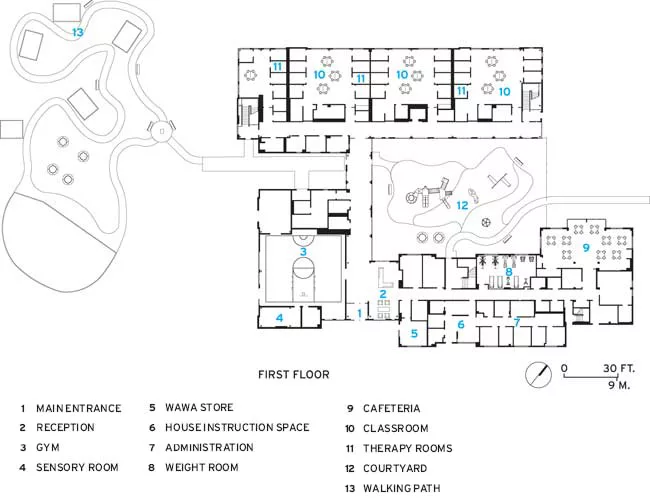
Designed by KSS Architects, the 38,300-square-foot facility incorporates an existing 12,900-square-foot houselike, gabled structure. KSS retained the intimate scale and form, giving the new section a contrasting flat roof and modest massing. The configuration, which accommodates early-intervention and outreach programs along with the day school for 62 students, aged 3 to 21, centers around a courtyard with a protected outdoor play area and a multipurpose gym. As in all these schools, exercise is important for both its calming effects and motor-skill development.
While the wide, daylit corridors are straight shots, changes in floor-tile colors signal classroom entrances. The flexible teaching rooms, as at REED and CFD, are designed for round tables, high faculty-student ratios, and ample maneuvering space, rather than blackboard-oriented lecture seating. These classrooms also have rows of small side rooms, offering a scale shift for more focused learning.
An unusual feature is each classroom's home-style kitchen (in addition to the school's professional cafeteria kitchen, where vocational training occurs). Here the daily life-learning curriculum actively involves students in lunch preparation, from grocery shopping to dishwasher loading.
While Eden's visual connections to daylight and surrounding greenery are strong, its sensory controls are subtle. They include indirect lighting, high-rated acoustic separations, muted natural colors, a large frosted window in the gym to diffuse distracting views, and an alarm system with a strobe specially synchronized to reduce jarring effects.
Despite their differences, these schools have significant aspects in common. In purely practical terms, all three were built on remarkably low budgets. (Slightly higher than REED's $175 per square foot, both Eden and CFD weighed in around $225.) And to varying extents, they all occupy a middle ground between 'real world' and stimulus-controlled approaches. (Even REED, one could argue, shields its pupils from mainstream sensory challenges, if only by housing its student body of 32 in 25,300 square feet.) None of these environments is sensory-sterile or austere.
And all three share a mission to promote social interaction among people with autism. Suggesting a broader trend toward socialization, Brown describes how he trained at a program that originally provided one isolating, 10-by-10-foot classroom per student. By the 1990s, some of the walls had come down, opening up the spaces. Now they're all gone.
Even with signs of progress, 'there's so much we still don't know about ASD,' says Dollard. 'We haven't yet created the metaphoric ramp into architecture for people with autism. But it's our mission to figure that out.'
Responding to Its Surroundings and Its Students
 |
| Photo © Frederick Charles |
|
Learning Spring School, New York City |
 |
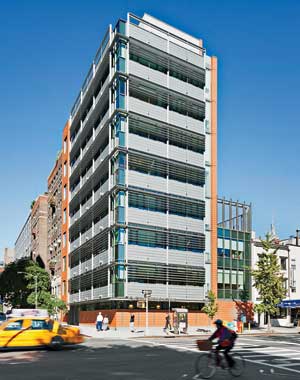
The Learning Spring School (LSS), in New York City, differs from the other ASD schools featured here in its narrower age range (grades K'8), highfunctioning student body, and context: The school's home is an eight-story building in a dense urban area. Yet LSS addresses some of the same issues.
The leadership, working with Platt Byard Dovell White Architects, sought to create a calming setting. 'We saw how distracting and detrimental to learning our previous physical environment was,' says head of school Margaret Poggi of the office building that once housed LSS. 'We wanted enough sensory control to make the students feel optimally comfortable.'
With ample daylight and natural materials like bamboo, the school (which achieved LEED for Schools Gold certification) was designed with close attention to consistency: The same desk chair, for example, appears throughout, graduating in size for older children. Cleanly detailed, closed storage minimizes visual clutter. And acoustic controls apply to partitions, finishes, street noise, and HVAC systems. Sound-absorbing cork covers hallway floors, and the library carpet has a circle pattern, selected for reputedly soothing effects. A generous $900 per square foot afforded the 34,000-square-foot building quality materials and details.
As in other ASD schools, student interaction is a priority. Corridor seating encourages social activity. (But small, padded quiet rooms allow overstimulated students to decompress.)
To teach life skills, the building has a kitchen and model studio apartment. And to help students transition to less restrictive environments, the upper grades include mainstream school features: lecture-style classrooms (but never with more than 12 pupils), hallway lockers, and a science lab.
'It was important to create a building the students would feel proud of,' says Poggi. When it first opened, one child, surprised to encounter an impressive science lab, proclaimed: 'Oh, it's a real school!'
—S.A.
Sarah Amelar is a contributing editor to Architectural Record.
People |
Products |
Looking for a reprint of this article?
From high-res PDFs to custom plaques, order your copy today!