Architectural Record
search
cart
facebook twitter linkedin youtube
  • Sign In
  • Subscribe
  • Sign Out
  • My Account
Architectural Record
  • NEWS
    • Latest News
    • Awards
    • Interviews
    • Obituaries
    • Podcasts
      • Design:Ed Podcast
      • Sponsored Podcasts
  • OPINION
    • Book Reviews / Excerpts
    • Exhibition Reviews
    • Forum
  • EXCLUSIVES
    • Videos
    • Design Vanguard
    • Top 300 Firms
    • Sponsored Content
    • Sponsored eBooks
    • From the Archives
  • CONTINUING ED
    • Editorial Continuing Ed
    • CE Center
    • CE Academies
  • PROJECTS
    • Buildings By Type
    • Reuse & Renovation
    • Museums & Arts Centers
    • Colleges & Universities
    • Multifamily Housing
    • Interiors
    • Lighting
    • Kitchen & Bath
  • HOUSES
    • Record Houses
    • House of the Month
    • Featured Houses
  • PRODUCTS
    • Products by Category
    • Record Products of the Year
    • Latest Products
  • EVENTS
    • Dates & Events
    • Record on the Road
    • Innovation Conference
    • Sustainability in Practice
    • Women In Architecture
    • Webinars
    • Ad Excellence Awards
    • Submit an Event
  • CONNECT
    • Ask RECORD AI
    • Newsletters
    • Contact
    • Advertise
    • Editorial Calendar
    • Store
    • Customer Service
  • SUBMIT
    • Submission Guidelines
    • RECORD Competitions
  • MAGAZINE
    • Subscribe
    • My Account
    • Digital Edition
    • Current Issue
    • Firm Pass
    • Historic Archive
ProjectsBuildings by TypeMultifamily Housing Architecture

Torre Júlia

Social Network: A trio of young architects enlivens a housing block for seniors by cleverly manipulating its facades and creating a series of community spaces.
By David Cohn
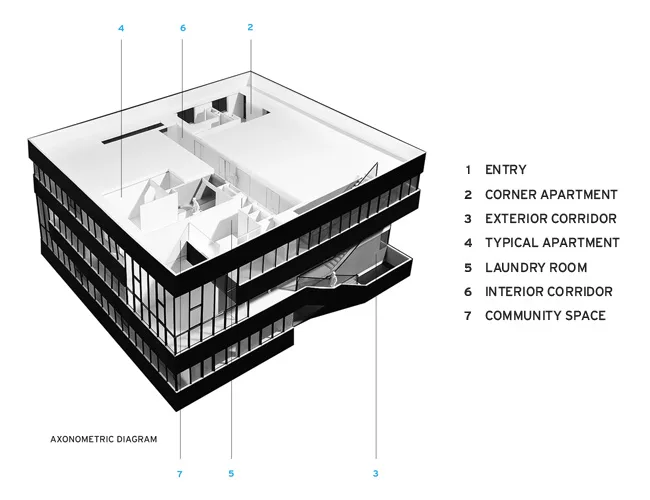
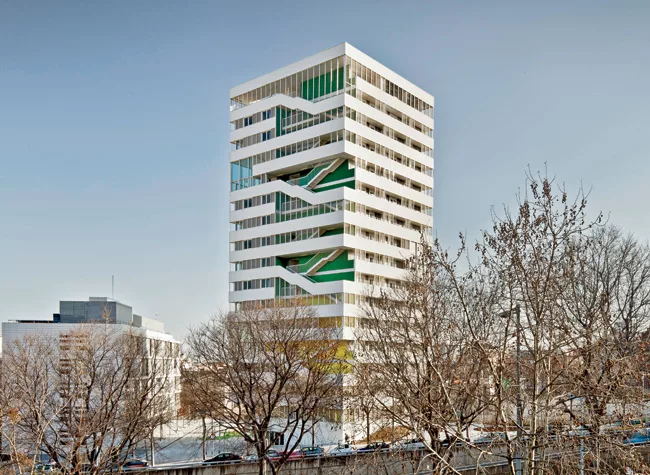
Set diagonally on its site, Torre Júlia is animated by outdoor stairs and double height common rooms on the corners.
Torre Júlia
Ricard Galiana, Sergi Pons, Pau Vidal
Barcelona
Set diagonally on its site, Torre Júlia is animated by outdoor stairs and double height common rooms on the corners.
Photo © Adria Goula
The continuous terraces of the apartment units further erode the facades.
Torre Júlia
Ricard Galiana, Sergi Pons, Pau Vidal
Barcelona
The continuous terraces of the apartment units further erode the facades.
Photo © Adria Goula
On the rooftop, the building has a public sun deck covered in artificial turf.
Torre Júlia
Ricard Galiana, Sergi Pons, Pau Vidal
Barcelona
On the rooftop, the building has a public sun deck covered in artificial turf.
Photo © Adria Goula
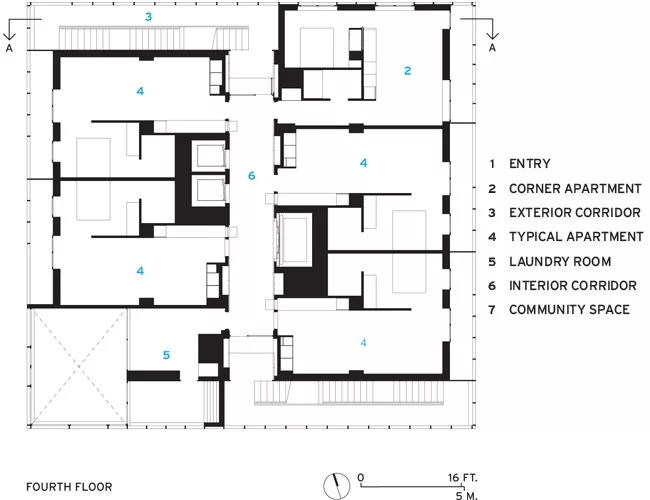
Apartments are grouped around the three common rooms with balconies housing washer-dryers. Finishes include patterned wallpaper and the corrugated aluminum of the facades.
Torre Júlia
Ricard Galiana, Sergi Pons, Pau Vidal
Barcelona
Apartments are grouped around the three common rooms with balconies housing washer-dryers. Finishes include patterned wallpaper and the corrugated aluminum of the facades.
Photo © Adria Goula
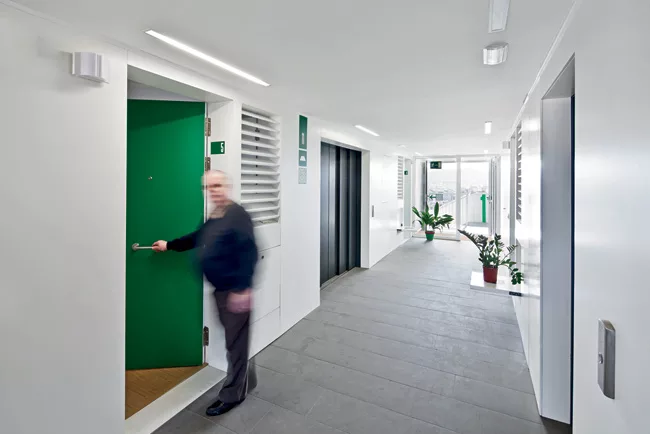
Corridors are extra-wide, with glazed ends opening to the outdoor stairs. The apartment units' louvered windows open to allow cross-ventilation.
Torre Júlia
Ricard Galiana, Sergi Pons, Pau Vidal
Barcelona
Corridors are extra-wide, with glazed ends opening to the outdoor stairs. The apartment units' louvered windows open to allow cross-ventilation.
Photo © Adria Goula
Torre Júlia
Torre Júlia
Ricard Galiana, Sergi Pons, Pau Vidal
Barcelona
Image courtesy of Ricard Galiana, Sergi Pons, Pau Vidal
Torre Júlia
Torre Júlia
Ricard Galiana, Sergi Pons, Pau Vidal
Barcelona
Image courtesy of Ricard Galiana, Sergi Pons, Pau Vidal
Torre Júlia
Torre Júlia
Ricard Galiana, Sergi Pons, Pau Vidal
Barcelona
Image courtesy of Ricard Galiana, Sergi Pons, Pau Vidal
Set diagonally on its site, Torre Júlia is animated by outdoor stairs and double height common rooms on the corners.
The continuous terraces of the apartment units further erode the facades.
On the rooftop, the building has a public sun deck covered in artificial turf.
Apartments are grouped around the three common rooms with balconies housing washer-dryers. Finishes include patterned wallpaper and the corrugated aluminum of the facades.
Corridors are extra-wide, with glazed ends opening to the outdoor stairs. The apartment units' louvered windows open to allow cross-ventilation.
Torre Júlia
Torre Júlia
Torre Júlia
July 16, 2013

Architects & Firms

Ricard Galiana, Sergi Pons, Pau Vidal

Barcelona

One of the challenges in designing housing is finding a middle ground between monotonous repetition and arbitrary variety. For Torre Júlia, a 17-story municipal apartment building for senior citizens on the northern edge of Barcelona, a team of architects fresh out of architecture school—Ricard Galiana, Sergi Pons, and Pau Vidal—uses singular elements such as social spaces and circulation to cleverly navigate between these extremes. Developed after the trio won a 2007 competition for another project on the site that was subsequently canceled, their formal strategy is part of a larger aim to make the building into a community. “This is, after all, basically a social container,” explains Pons.

The design for the $9.7 million, 90,000-square-foot tower starts from a premise as boring as that for a speculative office block: a reinforced-concrete structure with a square footprint and repetitive horizontal ribbons of openings and spandrels finished in white corrugated aluminum. But the architects treat this basic volume as a neutral field over which they deploy a series of variations. The 77 rental units, which overlook the northwest and southeast exposures, are pulled back behind continuous terraces, converting the facades into a sun screen. Outdoor stairs run down the other two facades, selectively interrupting the spandrel bands with dramatic, Constructivist-looking diagonals that reveal planes of yellow and green behind them-part of a color-coding system that groups several floors together into communities around corner common rooms.

These public living rooms are double-story, with full-height glazing, each with a 16-foot cantilever above supported by continuous concrete walls. Crowning the composition is a roof deck, open to the sky but surrounded by a ribbon of framed openings slightly taller than those below.

Inside, the architects push against the limits of subsidized-housing standards to encourage interaction among residents. Corridors are short and more than 7 feet wide (4 feet is the norm), with glazed ends opening to the exterior stairs, inviting visits to nearby floors. The 430-square-foot apartments, each with a single bedroom and a kitchen bar in the living area, have louvered windows facing into the corridors that residents can open to create cross-breezes and allow an auditory connection to the hall (fold-down seats in front of each unit were under-detailed, however, and can't support the weight of a sitter, though they're good for parking groceries). A midmorning trip through the building found residents' potted plants enlivening some of these bright spaces, sounds of a radio playing from one apartment, aromas of baking from another, and a woman crossing over to call out to a neighbor. More social mixing takes place on the entry floor, which has a full-time social-services staff and a meeting room with a small stage. Here residents and staff interact in front of the elevators and the mailboxes.

Although the tower's site is something of a leftover space, it benefits from Barcelona's decades-old city-planning programs. It is situated at the end of Via Júlia, a commercial street where, in the 1980s, the city planted trees and created wide sidewalks, now filled with pleasant outdoor cafés. It stands beside the Ronda de Dalt ring road, built for the 1992 Olympics. Largely buried under plazas and boulevards, the busy thoroughfare is an acoustic presence but not overpowering. And the tower is grouped with other city services, including a nursing home, a public market, and a planned municipal swimming pool. Although the site is rather steeply sloped (an obstacle that the entry plaza, with trees and flower beds between meandering walks, handsomely overcomes), the location provides residents with panoramic views toward the Olympic Village and the Mediterranean. Such amenities, together with the skillful, committed design, make a big difference in a project built on a modest budget.

Size: 90,000 square feet

Cost: $9.7 million

Completion date: September 2011

People

Owner: PATRONAT MUNICIPAL DE L'HABITATGE DE BARCELONA

Architects:
Ricard Galiana
(+34 649982427,www.ricardgaliana.com),
Sergi Pons
(+34 696126079, www.sergiponsarchitect.com)
Pau Vidal
(+34 679017446, www.pauvidal.eu)

Personnel in architect's firm who should receive special credit:
Gioia Guidazzi, Diana Sajdova

Associate architect(s): Encarna García Ramiro

Engineer(s): L3J TECNIC ASSOSSIATS

Consultant(s): BOMA Inpasa (structure)

General contractor: ACSA SORIGUÉ

Photographer(s): ADRIÀ GOULA www.adriagoula.com

Renderer(s): NANI PUJOL FOTO www.nanipujol.com , 3DLIFE


Products

Structural system
E.G CONCRETE

Exterior cladding
Metal Panels : Acieroid
Metal/glass curtain wall: Acieroid
Curtain wall: Acieroid

Windows
Metal frame: Acieroid

Glazing Glass: CLIMALIT

Interior finishes
Acoustical ceilings: PLADUR ACUSTIC

Lighting
Downlights: STI
Exterior: STI

Conveyance
Elevators/Escalators: OTIS

Energy
Photovoltaic system: Co-generation boiler

 
KEYWORDS: Spain

Share This Story

Looking for a reprint of this article?
From high-res PDFs to custom plaques, order your copy today!

David Cohn is a Madrid-based architecture critic and international correspondent for Architectural Record. His latest book, Spain: Modern Architectures in History, was released in 2025.

Post a comment to this article

Report Abusive Comment

Subscription Center
  • Create an Account
  • Start a Subscription
  • Manage My Account
  • Sign Up for Newsletters
  • Visit Customer Service
  • Update Preferences

More Videos

Sponsored Content

Sponsored Content is a special paid section where industry companies provide high quality, objective, non-commercial content around topics of interest to the Architectural Record audience. All Sponsored Content is supplied by the advertising company and any opinions expressed in this article are those of the author and not necessarily reflect the views of Architectural Record or its parent company, BNP Media. Interested in participating in our Sponsored Content section? Contact your local rep!

close
  • cold storage facility
    Sponsored byCarlisle SynTec Systems

    How Architects Can Design More Continuous Cold Storage Envelopes

  • TAMLYN XtremeTrim Exterior Trim
    Sponsored byTamlyn

    Designing Cleaner Panel Facades: Why Exterior Trim Details Matter

  • Building with Vapor Barriers
    Sponsored byReef Industries, Inc.

    Vapor Barriers Help Control Moisture in Tighter Building Designs

DESIGN:ED Podcast
Listen to Architectural Record’s DESIGN:ED Podcast

Events

June 18, 2026

Rebooting the Aging Office Building

Credits: 1 AIA LU/HSW; 1 AIBD P-CE; 0.1 ICC CEU; 1 PDH

Explore façade retrofit strategies and award-winning design concepts that can transform aging office buildings into healthier, higher-performing workplaces for today’s hybrid workforce.

June 23, 2026

Enhancing Fire Resistance with Advanced PVC Solutions

Credits: 1 AIA LU/HSW; 1 AIBD P-CE; 0.1 ICC CEU; 1 IIBEC CEH

Evaluate advanced PVC solutions that improve fire resistance, support WUI compliance, and enhance resilience in residential and commercial building design.

View All Submit An Event

Products

2026 Architect's Square Foot Costbook

2026 Architect's Square Foot Costbook

See More Products

Popular Stories

SanDiegoAirport

Top 300 Architecture Firms of 2026

Lorcan O' Herilhy

California Architect Lorcan O’Herlihy Has Died, Age 66

Coronado Bridge

The Architect’s Guide to San Diego

CCA, Studio Gang

The Winners of the AIA’s 2026 Architecture Award Range from Collegiate Rowing Hubs to Housing for the Homeless

Dusk House

Design Vanguard 2026: ONO

Rebooting the Aging Office Building - Free Webinar - June 18, 2026

Related Articles

  • Illa Glòries

    Design Vanguard 2026: Cierto Estudio

    See More
  • Torre Velasca

    Braced for the Future: Milan’s Renovated Torre Velasca Reconnects with the City

    See More
  • Full Circle Swing

    Full Circle Swing by Julia Jamrozik and Coryn Kempster

    See More

Related Products

See More Products
  • 3dthinking.jpg

    3D Thinking in Design and Architecture: From Antiquity to the Future

  • american arch.jpg

    American Architecture: An Illustrated Encyclopedia

  • WC_-SCA.png

    Building Great Schools for a Great City

See More Products
×

The latest news and information

#1 Source for Architectural Design, News and Products

SUBSCRIBE
  • RESOURCES
    • Advertise
    • Contact Us
    • Submit
    • Store
  • ACCOUNT CENTER
    • Create an Account
    • Start a Subscription
    • Manage My Account
    • Sign Up for Newsletters
    • Visit Customer Service
    • Update Preferences
  • PRIVACY
    • PRIVACY POLICY
    • TERMS & CONDITIONS
    • DO NOT SELL MY PERSONAL INFORMATION
    • PRIVACY REQUEST
    • ACCESSIBILITY
  • SERVICES
    • Marketing Services
    • Reprints
    • Market Research
    • List Rental
    • Survey/Respondent Access
  • STAY CONNECTED
    • Linkedin
    • Facebook
    • Instagram
    • YouTube
    • X (Twitter)

Copyright ©2026. All Rights Reserved BNP Media, Inc. and BNP Media II, LLC.

Design, CMS, Hosting & Web Development :: ePublishing