Architectural Record
search
cart
facebook twitter linkedin youtube
  • Sign In
  • Subscribe
  • Sign Out
  • My Account
Architectural Record
  • NEWS
    • Latest News
    • Awards
    • Interviews
    • Obituaries
    • Podcasts
      • Design:Ed Podcast
      • Sponsored Podcasts
  • OPINION
    • Book Reviews / Excerpts
    • Exhibition Reviews
    • Forum
  • EXCLUSIVES
    • Videos
    • Design Vanguard
    • Top 300 Firms
    • Sponsored Content
    • Sponsored eBooks
    • From the Archives
  • CONTINUING ED
    • Editorial Continuing Ed
    • CE Center
    • CE Academies
  • PROJECTS
    • Buildings By Type
    • Reuse & Renovation
    • Museums & Arts Centers
    • Colleges & Universities
    • Multifamily Housing
    • Interiors
    • Lighting
    • Kitchen & Bath
  • HOUSES
    • Record Houses
    • House of the Month
    • Featured Houses
  • PRODUCTS
    • Products by Category
    • Record Products of the Year
    • Latest Products
  • EVENTS
    • Dates & Events
    • Record on the Road
    • Innovation Conference
    • Sustainability in Practice
    • Women In Architecture
    • Webinars
    • Ad Excellence Awards
    • Submit an Event
  • CONNECT
    • Ask RECORD AI
    • Newsletters
    • Contact
    • Advertise
    • Editorial Calendar
    • Store
    • Customer Service
  • SUBMIT
    • Submission Guidelines
    • RECORD Competitions
  • MAGAZINE
    • Subscribe
    • My Account
    • Digital Edition
    • Current Issue
    • Firm Pass
    • Historic Archive
ProjectsBuildings by TypeMultifamily Housing Architecture

Songpa Micro Housing

Living Small In The Big City: Adapting to a changing program, an inventive project in Seoul mixes micro and small apartments with arts-focused functions.

By Clare Jacobson
Songpa Micro Housing
The architects pushed parking spaces to one side to free up the ground floor for an entry plaza.
 
Photo © SsD
Songpa Micro Housing
The six-story building, with its stacked boxes set behind a steel screen, stands out in a neighborhood of apartment blocks and light commercial buildings.
 
Photo © SsD
Songpa Micro Housing
After the client decided to change the program a bit, some micro units were combined into 240-square-foot apartments (left). All of the dwellings have monochromatic finishes and clerestory windows that help make the spaces feel bigger.
 
Photo © SsD
Songpa Micro Housing
Jinhee Park used her training as an industrial designer to good advantage, approaching the project as a machine for living. The interiors of the 120-square-foot micro units were prefabricated off-site and installed in just two days. Murphy beds, pull-out tables, and all kinds of built-ins make the most of every square inch.
 
Photo © SsD
Songpa Micro Housing
Jinhee Park used her training as an industrial designer to good advantage, approaching the project as a machine for living. The interiors of the 120-square-foot micro units were prefabricated off-site and installed in just two days. Murphy beds, pull-out tables, and all kinds of built-ins make the most of every square inch.
 
Photo © SsD
Songpa Micro Housing
Jinhee Park used her training as an industrial designer to good advantage, approaching the project as a machine for living. The interiors of the 120-square-foot micro units were prefabricated off-site and installed in just two days. Murphy beds, pull-out tables, and all kinds of built-ins make the most of every square inch.
 
Photo © SsD
Songpa Micro Housing
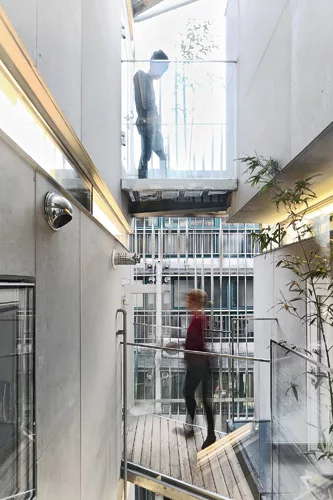
The spaces between the dwelling units help distinguish the project from most other micro-housing developments. Wide corridors and short bridges, for example, encourage residents to hang out together and interact.
 
Photo © SsD
Songpa Micro Housing
The spaces between the dwelling units help distinguish the project from most other micro-housing developments. Wide corridors and short bridges, for example, encourage residents to hang out together and interact.
 
Photo © SsD
Songpa Micro Housing
Originally envisioned as a work studio for artists living in the building, the basement space now serves as a café and toy store.
 
Photo © SsD
Songpa Micro Housing
A glass box on the ground floor offers views and access to the café.
 
Photo © SsD
Songpa Micro Housing
View of the project from the street.
 
Photo courtesy of SsD
Songpa Micro Housing
Looking down to the street level and into the second-floor gallery.
 
Photo courtesy of SsD
Songpa Micro Housing
A Murphy bed saves space in a micro unit.
 
Photo courtesy of SsD
Songpa Micro Housing
Every inch counts in a micro unit.
 
Photo courtesy of SsD
Songpa Micro Housing
Image courtesy SsD
Songpa Micro Housing
Image courtesy SsD
Songpa Micro Housing
Image courtesy SsD
Songpa Micro Housing
Image courtesy SsD
Songpa Micro Housing
October 16, 2014

Architects & Firms

SsD

Seoul

People/Products

Although they used repetitive units and simple construction in their Songpa Micro Housing in Seoul, Jinhee Park and John Hong of Single Speed Design (SsD) brought variety and style to the 5,500-square-foot project by animating the spaces in between and around the tiny apartments. Wrapped within a striking container of stainless-steel louvers and enhanced with outdoor and shared spaces, the eight residences subvert the monotonous forms of most micro housing. By design—and ultimately by the client's changes to that design—the project shows that this building type can play a flexible role in a city's mix of housing.

SsD stacked six stories of 120-square-foot boxes, pushing some forward and others to one side to create narrow balconies on the roofs of the units below. Picture Tejo Remy’s Chest of Drawers for Droog, not your grandmother’s credenza. The cement-panel boxes were constructed on-site using two sets of dimensions to add variety and were then placed within a structural steel frame. The stainless-steel scrim around the dwelling units presents a unified front to the street while providing privacy to outdoor decks, and hiding messy gas pipes. Eight variations in the bending of the steel give the screen a flowing rhythm.

The units themselves are tiny, but SsD designed built-in furniture—including Murphy beds and pullout tables—to give them a bit more space and a unified aesthetic. These interiors were prefabricated and then installed in only two days. (Park began her career as an industrial designer and brought her experience to the task.) A claustrophile will find comfort in the walk-in-closet-sized space, with its neat white doors and drawers, while a claustrophobe will appreciate design strategies that open up the space. For example, clerestory windows run the perimeter of each apartment, creating the effect of a floating ceiling. In addition, private decks and small porches offer some breathing room. Wide hallways, furnished with ottomans, provide light-filled communal areas. The outdoor spaces have the added benefit of not being included in the gross floor area calculation, so the building could be a bit bigger. And the corridors are not counted toward parking requirements, so a welcoming entry plaza replaces the more typical ground-floor parking lot.

The project, which replaced a four-story multiuse structure, stands on a quiet block lined with brick and concrete residential buildings in Seoul’s Songpa District. The district has little of the style of the nearby Gangnam neighborhood. Instead of Gucci and galleries, Songpa is characterized by apartment buildings and light commercial structures.

In South Korea, young people have traditionally lived with their parents until they marry, so neighborhoods offer mostly multi-bedroom apartments. But Korean society is changing. According to government figures, population growth in the country has declined from 16.32 percent in 1960 to 1.53 percent in 2010. One- and two-person households accounted for 48.1 percent of the housing market in 2010 and are projected to increase to 68.3 percent in 2035. Micro housing that can serve this population has some precedents in Korean society, including goshiwon (short-term one-room sleep and study spaces for students); goshitel, oneroomtel, or livingtel (longer-term rental apartments); and officetel (buildings that combine studio apartments with work spaces). Park says developers have recently rushed in to build micro housing, taking advantage of new low-interest construction loans designated for doshihyung saenghwal jutek (urban living housing) for one- or two-person households.

SsD notes that the design of its Songpa building differentiates it from other micro-housing projects. “We pushed the client to do something more interesting,” Park says. The clients—members of a local family headed by Chanill Lee, who owns several hospitals and has an interest in art— were receptive. They had visited SsD’s White Block Gallery and agreed with Park and Hong that an innovative design could attract a creative clientele and better compete against projects by big developers. The size of the Songpa units, smaller than Seoul’s more typical 200- to 300-square-foot micro housing, also makes them more affordable.

As the project progressed, the original plans changed, and half of the floors were redesigned for the Lees’ own use: a basement meant to be a work studio for resident artists was built as a café and toy store, second-floor units were converted into an art gallery, and the fourth floor was remade into an apartment for the family’s daughter. In addition, some of the 120-square-foot micro units were combined into 240-square-foot one-bedroom apartments. This means that only five of the planned 16 micro units were built. Yet the modules proved adaptable to changes in the program.

With the new mix of units and uses, it is unclear if the building will produce the kinds of social interaction that SsD had originally planned—such as residents congregating in the wide corridors and talking to each other from various bridges and balconies. But the innovative scheme should attract a design- focused clientele. In a perfect ending, the society they choose to make there will be as creative as the building that contains it.


People

Owner:
Chanill Lee

Architect:
SsD
11 Broadway, Suite 819
New York, NY 10004
Tel: +1 212 248 7500 /
Fax: +1 617 576 9300

Personnel in architect's firm who should receive special credit:
Jinhee Park AIA, principal in charge (registered)
John Hong AIA, LEED AP, collaborating principal (registered)
Seung-hoon Hyun, project manager (not registered)
Taylor Harper, Allison Austin, Evan Cerilli, Mark Pomarico, Yufeng Zheng, Victor Michel, Virginia Fernandez Alonso, design team (not registered)

Architect of Record:
Dyne Architecture

Engineers:
Mirae Stuctural Design Group, structural

Consultant(s):
Lighting:
Newlite

Acoustical:
RPG Korea

Other:
Mohse, metal screen; Madein, built-in furniture; Slyducks, outdoor furniture

General contractor:
Kiro Construction

Photographer(s):
SsD,
+1 212 248 7500

Construction cost:

$1.5 million

Size:

5,500 square feet

Completion date:

June 2014


Products

Structural system
Steel frame

Exterior cladding
Cement Panels:
Sinkwang

Metal/glass curtain wall:
Parker E&C Korea

Curtain wall:
Parker E&C Korea

Other cladding unique to this project:
Metal Screen: bent stainless steel; fabricator and consultant: Mohse

Windows
Metal frame:
Parker E&C Korea

Entrances:
Parker E&C Korea

Metal doors:
Dongbang Novoferm

Sliding doors:
Kiro construction

Fire-control doors, security grilles:
Dongbang Novoferm

Upswinging doors, other:
Somfy auto-shutter

Hardware
Locksets:
Samsung

Closers:
King

Pulls:
Parker E&C Korea

Security devices:
S-1 Secom

Other special hardware:
Hafele (built-in foldaway bed)

Interior finishes
Acoustical ceilings:
RPG Korea

Suspension grid:
RPG Korea

Demountable partitions:
RPG Korea

Cabinetwork and custom woodwork:
Madein

Paints and stains:
Olympic stain

Special surfacing:
Pos eco grating (bridge)

Floor and wall tile:
GAI International (bathroom)

Resilient flooring:
Dongwha nature flooring

Special interior finishes unique to this project:
DEAMP acrylic perforated panel (Auditorium), Serim ceramic tile (lobby)

Furnishings
Office furniture:
Madein

Reception furniture:
Madein

Built-in furniture:
Madein

Chairs:
Bentek

Tables:
Bentek

Lighting
Interior ambient lighting:
Newlite

Downlights:
Newlite

Task lighting:
Watts lighting

Exterior:
Newlite

Dimming System or other lighting controls:
Newlite

Conveyance
Elevators/Escalators:
ThyssenKrupp

Plumbing
Sink:
Daelim

Toilet:
Daelim

Accessories:
Daelim

Energy
Energy management or building automation system:
Kocom (Home automation sys.)

Other unique products that contribute to sustainability:
Permeable Paving:
Zauum Uniblock

 
KEYWORDS: South Korea

Share This Story

Looking for a reprint of this article?
From high-res PDFs to custom plaques, order your copy today!
Clare Jacobson is a San Francisco-based contributor to Architectural Record.

Post a comment to this article

Report Abusive Comment

Subscription Center
  • Create an Account
  • Start a Subscription
  • Manage My Account
  • Sign Up for Newsletters
  • Visit Customer Service
  • Update Preferences

More Videos

Sponsored Content

Sponsored Content is a special paid section where industry companies provide high quality, objective, non-commercial content around topics of interest to the Architectural Record audience. All Sponsored Content is supplied by the advertising company and any opinions expressed in this article are those of the author and not necessarily reflect the views of Architectural Record or its parent company, BNP Media. Interested in participating in our Sponsored Content section? Contact your local rep!

close
  • TAMLYN XtremeTrim Exterior Trim
    Sponsored byTamlyn

    Designing Cleaner Panel Facades: Why Exterior Trim Details Matter

  • Building with Vapor Barriers
    Sponsored byReef Industries, Inc.

    Vapor Barriers Help Control Moisture in Tighter Building Designs

  • Duct Interior with Prodeq System
    Sponsored byHenry, a Carlisle Company

    Designing Resilient Water Containment Systems

DESIGN:ED Podcast
Listen to Architectural Record’s DESIGN:ED Podcast

Events

June 10, 2026

Rethinking Stormwater – The Power of Porous Paving

Credits: 1 AIA LU/HSW; 1 AIBD P-CE; 0.1 ICC CEU

Learn how porous paving systems support stormwater management, reduce heat island effects, and enhance sustainable site design performance.

June 11, 2026

Very Early Warning Fire Detection for Mission-Critical Facilities

Credits: 1 AIA LU/HSW; 1 AIBD P-CE; 0.1 ICC CEU

Examine advanced fire detection strategies that support uptime and enhance safety in data centers and other mission-critical facilities.

View All Submit An Event

Products

2026 Architect's Square Foot Costbook

2026 Architect's Square Foot Costbook

See More Products

Popular Stories

Practice Matters illustration

What’s in a (Firm’s) Name? Thinking About Succession and Legacy

Coronado Bridge

The Architect’s Guide to San Diego

Practice Matters illustration

By the Numbers: Counting America's Architects

House on a Hill

Design Vanguard 2026: Forma

Crane Cove, ONO

Design Vanguard 2026 Winners

Broader Sustainability of CMU - Free Webinar - May 21, 2026

Related Articles

  • Tahanan Supportive Housing.

    David Baker's Tahanan Supportive Housing Takes its Design Cues from the Surrounding Filipino Community

    See More
  • Cities Court Creatives with Micro-Units

    See More
  • nARCHITECTS Wins NYC Micro-Unit Competition

    See More

Related Products

See More Products
  • 9 ways.jpg

    9 Ways To Make Housing for People

See More Products
×

The latest news and information

#1 Source for Architectural Design, News and Products

SUBSCRIBE
  • RESOURCES
    • Advertise
    • Contact Us
    • Submit
    • Store
  • ACCOUNT CENTER
    • Create an Account
    • Start a Subscription
    • Manage My Account
    • Sign Up for Newsletters
    • Visit Customer Service
    • Update Preferences
  • PRIVACY
    • PRIVACY POLICY
    • TERMS & CONDITIONS
    • DO NOT SELL MY PERSONAL INFORMATION
    • PRIVACY REQUEST
    • ACCESSIBILITY
  • SERVICES
    • Marketing Services
    • Reprints
    • Market Research
    • List Rental
    • Survey/Respondent Access
  • STAY CONNECTED
    • Linkedin
    • Facebook
    • Instagram
    • YouTube
    • X (Twitter)

Copyright ©2026. All Rights Reserved BNP Media, Inc. and BNP Media II, LLC.

Design, CMS, Hosting & Web Development :: ePublishing