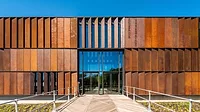
Arena Stage at the Mead Center for American Theater

The main entrance, on Sixth Street, abuts the Kogod Cradle.

The complex in 1971, with the Fichandler (left in photo) and Kreeger (upper right) theaters.
Photo courtesy Arena Stage
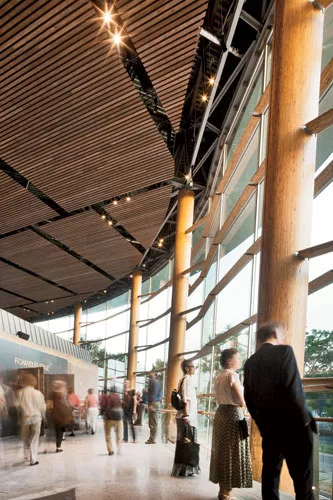
From the main lobby, theatergoers enter Harry Weese’s Fichandler Stage (1961) or gaze out the glass window wall to the Washington Channel.

The elevation along Maine Avenue emphasizes the center’s glassy amoeboid shape with a cantilevered roof sailing over an upper-level terrace.

The main entrance to the center, along Sixth Street, is embedded in the glass wall topped by a white canopy, which is supported by timber columns.
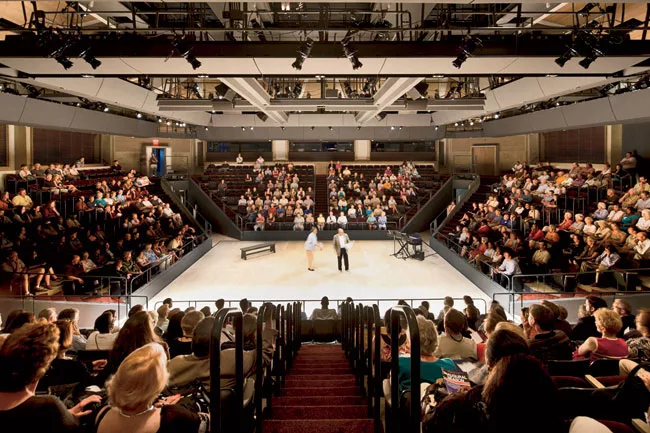
The Fichandler kept its arena plan, although it was reduced by 200 seats for acoustical modifications.
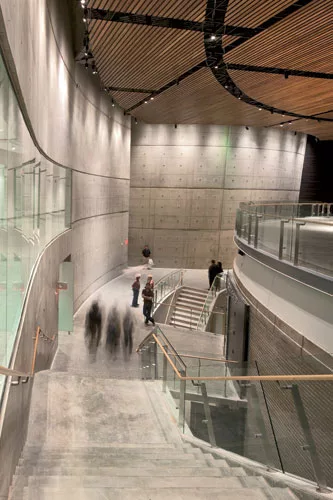
From the fourth-level terrace and café, theatergoers descend stairs between the Kogod Cradle and the Kreeger (on the right).
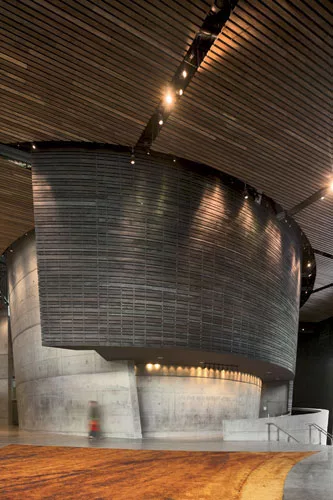
Poplar wood stained black partially wraps the exterior of the concrete Cradle and its entry ramp. Next to it, the grand stair leads down to the main entrance on Sixth Street.

Theatergoers walk along the curved ramp where enclosing walls tilt 4 degrees off plumb. They soon arrive at the oval auditorium.

Theatergoers walk along the curved ramp where enclosing walls tilt 4 degrees off plumb. They soon arrive at the oval auditorium.

The interior of the Kogod Cradle, an intimate 200-seat space, required special acoustical treatment using a poplar-wood basket weave.

Image courtesy Bing Thom Architects

Image courtesy Bing Thom Architects
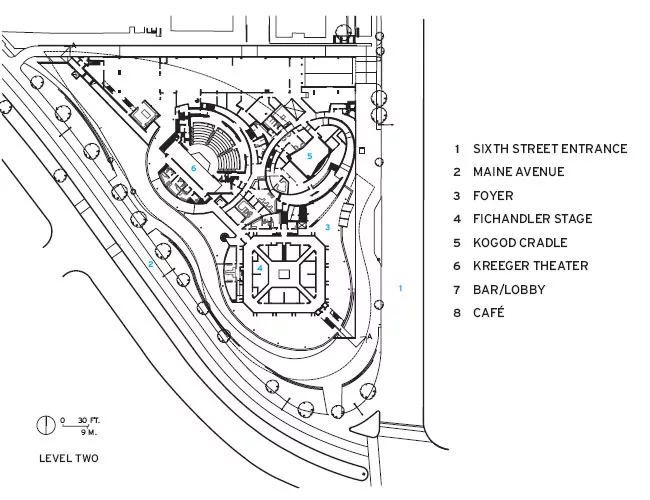
Image courtesy Bing Thom Architects
Architects & Firms
Washington, D.C.
Architects assigned to create an addition to an existing structure often face a delicate task. The original work is revered not only for its history but for its craftsmanship, materials, and quality of design. Happily this was not the case with the $135 million Arena Stage at the Mead Center for American Theater in Washington, D.C. The two theaters at Arena Stage — the 683-seat Fichandler (1961) and the 514-seat Kreeger (1971), both designed by Chicago architect Harry Weese — provided significant theatrical contributions to the nation’s capital. But they could not be described as Weese’s shining moment, on the level of his concrete coffered, vaulted Washington Metro stations that opened in 1976.
It can definitely be said that the 200,000-square-foot Arena Stage, just renovated and expanded by Bing Thom Architects, improves upon what was found. Thom’s swallowing up the lumpy late Modernist theaters in a glass case may have concerned some preservationists, but it helped tie the two together on this triangular site in the southwest part of the city — initially part of an urban renewal area that may be further uplifted by a waterfront redevelopment plan. Yet the overall scheme does deploy some quixotic design gestures that ignore certain notions of scale, proportion, and the use of a consistent architectural vocabulary. But more about that later.
Considering the success of the nonprofit organization founded in D.C. in 1950 to promote regional theater, the Arena Stage‘s current artistic director, Molly Smith, saw the need to add a third, 200-seat experimental theater to the existing ones. She didn’t want the usual “black box,” and Thom’s vine-covered Chan Centre for Performing Arts in Vancouver, Canada (1997) appealed to her. The Hong Kong–born, Vancouver-based, Berkeley-trained architect was selected from 150 contenders.
Since the Fichandler and the Kreeger theaters had acoustical problems (mainly jet noise from a nearby airport), bringing the three together under one swerving, 500-foot-long roof and encasing the two older structures behind a 45-foot-high glass curtain wall proved to be a viable solution.
Eighteen parallel strand lumber columns of Douglas fir going up as high as 56 feet support the roof’s steel trusses, girders, and rafters. This structure, enabling dramatic cantilevers, is topped by a thermoplastic polyolefin (TPO) membrane and edged by a white acrylic stucco knife-edged canopy.
The entire enclosure hooks into a swirling poured-in-place concrete hub — the newly added third theater, named the Arlene and Robert Kogod Cradle. This beehive provides the center’s “massive ballast,” in Thom’s words, since it shares some of the structural load of the roof, in addition to accommodating wind shear and resisting rotation.
Theatergoers enter the complex from Sixth Street, where stairs lead from the ticketing area up to a main lobby connecting the three theaters. A large undulating window wall allows visitors to look out to the Washington Channel and catch a glimpse of the Jefferson Memorial in the distance. From this level they also enter Weese’s original Fichandler, jutting up like some giant slumbering sea creature with its scales (brownish brick and seamed metal roof) intact. Inside the theater, the architects kept the Fichandler’s boxing ring plan, only removing back rows of seating to insert acoustical reflectors.
The semicircular Kreeger, now with a café on its top and ramps around its outer walls, is embedded in new construction. But it nicely establishes a counterpart to the nearby spiraling ramp that takes theatergoers into the Kogod Cradle, whose concrete walls are 4 degrees off the plumb line, as are the timber columns. The experience, intentionally reminiscent of entering a Richard Serra Cor-Ten steel sculpture, is pure theater — especially when arriving at the interior of the Kogod, where the oval room is sheathed entirely in stained-black poplar slats woven to solve acoustical problems inherent in the rounded shape (For more information on the space’s acoustics see the related technology story.)
The backstage areas of the theaters are labyrinthine, but connect to expansive and light-filled scenery and costume shops on the lowest level. In addition, administrative offices below are visible from the lobby on the south side where the floor is pulled away from the outer wall.
Uniting three theaters under one roof seems to have created a vibrant, humming, dramatic center. As an architectural entity, however, the combination of elements generates syntactical and semantic peculiarities. While the curves follow an organic flow, the combination of the swirling canopy, the glass-paneled and cable-suspension curtain wall, and the timber columns introduce divergent associations: They range (in order) from Miami Modern hotels to high-tech offices designed by Norman Foster and finally to civic structures in the Northwest woods.
The three elements lack consistency and tectonic unity, exaggerated by the structure’s large size and ambiguous proportions. When a curtain wall extends blithely to a point at which it is cut off suddenly by the lid of the overhanging roof, even abstractly Modern forms can seem lacking in human scale. To be fair, Thom wanted to counter the rectilinear, stolid limestone blocks of the city’s architecture with a transparent, free-form shape. And he did.
Yet the sense of scale and proportional principles of traditional architecture needn’t be jettisoned entirely. More than a hundred years ago, in record’s pages, Montgomery Schuyler criticized eclectic architecture of the late 19th century for its solecism, or lack of grammatical consistency. Schuyler may have been referring to columns and capitals mixed with gables and gargoyles, but Thom’s approach could be described by this term too. Even if the Kogod achieves an integration of structure and form, and the interior plan unifies all, the overall enclosure is too much of a jingle-jangle.
Architect:
Bing Thom Architects
1430 Burrard Street
Vancouver, BC V6Z 2A3, Canada
Phone (604) 682-1881
Fax (604) 688-1343
Location: Washington, D.C.
Completion Date: October 2010
Gross square footage: 200,000 sq. ft.
Total construction cost: $135 million
PeopleOwner: Arena Stage Architect: Personnel in architect's firm who should receive special credit: Architect of record: Bing Thom Engineer(s): Theater Consultant: Fisher Dachs Associates (New York, NY) Structural Engineer: Fast & Epp (Vancouver, BC) Electrical Engineers: Stantec (Vancouver, BC) in association with Vanderweil Engineers (Alexandria, VA) Mechanical Engineers: Yoneda & Associates (Vancouver, BC) Consultant(s): Acoustical: Talaske (Oak Park, IL) Other: Construction Manager: KCM, Inc. (Paeonian Springs, VA) Photographer(s): CAD system, project management, or other software used: |
ProductsStructural system Manufacturer of any structural components unique to this project: Exterior cladding Metal Panels: Metal/glass curtain wall: Unitized IGU: ICON Exterior Building Solutions, LLC Cast In Place Concrete: Clark Concrete Wood: EIFS, ACM, or other: Curtain wall: Asymmetric double-glazed unitized IGU system: ICON Exterior Building Solutions, LLC Roofing Main flat roof: Henry/Bakor Hot Rubberized System 790-11 Doors Metal doors: C.H. Edwards Wood doors: C.H. Edwards Fire-control doors, security grilles: Overhead Door Company Overhead doors: Cookson Rolling Doors Hardware Closers: Ives, Dorma, LCN Exit devices: Von Duprin, Besam/Assa Abloy Security devices: Von Duprin, Besam/Assa Abloy Other special hardware: Interior finishes Suspension grid: Armstrong Cabinetwork and custom woodwork: ISEC Inc. Paints and stains: Benjamin Moore and Pittsburgh Paints Wall coverings: Z-Best Wallcoverings Inc. (Acoustic Fabric Panels) Paneling: Z-Best Wallcoverings Inc. (Acoustic Fabric Panels) Solid surfacing: Corian Floor and wall tile (cite where used): Daltile Resilient flooring: Marmoleum Concrete floor finish: Retroplate Carpet: Design by Bonnie Thom, Produced by Soroush (Main Lobby Carpet) Special interior finishes unique to this project: Miscellaneous Metals: Superior Iron Works Inc. Furnishings Fichandler and Kreeger Theatre Seating: Irwin Seating Company Lighting Downlights: Times Square Lighting, Lightolier, SPI Lighting, Lithonia, Task lighting: Times Square Lighting, Lightolier, SPI Lighting, Lithonia, Exterior: Allscape, FC Lighting Conveyance Plumbing Water closet and urinals: Kohler, American Standard Faucets and Controls: Sloan, Cifial Energy |
Looking for a reprint of this article?
From high-res PDFs to custom plaques, order your copy today!