Architectural Record
search
cart
facebook twitter linkedin youtube
  • Sign In
  • Subscribe
  • Sign Out
  • My Account
Architectural Record
  • NEWS
    • Latest News
    • Awards
    • Interviews
    • Obituaries
    • Podcasts
      • Design:Ed Podcast
      • Sponsored Podcasts
  • OPINION
    • Book Reviews / Excerpts
    • Exhibition Reviews
    • Forum
  • EXCLUSIVES
    • Videos
    • Design Vanguard
    • Top 300 Firms
    • Sponsored Content
    • Sponsored eBooks
    • From the Archives
  • CONTINUING ED
    • Editorial Continuing Ed
    • CE Center
    • CE Academies
  • PROJECTS
    • Buildings By Type
    • Reuse & Renovation
    • Museums & Arts Centers
    • Colleges & Universities
    • Multifamily Housing
    • Interiors
    • Lighting
    • Kitchen & Bath
  • HOUSES
    • Record Houses
    • House of the Month
    • Featured Houses
  • PRODUCTS
    • Products by Category
    • Record Products of the Year
    • Latest Products
  • EVENTS
    • Dates & Events
    • Record on the Road
    • Innovation Conference
    • Sustainability in Practice
    • Women In Architecture
    • Webinars
    • Ad Excellence Awards
    • Submit an Event
  • CONNECT
    • Ask RECORD AI
    • Newsletters
    • Contact
    • Advertise
    • Editorial Calendar
    • Store
    • Customer Service
  • SUBMIT
    • Submission Guidelines
    • RECORD Competitions
  • MAGAZINE
    • Subscribe
    • My Account
    • Digital Edition
    • Current Issue
    • Firm Pass
    • Historic Archive
ProjectsBuildings by TypeAdaptive Reuse and Renovation

Queens Museum

The World of Tomorrow Today: A long-span-steel structure cloaked in modern-classical-style architecture has proved to be flexible for reinvention.

By Suzanne Stephens
Queens Museum
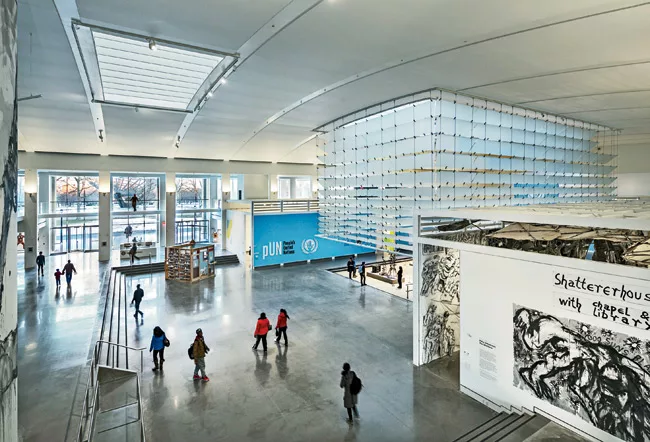
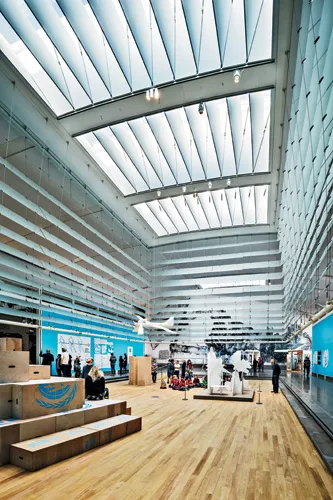
Grimshaw reworked the west facade of the building using a screen of ceramic-fritted glass panels, enlivened at night by LEDs. Inside, the skylit atrium gallery is given a sense of enclosure by a 30-foot-tall glass lantern.
 
Photo © David Sundberg/Esto
Queens Museum
Grimshaw reworked the west facade of the building using a screen of ceramic-fritted glass panels, enlivened at night by LEDs. Inside, the skylit atrium gallery is given a sense of enclosure by a 30-foot-tall glass lantern.
 
Photo © David Sundberg/Esto
Queens Museum
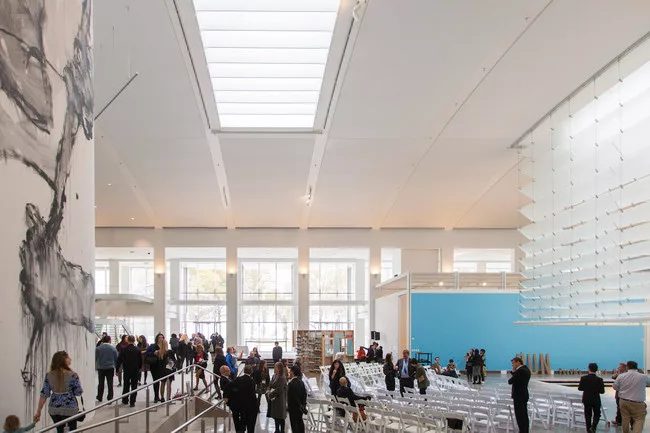
Various galleries open off the atrium, marked by its flowing open spaces and the diffusion of natural and electric light.
 
Photo © David Sundberg/Esto
Queens Museum
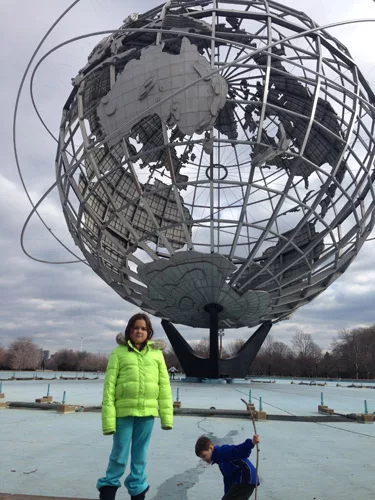
From the glass bridge and mezzanine on the east, visitors take in the gigantic Unisphere, created for the 1964 world’s fair. The east entrance leads to a plaza and the Flushing Meadows–Corona Park.
 
Photo © David Sundberg/Esto
Queens Museum
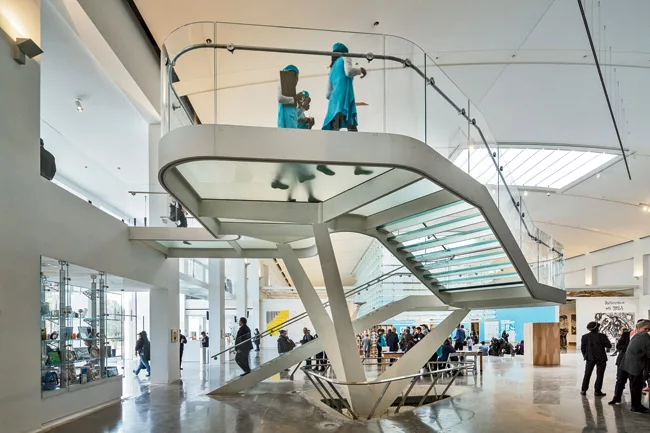
A large open-riser and glass-tread stair twists up to the new glass bridge on the mezzanine level.
 
Photo © David Sundberg/Esto
Queens Museum
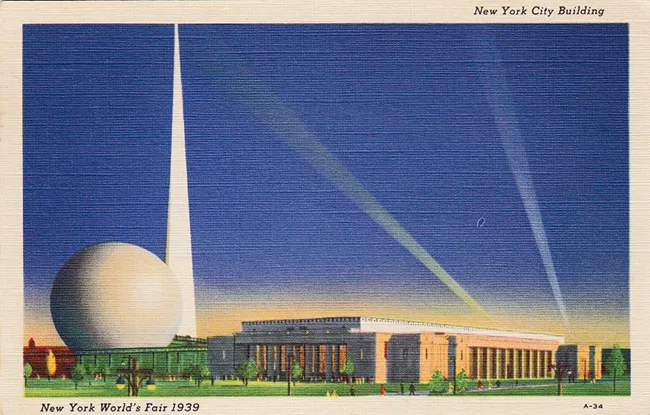
A postcard from the 1939 world’s fair shows the Pylon and the Perisphere located to the east of the original building, now the location of the Unisphere.
 
Image courtesy Queens Museum
Queens Museum
Photo © Scott Rudd
Queens Museum
Photo © Scott Rudd
Queens Museum
Photo © Architectural Record/Beth Broome
Queens Museum
Photo © Scott Rudd
Queens Museum
Photo © Architectural Record/Beth Broome
Queens Museum
Photo © Architectural Record/Beth Broome
Queens Museum
Image courtesy Grimshaw and Ammann & Whitney
Queens Museum
Image courtesy Grimshaw and Ammann & Whitney
Queens Museum
Image courtesy Grimshaw and Ammann & Whitney
Queens Museum
Image courtesy Grimshaw and Ammann & Whitney
Queens Museum
Queens Museum
Queens Museum
Queens Museum
Queens Museum
Queens Museum
Queens Museum
Queens Museum
Queens Museum
Queens Museum
Queens Museum
Queens Museum
Queens Museum
Queens Museum
Queens Museum
Queens Museum
February 15, 2014

Architects & Firms

Grimshaw

Ammann & Whitney

Queens, New York

People/Products

Since it was constructed for the 1939 world’s fair, the New York City Building in Flushing Meadows–Corona Park, now the Queens Museum, has played assorted unexpected roles. Its staid, modern-classical architecture, designed, ironically, to suit the “Building the World of Tomorrow” theme, has demonstrated a surprising agility in supporting a variety of programs. Planned to be the fair’s only structure to remain in permanent use, it was to become a recreation center for roller-skating and ice-skating. Yet it also served as temporary quarters for the United Nations General Assembly in the late 1940s—while the U.N.’s real home in Manhattan was being completed—and then as the New York City Pavilion for the 1964 New York World’s Fair. In 1972, the Queens Museum of Art moved into the north half, leaving only the ice-skating rink on the south.

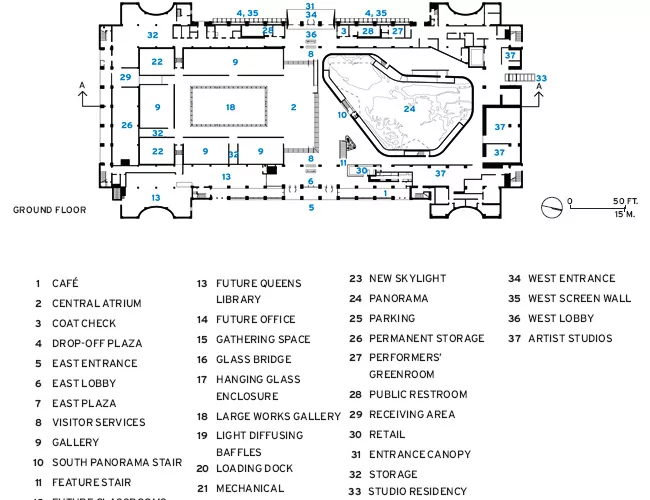
Now, after a $69 million first phase of a renovation by Grimshaw and Ammann & Whitney, and called simply the Queens Museum, the entire steel-framed, long-span structure has been given over to 105,000 square feet of galleries, performance and event spaces, educational workshops, community activity areas, and a future library branch. It also includes nine studios for resident artists, a café and shop, and the famous Panorama of the City of New York—a 9,335-square-foot model created for the 1964 fair—as well as open-storage vitrines for the museum’s collection of artifacts from both expositions.

The original architect, Aymar Embury II, known for his Colonial Revival country houses and later for metropolitan bridges, conceived the restrained monumentality of this colonnaded limestone hall for the city’s uber-boss of parks and roads, Robert Moses. The long-span steel trusses Embury employed for the roof allowed flexible-use, column-free spaces unusual at the time, notes Grimshaw’s partner in charge Mark Husser. “We wanted to make the most of Embury’s rigorous structural frame,” he says of Grimshaw’s design approach, “and emphasize the large open space.”

In the years before Grimshaw arrived on the scene, as the program changed, other architects left their mark—or tried to: architect Daniel Chait designed the ameboid setting for the Panorama in 1964; in a 1994 renovation, Rafael Viñoly Architects added glass ramps around the gigantic model and created a 30-foot-high aluminum-and-glass curtain wall for the east facade. By 2001, the city-owned museum had decided to take over the entire building, and held a competition. It was won by Los Angeles architect Eric Owen Moss, who proposed gutting the middle section of the structure and inserting a glass “drape” that bulged out from the east side (looking more like a giant wire bustle). In spite of Moss’s West Coast success in using brash, swashbuckling forms to make the once down-at-the-heels Culver City an architectural landmark of sorts, his proposal for Queens encountered increasing opposition and budget questions. By 2005, the museum’s executive director, Tom Finkelpearl, along with New York City’s Department of Design and Construction (DDC), began searching for another architect. The contract went to the New York office of the London architect Nicholas Grimshaw, and to Ammann & Whitney, an engineering and architecture firm. Perhaps it was a good omen: the latter was founded in 1946 by Othmar Ammann, who had worked with Embury on the Triborough Bridge (1926), connecting Manhattan, the Bronx, and Queens.

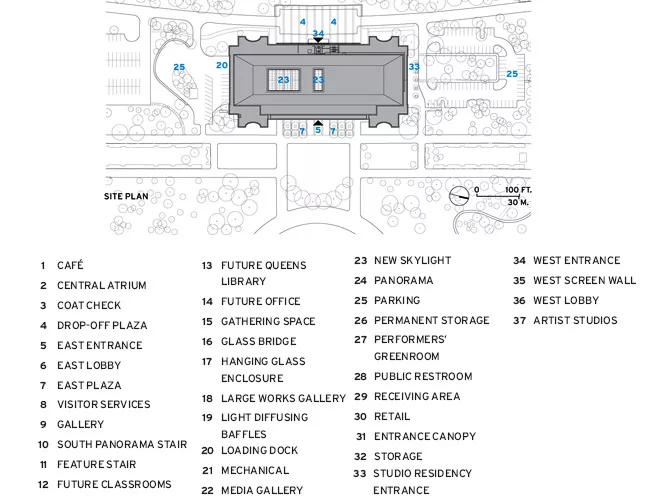
The architects decided to grab the attention of passersby on Grand Central Parkway by designing an elegant 200-by-27-foot screen wall of high-performance, ceramic-fritted glass —lit by LEDs at night—on the museum’s west facade. It is framed within Embury’s temple-like volume, with the entrance placed on an axis that cuts through the interior to the east. There, Viñoly’s 1994 curtain wall opens to the park and a head-on view of the Unisphere, the giant latticed steel landmark globe that flamboyantly symbolized the international aspirations of the 1964 fair.

Inside the building, Grimshaw installed a 55-by-40-foot skylight and suspended a 30-foot-tall glass lantern from the building’s steel trusses to give a sense of enclosure to a newly formed atrium gallery, which has replaced the ice-skating rink. The lantern’s glass fins, along with tensile-membrane ceiling and wall panels covering the roof trusses, help reflect and bounce light to the side galleries around the space. In these open galleries off the atrium, the architects employed fixed aluminum baffles on the ceilings to diffuse light. (Only two of the seven galleries are enclosed, one for video works, the other for the Neustadt Collection of Tiffany Glass.)

Grimshaw also made the Panorama more accessible from the central hub, moving the entrance from the exhibition’s north end to the main lobby. At the Panorama’s old entrance, the museum has created artists’ studios in former gallery spaces. A Grimshaw-designed spiral stair supported by a gangly tripod-like structure (intended to echo the base of the Unisphere) takes visitors up to a glass bridge on the mezzanine, where they encounter startlingly close-up views of the symbolic 1964 sculpture before moving on to other activities. Construction quality is rough, and elements of the punch list were left to be finished after the opening, while the second phase of the renovation is expected to be completed in 18 months.

The architectural team has not only reinforced the openness and flexibility of Embury’s long-span structure but exploited its Early Modern characteristics with current glass technology. The result dramatizes the sense of light and space inside and out without resorting to pumped-up architectural effects. In this manner, the makeover becomes a palimpsest—manifesting the contributions of Embury, Chait, and Viñoly—by quietly revealing traces of the building’s past architectural lives.


People

Client:
Queens Museum; New York City Department of Design and Construction

Owner:
Queens Museum; The City of New York

Architect:
Grimshaw
637 West 27th Street
New York, New York 10001
T: 646.293.3600
F: 646.293.3610

Personnel in architect's firm who should receive special credit:
Grimshaw
Mark Husser* RA AIA LEED NCARB, Partner in Charge
Juan Porral* RA BA Dipl Arch RIBA GSAS/QSAS CGP, Project Associate
Nicolas Ryan* RA AIA LEED, Project Manager
Richard Yoo, Project Architect

Grimshaw Design Team:
George Hauner, Associate Principal
Casimir Zdanius, Industrial Design
Ceren Bingol* RA
Greg Hildebrand* RA
Hoang Nguyen* RA
Robert Garneau* RA
Rosario D'Urso* RA
Kyuseon Hong* RA
Sarah Jazmine Fugate* RA
Corey McCormack* RA
Mariam Mojdehi* RA
Courtney Hunt
Kendall Baldwin
Scott Segal
Nick Paradowski
Brooke Gasaway
Shane Burger
* denotes registered architect

Ammann and Whitney
Joel Stahmer, PE, Project Manager, Vice President
Alan Denker* RA, Associate
Senthil Sabanayagam* RA, Senior Architect
Tricia Bacchus, Architectural Designer
Ivan Shankar, Senior Architectural Designer
' denotes registered architect

Interior designer:
Grimshaw

Engineers:
Ammann and Whitney ' Lead Structural Engineer
M. Ludvik Engineering ' Specialty Structures
Buro Happold ' MEP Engineer & Fire Protection

Consultant(s):
Landscape:
Mathews Nielsen Landscape Architects

Lighting:
George Sexton Associates

Audio / Visual / IT:
Shen Milsom and Wilke

Cost Consultants:
Donnell Consultants

Museum Programming:
Lord Cultural Resources

Food Service:
Post & Grossbard

Vertical Transportation:
Van Deusen Associates

General contractor:
URS

Photographer(s):
917.494.7553
' David Sundberg / Esto

Size:

105,000 square feet

Cost:

$69 million

Completion date:

November 2013


Products

Exterior cladding
Precast concrete polishing:
Concrete Reflections

Monolithic concrete floor polishing:
Concrete Reflections

Interior finishes
Paints and stains:
Ferroxstone by Bollen International (Paint on metal)

Special interior finishes unique to this project:
AGNORA (glass stair); Pulp Studio (glass panels for the hanging enclosure in the large works gallery); Newmat (fabric ceiling)

 
KEYWORDS: New York City

Share This Story

Looking for a reprint of this article?
From high-res PDFs to custom plaques, order your copy today!

Stephens

Suzanne Stephens, a former deputy editor of Architectural Record, has been a writer, editor, and critic in the field of architecture for several decades. She has a Ph.D. in architectural history from Cornell University, and teaches a seminar in the history of architectural criticism in the architecture program of Barnard and Columbia colleges.

Post a comment to this article

Report Abusive Comment

Subscription Center
  • Create an Account
  • Start a Subscription
  • Manage My Account
  • Sign Up for Newsletters
  • Visit Customer Service
  • Update Preferences

More Videos

Sponsored Content

Sponsored Content is a special paid section where industry companies provide high quality, objective, non-commercial content around topics of interest to the Architectural Record audience. All Sponsored Content is supplied by the advertising company and any opinions expressed in this article are those of the author and not necessarily reflect the views of Architectural Record or its parent company, BNP Media. Interested in participating in our Sponsored Content section? Contact your local rep!

close
  • TAMLYN XtremeTrim Exterior Trim
    Sponsored byTamlyn

    Designing Cleaner Panel Facades: Why Exterior Trim Details Matter

  • Building with Vapor Barriers
    Sponsored byReef Industries, Inc.

    Vapor Barriers Help Control Moisture in Tighter Building Designs

  • Duct Interior with Prodeq System
    Sponsored byHenry, a Carlisle Company

    Designing Resilient Water Containment Systems

DESIGN:ED Podcast
Listen to Architectural Record’s DESIGN:ED Podcast

Events

June 18, 2026

Rebooting the Aging Office Building

Credits: 1 AIA LU/HSW; 1 AIBD P-CE; 0.1 ICC CEU; 1 PDH

Explore façade retrofit strategies and award-winning design concepts that can transform aging office buildings into healthier, higher-performing workplaces for today’s hybrid workforce.

June 23, 2026

Enhancing Fire Resistance with Advanced PVC Solutions

Credits: 1 AIA LU/HSW; 1 AIBD P-CE; 0.1 ICC CEU; 1 IIBEC CEH

Evaluate advanced PVC solutions that improve fire resistance, support WUI compliance, and enhance resilience in residential and commercial building design.

View All Submit An Event

Products

2026 Architect's Square Foot Costbook

2026 Architect's Square Foot Costbook

See More Products

Popular Stories

SanDiegoAirport

Top 300 Architecture Firms of 2026

Coronado Bridge

The Architect’s Guide to San Diego

Lorcan O' Herilhy

California Architect Lorcan O’Herlihy Has Died, Age 66

CCA, Studio Gang

The Winners of the AIA’s 2026 Architecture Award Range from Collegiate Rowing Hubs to Housing for the Homeless

Dusk House

Design Vanguard 2026: ONO

Rebooting the Aging Office Building - Free Webinar - June 18, 2026

Related Articles

  • Renovated Queens Museum Opens in New York

    See More
  • Fifth Avenue Apartment

    Diller Scofidio + Renfro Rebuilds a Manhattan Apartment to House Museum-Quality Art and Its Collector

    See More
  • The Hood Museum of Art at Dartmouth College

    Post-Occupancy Evaluation of the Remodeled Hood Museum

    See More
×

The latest news and information

#1 Source for Architectural Design, News and Products

SUBSCRIBE
  • RESOURCES
    • Advertise
    • Contact Us
    • Submit
    • Store
  • ACCOUNT CENTER
    • Create an Account
    • Start a Subscription
    • Manage My Account
    • Sign Up for Newsletters
    • Visit Customer Service
    • Update Preferences
  • PRIVACY
    • PRIVACY POLICY
    • TERMS & CONDITIONS
    • DO NOT SELL MY PERSONAL INFORMATION
    • PRIVACY REQUEST
    • ACCESSIBILITY
  • SERVICES
    • Marketing Services
    • Reprints
    • Market Research
    • List Rental
    • Survey/Respondent Access
  • STAY CONNECTED
    • Linkedin
    • Facebook
    • Instagram
    • YouTube
    • X (Twitter)

Copyright ©2026. All Rights Reserved BNP Media, Inc. and BNP Media II, LLC.

Design, CMS, Hosting & Web Development :: ePublishing