Architectural Record
search
cart
facebook twitter linkedin youtube
  • Sign In
  • Subscribe
  • Sign Out
  • My Account
Architectural Record
  • NEWS
    • Latest News
    • Awards
    • Interviews
    • Obituaries
    • Podcasts
      • Design:Ed Podcast
      • Sponsored Podcasts
  • OPINION
    • Book Reviews / Excerpts
    • Exhibition Reviews
    • Forum
  • EXCLUSIVES
    • Videos
    • Design Vanguard
    • Top 300 Firms
    • Sponsored Content
    • Sponsored eBooks
    • From the Archives
  • CONTINUING ED
    • Editorial Continuing Ed
    • CE Center
    • CE Academies
  • PROJECTS
    • Buildings By Type
    • Reuse & Renovation
    • Museums & Arts Centers
    • Colleges & Universities
    • Multifamily Housing
    • Interiors
    • Lighting
    • Kitchen & Bath
  • HOUSES
    • Record Houses
    • House of the Month
    • Featured Houses
  • PRODUCTS
    • Products by Category
    • Record Products of the Year
    • Latest Products
  • EVENTS
    • Dates & Events
    • Record on the Road
    • Innovation Conference
    • Sustainability in Practice
    • Women In Architecture
    • Webinars
    • Ad Excellence Awards
    • Submit an Event
  • CONNECT
    • Ask RECORD AI
    • Newsletters
    • Contact
    • Advertise
    • Editorial Calendar
    • Store
    • Customer Service
  • SUBMIT
    • Submission Guidelines
    • RECORD Competitions
  • MAGAZINE
    • Subscribe
    • My Account
    • Digital Edition
    • Current Issue
    • Firm Pass
    • Historic Archive
ProjectsBuildings by TypeColleges & Universities

Gilman Hall, Johns Hopkins University

Kliment Halsband replaces the void at the core of a stately building with a lively space for study and socializing.

By Joann Gonchar, FAIA
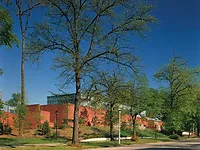
The campanile-topped Gilman occupies a privileged spot at the head of the main campus quadrangle.
Gilman Hall, Johns Hopkins University
Kliment Halsband Architects
Baltimore
The campanile-topped Gilman occupies a privileged spot at the head of the main campus quadrangle.
Photo © Peter Mauss / Esto
The historic reading room now has perimeter millwork that helps disguise mechanical systems.
Gilman Hall, Johns Hopkins University
Kliment Halsband Architects
Baltimore
The historic reading room now has perimeter millwork that helps disguise mechanical systems.
Photo © Peter Mauss / Esto
In a space that had been an inaccessible light well, the architects created a skylit social hub. The walls’ new terra-cotta cladding conceals acoustical material.
Gilman Hall, Johns Hopkins University
Kliment Halsband Architects
Baltimore
In a space that had been an inaccessible light well, the architects created a skylit social hub. The walls’ new terra-cotta cladding conceals acoustical material.
Photo © Peter Mauss / Esto
The architects inserted an archaeology study center just below the atrium. The center is surrounded on all four sides by vitrines and by a circulation zone open to the skylight above.
Gilman Hall, Johns Hopkins University
Kliment Halsband Architects
Baltimore
The architects inserted an archaeology study center just below the atrium. The center is surrounded on all four sides by vitrines and by a circulation zone open to the skylight above.
Photo © Peter Mauss / Esto
In a few locations, anyone walking around the study center can peer beyond the artifacts on display and into the room’s interior.
Gilman Hall, Johns Hopkins University
Kliment Halsband Architects
Baltimore
In a few locations, anyone walking around the study center can peer beyond the artifacts on display and into the room’s interior.
Photo © Peter Mauss / Esto
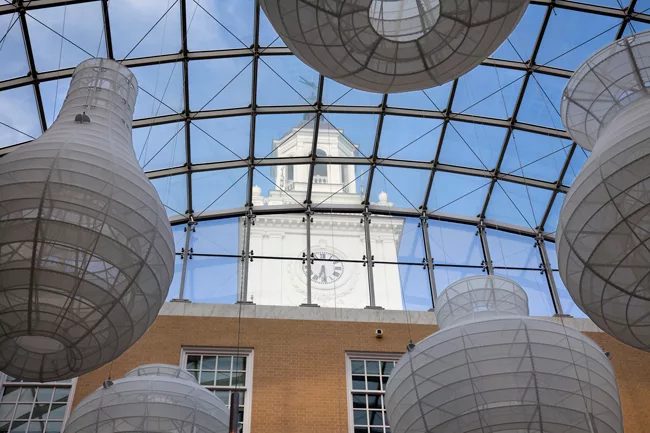
Diaphanous, gourd-shaped sculptures by artist Kendall Buster are suspended from the atrium's tension-grid glazed roof.
Gilman Hall, Johns Hopkins University
Kliment Halsband Architects
Baltimore
Diaphanous, gourd-shaped sculptures by artist Kendall Buster are suspended from the atrium's tension-grid glazed roof.
Original building plan: Courtesy Johns Hopkins University
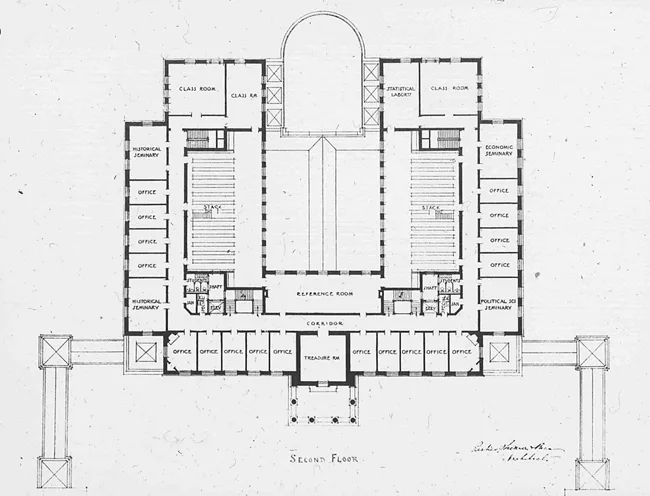
Gilman’s original configuration included a central light well bisected by a bridgelike passage and 25,000 square feet of library stacks.
Gilman Hall, Johns Hopkins University
Kliment Halsband Architects
Baltimore
Gilman’s original configuration included a central light well bisected by a bridgelike passage and 25,000 square feet of library stacks.
Original building plan: Courtesy Johns Hopkins University
Gilman Hall, Johns Hopkins University
Kliment Halsband Architects
Baltimore
Image courtesy Kliment Halsband Architects
Gilman Hall, Johns Hopkins University
Kliment Halsband Architects
Baltimore
Image courtesy Kliment Halsband Architects
The campanile-topped Gilman occupies a privileged spot at the head of the main campus quadrangle.
The historic reading room now has perimeter millwork that helps disguise mechanical systems.
In a space that had been an inaccessible light well, the architects created a skylit social hub. The walls’ new terra-cotta cladding conceals acoustical material.
The architects inserted an archaeology study center just below the atrium. The center is surrounded on all four sides by vitrines and by a circulation zone open to the skylight above.
In a few locations, anyone walking around the study center can peer beyond the artifacts on display and into the room’s interior.
Diaphanous, gourd-shaped sculptures by artist Kendall Buster are suspended from the atrium's tension-grid glazed roof.
Gilman’s original configuration included a central light well bisected by a bridgelike passage and 25,000 square feet of library stacks.
Gilman Hall, Johns Hopkins University
November 15, 2011

Architects & Firms

Kliment Halsband Architects

Baltimore

When a college expands and grows, building shiny state-of-the art facilities at its periphery, the oldest buildings at the heart of campus are sometimes neglected. Such was the case with campanile-topped Gilman Hall at Johns Hopkins University in Baltimore. The Federal style redbrick structure, built in 1915 to house the School of Arts and Sciences, occupied a privileged spot at the head of the main quadrangle. But despite its prominent location, Gilman, which included a library and four stories of office and classroom space around a courtyard, lacked basic infrastructure such as up-to-date climate-control systems and code-compliant stairs—that is, until the completion of a $58.6 million renovation last year by the New York City architects Kliment Halsband.


Not only were the facilities antiquated, but Gilman's space was underutilized: The 25,000 square feet of book stacks had sat almost completely empty since the construction of a new library in 1964. In addition, the courtyard, which included an enclosed passageway linking the main entry to a reading room, was inaccessible to occupants. It functioned as little more than a light well.

The client considered Gilman's exterior “a don't-touch zone,” according to Kliment Halsband partner Frances Halsband. However, her firm had more freedom on the interior. “We kept what worked, but were completely unsentimental about what didn't,” she explains. For example, the architects got rid of the old stacks, claiming the space for new faculty offices, seminar rooms, and administrative areas. And they reconfigured circulation, adding elevators and rebuilding stairs.

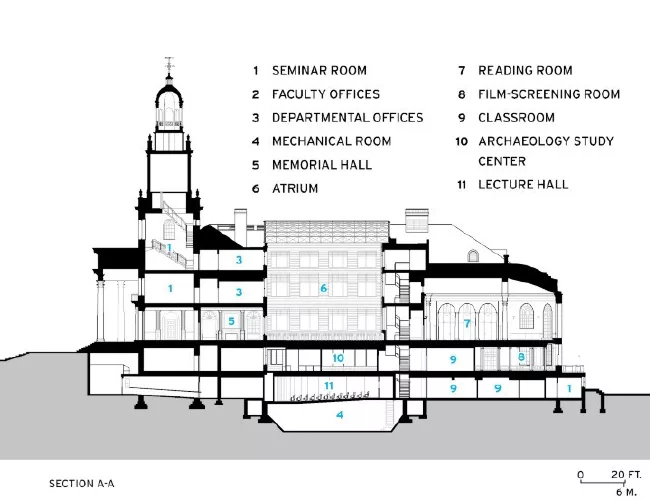
The renovation's boldest move was demolition of the courtyard passageway. Its removal allowed the transformation of the previously unusable core into a lively atrium, where students can chat or study. This new gathering space has a precisely engineered tension-grid skylight overhead, white marble salvaged from the old library stacks underfoot, and walls clad in buff terra-cotta panels. These conceal sound-absorptive material, softening what would have been an acoustically harsh environment.

Tucked underneath the atrium is a new archaeology study center. It is surrounded on all four sides by cases for the display of ancient pottery, glassware, and other artifacts and by an almost 8-foot-wide circulation zone open to the skylight above. In certain locations, anyone circumnavigating the study center can peer beyond the objects on view, through a second layer of glass, into the center's interior—a feature that has the effect of making the entire room into an oversized vitrine.

In Gilman's grand historic spaces, the architects' touch was much lighter. In the reading room, for instance, where colonnades separate an apselike area from a pair of side areas, they restored stained glass windows, replaced historically unsympathetic lighting with replicas of the original torchères and wall sconces, and disguised new mechanical systems in paneled millwork. They also inserted structural glass partitions behind the columns to acoustically divide the main and flanking spaces.

Much of the renovation work focused on improving environmental performance. In addition to the new building systems, changes such as the replacement of single-glazed wood windows with double-glazed versions and the furring out of perimeter walls for insulation have put Gilman on track for LEED Silver certification. Fortuitously, creation of the atrium should also help the building achieve its energy-saving goals, since covering the former light well reduces the size of the exterior envelope by almost one-third. However, the architects make no distinction between the efficiency measures and the conversion of a lifeless void into a social hub. Both efforts are intended to enhance the utility of the nearly century-old building, according to Halsband. “All of it,” she says, “is part of preparing Gilman for the next 100 years.”

Total construction cost: $58.6 million

Completion Date:  June 2010

Gross square footage: 146,500

Architect:
Kliment Halsband Architects
322 Eighth Avenue
New York, NY  10001
212.243.7400 phone
212.633.9769 fax
info@kliment-halsband.com
www.kliment-halsband.com

People

Owner: Johns Hopkins University

Architect: 
Kliment Halsband Architects
322 Eighth Avenue
New York, NY  10001
212.243.7400 phone
212.633.9769 fax
info@kliment-halsband.com
www.kliment-halsband.com

Personnel in architect's firm who should receive special credit:
Frances Halsband, FAIA – Partner/Project Designer
Robert Kliment, FAIA – Parnter/Collaborating Designer
Alex Diez, AIA, LEED AP – Partner/Project Manager
Carolyn Hinger, AIA, LEED AP  – Associate/Project Architect
David Miller, AIA – Project Architect
Jennifer Stencel, AIA, LEED AP – Architect
Natalie Rebuck, AIA, LEED AP – Associate/Architect
Robert Litherland - Architect

Engineer(s):
MEP/FP: James Posey Associates

Structural: Robert Silman Associates (Washington, D.C. office)

Telecom Engineer: RTKL

Consultant(s):
Landscape: Mahan Rykiel Associates, Inc.

Lighting: Tillotson Design Associates

Acoustical: Acoustical Design Collaborative, Ltd.

Gridshell Consultant: Schlaich Bergermann and Partner LP

Donor Signage Consultant: C&G Partners

Artist: Kendall Buster

Art Consultant: Nancy Rosen

LEED Consultant: Steven Winter Associates, Inc.

Audio/Visual Consultant: Technology Design Resources LLC

Cost Estimating Consultant: Faithful + Gould

Elevator Consultant: Van Deusen and Associates

Code Consultant: Koffel Associates

General contractor: Lend Lease Construction

Photographer(s)
Peter Mauss / Esto
914.698.4060

Renderer(s): Brian Burr

CAD system, project management, or other software used:  AutoCad 
 

Products

Structural system
New floor and roof structures - Steel frame with concrete on metal deck

Manufacturer of structural components unique to this project: Tension Grid Skylight System – Novum Structures, LLC

Exterior cladding
Metal/glass curtain wall: EFCO

Moisture barrier:  Grace Construction Products

Curtain wall:  EFCO 

Roofing

Elastomeric: EPDM – Firestone

Metal: Copper dormers, bell tower & dome – Revere Copper & Brass

Tile/shingles: Slate – North Country Slate

Windows
Wood frame: Historically replicated wood and glass windows:  Marvin

Metal frame:  Interior atrium windows:  EFCO

Glazing
Glass: Interior atrium windows: EFCO

Skylights: Tension Grid Skylight Glazing: Novum Structures LLC

Other:
Stained Glass Conservation and Restoration: Worcester Eisenbrandt, Inc.

Patterned Glass at Interior Partitions: Bendheim

Structural Glass Wall System - Structural Glass Wall: Oldcastle BuildingEnvelope

Doors 
Hollow Metal doors:  Michbi Doors

Exterior Solid Wood doors: Harring Doors

Fire-control doors, security grilles:  Horizontal and Overhead Coiling Fire Shutters – Overhead Door Corp.

Hardware 
Locksets:  Best Access

Closers: Hager; LCN Closers

Exit devices: Von Duprin

Pulls: Hager

Other special hardware: Front entrance door pulls – Forms + Surfaces

Interior finishes
Acoustical ceilings:  Decoustics; USG

Suspension grid:  USG

Cabinetwork and custom woodwork: Ilex Woodworking

Paints and stains:  Sherwin Williams

Acoustic Wood Paneling:  Decoustics

Plastic laminate:  Formica

Solid surfacing:  Corian

Floor and wall tile:  Toilet Rooms -Daltile

Carpet: Karastan;Mohawk

Special interior finishes unique to this project:
Corkboard – Forbo

Roll Down Shades – Mechoshade

Interior Stonework – Hilgartner Natural Stone Company

Terrazzo – Roman Mosaic & Tile Company

Terracotta Atrium Wall Cladding – NBK Terracotta by HunterDouglas

Furnishings 
Office furniture: Herman Miller Desk and Aeron Chair; 40/4 Stacking Chairs

Atrium furniture: Bertoia Diamond Chair; Vignelli Café Table; D’Urso Coffee Table

Fixed seating:  Theater Solutions; Knoll upholstery

Historic Classroom/Reading Room Furniture: Palmieri Tables; Agati Prairie Chair

Chairs: Bertoia Diamond Chair; Agati Prairie Chair; Mies van der Rohe Krefeld-inspired chair by David Edward

Tables: Palmieri Tables; Vignelli Café Table; D’Urso Coffee Table; Florence Knoll Coffee Table

Lighting 
Office Lighting: Gammalux

Classroom Lighting: Gammalux

Atrium Lighting: Sistamalux

Historic Replica Lighting: Rambusch

Dimming System: Lutron

Daylighting System:  Sensor Switch

Conveyance
Elevators – Kone EcoSpace

Plumbing
Fixtures – American Standard
Faucets & flushing devices – Sloan

Energy
Energy management or building automation system:  Johnson Controls

Add any additional building components or special equipment that made a significant contribution to this project:
Movable Storage System for Archaeology Collection – F.A. O’Toole Office Systems, Inc. provided Kardex and Tennsco

Archaeology Custom Vitrines – Helmut Guenschel

 
KEYWORDS: Baltimore

Share This Story

Looking for a reprint of this article?
From high-res PDFs to custom plaques, order your copy today!

Joann gonchar

Joann Gonchar, FAIA, LEED AP, is deputy editor at Architectural Record. She joined RECORD in 2006, after working for eight years at its sister publication, Engineering News-Record. Before starting her career as a journalist, Joann worked for several architecture firms and spent three years in Kobe, Japan, with the firm Team Zoo, Atelier Iruka. She earned a Master of Architecture degree from the University of Pennsylvania and a Bachelor of Arts from Brown University. She is licensed to practice architecture in New York State.

Post a comment to this article

Report Abusive Comment

Subscription Center
  • Create an Account
  • Start a Subscription
  • Manage My Account
  • Sign Up for Newsletters
  • Visit Customer Service
  • Update Preferences

More Videos

Sponsored Content

Sponsored Content is a special paid section where industry companies provide high quality, objective, non-commercial content around topics of interest to the Architectural Record audience. All Sponsored Content is supplied by the advertising company and any opinions expressed in this article are those of the author and not necessarily reflect the views of Architectural Record or its parent company, BNP Media. Interested in participating in our Sponsored Content section? Contact your local rep!

close
  • cold storage facility
    Sponsored byCarlisle SynTec Systems

    How Architects Can Design More Continuous Cold Storage Envelopes

  • TAMLYN XtremeTrim Exterior Trim
    Sponsored byTamlyn

    Designing Cleaner Panel Facades: Why Exterior Trim Details Matter

  • Building with Vapor Barriers
    Sponsored byReef Industries, Inc.

    Vapor Barriers Help Control Moisture in Tighter Building Designs

DESIGN:ED Podcast
Listen to Architectural Record’s DESIGN:ED Podcast

Events

June 23, 2026

Enhancing Fire Resistance with Advanced PVC Solutions

Credits: 1 AIA LU/HSW; 1 AIBD P-CE; 0.1 ICC CEU; 1 IIBEC CEH

Evaluate advanced PVC solutions that improve fire resistance, support WUI compliance, and enhance resilience in residential and commercial building design.

June 25, 2026

Designing Glass Railing Systems that Enhance Aesthetics and Meet Code

Credits: 1 AIA LU/HSW; 1 AIBD P-CE; 0.1 ICC CEU

Upon course completion, participants will possess a deeper understanding of glass railings to help ensure that safety, aesthetic, and performance objectives are achieved.

View All Submit An Event

Products

2026 Architect's Square Foot Costbook

2026 Architect's Square Foot Costbook

See More Products

Popular Stories

Lorcan O' Herilhy

California Architect Lorcan O’Herlihy Has Died, Age 66

Obama Presidential Center, Chicago

The Obama Presidential Center Opens on Chicago’s South Side

Spoonbill Ranch

Johnsen Schmaling Architects Integrates Spoonbill Ranch into a Pristine Landscape

Image of Bruce Springsteen Center for American Music

The CookFox-designed Bruce Springsteen Center for American Music Opens in New Jersey

Three Courtyards House

Design Vanguard 2026: Balsa Crosetto Piazzi

Enhancing Fire Resistance with Advanced PVC Solutions - Free Webinar - June 23, 2026

Related Articles

  • Mattin Center.

    Johns Hopkins Loses a Gem by Williams and Tsien

    See More
  • Lindemann Performing Arts Center

    A Performance Venue at Brown University Gives the Arts Top Billing

    See More
  • Gund Hall

    Bruner/Cott Architects Gives Harvard’s Gund Hall a High-Tech Facelift

    See More
×

The latest news and information

#1 Source for Architectural Design, News and Products

SUBSCRIBE
  • RESOURCES
    • Advertise
    • Contact Us
    • Submit
    • Store
  • ACCOUNT CENTER
    • Create an Account
    • Start a Subscription
    • Manage My Account
    • Sign Up for Newsletters
    • Visit Customer Service
    • Update Preferences
  • PRIVACY
    • PRIVACY POLICY
    • TERMS & CONDITIONS
    • DO NOT SELL MY PERSONAL INFORMATION
    • PRIVACY REQUEST
    • ACCESSIBILITY
  • SERVICES
    • Marketing Services
    • Reprints
    • Market Research
    • List Rental
    • Survey/Respondent Access
  • STAY CONNECTED
    • Linkedin
    • Facebook
    • Instagram
    • YouTube
    • X (Twitter)

Copyright ©2026. All Rights Reserved BNP Media, Inc. and BNP Media II, LLC.

Design, CMS, Hosting & Web Development :: ePublishing