Architectural Record
search
cart
facebook twitter linkedin youtube
  • Sign In
  • Subscribe
  • Sign Out
  • My Account
Architectural Record
  • NEWS
    • Latest News
    • Awards
    • Interviews
    • Obituaries
    • Podcasts
      • Design:Ed Podcast
      • Sponsored Podcasts
  • OPINION
    • Book Reviews / Excerpts
    • Exhibition Reviews
    • Forum
  • EXCLUSIVES
    • Videos
    • Design Vanguard
    • Top 300 Firms
    • Sponsored Content
    • Sponsored eBooks
    • From the Archives
  • CONTINUING ED
    • Editorial Continuing Ed
    • CE Center
    • CE Academies
  • PROJECTS
    • Buildings By Type
    • Reuse & Renovation
    • Museums & Arts Centers
    • Colleges & Universities
    • Multifamily Housing
    • Interiors
    • Lighting
    • Kitchen & Bath
  • HOUSES
    • Record Houses
    • House of the Month
    • Featured Houses
  • PRODUCTS
    • Products by Category
    • Record Products of the Year
    • Latest Products
  • EVENTS
    • Dates & Events
    • Record on the Road
    • Innovation Conference
    • Sustainability in Practice
    • Women In Architecture
    • Webinars
    • Ad Excellence Awards
    • Submit an Event
  • CONNECT
    • Ask RECORD AI
    • Newsletters
    • Contact
    • Advertise
    • Editorial Calendar
    • Store
    • Customer Service
  • SUBMIT
    • Submission Guidelines
    • RECORD Competitions
  • MAGAZINE
    • Subscribe
    • My Account
    • Digital Edition
    • Current Issue
    • Firm Pass
    • Historic Archive
ProjectsLighting Design

Louis Vuitton Matsuya Ginza Facade

Architect Jun Aoki's new facade for Louis Vuitton in Tokyo's Ginza district is a glowing tour de force that sets the shop apart from the Matsuya Department Store that houses it.

By Naomi Pollock, FAIA
Louis Vuitton Matsuya Ginza Facade
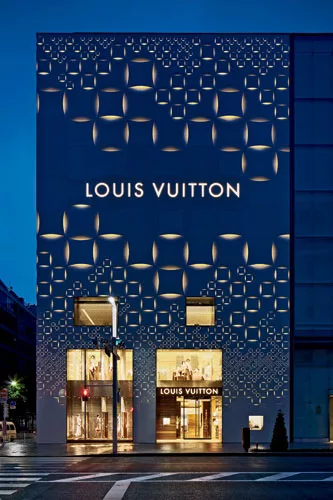
Echoing the client’s signature checkered motif, Aoki’s facade wraps the corner of an existing department store with a textured opalescent surface (left) that transforms into an elegant light box after dark (slide 2).
 
Photo © Daici Ano
Louis Vuitton Matsuya Ginza Facade
Echoing the client’s signature checkered motif, Aoki’s facade wraps the corner of an existing department store with a textured opalescent surface (slide 1) that transforms into an elegant light box after dark (left).
 
Photo © Daici Ano
Louis Vuitton Matsuya Ginza Facade
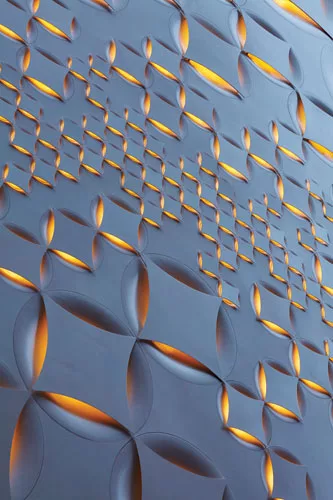
Thin overlays affixed to the aluminum skin's back panel conceal rings of LEDs behind them.
 
Photo © Daici Ano
Louis Vuitton Matsuya Ginza Facade
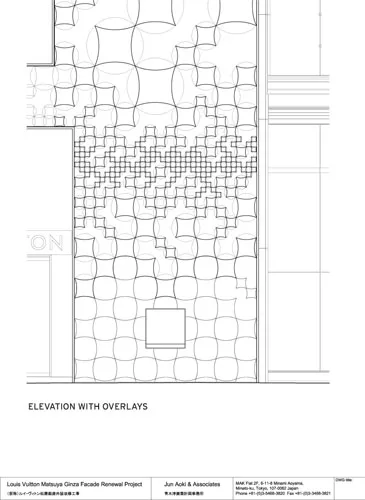
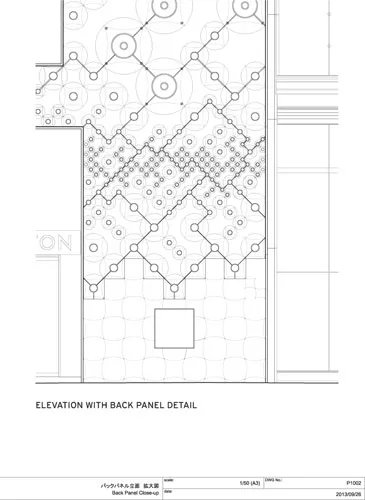
The elevation details illustrate the placement of the facade’s light wells before they are covered by the curved-square overlays (slide 5), and the completed facade with the overlays in place (left).
 
Drawing courtesy Jun Aoki & Associates
Louis Vuitton Matsuya Ginza Facade
The elevation details illustrate the placement of the facade’s light wells before they are covered by the curved-square overlays (left), and the completed facade with the overlays in place (slide 4).
 
Drawing courtesy Jun Aoki & Associates
Louis Vuitton Matsuya Ginza Facade
November 15, 2014

Architects & Firms

Jun Aoki & Associates

Tokyo

People/Products

Despite Japan's energy belt-tightening, triggered by the Great Eastern Japan Earthquake of 2011, dazzling lighting effects still bedeck most luxury boutiques in Tokyo's Ginza shopping district. But a new Louis Vuitton facade designed by Jun Aoki trumps them all, with understated, energy-conscious elegance. The eight-story aluminum skin wrapping a corner of the existing Matsuya Department Store building is illuminated by a subtle light grid, realized not by using more electricity but by using less.

The Tokyo-based architect was commissioned to create the facade—his 10th for the French fashion brand—at a time when Japan was still reeling from the colossal damage caused by the catastrophic series of events: immediately following the failure of the Fukushima power plant, the nation halted nuclear energy generation and quickly cut its electricity consumption by dimming lights. Though illumination levels gradually returned to near normal over the following months, Japan had proven its ability to make do with less. Maintaining this standard while providing a facade that stands out from the pack became Aoki's primary objective.

In addition to this self-imposed limit on light usage, Aoki had to cope with stringent construction restrictions. He could not exceed a depth of 18 centimeters (about 7 inches) or a weight of 40 kilograms per square meter (8.2 pounds per square foot). The architect also wanted to distinguish the unique identity of the boutique, which occupies a berth on the department store's bottom three floors. In response, Aoki devised a stylized checkered pattern in lightweight aluminum, based on the Louis Vuitton signature damier, or check pattern. Extending up the department store's full height, the punctuated opalescent surface appears to be the facade of a separate building.

By day, the corner shop is distinct from its surroundings, with a solid presence among the attention-grabbing storefronts nearby. But the potency of Aoki's design is at its most compelling when the sun goes down, and the gradated layout of his textural wrapping transforms the building into a light box that enlivens the corner with a uniform intensity. To achieve this effect, the architect took advantage of his overall motif and punched the metal wrapping with circular indentations, concealing each one with a slightly curved, square overlay. Connecting the two layers at each juncture, metal cylinders ringed with LEDs are the facade's only light source. Selected for their overall efficiency, the LEDs emit a glare-free glow that leaks delicately from behind the overlays, illuminating and exaggerating the abstract design of the ornamentation.

As with the moir' patterns Aoki used for his previous Louis Vuitton projects, the overall scheme creates a strong optical effect. Close up, the walls' individual components are easily discerned. But from afar they meld together into a single, soft-looking surface, especially at night, when the solids recede and the light-filled voids pop. This impact is compounded by a control system with various programs that enable the lights to pulsate at different cadences appropriate to a given mood or occasion.

The concavities have five different diameters, ranging from about 6 inches near the elevation's top and bottom to more than 78 inches toward the middle, where perforations in the panels spell out the brand name. Because of such size and proportion differences (the big basins are shallow, while the small ones are deep), Aoki had to carefully calibrate the number of LEDs needed to maintain a consistent level of illumination from circle to circle. This painstaking trial-and-error process began at the manufacturer's rural Chiba Prefecture facility and finished on-site, where the team tested a large-scale mock-up amid Ginza's nighttime glitz.

In terms of construction, the smaller circles were cast, while the larger ones were fabricated from sheets. Linked by well-disguised diagonal joints, the metal wall is coated with a beige paint containing aluminum powder—a metallic pigment used by automobile manufacturers—and blends, almost seamlessly, with a durable limestone base Aoki created, using the same motif, at the sidewalk. On the back side, the panels attach to an existing steel frame that connects to the base building's concrete structure.

Unsurprisingly, the construction of the new facade necessitated the destruction of the old, a two-story facade Aoki created for Louis Vuitton in 2000. “Of course, I loved that design too, but now conditions are so different,” remarks the architect. Indeed, in Aoki's timely restraint there is tremendous strength. As his gentle scheme attests, energy conservation need not be a compromise.


People

Architect:

Jun Aoki & Associates — Jun Aoki, principal; Mirei Uchibe, design team

Engineers:

TAISEI Corporation; Permasteelisa Japan

Client:

Louis Vuitton Japan

Size:

15,900 square feet (wall area)

Cost:

Withheld

Completion date:

September 2013


Products

 
KEYWORDS: Tokyo

Share This Story

Looking for a reprint of this article?
From high-res PDFs to custom plaques, order your copy today!
Contributing Editor Naomi Pollock, FAIA, is the author of Japanese Design Since 1945: A Complete Sourcebook and the forthcoming Vanishing Japan: Modern Architecture Gone But Not Forgotten,

Post a comment to this article

Report Abusive Comment

Subscription Center
  • Create an Account
  • Start a Subscription
  • Manage My Account
  • Sign Up for Newsletters
  • Visit Customer Service
  • Update Preferences

More Videos

Sponsored Content

Sponsored Content is a special paid section where industry companies provide high quality, objective, non-commercial content around topics of interest to the Architectural Record audience. All Sponsored Content is supplied by the advertising company and any opinions expressed in this article are those of the author and not necessarily reflect the views of Architectural Record or its parent company, BNP Media. Interested in participating in our Sponsored Content section? Contact your local rep!

close
  • cold storage facility
    Sponsored byCarlisle SynTec Systems

    How Architects Can Design More Continuous Cold Storage Envelopes

  • TAMLYN XtremeTrim Exterior Trim
    Sponsored byTamlyn

    Designing Cleaner Panel Facades: Why Exterior Trim Details Matter

  • Building with Vapor Barriers
    Sponsored byReef Industries, Inc.

    Vapor Barriers Help Control Moisture in Tighter Building Designs

DESIGN:ED Podcast
Listen to Architectural Record’s DESIGN:ED Podcast

Events

June 23, 2026

Enhancing Fire Resistance with Advanced PVC Solutions

Credits: 1 AIA LU/HSW; 1 AIBD P-CE; 0.1 ICC CEU; 1 IIBEC CEH

Evaluate advanced PVC solutions that improve fire resistance, support WUI compliance, and enhance resilience in residential and commercial building design.

June 25, 2026

Designing Glass Railing Systems that Enhance Aesthetics and Meet Code

Credits: 1 AIA LU/HSW; 1 AIBD P-CE; 0.1 ICC CEU

Upon course completion, participants will possess a deeper understanding of glass railings to help ensure that safety, aesthetic, and performance objectives are achieved.

View All Submit An Event

Products

2026 Architect's Square Foot Costbook

2026 Architect's Square Foot Costbook

See More Products

Popular Stories

Lorcan O' Herilhy

California Architect Lorcan O’Herlihy Has Died, Age 66

Obama Presidential Center, Chicago

The Obama Presidential Center Opens on Chicago’s South Side

Spoonbill Ranch

Johnsen Schmaling Architects Integrates Spoonbill Ranch into a Pristine Landscape

Image of Bruce Springsteen Center for American Music

The CookFox-designed Bruce Springsteen Center for American Music Opens in New Jersey

Three Courtyards House

Design Vanguard 2026: Balsa Crosetto Piazzi

Enhancing Fire Resistance with Advanced PVC Solutions - Free Webinar - June 23, 2026

Related Articles

  • Louis Vuitton New Bond Street

    See More
  • Fondation Louis Vuitton Auditorium

    See More
  • Fondation Louis Vuitton

    See More

Related Products

See More Products
  • Architectural Record - February 2026

    Architectural Record February 2026 Issue

See More Products
×

The latest news and information

#1 Source for Architectural Design, News and Products

SUBSCRIBE
  • RESOURCES
    • Advertise
    • Contact Us
    • Submit
    • Store
  • ACCOUNT CENTER
    • Create an Account
    • Start a Subscription
    • Manage My Account
    • Sign Up for Newsletters
    • Visit Customer Service
    • Update Preferences
  • PRIVACY
    • PRIVACY POLICY
    • TERMS & CONDITIONS
    • DO NOT SELL MY PERSONAL INFORMATION
    • PRIVACY REQUEST
    • ACCESSIBILITY
  • SERVICES
    • Marketing Services
    • Reprints
    • Market Research
    • List Rental
    • Survey/Respondent Access
  • STAY CONNECTED
    • Linkedin
    • Facebook
    • Instagram
    • YouTube
    • X (Twitter)

Copyright ©2026. All Rights Reserved BNP Media, Inc. and BNP Media II, LLC.

Design, CMS, Hosting & Web Development :: ePublishing