Architectural Record
search
cart
facebook twitter linkedin youtube
  • Sign In
  • Subscribe
  • Sign Out
  • My Account
Architectural Record
  • NEWS
    • Latest News
    • Awards
    • Interviews
    • Obituaries
    • Podcasts
      • Design:Ed Podcast
      • Sponsored Podcasts
  • OPINION
    • Book Reviews / Excerpts
    • Exhibition Reviews
    • Forum
  • EXCLUSIVES
    • Videos
    • Design Vanguard
    • Top 300 Firms
    • Sponsored Content
    • Sponsored eBooks
    • From the Archives
  • CONTINUING ED
    • Editorial Continuing Ed
    • CE Center
    • CE Academies
  • PROJECTS
    • Buildings By Type
    • Reuse & Renovation
    • Museums & Arts Centers
    • Colleges & Universities
    • Multifamily Housing
    • Interiors
    • Lighting
    • Kitchen & Bath
  • HOUSES
    • Record Houses
    • House of the Month
    • Featured Houses
  • PRODUCTS
    • Products by Category
    • Record Products of the Year
    • Latest Products
  • EVENTS
    • Dates & Events
    • Record on the Road
    • Innovation Conference
    • Sustainability in Practice
    • Women In Architecture
    • Webinars
    • Ad Excellence Awards
    • Submit an Event
  • CONNECT
    • Ask RECORD AI
    • Newsletters
    • Contact
    • Advertise
    • Editorial Calendar
    • Store
    • Customer Service
  • SUBMIT
    • Submission Guidelines
    • RECORD Competitions
  • MAGAZINE
    • Subscribe
    • My Account
    • Digital Edition
    • Current Issue
    • Firm Pass
    • Historic Archive
ProjectsLighting Design

AGC Quality Manufacturing Training Center

Takenaka Corporation's design for the AGC Training Center transforms a building into a nighttime rainbow.

By Naomi Pollock, FAIA
May 19, 2008

Architects & Firms

Takenaka Corporation

Tokyo, Japan

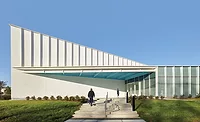
Aquiet collection of aging factories and outdated manufacturing plants, the Keihin industrial district of Tokyo seems light-years away from the city’s eye-popping, neon-clad commercial centers. But against this monochromatic backdrop, the AGC Quality Manufacturing Training Center, designed by Takenaka Corporation, positively glows. During the day, the building’s prominent, bullet-shaped south elevation reads as a series of concrete planes rhythmically interspersed with narrow strips of glass. But at night, when the building is illuminated from within, the masonry recedes and the transparent panels change the four-story structure into a graphic display of the color spectrum.

The center belongs to Japan’s largest glass manufacturer, Asahi Glass Company (AGC), a major supplier to the automotive, architecture, and electronics industries, as well as a producer of glass-related chemicals. Located in different parts of the country, AGC’s various sectors are physically isolated and fairly independent entities. But all of the organization’s companies anticipate the retirement of their highly skilled, baby-boomer workforce in the near future. This pressing reality generated a need for a joint facility where technical know-how could be transmitted to the next generation of employees. In 2005, AGC conducted an invited design competition for a training center on the grounds of its Keihin factory and awarded the commission to the building design department of Takenaka, one of Japan’s five major construction companies.

Linked by a covered walkway and a shared parking lot, Takenaka’s center consists of two parts. One is a 19,736-square-foot, metal-clad volume containing a variety of workshops on three floors. The other is the concrete-skinned, 70,455-square-foot structure designated for conferences and classroom-style learning. Organized around an enclosed courtyard that admits daylight into the middle of the interior, the larger building holds the entrance hall, exhibition area, and a variety of meeting rooms on the ground floor; a practical training room and seminar rooms on the second floor; then two floors of additional seminar and meeting rooms, as well as a lounge and a terrace on the fourth floor.

The no-nonsense plan of the seminar building practically designed itself: Hugging the perimeter walls, the various rooms are strung together by circulation spines running the building’s length. On the other hand, creating a distinct character for this facility required careful consideration. “We needed a concept for expressing the company ideas through the building,” explains Hirotsugu Yamaguchi, manager of Takenaka’s architectural design section. The architects’ solution lay in the relationship between light and glass itself.

Borrowing a concept from physics, the Takenaka team used the spectrograph of glass, or graphic representation of the light waves emitted by glass, as its model for painting and positioning thin bands of 17 different colors on interior corridor walls and ceilings. The rainbow stripes range from dark red to deep purple with selected shades of orange, yellow, green, and blue in between. Each one aligns perfectly with an exterior, 2-foot-wide slit window that extends the height of the south elevation and bends over to become a skylight. Punctuating the long corridors, the painted stripes are concentrated in wall recesses where fluorescent lamps hidden in vertical cove fixtures bounce light off the tinted surfaces, resulting in the brilliant, reflected hues that both animate the interior during the day and brighten up the exterior at night.

In order not to detract from the colored walls, overhead luminaires were omitted from the circulation spaces. But individual room interiors were another matter. Here the designers used ceiling-mounted fluorescent lights made from 1¼2-inch-diameter glass tubes earmarked for convenience-store display cases. While room light is normally one consistent color temperature measured in kelvins, the architects hoped to awaken the senses and improve working conditions by blending lights of different temperatures together. In the lounge, for example, the 15-foot-high ceiling is lined with 100 red, white, blue, and yellow lamps intended to infuse the room with a relaxed atmosphere and to stimulate communication.

“We tried to introduce company products as much as possible,” explains Yamaguchi. Indeed, while the largely opaque south elevation helped keep costs down, the east-facing facade is made entirely of the heat-absorbing sheets that AGC produces as windshields for its carmaker clients. Tinted like privacy glass, the wall comprises 450 3-foot-square panels that effectively block out the early morning sun.

In 1916, when Asahi Glass first opened its factory on this site, Japan was in the throes of rapid Westernization and modernization. Today, AGC is on the brink of another major transition. And with 25,000 people passing through its doors yearly, its training center is doing its share to light the way.

KEYWORDS: Tokyo

Share This Story

Looking for a reprint of this article?
From high-res PDFs to custom plaques, order your copy today!
Contributing Editor Naomi Pollock, FAIA, is the author of Japanese Design Since 1945: A Complete Sourcebook and the forthcoming Vanishing Japan: Modern Architecture Gone But Not Forgotten,

Post a comment to this article

Report Abusive Comment

Subscription Center
  • Create an Account
  • Start a Subscription
  • Manage My Account
  • Sign Up for Newsletters
  • Visit Customer Service
  • Update Preferences

More Videos

Sponsored Content

Sponsored Content is a special paid section where industry companies provide high quality, objective, non-commercial content around topics of interest to the Architectural Record audience. All Sponsored Content is supplied by the advertising company and any opinions expressed in this article are those of the author and not necessarily reflect the views of Architectural Record or its parent company, BNP Media. Interested in participating in our Sponsored Content section? Contact your local rep!

close
  • TAMLYN XtremeTrim Exterior Trim
    Sponsored byTamlyn

    Designing Cleaner Panel Facades: Why Exterior Trim Details Matter

  • Building with Vapor Barriers
    Sponsored byReef Industries, Inc.

    Vapor Barriers Help Control Moisture in Tighter Building Designs

  • Duct Interior with Prodeq System
    Sponsored byHenry, a Carlisle Company

    Designing Resilient Water Containment Systems

DESIGN:ED Podcast
Listen to Architectural Record’s DESIGN:ED Podcast

Events

June 10, 2026

Rethinking Stormwater – The Power of Porous Paving

Credits: 1 AIA LU/HSW; 1 AIBD P-CE; 0.1 ICC CEU

Learn how porous paving systems support stormwater management, reduce heat island effects, and enhance sustainable site design performance.

June 11, 2026

Very Early Warning Fire Detection for Mission-Critical Facilities

Credits: 1 AIA LU/HSW; 1 AIBD P-CE; 0.1 ICC CEU

Examine advanced fire detection strategies that support uptime and enhance safety in data centers and other mission-critical facilities.

View All Submit An Event

Products

2026 Architect's Square Foot Costbook

2026 Architect's Square Foot Costbook

See More Products

Popular Stories

Practice Matters illustration

What’s in a (Firm’s) Name? Thinking About Succession and Legacy

Practice Matters illustration

By the Numbers: Counting America's Architects

House on a Hill

Design Vanguard 2026: Forma

Crane Cove, ONO

Design Vanguard 2026 Winners

KRESA by DLR

In Kalamazoo, DLR Group Completes a Mass-Timber Hub for Career and Technical Education Programs

Broader Sustainability of CMU - Free Webinar - May 21, 2026

Related Articles

  • AGC Quality Manufacturing Training Center Lighting Projects

    See More
  • Trumpf Education Center

    Barkow Leibinger’s Mass-Timber Training Center Buzzes with Activity

    See More
  • Training Recreation Education Center

    Training Recreation Education Center by Ikon 5 Architects

    See More

Related Products

See More Products
  • Architectural Record - June 2025

    Architectural Record June 2025 Issue

See More Products

Events

View AllSubmit An Event
  • May 21, 2026

    Broader Sustainability of CMU: Sourcing, Manufacturing and Circular Economy

    NOW ON DEMANDCredits: 1 AIA LU/HSW; 1 AIBD P-CE; 0.1 ICC CEU Discover how to design with concrete masonry to reduce life-cycle environmental impacts, improve supply-chain efficiency, and support resilient, low-carbon building outcomes.
View AllSubmit An Event
×

The latest news and information

#1 Source for Architectural Design, News and Products

SUBSCRIBE
  • RESOURCES
    • Advertise
    • Contact Us
    • Submit
    • Store
  • ACCOUNT CENTER
    • Create an Account
    • Start a Subscription
    • Manage My Account
    • Sign Up for Newsletters
    • Visit Customer Service
    • Update Preferences
  • PRIVACY
    • PRIVACY POLICY
    • TERMS & CONDITIONS
    • DO NOT SELL MY PERSONAL INFORMATION
    • PRIVACY REQUEST
    • ACCESSIBILITY
  • SERVICES
    • Marketing Services
    • Reprints
    • Market Research
    • List Rental
    • Survey/Respondent Access
  • STAY CONNECTED
    • Linkedin
    • Facebook
    • Instagram
    • YouTube
    • X (Twitter)

Copyright ©2026. All Rights Reserved BNP Media, Inc. and BNP Media II, LLC.

Design, CMS, Hosting & Web Development :: ePublishing