A Cluster of Hadid Projects Share a Particular Strain of Design DNA

A cluster of Hadid projects share a particular strain of design DNA
Zaha Hadid Architects
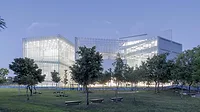
MAXXI (white building in foreground) snakes through the Flaminio district, responding to one city grid on the south (right in photo) and another on the north (left). Pier Luigi Neri's domed Sports Palace stands east of MAXXI, while the three performance halls of Renzo Piano's Parco della Musica lie a little farther east.
Photo ©

A cluster of Hadid projects share a particular strain of design DNA
Zaha Hadid Architects
Interior of the BMW Central Building in Leipzig, Germany (February 2005).
Photo © Helene Binet

A cluster of Hadid projects share a particular strain of design DNA
Zaha Hadid Architects
Losing design for a new campus center at IIT in Chicago.
Image courtesy Zaha Hadid Architects

A cluster of Hadid projects share a particular strain of design DNA
Zaha Hadid Architects
Phaeno Science Center in Wolfsburg, Germany (November 2005).
Photo © Werner Huthmacher

A cluster of Hadid projects share a particular strain of design DNA
Zaha Hadid Architects
Hoenheim-Nord Terminus in Strasbourg, France (2001).
Photo © Roger Rothan

A cluster of Hadid projects share a particular strain of design DNA
Zaha Hadid Architects
Sketch of the Museum for the Royal Collection in Madrid.
Image courtesy Zaha Hadid Architects
Architects & Firms
Turn the clock back to 1999 and you find Zaha Hadid and her partner Patrik Schumacher working on a critical set of projects, four of which (including MAXXI) eventually got built and two that never moved off the page or computer screen. Reacting against the notion of buildings as sculptural objects — popularized at the time by Frank Gehry’s Guggenheim Museum in Bilbao — Hadid and Schumacher explored the possibility of designing buildings as fields or networks of elements and connections. From a car factory and a transit hub to different kinds of museums, these projects imagine architecture as a three-dimensional fabric woven and layered in ways that emphasize movement and interaction. To understand these projects, you need to look at them individually as expressions of interconnectivity, and collectively as a family of designs sharing similar beliefs and quirks.
People
Heading - simply apply bold:
Sub-heading - apply ital: |
Products
Heading - simply apply bold:
Sub-heading - apply ital: |
Looking for a reprint of this article?
From high-res PDFs to custom plaques, order your copy today!