City of Culture of Galicia Archive and Library
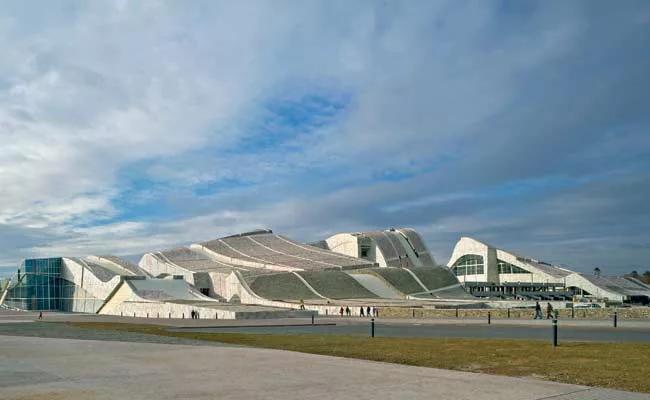
Peter Eisenman’s 173-acre cultural complex outside Santiago de Compostela, Spain, is still a construction site. The archive and the library (foreground) are now open, while the Central Services building (background) nears completion.
Photo © Duccio Malagamba
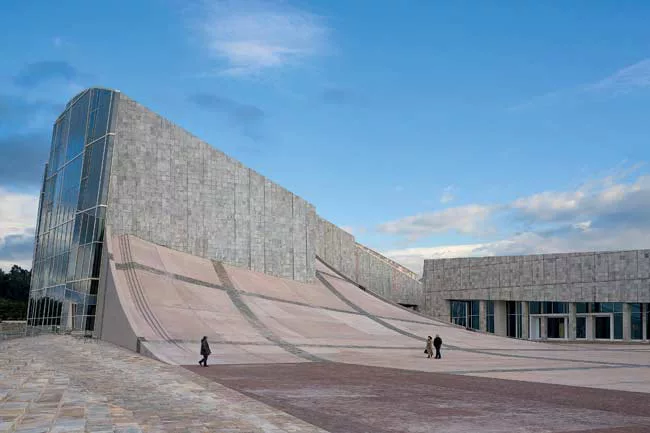
A granite and quartzite stone slope at the back of the library leads visitors around to the glazed north face.
Photo © Duccio Malagamba
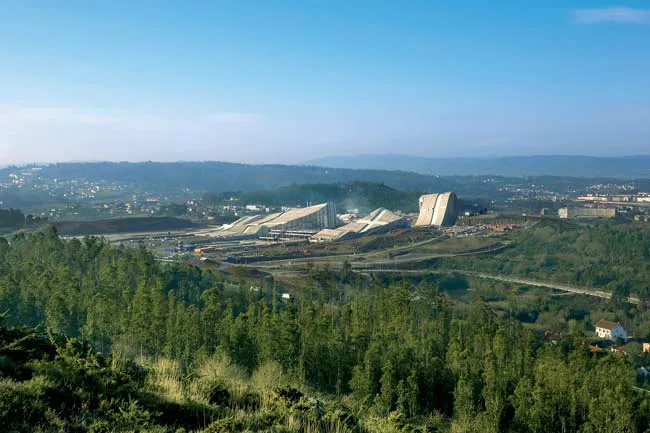
From afar, four of the six buildings that compose the City of Culture of Galicia rise up out of the earth with buckling stone-clad forms.
Photo © Duccio Malagamba
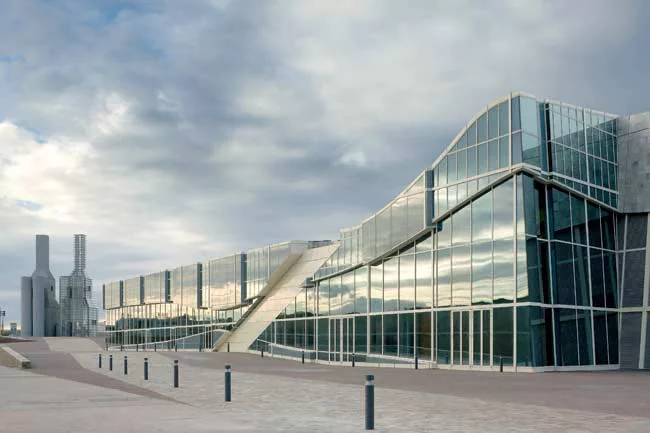
Jagged mullions along the south elevation of the archive building frame gray-tinted glass while a white aluminum channel breaks the surface. At the southwest corner are the John Hejduk Towers, originally projected for a site in Santiago de Compostela, but unrealized, and so erected here at Eisenman’s suggestion.
Photo © Duccio Malagamba
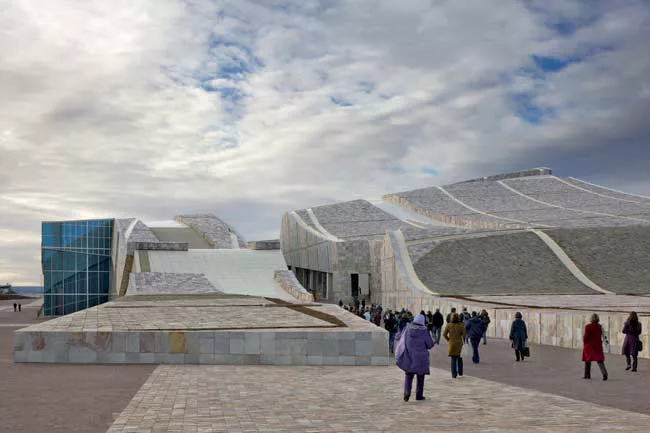
Visitors park at the east end of the complex, and enter on the red granite and asphalt paths that cleave the archive and the library. The rose and tan quartzite stone surfacing the roof is supported by steel scaffolding above a secondary roof of concrete with waterproofing and insulation.
Photo © Duccio Malagamba
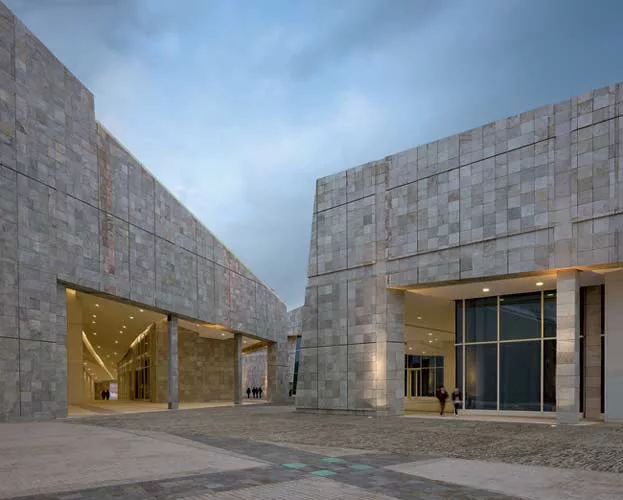
Arcades and open passages lead visitors to the City of Culture exhibition on the north side of the archive. A service tunnel under the complex offers vehicular access to all bulldings.
Photo © Duccio Malagamba
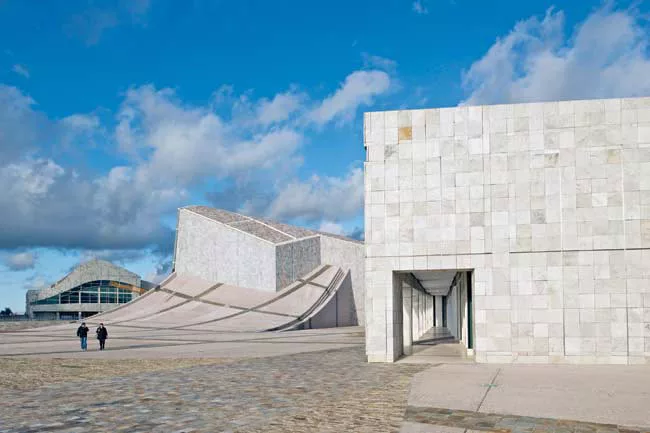
The rectilinear arcade along the north side of the archive contrasts with the slippery slope of granite-paved plaza on the west end of the library. On the other side of a large construction pit rises the Central Services building with conference halls.
Photo © Iñigo Bujedo Aguirre
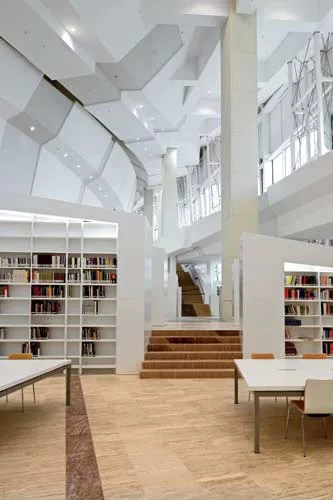
The interior of the library receives daylight from the north window wall; open stacks are designed for individual reading areas. Here 4-foot-square columns support the roof and contain drains.
Photo © Iñigo Bujedo Aguirre
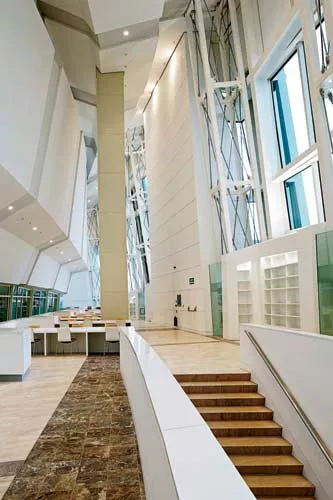
Travertine stairs lead to a mezzanine that contains computer workstations, overlooking the UV-filtering-glass-enclosed core for rare books. On the north glazed elevation, cable-stayed vertical trusses help with wind loads.
Photo © Iñigo Bujedo Aguirre
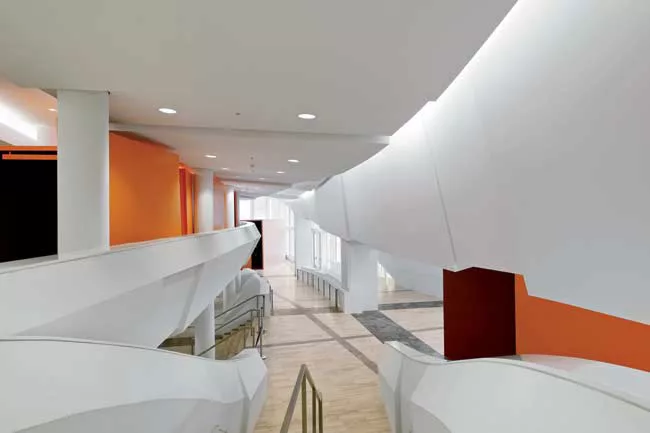
The orange exhibition enclosures on two levels were installed by the foundation to house rare artifacts and manuscripts.
Photo © Iñigo Bujedo Aguirre
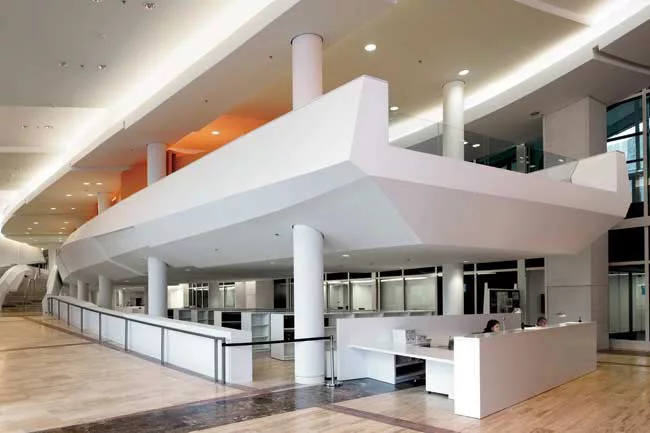
The plaster-finished round concrete columns in the archive form a secondary support system for the internal spaces.
Photo © Iñigo Bujedo Aguirre
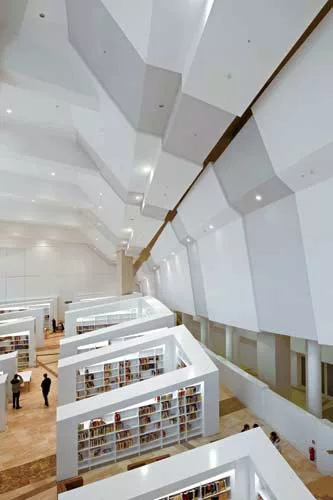
The library’s open stacks and changing levels create alcoves for reading. The shaped soffits and upper walls molded of drywall define the interior spaces.
Photo © Iñigo Bujedo Aguirre
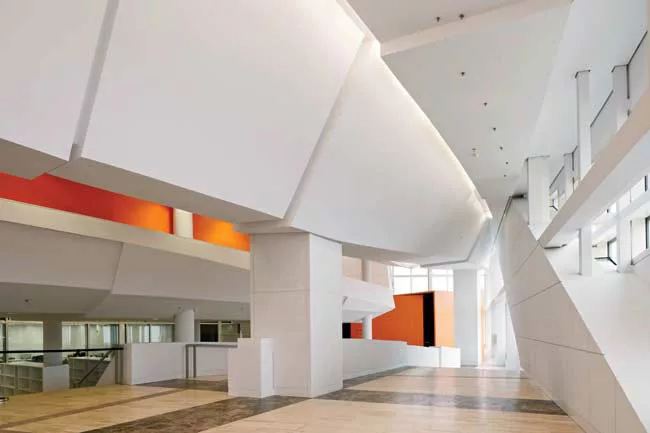
The orange exhibition enclosures on two levels were installed by the foundation to house rare artifacts and manuscripts.
Photo © Iñigo Bujedo Aguirre
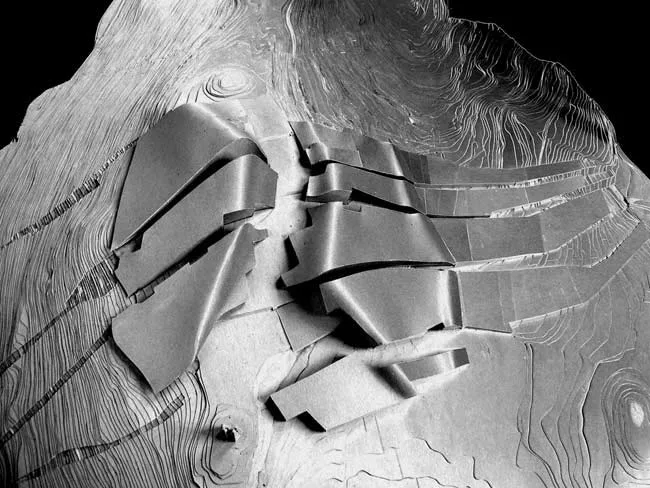
When Eisenman first won the competition in 1999, the wood model indicated that eight buildings would merge with the topography of the site. As time passed, the program was adjusted and the number of buildings was scaled back to six.
Image courtesy Eisenman Architects
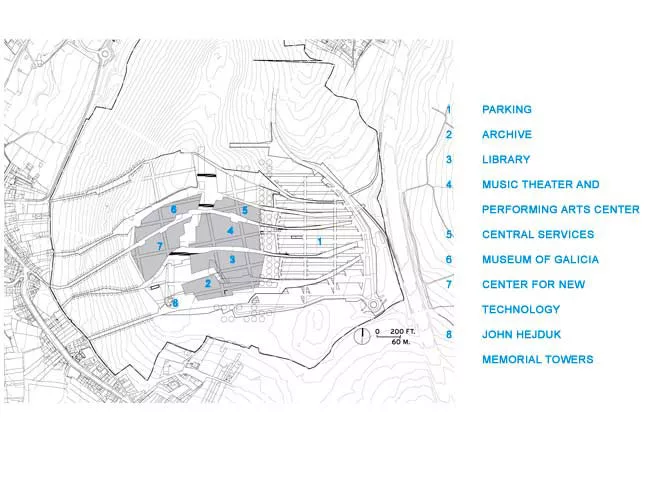
Image courtesy Eisenman Architects
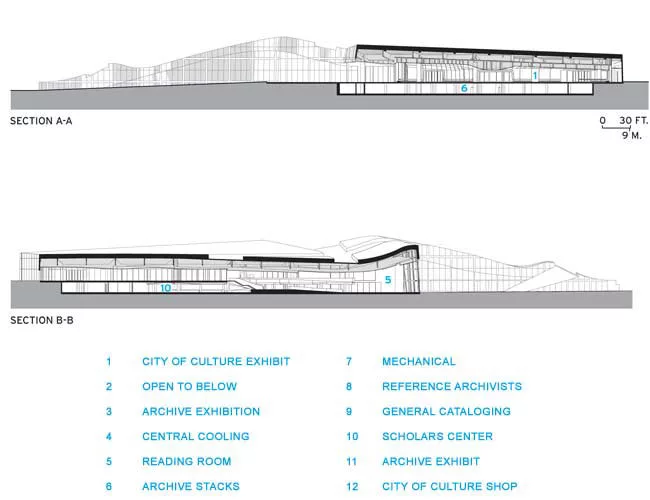
Image courtesy Eisenman Architects
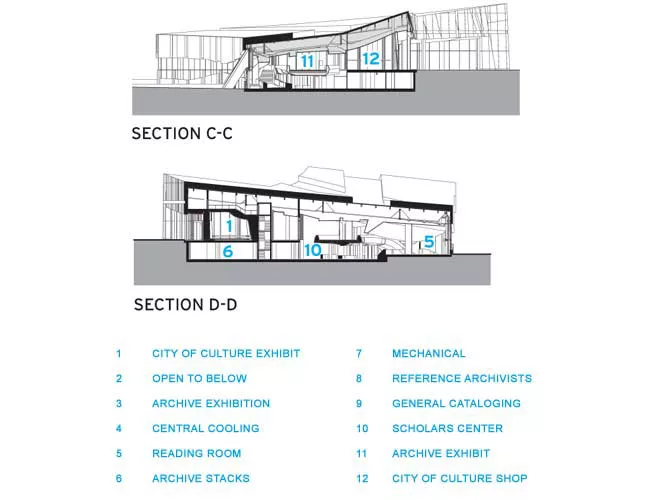
Image courtesy Eisenman Architects
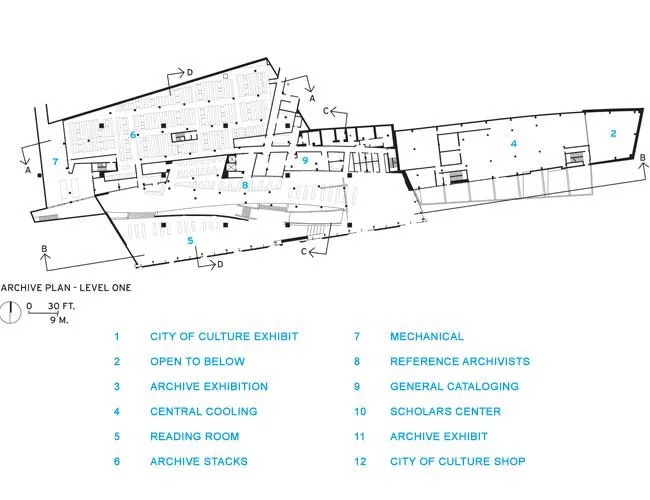
Image courtesy Eisenman Architects
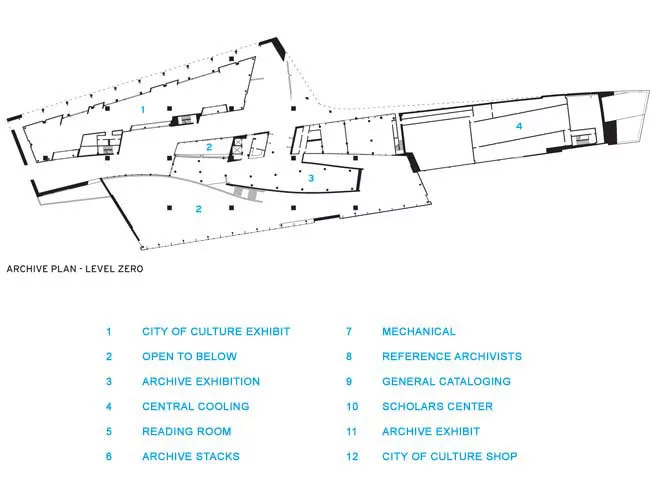
Image courtesy Eisenman Architects
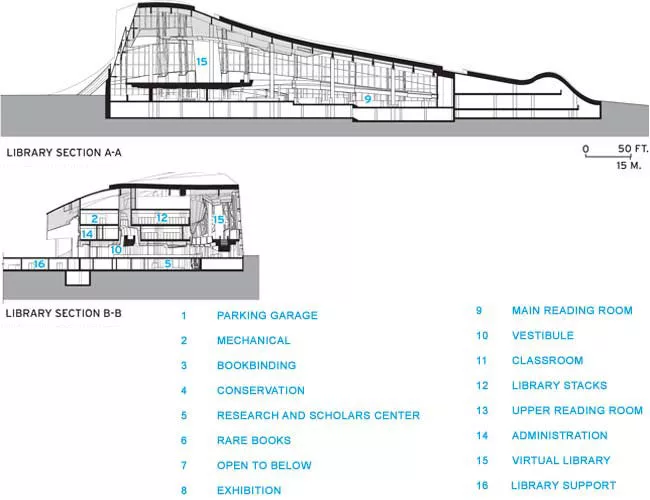
Image courtesy Eisenman Architects
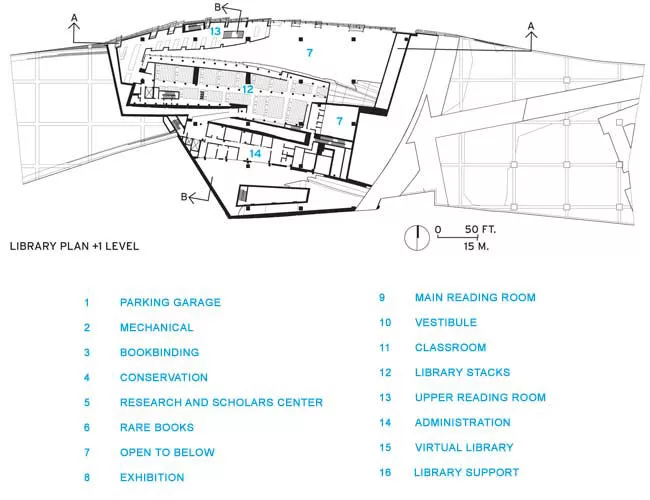
Image courtesy Eisenman Architects
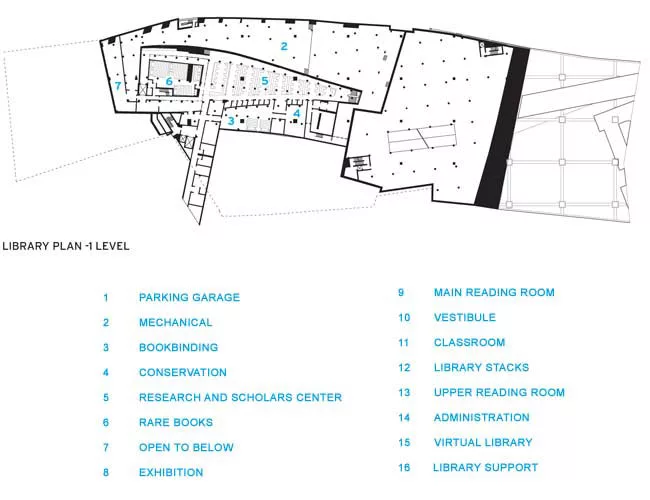
Image courtesy Eisenman Architects
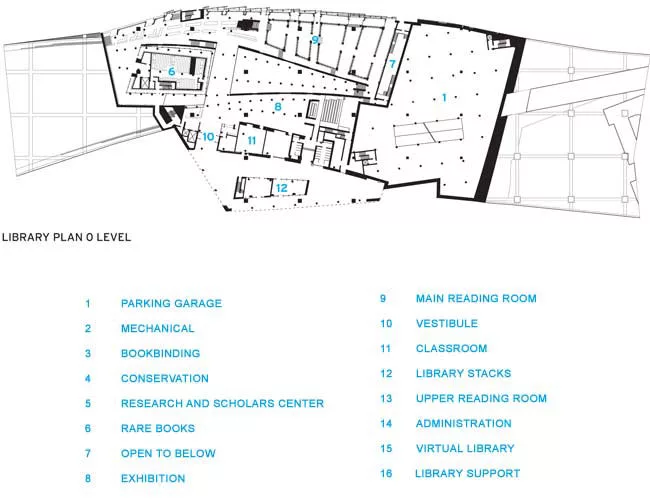
Image courtesy Eisenman Architects
Architects & Firms
Santiago de Compostela, Spain
The evocative title of the exhibition Cities of Artificial Excavation: The Work of Peter Eisenman, 1978–1988 at the Canadian Centre for Architecture in Montreal in 1994 turns out to be an oracular description of the architect’s City of Culture of Galicia in northwest Spain. Eisenman’s project of a lifetime, now 12 years in design and construction, has involved serious digging and earthmoving to create topographical man-made structures that blur figure and ground. With two buildings just open, the complex’s raw state presents an artificial landscape of thrashing, gnashing stone creatures restlessly rising up from the earth before subsiding into calm ripples.
Eisenman won the competition for the City of Culture in 1999 at the right time economically, and in the right country architecturally. Since the end of Franco’s reign in 1975, Spanish architects have been turning out high-quality Modernist design in a country also receptive to the tours de force of internationally known architects. After Frank Gehry’s Guggenheim Museum in Bilbao opened in 1997, Manuel Fraga Iribarne, the president of the Xunta of Galicia, initiated the 1 million-square-foot research, study, and arts center for his own region. The brief for the City of Culture ambitiously called for a periodicals archive, library, museum, music theater, central services and administration building, and international arts center with a budget of around $145 million.
Eisenman’s winning scheme, folded into the earth and seductively represented by a molded wood model, beat out varied proposals by ten finalists: Steven Holl Architects, OMA/Rem Koolhaas, Ateliers Jean Nouvel, Gigon Guyer Architects, Dominique Perrault Architecture, Studio Daniel Libeskind, Juan Navarro Baldeweg, César Portela, Ricardo Bofill/Taller de Arquitectura, and José Manuel Gallego Jorreto.
The 173-acre site on Mount Gaiás can be glimpsed from nearby Santiago de Compostela where the cathedral houses the remains of the apostle St. James, brought to Spain from Jerusalem after his death in AD 44. Since the eighth century, pilgrims have trekked to the medieval town to pay homage to his shrine.
Although Eisenman’s proposal indicated eight buildings, today it’s down to six. Two of the buildings, the 155,205-square-foot Archive of Galicia and the 186,990-square-foot Library of Galicia, opened in January. The 223,889-square-foot Museum of Galicia and the 80,729-square-foot Central Services Building are expected to be completed by late fall, although the museum won’t be installed until next spring. It is easy to see that the scale is daunting. When all six structures are finished, the City of Culture could almost function as a small international airport (except, of course, the planes’ pilots might mistake the buildings for runways). But the projected space needs were not determined by the architects.
The program, conceived at the cusp of the digtal age and during the halcyon years of economic prosperity, got caught in a programmatic and financial time warp. And the government changed in 2005. The archive was slated to be a periodicals library with a large reading room. When it morphed into an archive for storing regional documents, the large space for a reading room was turned over to the exhibition of rare documents. But because of the presence of an expansive south-facing glazed wall, temporary polygonal structures enclose the fragile artifacts. As for the library, the original plan to house 250,000 books grew to a million under the wishes of the Galician administration. Now, while rare books occupy a central glazed core, the ongoing digitization of library collections generally raises a question about future space requirements. It doesn’t mean that these buildings can’t undergo adaptive reuse. But the weak link to the program certainly turns the formal qualities of the architecture into the main event. As if anticipating such questions, the City of Culture has mounted its own exhibition in the archive featuring a video of Eisenman explaining how he arrived at these striated forms.
Eisenman began with the outline and street plan of the medieval city of Santiago de Compostela based on the shape and ridges of a scallop, the emblem for the shrine. He then placed a similar street pattern on the top of Mount Gaiás to separate the original eight buildings and let the site’s topography mold this medieval pattern. Then he overlaid the plan with a Cartesian grid while finally digitally warping the result with a computer-modeling wire frame to generate, he says, “dimension and direction.”
Overlays and interplays of these grids are called out in stonework, mullions, aluminum channels, and glazing, as well as contoured drywall soffits and walls inside the buildings. Lay people might find this flow and deformation a bit obsessive. A different matter is the dynamism of the actual shapes and the surface textures of the swelling and heaving structures. You don’t need to climb all the contours of these convulsing carapaces (as some do) to know you have entered an experientially based landscape where kinesthetic and haptic, as well as visual, perceptions dominate. Even inside, where interior surfaces assume quite different shapes, contracting and expanding spaces heighten the temporal experience of architecture.
Executing these leviathan structures should ultimately cost an estimated $581 million for the six buildings. But the economy has slowed down the construction schedule to a point where no one is talking about the completion date for the last two buildings, one of which is the opera, the other, now slated for a new technologies center.
Originally the design team wanted grass roofs, but found that grass was heavier and harder to maintain than stone. Nevertheless, the local quartzite (in brown, rose, and off-white hues and varied textures) that clads the roofs and walls proved to be hard for the local quarry to supply on time. Stone also came from Brazil.
The hand-quarried stone, cut by machine in 20-inch square blocks (with blocks at the edges specially trimmed), is mounted on a steel armature of curved box beams (or steel girders in the archive) plus steel cross-bracing. The ventilated chunky roof surges over an under layer of concrete deck, waterproofing, and protective insulation. (The interstitial space between the two layers also houses mechanical equipment.) The side walls of mortarless quartzite panels with stainless steel reveals stand out from the buildings like a rainscreen against galvanized aluminum. But while the steel and stone do a lot of work, the actual structure of the buildings is reinforced concrete: the megacolumns are placed on a 53-by-66-foot grid, while a secondary 26-by-26-foot grid of round concrete columns is rotated 7 degrees from the main one.
The glazing posed its own challenge; where a double curvature is called for, flat transparent, reflective, and opaque glass is angled in layers to produce the contour. Since the library’s glass wall soars to a 98-foot height, cable-stayed vertical trusses were needed for wind loads. They are plentiful: It seems even the trusses have trusses. Eisenman wanted (and thought he was getting) gray glass, but it turns bluish and greenish under different lighting. Oddly, the glass sometimes overpowers the stone, and the thick grid of variously sized mullions sometimes overpowers the glass.
This isn’t a work of architecture where you are overawed by the elegant detailing of the mullions: the strength actually emanates from the skillful craftsmanship of the stonework. Eisenman gives much credit for the execution to architect of record Andrés Perea Ortega, plus Antonio Maroño, the architect for the Foundation of the City of Culture of Galicia, who has been on-site since 2001.
Although it is too early to fully evaluate a complex still very much under construction, already it has become a lightning rod for debate regarding its high cost, excessive space, and ambiguous program. At least the current government officials in charge appear to be fully behind it: Perhaps the perfect fit of program to form will evolve in time. As it ages, it will no doubt lose its rawness, but probably keep its brute energy. The gesture is so defiant. Its brazen monumentality and unsettling scale ravenously explore the difference between artifice and nature. Time will reveal its significance.
PeopleOwner: Diputación Foral de Álava (Provincial Government of Álava) Architect: Personnel in architect's firm who should receive special credit: Collaborators (architecture): Jose Gastaldo, Richard Král’ovič, Eduardo Pérez de Arenaza Engineer(s) Mechanical engineering: Iturralde y Sagüés Ingenieros / César Martín Quantity surveyor: Laura Montoya López de Heredia Consultant(s) General contractor: UTE Arqueología (Dragados SA, Lagunketa SA) Photographer(s) Pedro Pegenaute |
ProductsStructural system Manufacturer of any structural components unique to this project: Post-tensioned elements: CTT Stronghold SA Exterior cladding Bronze panels on façade: Dragados and Lagunketa, Connectic Supplier of bronze: KME Locsa Metal: Goros Bronze cladding: Connectic Glass: Etxeglass Wood: Tarimas y parquets Gamiz SA EIFS, ACM, or other: Gabiria Moisture barrier: Alimco Roofing Windows Metal frame: Inoxfelgon Glazing Doors Wood doors:Gamiz Sliding doors: Dorma Fire doors: Noratek, VTL Sliding doors: Dorma Extension jamb kits: Oca Industrial Hardware Exit devices:SVC Security devices: SVC, Tecdoa Other special hardware: Domotic control: Tecdoa Interior finishes False ceilings: Fejeme Norte, Aisnor Wall coverings: Wood: Tarimas y Parquets Gamiz S.A. Paneling: Tatec Floor and wall tile: Resins in flooring: Oca Industrial SA Furnishings Reception furniture: Mobaux Fixed seating: Dynamobel Other furniture: Mobile shelving: Grupo EUN Lighting Downlights:Eskoop, Ca2L Exterior:Eskoop, Ca2L Conveyance Plumbing Add any additional building components or special equipment that made a significant contribution to this project: Air conditioning: Venticlima Fire detection, access control: SVC Fire network: Rabsal Metalwork (stainless): Inoxfelgon, Calderería César Metalwork (iron): Vemsa, Talleres Ral, Lama Paints: Adok Prefabricated concrete elements: Pavimentos de Tudela Monolayer application: Armentia Polyurethane application: Gabiria Sandwich roof, Tramex_ Oli-Cer Brick: Jorge Fernández Tiles: Disdelan Deployee: Veca-Tech Lifeline: Proteclan Soundproofing: Sico Ayala Masonry workers: Oberduoro Companies that worked with COMSA at the start of construction: Fibercement dismantling: Cespa Conten Micropilotis: Perforaciones y Sondeos SA Masonry: Construcciones Subhani SL Scaffolding: Nopin Alavesa SA Post-tensioned elements: CTT Stronghold SA Damp-proofing: Alimco SL Insulation: Aislamientos Vascos Isocas SL |
Looking for a reprint of this article?
From high-res PDFs to custom plaques, order your copy today!