Architectural Record
search
cart
facebook twitter linkedin youtube
  • Sign In
  • Subscribe
  • Sign Out
  • My Account
Architectural Record
  • NEWS
    • Latest News
    • Awards
    • Interviews
    • Obituaries
    • Podcasts
      • Design:Ed Podcast
      • Sponsored Podcasts
  • OPINION
    • Book Reviews / Excerpts
    • Exhibition Reviews
    • Forum
  • EXCLUSIVES
    • Videos
    • Design Vanguard
    • Top 300 Firms
    • Sponsored Content
    • Sponsored eBooks
    • From the Archives
  • CONTINUING ED
    • Editorial Continuing Ed
    • CE Center
    • CE Academies
  • PROJECTS
    • Buildings By Type
    • Reuse & Renovation
    • Museums & Arts Centers
    • Colleges & Universities
    • Multifamily Housing
    • Interiors
    • Lighting
    • Kitchen & Bath
  • HOUSES
    • Record Houses
    • House of the Month
    • Featured Houses
  • PRODUCTS
    • Products by Category
    • Record Products of the Year
    • Latest Products
  • EVENTS
    • Dates & Events
    • Record on the Road
    • Innovation Conference
    • Sustainability in Practice
    • Women In Architecture
    • Webinars
    • Ad Excellence Awards
    • Submit an Event
  • CONNECT
    • Ask RECORD AI
    • Newsletters
    • Contact
    • Advertise
    • Editorial Calendar
    • Store
    • Customer Service
  • SUBMIT
    • Submission Guidelines
    • RECORD Competitions
  • MAGAZINE
    • Subscribe
    • My Account
    • Digital Edition
    • Current Issue
    • Firm Pass
    • Historic Archive
Projects

8 House

By Joann Gonchar, FAIA
The 8 House Copenhagen

8 House

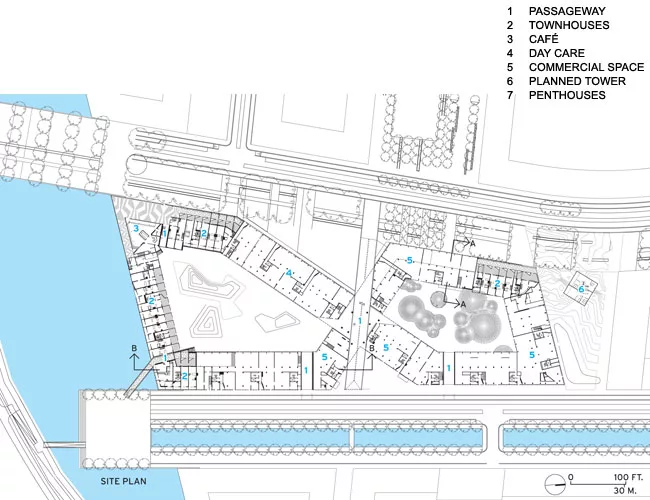
The 8 House is located at the southern tip of Ørestad, a new development rising along a branch of Copenhagen's metro line. The building sits alongside a canal and next to the Kalvebod Fælled's vast meadowlike landscape.

Drawing courtesy Bjarke Ingels Group

8 House
8 House
The 8 House is located at the southern tip of Ørestad, a new development rising along a branch of Copenhagen's metro line. The building sits alongside a canal and next to the Kalvebod Fælled's vast meadow-like landscape.
 
Drawing courtesy Bjarke Ingels Group
8 House
8 House
With almost 500 apartments and more than 650,000 square feet, 8 House is Denmark's largest private development to date. It is so big, according to the architect, that 'it straddles the boundary between building and city planning.'
 
Drawing courtesy Bjarke Ingels Group
8 House
8 House
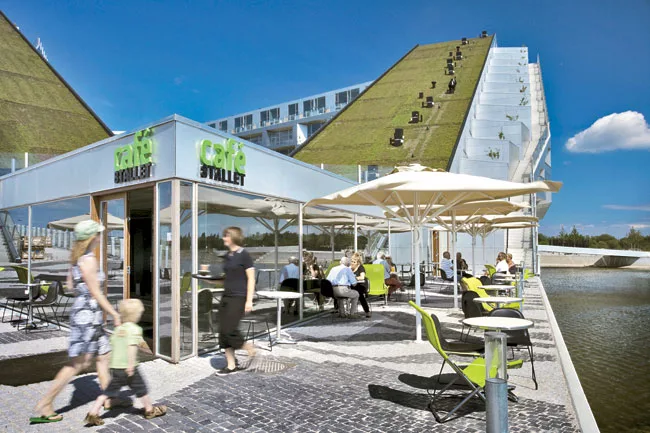
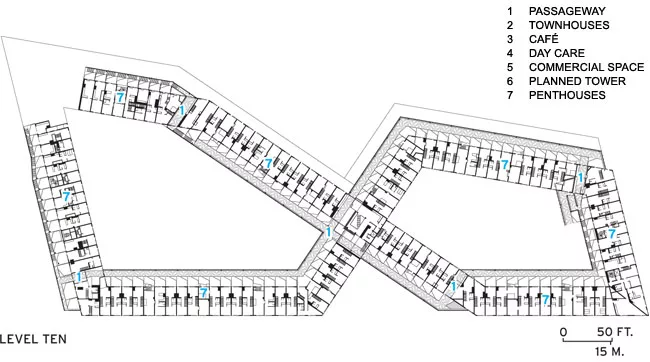
The building is 10 stories at its tallest point, sloping down to only one story at the southwest corner, where a café sits overlooking the canal.
 
Drawing courtesy Bjarke Ingels Group
8 House
8 House
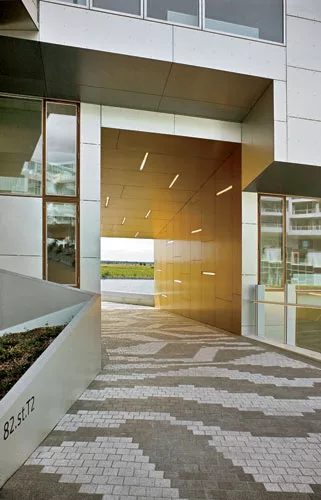
A number of passageways penetrate the building's figure-eight-shaped perimeter block, providing access from the building's courtyards to the street.
 
Drawing courtesy Bjarke Ingels Group
8 House
8 House
The layer-cakelike arrangement of different uses is recognizable in the building's street-facing facades, with commercial space enclosed behind a glass curtain wall at the base and the various types of apartments behind projecting aluminum-clad bands above.
 
Drawing courtesy Bjarke Ingels Group
8 House
8 House
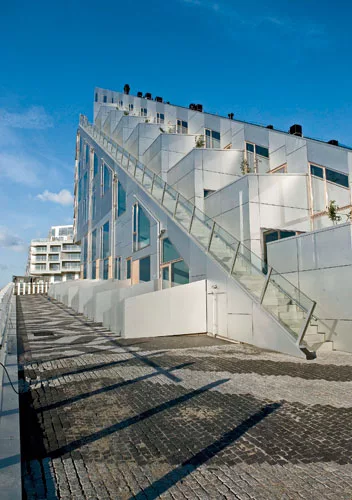
The sloping path that loops around the building provides direct access to some apartments. The pattern in the paving is intended to delineate a slope comfortable for people in wheelchairs.
 
Drawing courtesy Bjarke Ingels Group
8 House
8 House
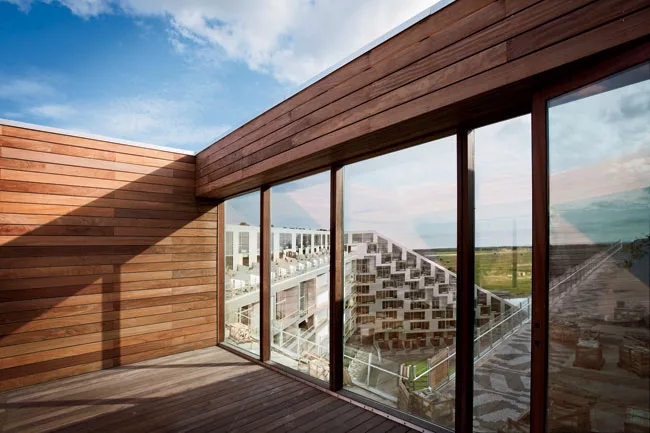
There are three basic types of 8 House apartments ' townhouses, flats, and penthouses ' but all have open and airy layouts, hardwood floors, and individual terraces or garden spaces.
 
Drawing courtesy Bjarke Ingels Group
8 House
8 House
The bowtie's knot houses various communal facilities, including a shared roof deck that affords views out over the complex.
 
Drawing courtesy Bjarke Ingels Group
8 House
8 House
 
Drawing courtesy Bjarke Ingels Group
8 House
8 House
 
Drawing courtesy Bjarke Ingels Group
8 House
8 House
 
Drawing courtesy Bjarke Ingels Group
8 House
8 House
 
Drawing courtesy Bjarke Ingels Group
8 House
8 House
 
Drawing courtesy Bjarke Ingels Group
The 8 House Copenhagen
8 House
8 House
8 House
8 House
8 House
8 House
8 House
8 House
8 House
8 House
8 House
8 House
8 House
August 16, 2011

Architects & Firms

Bjarke Ingels Group

Copenhagen, Denmark

People/Products

“Humble” seems an unlikely word to associate with an architect who, at 36, has already built three inventive apartment complexes on his home turf of Copenhagen, has a high-profile commission for another in New York City, and is the darling of the design blogosphere. But that’s one of the adjectives (along with “talented”) that Danish developer and general contractor Per Høpfner uses to describe Bjarke Ingels, founder of the six-year-old Bjarke Ingels Group (BIG). According to Høpfner, Ingels knows how to listen to his clients and is sensitive to budget issues.

For anyone familiar with BIG’s work, it won’t be surprising to hear that the firm’s goals are larger than keeping costs in check. “We build in the most economical way,” says Ingels, “but are constantly asking ourselves, ‘What can the project provide for the neighborhood and its residents?‘“ Otherwise, ”the money is wasted and the opportunity is lost.”

For the most recently completed and largest of Ingels’s Copenhagen residential projects — the $133 million 8 House, which includes 476 apartments and more than 100,000 square feet of commercial space and shared facilities — the aim was to build a “three-dimensional community even though the building is in the middle of nowhere,” says Ingels. The “nowhere” is about 7 miles from the city center at the southern tip of Ørestad, a still somewhat barren district rising along a branch of Copenhagen’s new metro line. Ingels’s two earlier residential projects — the 221-unit VM Houses, named after the shape of the complex when seen from the air, and the Mountain, which features 80 apartments that terrace down over a parking garage — are located not far away in the same developing quarter. Høpfner joined forces with the Danish Oil Company to develop the first two buildings. For 8 House, he teamed with holding company St. Frederikslund, but has since sold his interest in the project.

Design work on 8 House, which is reportedly Denmark’s largest private development, began in 2006, before Copenhagen’s housing bubble burst. In order to create an architectural framework for the community the designers envisioned there, they based the 8 House scheme on the typology of a perimeter block, but squeezed it in the middle to form a bowtie shape that defines two courtyards. At the central “knot,” they created a 30-foot-wide passageway that connects the east and west sides of the site. They then layered the components of the program one on top of the other like a cake: Commercial uses, including retail space, a café, a day care center, and offices, are placed near the base, so that they can benefit from direct contact with the street, while the different types of apartments — townhouses, flats, and penthouses — are stacked above. And in order to provide the residential units with daylight and views of marshes and grazing lands that sit directly to the south, they raised the building’s northeast corner to 10 stories, sloping it to only one story at the diagonally opposite corner by stepping down each successive line of apartments. The result is plenty of variety in the building’s precast-concrete structural components.

The most unusual aspect of 8 House, one that stops just shy of gimmicky, is a continuous open-air ramp. Along with stairs and elevators, it provides access to the townhouses and penthouses as it loops around the building, stretching from the street level to the top floor and back again. More than any other feature, the ramp is intended to imbue the mammoth complex with a sense of community: “Where social life, the spontaneous encounter, and neighbor interaction are traditionally restricted to the ground level, the 8 House allows them to expand all the way to the top,” explains Ingels. The resulting environment, according to the firm’s promotional literature, is a “lively urban neighborhood” with the “intimacy of an Italian hill town,” even in the midst of Copenhagen’s flat-as-a pancake terrain.

In 8 House’s big, bold moves and its geometric complexity one can easily recognize the influence of Rem Koolhaas and the Office of Metropolitan Architecture (both Ingels and Julien De Smedt, his former partner in the now-dissolved practice PLOT, are OMA alums). The inventiveness extends to the smaller scale with cleverly conceived components, such as a zigzagging cable system supporting the stairs inside two-story apartments and the outdoor ramp’s stone paving pattern delineating a slope gradual enough for people in wheelchairs. However, on the whole, 8 House isn’t a project of refined details. Some elements, like the aluminum rainscreen cladding, feel undeveloped; at certain locations, the spaces between the individual facade panels read as gaps or awkward joints, rather than carefully considered reveals.

Although they may be a little rough around some of their edges, the 8 House units, which are considered “mid-market” by Danish standards, seem like appealing places to live. Most apartments have dual exposures and all have open and airy layouts, terraces or garden spaces, and niceties such as tiled baths and hardwood floors. And then there is the allure of BIG’s social vision. But it is too soon to know for certain if the hoped-for sense of community and neighborhood vitality will materialize, because current market conditions are very different from those during the boom times when the project was conceived. A little over half of the apartments have sold since the building’s completion in December and a 25-unit apartment tower included in the original scheme has been put on indefinite hold.

However, there are encouraging signs of 8 House’s potential. On a gloomy early spring afternoon, the café, which sits at the building’s low, southwest tip, had customers even though it was well after lunchtime. Patio furniture had begun to populate the terraces and entry gardens, and from a vantage point in the northern courtyard, office workers could be seen busy at their desks.

The building is apparently popular with nonresidents, including architectural tourists. There are enough of these visitors that one page of the sales office website has instructions for obtaining permission for tour groups. It is the only part of the site in English — one indication that the building is already a destination for design junkies from all over the world.

According to Ingels, the building also attracts people from other parts of the city. In good weather, they stroll on the looping path’s man-made terrain. “Since Copenhagen is so flat,” he says, “they come to enjoy the urban landscape."


People

Architect
BIG-Bjarke Ingels Group
Norrebrogade 66D 2nd Fl
2200 CPH N, Denmark
T  +45 7221 7227
F  +45 3512 7227

Personnel in architect's firm who should receive special credit:
Partner-In-Charge: Bjarke Ingels, Thomas Christoffersen
Project Leader: Ole Elkjaer-Larsen, Henrick Poulsen

Project Manager
Finn Norkjaer, Henrik Lund

Engineer(s)
Moe & Brodsgaard

Consultant(s)
Landscape: KLAR

General contractor
Hopfner Partners

Photographer(s)
Dragor Luftfoto, Jens Lindhe, Ty Stange, Ulrik Reeh

Owner:

St. Frederikslund Holding

Gross square footage:

650,000

Completion date:

December 2010

Total construction cost:

$133 million


Products

Structural system
List type, e.g. concrete or steel frame, wood, etc.: concrete element construction

Exterior cladding

Concrete work, site cast: Hoffmann
Mounting of Facades: Timbra
Facades Row Houses/Penthouse: Krone Vinduer
Facades Apartments: Velfac
Facades Office/Retail: Eilar Thomsen Alufacader
Facades Material: VINK Aluminum plates

Roofing

Roofing: Uldum Tag
Roof Gardens: Veg Tech
Roof Decks: Skandek Tagelementfabrik

Windows

All frames: SA /Krone vinduer
All Handles and fittings: SA /Krone vinduer

Glazing

Skylights:Lumex

Doors

All outer doors: Eiler Thomsen/Schüco
All inner doors: Swedoor/Jeld-Wen
Handles & Fittings: Eiler Thomsen
Locks & Keys: RUKO

Interior finishes

Inner floor covering: Danish Hardwood A/S
Outer floor covering: Danish Hardwood A/S

Lighting

Downlights: Fugmann El-Anlæg
Task lighting: Fugmann El-Anlæg
Exterior: Fugmann El-Anlæg

Conveyance

Elevators/Escalators: KONE

Plumbing

Sanitary Fittings: E.J Badekabiner
Sanitary Objects: Unidrain

Add any additional building components or special equipment that made a significant contribution to this project:
Two sloping green roofs totaling 1,700 m2 are strategically placed to reduce the urban heat island effect as well as providing the visual identity to the project and tying it back to the adjacent farmlands towards the south; The apartments are placed at the top while the commercial programme unfolds at the base of the building. As a result, the different horizontal layers have achieved a quality of their own: the apartments benefit from the view, sunlight and fresh air, while the office leases merge with life on the street. This is emphasized by the shape of 8 house which is literally hoisted up in the Northeast corner and pushed down at the Southwest corner, allowing light and air to enter the southern courtyard – optimizing the daylight and natural heating for all inhabitants and users of the building and providing natural ventilation; Rainwater is collected in a storm water management system; 

 
KEYWORDS: Denmark

Share This Story

Looking for a reprint of this article?
From high-res PDFs to custom plaques, order your copy today!

Joann gonchar

Joann Gonchar, FAIA, LEED AP, is deputy editor at Architectural Record. She joined RECORD in 2006, after working for eight years at its sister publication, Engineering News-Record. Before starting her career as a journalist, Joann worked for several architecture firms and spent three years in Kobe, Japan, with the firm Team Zoo, Atelier Iruka. She earned a Master of Architecture degree from the University of Pennsylvania and a Bachelor of Arts from Brown University. She is licensed to practice architecture in New York State.

Post a comment to this article

Report Abusive Comment

Subscription Center
  • Create an Account
  • Start a Subscription
  • Manage My Account
  • Sign Up for Newsletters
  • Visit Customer Service
  • Update Preferences

More Videos

Sponsored Content

Sponsored Content is a special paid section where industry companies provide high quality, objective, non-commercial content around topics of interest to the Architectural Record audience. All Sponsored Content is supplied by the advertising company and any opinions expressed in this article are those of the author and not necessarily reflect the views of Architectural Record or its parent company, BNP Media. Interested in participating in our Sponsored Content section? Contact your local rep!

close
  • TAMLYN XtremeTrim Exterior Trim
    Sponsored byTamlyn

    Designing Cleaner Panel Facades: Why Exterior Trim Details Matter

  • Building with Vapor Barriers
    Sponsored byReef Industries, Inc.

    Vapor Barriers Help Control Moisture in Tighter Building Designs

  • Duct Interior with Prodeq System
    Sponsored byHenry, a Carlisle Company

    Designing Resilient Water Containment Systems

DESIGN:ED Podcast
Listen to Architectural Record’s DESIGN:ED Podcast

Events

June 10, 2026

Rethinking Stormwater – The Power of Porous Paving

Credits: 1 AIA LU/HSW; 1 AIBD P-CE; 0.1 ICC CEU

Learn how porous paving systems support stormwater management, reduce heat island effects, and enhance sustainable site design performance.

June 11, 2026

Very Early Warning Fire Detection for Mission-Critical Facilities

Credits: 1 AIA LU/HSW; 1 AIBD P-CE; 0.1 ICC CEU

Examine advanced fire detection strategies that support uptime and enhance safety in data centers and other mission-critical facilities.

View All Submit An Event

Products

2026 Architect's Square Foot Costbook

2026 Architect's Square Foot Costbook

See More Products

Popular Stories

Practice Matters illustration

What’s in a (Firm’s) Name? Thinking About Succession and Legacy

Practice Matters illustration

By the Numbers: Counting America's Architects

House on a Hill

Design Vanguard 2026: Forma

Crane Cove, ONO

Design Vanguard 2026 Winners

KRESA by DLR

In Kalamazoo, DLR Group Completes a Mass-Timber Hub for Career and Technical Education Programs

Broader Sustainability of CMU - Free Webinar - May 21, 2026

Related Articles

  • House 8

    See More
  • Glass/Wood House by Kengo Kuma and Associates

    Glass/Wood House by Kengo Kuma and Associates

    See More
  • Paravant Architects Passive House

    Is the Passive House Standard the Answer?

    See More

Related Products

See More Products
  • biogenic.jpg

    Manual of Biogenic House Sections

  • iconic house.jpg

    The Iconic House

See More Products
×

The latest news and information

#1 Source for Architectural Design, News and Products

SUBSCRIBE
  • RESOURCES
    • Advertise
    • Contact Us
    • Submit
    • Store
  • ACCOUNT CENTER
    • Create an Account
    • Start a Subscription
    • Manage My Account
    • Sign Up for Newsletters
    • Visit Customer Service
    • Update Preferences
  • PRIVACY
    • PRIVACY POLICY
    • TERMS & CONDITIONS
    • DO NOT SELL MY PERSONAL INFORMATION
    • PRIVACY REQUEST
    • ACCESSIBILITY
  • SERVICES
    • Marketing Services
    • Reprints
    • Market Research
    • List Rental
    • Survey/Respondent Access
  • STAY CONNECTED
    • Linkedin
    • Facebook
    • Instagram
    • YouTube
    • X (Twitter)

Copyright ©2026. All Rights Reserved BNP Media, Inc. and BNP Media II, LLC.

Design, CMS, Hosting & Web Development :: ePublishing