L.A. Fires, One Year Later
Is the Passive House Standard the Answer?

In the aftermath of the wildfire that swept through Los Angeles’ Pacific Palisades last January, reports circulated of a house, designed to the Passive House standard, that was still standing, seemingly unscathed, while its immediate neighbors had been reduced to charred rubble. It turns out that the house is not a true Passive House, but instead borrows some of the construction methodology’s principles. The residence’s architect, Santa Monica–based Greg Chasen, credits the structure’s survival to those features—along with good fortune. “Some of the design choices we made here helped,” he said in a January 12, 2025, Instagram post. “But we were also very lucky.”
What exactly is Passive House? It was not created as a fire-resilience program but rather as a performance-based certification system focused almost exclusively on energy efficiency. Nevertheless, many Passive House proponents see the program and its strategies as having great potential for the rebuilding of L.A.’s devastated neighborhoods. “Passive House and wildfire design have significant synergies,” says Christian Kienapfel, co-founder of Paravant Architects. Kienapfel designed his own Culver City residence to the standard, completing the metal-clad 1,750-square-foot, net zero, all-electric structure in 2018, making it L.A. County’s first certified Passive House.
Known as Passivhaus in Germany, where the program originated in the early 1990s, the certification system is applicable to any building type (not just residential construction, as the name would seem to suggest). It seeks to minimize energy expended for heating and cooling, with tenets that include an extra-insulated, airtight building envelope with minimal thermal bridging, ultra-high-performance windows, and mechanical ventilation with heat recovery.
Passive House designers say that the aspect of the program providing the most benefit in wildfire-prone regions is the continuous air-sealing of the envelope. Passive House International (one of two certifying bodies) permits only 0.6 air changes per hour at 50 Pascals of pressure through leakage—a tough performance bar that must be confirmed with a blower door test. “The point is to prevent energy loss,” says Timothy Lock, management partner at OPAL, a Belfast, Maine–based architecture firm specializing in Passive House projects. However, the envelope’s robustness, he says, also protects against extreme heat and the intrusion of wind-borne embers—the chief cause of building ignition in a wildfire. OPAL recently won first place in the “contemporary” category of a California Rebuilds competition organized by the non-profits Passive House Network and Passive House California.
Kienapfel, whose firm also won a first-place prize in the same competition—in the “midcentury modern” category—elaborates, noting that glazing can be a vulnerability. But the high-performance windows required by Passive House provide an added defense, he says. He also points to a secondary fire-resilience-related benefit of the program—excellent indoor-air quality. His own house has a heat-recovery-ventilation unit, which effectively removes outdoor pollutants including pollen, smoke, and ash, although, during wildfire events, the filters require frequent replacement, he says.
1
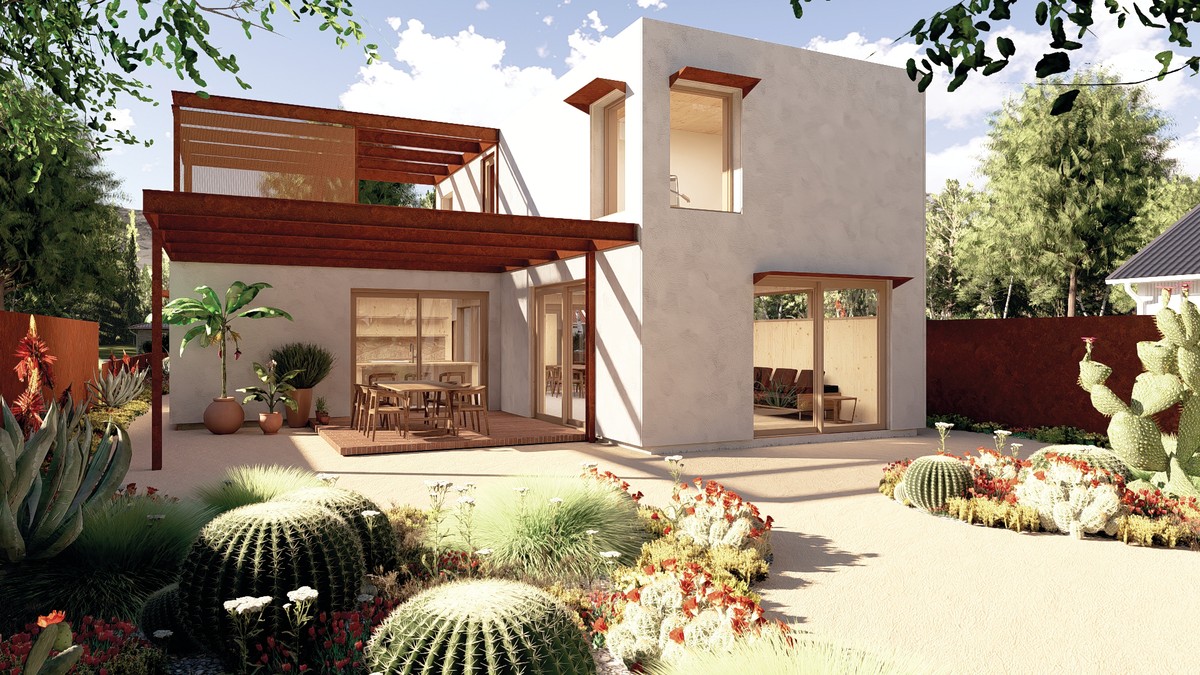
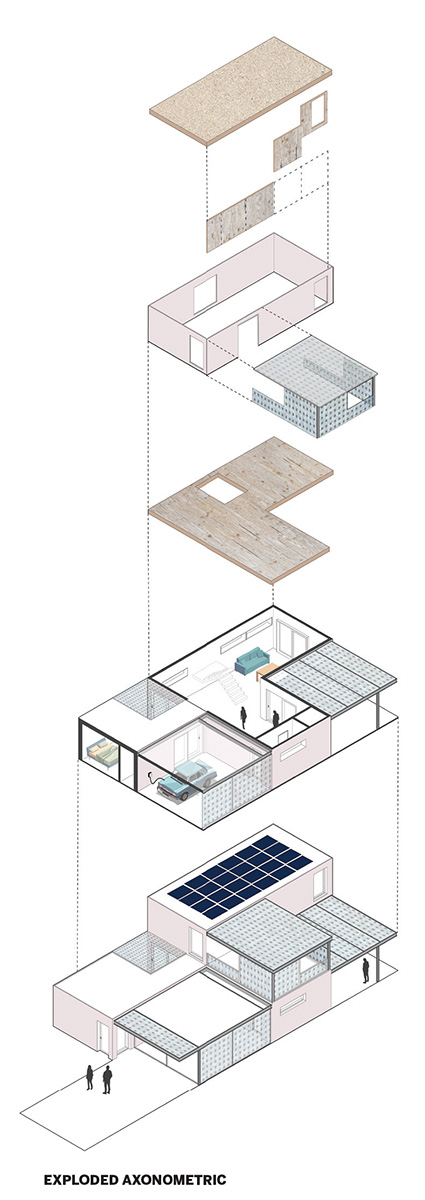
OPAL’s scheme for the California Rebuilds competition has a mass-timber structure (1 & 2). Images © OPAL, click to enlarge.
2
With most of its projects in New England, OPAL can offer perspective on designing Passive House projects in different regions. Though the firm’s buildings generally favor compact forms for energy efficiency, the Southern California climate allows for more generous exterior surface area, points out Riley Pratt, OPAL’s design partner. A Passive House project in L.A. would require less insulation, he says, and should incorporate shading to avoid heat gain. Accordingly, the firm’s two-story, three-bedroom competition scheme features stacked boxlike volumes defining outdoor spaces, including a courtyard and roof terrace, protected by weathering steel pergolas.
OPAL’s proposal has a mass-timber structure, largely exposed on the interior, and a clay-plaster finish on the exterior. Mass timber is well suited to fire-prone areas, says Lock, since it develops a protective layer of char—accounted for in the structural design—when it burns. In addition, the off-site nature of mass-timber fabrication allows for fast post-disaster construction, he adds.
Looking for quick answers on architecture and design topics?
Try Ask RECORD, our new smart AI search tool.
Ask RECORD →
Meanwhile, Paravant, which is designing four Passive House projects in Altadena and Pacific Palisades for clients who lost their homes in last year’s fires, typically uses conventional wood framing. The assembly, rather than the material, “is critical,” says Kienapfel, noting that concrete and steel structures can also burn. To achieve the necessary insulation levels for Passive House, Paravant wraps the frame in a blanket of stone wool that it combines with dense-packed cellulose: “If the cavities are filled, the structure is less likely to combust.” The firm generally clads its houses in stucco, stone, metal, or fiber-cement board.
Chasen credits the survival of his Pacific Palisades project to a straightforward gabled roof, without eaves or an attic space, reducing places where embers can penetrate or easily ignitable debris can collect. These are features that Passive House buildings also often omit, since they complicate the design of air sealing and thermal breaks. And, naturally, Chasen points to the house’s airtightness, though he says the envelope was not sealed to the degree required for certification—he had considered it “overkill” in the Southern California climate. But now, since the house needed remediation for elevated levels of heavy metals, he is reassessing that approach.
Even the most enthusiastic Passive House fans don’t always go for certification. Not all of OPAL’s projects, for instance, meet the program’s stringent standards. However, the firm tries to employ Passive House strategies on all its buildings. The methodology brings lasting benefits to clients—beyond energy savings—including durability and resilience, says Lock. “Certification is secondary.”
Looking for a reprint of this article?
From high-res PDFs to custom plaques, order your copy today!