Architectural Record
search
cart
facebook twitter linkedin youtube
  • Sign In
  • Subscribe
  • Sign Out
  • My Account
Architectural Record
  • NEWS
    • Latest News
    • Awards
    • Interviews
    • Obituaries
    • Podcasts
      • Design:Ed Podcast
      • Sponsored Podcasts
  • OPINION
    • Book Reviews / Excerpts
    • Exhibition Reviews
    • Forum
  • EXCLUSIVES
    • Videos
    • Design Vanguard
    • Top 300 Firms
    • Sponsored Content
    • Sponsored eBooks
    • From the Archives
  • CONTINUING ED
    • Editorial Continuing Ed
    • CE Center
    • CE Academies
  • PROJECTS
    • Buildings By Type
    • Reuse & Renovation
    • Museums & Arts Centers
    • Colleges & Universities
    • Multifamily Housing
    • Interiors
    • Lighting
    • Kitchen & Bath
  • HOUSES
    • Record Houses
    • House of the Month
    • Featured Houses
  • PRODUCTS
    • Products by Category
    • Record Products of the Year
    • Latest Products
  • EVENTS
    • Dates & Events
    • Record on the Road
    • Innovation Conference
    • Sustainability in Practice
    • Women In Architecture
    • Webinars
    • Ad Excellence Awards
    • Submit an Event
  • CONNECT
    • Ask RECORD AI
    • Newsletters
    • Contact
    • Advertise
    • Editorial Calendar
    • Store
    • Customer Service
  • SUBMIT
    • Submission Guidelines
    • RECORD Competitions
  • MAGAZINE
    • Subscribe
    • My Account
    • Digital Edition
    • Current Issue
    • Firm Pass
    • Historic Archive
Projects

National September 11 Memorial & Museum

Creating a Place to Honor the Past and Look Ahead

By Clifford A. Pearson
Water around and in the memorial pools reflects the skyline of Lower Manhattan without the Twin Towers.
National September 11 Memorial & Museum
Memorial: Michael Arad and Peter Walker and Partners
Entry Pavilion to Museum: Sn'hetta
Museum: Davis Brody Bond
New York, New York
Water around and in the memorial pools reflects the skyline of Lower Manhattan without the Twin Towers.
Photos by James Ewing
The memorial plaza occupies nearly half of the 16-acre site with a pair of voids identifying the footprints of the destroyed skyscrapers.
National September 11 Memorial & Museum
Memorial: Michael Arad and Peter Walker and Partners
Entry Pavilion to Museum: Sn'hetta
Museum: Davis Brody Bond
New York, New York
The memorial plaza occupies nearly half of the 16-acre site with a pair of voids identifying the footprints of the destroyed skyscrapers.
Photos by James Ewing
Water falls over serrated stainless steel weirs and down granite walls around the two voids.
National September 11 Memorial & Museum
Memorial: Michael Arad and Peter Walker and Partners
Entry Pavilion to Museum: Sn'hetta
Museum: Davis Brody Bond
New York, New York
Water falls over serrated stainless steel weirs and down granite walls around the two voids.
Photos by James Ewing
The names of the dead have been stencil-cut into angled bronze plates so sunlight catches them during the day and backlighting illuminates them at night. The names are organized by groups of people wh
National September 11 Memorial & Museum
Memorial: Michael Arad and Peter Walker and Partners
Entry Pavilion to Museum: Sn'hetta
Museum: Davis Brody Bond
New York, New York
The names of the dead have been stencil-cut into angled bronze plates so sunlight catches them during the day and backlighting illuminates them at night. The names are organized by groups of people who worked or died together, based in part on adjacencies requested by the families and colleagues of the victims.
Photos by James Ewing
A combination of glass and stainless steel panels animates the museum pavilion's skin with changing daylight. The pavilion points west, helping to orient visitors on the site.
National September 11 Memorial & Museum
Memorial: Michael Arad and Peter Walker and Partners
Entry Pavilion to Museum: Sn'hetta
Museum: Davis Brody Bond
New York, New York
A combination of glass and stainless steel panels animates the museum pavilion's skin with changing daylight. The pavilion points west, helping to orient visitors on the site.
Photos by James Ewing
A combination of glass and stainless steel panels animates the museum pavilion's skin with changing daylight. The pavilion points west, helping to orient visitors on the site.
National September 11 Memorial & Museum
Memorial: Michael Arad and Peter Walker and Partners
Entry Pavilion to Museum: Sn'hetta
Museum: Davis Brody Bond
New York, New York
A combination of glass and stainless steel panels animates the museum pavilion's skin with changing daylight. The pavilion points west, helping to orient visitors on the site.
Photos by James Ewing
One of the tridents from the Twin Towers stands (temporarily wrapped) in the stair atrium of the museum pavilion. The glass-and-steel pavilion sits atop a hybrid steel-and-concrete structure with many
National September 11 Memorial & Museum
Memorial: Michael Arad and Peter Walker and Partners
Entry Pavilion to Museum: Sn'hetta
Museum: Davis Brody Bond
New York, New York
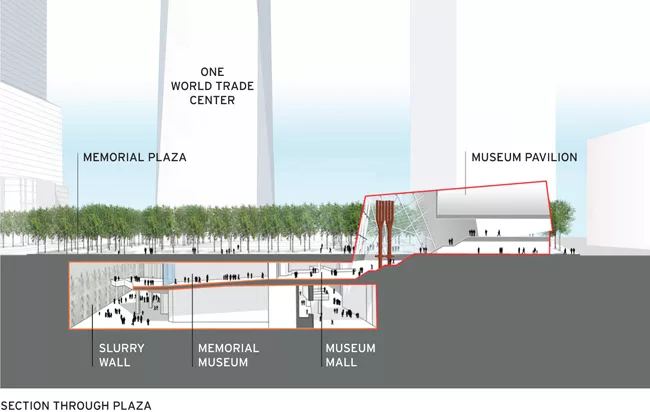
One of the tridents from the Twin Towers stands (temporarily wrapped) in the stair atrium of the museum pavilion. The glass-and-steel pavilion sits atop a hybrid steel-and-concrete structure with many layers of transportation and mechanical infrastructure below it.
Photos by James Ewing
National September 11 Memorial & Museum
Memorial: Michael Arad and Peter Walker and Partners
Entry Pavilion to Museum: Sn'hetta
Museum: Davis Brody Bond
New York, New York
Photos by James Ewing
National September 11 Memorial & Museum
Memorial: Michael Arad and Peter Walker and Partners
Entry Pavilion to Museum: Sn'hetta
Museum: Davis Brody Bond
New York, New York
Photos by James Ewing
National September 11 Memorial & Museum
Memorial: Michael Arad and Peter Walker and Partners
Entry Pavilion to Museum: Sn'hetta
Museum: Davis Brody Bond
New York, New York
Photos by James Ewing
Water around and in the memorial pools reflects the skyline of Lower Manhattan without the Twin Towers.
The memorial plaza occupies nearly half of the 16-acre site with a pair of voids identifying the footprints of the destroyed skyscrapers.
Water falls over serrated stainless steel weirs and down granite walls around the two voids.
The names of the dead have been stencil-cut into angled bronze plates so sunlight catches them during the day and backlighting illuminates them at night. The names are organized by groups of people wh
A combination of glass and stainless steel panels animates the museum pavilion's skin with changing daylight. The pavilion points west, helping to orient visitors on the site.
One of the tridents from the Twin Towers stands (temporarily wrapped) in the stair atrium of the museum pavilion. The glass-and-steel pavilion sits atop a hybrid steel-and-concrete structure with many
National September 11 Memorial & Museum
September 16, 2011

Architects & Firms

Davis Brody Bond
Michael Arad
Peter Walker and Partners
Snøhetta

New York, New York


Memorial: Michael Arad and Peter Walker and Partners
Entry Pavilion to Museum: Snøhetta
Museum: Davis Brody Bond

Remembering the dead and embracing the living are the twin forces driving the architecture of the National September 11 Memorial & Museum. Although designed by different teams and created for different purposes, the Memorial and the Museum overlap physically and metaphorically. For many people visiting Ground Zero, the two projects will fuse together as a single experience ' a continuum of outdoor and enclosed spaces that elicit a range of emotions and interpretations.

The memorial, designed by Michael Arad and Peter Walker, opens this month on the tenth anniversary of the attacks on the World Trade Center. Based on Arad's entry to the 2003 international competition that drew 5,201 submissions, it forms an 8-acre plaza comprising outdoor rooms shaped by granite, bronze, water, and trees. Arad called his entry 'Reflecting Absence' because it preserves the footprints of the Twin Towers as square holes where water cascades into pools that reflect the Lower Manhattan skyline. 'I imagined a pair of voids cut into the surface of the Hudson River,' says the architect of his original idea. 'Instead of an object, I designed a plaza where people could gather.' He recalls going to Washington Square around 2:00 a.m. a couple of days after the attacks and sharing the park silently with others who had come there. 'I realized the important role that public places play in our civic life,' he says. 'They're the glue that binds us together as a society.'


After the competition jury (which included designer Maya Lin, architect Enrique Norten, landscape architect Michael Van Valkenburgh, and artist Martin Puryear) put Arad's design on a short list of eight finalists, it recommended he team up with a landscape architect. So Arad brought in Walker to collaborate on the project. Responding to criticism that the original scheme was too austere, Arad and Walker integrated more greenery into the plan and used trees to reinforce its geometry. 'We envisioned the trees as points on an abacus,' explains Arad. 'When approached from the east or west, you see the trees in rows. But from the north and south, they appear to be placed randomly, as in a forest.' Walker notes, 'Our challenge was to create a park here yet maintain the strength of the plane.'

Daniel Libeskind's master plan for Ground Zero placed the memorial 30 feet below the streets, so parts of the massive slurry walls surrounding the site could be integrated in the design. Arad, however, brought his memorial plaza to street level, wanting to connect it with the rest of the city. Underneath the plaza, though, he inserted galleries that would look through the cascading water into the voids of the missing Twin Towers and display the names of the 2,982 people who lost their lives in the WTC attacks of 2001 and 1993.

Even after the jury selected 'Reflecting Absence' as the winning design in January 2004, Arad and Walker continued to make changes in response to comments from many different groups. The process wasn't always pretty and often involved heated debate, but Arad says he's proud of the result and feels it retains the integrity of his original design.

The biggest change was eliminating the underground galleries, which he says was painful at first but brought the plaques with the names of the victims up to the plaza level. 'Now we have a more seamless sequence of sidewalk, plaza, names, water, and voids,' says Arad. Other changes came in response to various interest groups, such as the disabled, who said people in wheelchairs would have trouble seeing the voids beyond the bronze panels displaying the names. So Arad chamfered the corners of the panels wrapping the voids and cantilevered them above the walkways so wheelchairs could roll underneath. 'These changes made the design better,' states Arad.

Finding the right trees for the plaza proved to be a complex task, because they needed to grow in a tough urban environment in just 6 feet of soil and create a uniform leaf canopy. The designers ended up selecting white oaks, growing them in New Jersey, then transferring them to the memorial plaza.

Just as the memorial navigated a tortuous process of design and redesign, so did the September 11 Museum. Begun as a cultural facility with two mismatched institutions, the Drawing Center and the International Freedom Center, as tenants, the project morphed in concept and design as those organizations dropped out for different reasons. After winning the competition to design the cultural center in 2005, the Norwegian firm Sn'hetta had to shift gears several times as the program and size of the project changed (and shrank) radically. When Arad was forced to abandon his scheme with galleries tucked around voids, the Lower Manhattan Development Corporation needed to find a new way of bringing visitors underground. So Sn'hetta partner Craig Dykers suggested using his building as an entry pavilion to an underground museum that Davis Brody Bond would design. Although it will occupy some of the space that Arad's galleries would have, the museum will not look into the voids, display the names of the dead, nor have the same connection to the memorial.

While the museum isn't scheduled to open until September 11, 2012, the entry pavilion's exterior is mostly done and provides a sense of scale to the memorial. To help emphasize the horizontal nature of the memorial, Dykers and his team tilted their building up to the east so the plaza seems to slide underneath it. Visitors will enter on the east where the building is widest, go through security, get tickets, and then move downstairs to the museum or upstairs to a small auditorium. A private room on the second floor for family members of 9/11 victims will provide views of the memorial and space for contemplation.

Dykers had originally wanted to clad the building with glass prisms, but that strategy proved too expensive. So his team developed a system of stainless steel panels in which some are perforated and some are opaque. Bead-blasted and scratched finishes help catch the changing daylight while providing blurred reflections of people visiting the site. The architects designed the steel-frame pavilion with angled supports that respond to the different structural demands of the varied infrastructure below it. 'The memorial looks to the past and the skyscrapers to the future,' says Dykers. 'We wanted our building to be about the present, the everyday.'

National September 11 Memorial at the World Trade Center

Design Architect:
Handel Architects — Michael Arad and Gary Handel, partners; Amanda Sachs, David Margolis, Robert Jamieson, Cristóbal Canas, and Garrett Brignoli, project team

Architect of Record:
Davis Brody Bond — Steven Davis, Carl Krebs, David Williams, Joseph Grant, Richard Franklin, project team

Landscape Architect:
PWP Landscape Architecture — Peter Walker, Douglas Findlay, David Walker, Matthew Donham, project team

Entry Pavilion to National September 11 Memorial Museum

Architect:
Snøhetta — Craig Dykers, partner in charge; Anne Lewison, project manager; Aaron Dorf, project architect

Architect of Record:
Adamson Associates International

National September 11 Memorial Museum

Architect:
Davis Brody Bond — Steven Davis, Carl Krebs, David Williams, Mark Wagner, Oliver Sippl

People

National September 11 Memorial at the World Trade Center

Architect
Handel Architects.
150 Varick Street, 8th Floor.
New York, NY 10013
tel: 212 595-4112
fax: 212 595-9032

Personnel in architect's firm who should receive special credit:
Handel Architects to complete

Design Architect:
Handel Architects — Michael Arad, partner, Gary Handel, partner; Amanda Sachs, David Margolis, Robert Jamieson, Cristobal Canas, and Garrett Brignoli, project team

Architect of Record:
Davis Brody Bond
Partner in Charge: Steven Davis, FAIA
Managing Partner: Carl Krebs, AIA
Project Director: David Williams, AIA
Project Architect: Joseph Grant, AIA
Project Architect: Richard Franklin, AIA

Landscape Architect:
PWP Landscape Architecture
Peter Walker
Doug Findlay
David Walker
Matthew Donham

(For extended credits on-line for PWP):
Conard Lindgren
Su-Jung Park
David Walker
Michael Dellis
Doris Schenk
Phoebe McCormick Lickwar
Don Shillingburg
Tony Sinkosky
Adam Greenspan

Fountain designer:
DEW Inc.
Dan Euser
Steve Euser

Lighting Designers:
Fisher Marantz Stone
Paul Marantz
Zack Zanolli

Engineers
Structural Engineers: WSP Cantor Senuik
Project Executive: Silvian Marcus
Project Manager: Yefim Gurevich
Project Engineer: Justin Hahn
MEP Engineers: Jaros Baum Boles
Partner in Charge: Augustinie DiGiacomo
Electrical: Mark Torre
Mechanical: Robert Downward
Plumbing: Jim McGarity
Security Engineers
ARUP
Waterproofing Engineers
WJE Engineers & Architects P.C.
Douglas Stevie
Jesse Torres
Geotechnical Engineers
Mueser Rutledge Consulting Engineers
Langan Engineering & Environmental Services
Managing Engineer (in Memoriam): John Quinlan
Simpson Gumpertz & Heger Inc.

Consultants
Blast Hardening Consultant: Weidlinger Consulting Engineers
Commissioning: Horizon Engineers
Sustainability:  Viridian Energy & Environmental LLC
Code Consultants:  Code Consultants Inc.     
Construction Manager:  Lend Lease Inc.

Contractors
Foundations: EE Cruz & Company Inc.
Steel: Owen Steel Company Inc.
Concrete: Navillus Contracting
Names Parapets: Service Metals Fabricating/ KC Fabrications Inc.
Plaza/Fountain Stone: Port Morris Tile and Marble Corp.
Plumbing: 4J’s Associates LLC
Electrical: Five Star Electric Corp.
Hugh O’Kane Electric Inc.
Waterproofing: KJC Waterproofing Inc.
Landscaping: Kelco Construction Inc.
Names Parapet Mechanical: KSW Mechanical Services Inc.
Fountain Controls: Johnson Controls Inc.
Plaza Metals: Skyline Steel Corp.

National September 11 Memorial Museum Entry Pavilion

Interior designer
Snøhetta Architecture Design Planning P.C.

Engineers
Buro Happold – Structural, Mechanical, Electrical, Plumbing, Fire Protection, Sustainability
100 Broadway
New York, NY 10005
212 334-2025

Weidlinger Associates Inc. - Blast Engineering
375 Hudson Street
NYC, NY  10014
212 367-3000

Lighting
Fisher Marantz Stone
22 West 19th Street
New York City 10011
212 691-3020 phone
           
Acoustical
Arup - Acoustics, Audio Visual
155 Avenue of the Americas
New York
NY 10013
USA
T+1 212 229 2669

Other:
Security: Arup
Vertical Transportation: Barker Mohandas, LLC
Graphics and Signage: C&G Partnership, LLC
Fire & Life Safety: Code Consultants, Inc.
Cost Consulting: Davis Langdon
Cladding Consulting: Front Inc.
IT: Shen Milson & Wilke
LEED: Viridian

Construction Manager
Lend Lease

Renderers
Squared Design Lab
Snøhetta Architecture Design Planning P.C.

CAD system, project management, or other software used:
Autocad
Rhinoceros


Products

National September 11 Memorial at the World Trade Center

Structural system
Steel Frame and Concrete
Manufacturer of any structural components unique to this project:
Steel: Owen Steel – Kevin Phillips – 803-251-7565
Concrete: Navillus Construction – Kevin Smith - 718-784-0500

Fountain
Stone: Port Morris – Anthony Vespa
Fountain Pavers: Roof Block Architectural Pavers
Fountain Sub-Pavers: Carlisle
Metal Fountain Weirs: 4Js Plumbing/Delta Fountains – Mike Russo – 718-961-6634/ Joe Petry – 904-886-9030
Fountain Names Panels: Service Metal Fabricating/KC Fabrications- Joe Moretti -973-625-0694 – Chris Powers – 845-255-0097
Fountain Waterproofing: C.I.M. Industries Inc – Chris Tufano – 800-543-6352
Situra Building Envelopes – Kris Zielonka - 800-474-8872

Plaza
Stone: Port Morris Tile and Marble Corp.
Plaza Waterproofing: American Hydotech
Plaza Lighting: Selux – Michael Manicone – 845-691-77
Insulation: Dow Corning
Leak Integrity Testing: ILD
Plaza Irrigation: Rain Bird

National September 11 Memorial Museum Entry Pavilion

Structural steel
W&W Steel Erectors, LLC – Structural and Atrium Steel Frame
1730 W. Reno
Oklahoma City, OK 73106
405-235-3621

Concrete
Sorbara Construction Corp. - Structural concrete
270 Broadway
Lynbrook, NY 11563

Exterior cladding
Metal/glass curtain wall:
W&W Glass – GC for Cladding: Metal Panel System, Glass Storefront and Atrium
W & W Glass, LLC
300 Airport Executive Park
Nanuet, NY 10954
845 425 4000

Metal Panel Supplier:
A. Zahner Co. – Stainless steel skin forming & finishing
1400 East 9th St.
Kansas City, MO 64106

Panel Fabrication:
Island Exterior Fabricators – Stainless steel skin cladding assembly and installation
1101 Scott Avenue
Calverton, NY 11922

Glass Supplier:
Viracon
800 Park Drive
Owatonna, MN 55060
800 533-2080

Storefront Systems:
Erie & Associates Engineering
39555 Orchard Hill Place, Suite 115
Novi, MI 48375

Atrium Glass Framing:
Post Road Iron Works
345 W. Putnam Ave.,
Greenwich, Ct 06830
203 869-6322


KEYWORDS: New York City

Share This Story

Looking for a reprint of this article?
From high-res PDFs to custom plaques, order your copy today!

Cliff portrait 2 0t5a1761 0031

Contributing editor Clifford Pearson is the co-author, with A. Eugene Kohn, of The World By Design, and writes about architecture and urbanism.

Post a comment to this article

Report Abusive Comment

Subscription Center
  • Create an Account
  • Start a Subscription
  • Manage My Account
  • Sign Up for Newsletters
  • Visit Customer Service
  • Update Preferences

More Videos

Sponsored Content

Sponsored Content is a special paid section where industry companies provide high quality, objective, non-commercial content around topics of interest to the Architectural Record audience. All Sponsored Content is supplied by the advertising company and any opinions expressed in this article are those of the author and not necessarily reflect the views of Architectural Record or its parent company, BNP Media. Interested in participating in our Sponsored Content section? Contact your local rep!

close
  • TAMLYN XtremeTrim Exterior Trim
    Sponsored byTamlyn

    Designing Cleaner Panel Facades: Why Exterior Trim Details Matter

  • Building with Vapor Barriers
    Sponsored byReef Industries, Inc.

    Vapor Barriers Help Control Moisture in Tighter Building Designs

  • Duct Interior with Prodeq System
    Sponsored byHenry, a Carlisle Company

    Designing Resilient Water Containment Systems

DESIGN:ED Podcast
Listen to Architectural Record’s DESIGN:ED Podcast

Events

June 18, 2026

Rebooting the Aging Office Building

Credits: 1 AIA LU/HSW; 1 AIBD P-CE; 0.1 ICC CEU; 1 PDH

Explore façade retrofit strategies and award-winning design concepts that can transform aging office buildings into healthier, higher-performing workplaces for today’s hybrid workforce.

June 23, 2026

Enhancing Fire Resistance with Advanced PVC Solutions

Credits: 1 AIA LU/HSW; 1 AIBD P-CE; 0.1 ICC CEU; 1 IIBEC CEH

Evaluate advanced PVC solutions that improve fire resistance, support WUI compliance, and enhance resilience in residential and commercial building design.

View All Submit An Event

Products

2026 Architect's Square Foot Costbook

2026 Architect's Square Foot Costbook

See More Products

Popular Stories

SanDiegoAirport

Top 300 Architecture Firms of 2026

Coronado Bridge

The Architect’s Guide to San Diego

Lorcan O' Herilhy

California Architect Lorcan O’Herlihy Has Died, Age 66

CCA, Studio Gang

The Winners of the AIA’s 2026 Architecture Award Range from Collegiate Rowing Hubs to Housing for the Homeless

Dusk House

Design Vanguard 2026: ONO

Rebooting the Aging Office Building - Free Webinar - June 18, 2026

Related Articles

  • First Look: National September 11 Memorial Museum

    See More
  • National September 11 Memorial

    See More
  • Emotional Architecture: Designers Discuss the September 11 Memorial

    See More

Events

View AllSubmit An Event
  • September 11, 2025

    Safe by Design: Security Glazing and High-Performance Glass in Educational Facilities

    NOW ON DEMANDCredits: 1 AIA LU/HSW; 1 AIBD P-CE; 0.1 ICC CEU; 0.1 IACET CEUThis webinar explores the critical role of security glazing and high-performance glass in educational facility design.
View AllSubmit An Event
×

The latest news and information

#1 Source for Architectural Design, News and Products

SUBSCRIBE
  • RESOURCES
    • Advertise
    • Contact Us
    • Submit
    • Store
  • ACCOUNT CENTER
    • Create an Account
    • Start a Subscription
    • Manage My Account
    • Sign Up for Newsletters
    • Visit Customer Service
    • Update Preferences
  • PRIVACY
    • PRIVACY POLICY
    • TERMS & CONDITIONS
    • DO NOT SELL MY PERSONAL INFORMATION
    • PRIVACY REQUEST
    • ACCESSIBILITY
  • SERVICES
    • Marketing Services
    • Reprints
    • Market Research
    • List Rental
    • Survey/Respondent Access
  • STAY CONNECTED
    • Linkedin
    • Facebook
    • Instagram
    • YouTube
    • X (Twitter)

Copyright ©2026. All Rights Reserved BNP Media, Inc. and BNP Media II, LLC.

Design, CMS, Hosting & Web Development :: ePublishing