Architectural Record
search
cart
facebook twitter linkedin youtube
  • Sign In
  • Subscribe
  • Sign Out
  • My Account
Architectural Record
  • NEWS
    • Latest News
    • Awards
    • Interviews
    • Obituaries
    • Podcasts
      • Design:Ed Podcast
      • Sponsored Podcasts
  • OPINION
    • Book Reviews / Excerpts
    • Exhibition Reviews
    • Forum
  • EXCLUSIVES
    • Videos
    • Design Vanguard
    • Top 300 Firms
    • Sponsored Content
    • Sponsored eBooks
    • From the Archives
  • CONTINUING ED
    • Editorial Continuing Ed
    • CE Center
    • CE Academies
  • PROJECTS
    • Buildings By Type
    • Reuse & Renovation
    • Museums & Arts Centers
    • Colleges & Universities
    • Multifamily Housing
    • Interiors
    • Lighting
    • Kitchen & Bath
  • HOUSES
    • Record Houses
    • House of the Month
    • Featured Houses
  • PRODUCTS
    • Products by Category
    • Record Products of the Year
    • Latest Products
  • EVENTS
    • Dates & Events
    • Record on the Road
    • Innovation Conference
    • Sustainability in Practice
    • Women In Architecture
    • Webinars
    • Ad Excellence Awards
    • Submit an Event
  • CONNECT
    • Ask RECORD AI
    • Newsletters
    • Contact
    • Advertise
    • Editorial Calendar
    • Store
    • Customer Service
  • SUBMIT
    • Submission Guidelines
    • RECORD Competitions
  • MAGAZINE
    • Subscribe
    • My Account
    • Digital Edition
    • Current Issue
    • Firm Pass
    • Historic Archive
Projects

Sipopo Congress Center

Diplomatic Maneuver: A Turkish firm combines natural forms and rich materials in a meeting hall for the African Union.
By William Hanley
Sipopo Congress Center
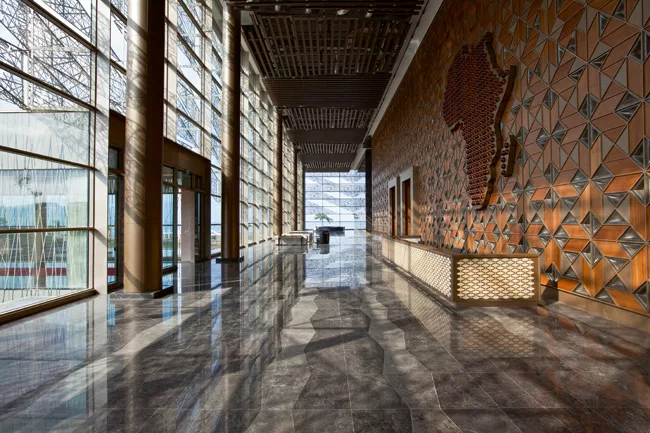
A double-height space finished in wood, glass, marble, and metal greets visitors attending meetings at the Sipopo center.
 
Photo © Emre D'rter
Sipopo Congress Center
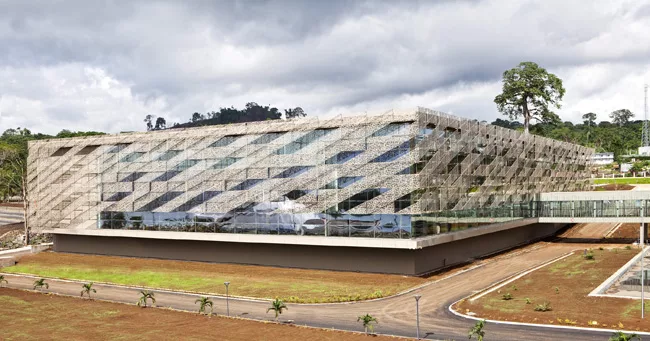
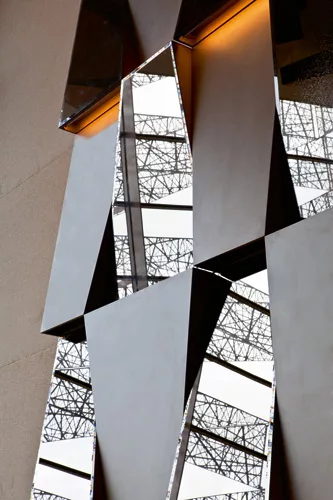
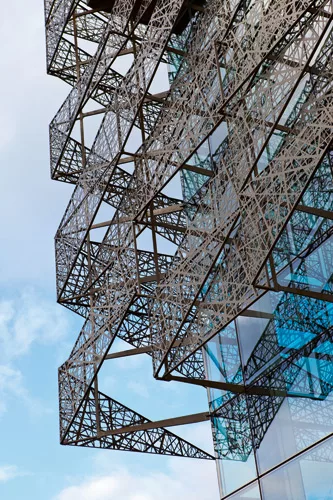
Murat Tabanlıoğlu arrived at the pattern on the project’s exterior metal screen by first sketching the canopies of trees in the surrounding forest and abstracting the forms into an irregular geometric lattice.
 
Photo © Emre D'rter
Sipopo Congress Center
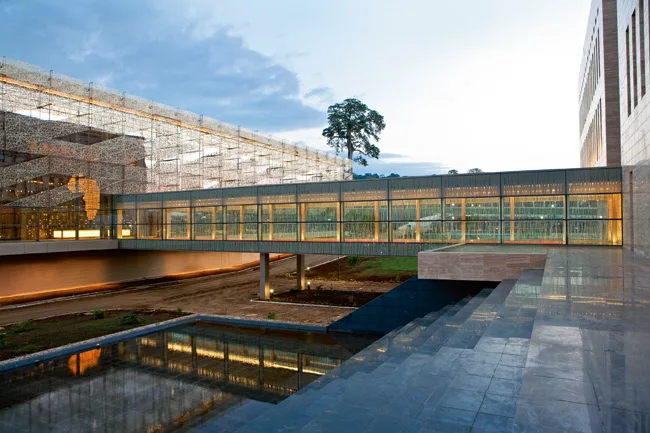
Members of the Assembly of the African Union arrive at the Sipopo center via a bridge that connects the project to an existing convention hall.
 
Photo © Emre D'rter
Sipopo Congress Center
The designers based many of the Sipopo center’s details on Bioko island’s tropical flora. Murat Tabanlıoğlu arrived at the pattern on the project’s exterior metal screen by first sketching the canopies of trees in the surrounding forest and abstracting the forms into an irregular geometric lattice.
 
Photo © Emre D'rter
Sipopo Congress Center
The firm modeled the alternating mirror and wood panels of the wall coverings in the restaurant on the skin of local pineapples.
 
Photo © Emre D'rter
Sipopo Congress Center
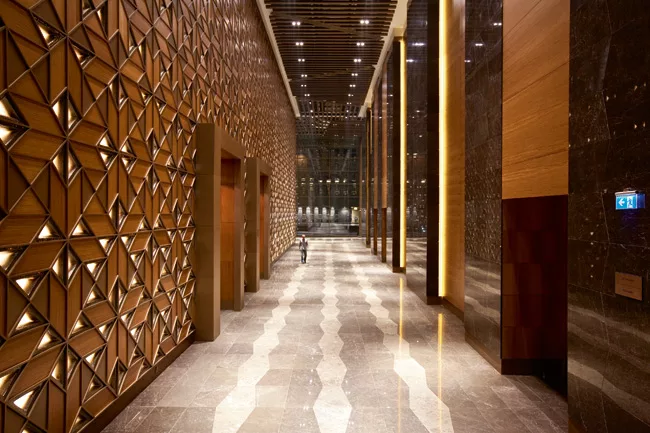
The designers used a palette of wood and metal for the interior-wall surfaces in the public spaces.
 
Photo © Emre D'rter
Sipopo Congress Center
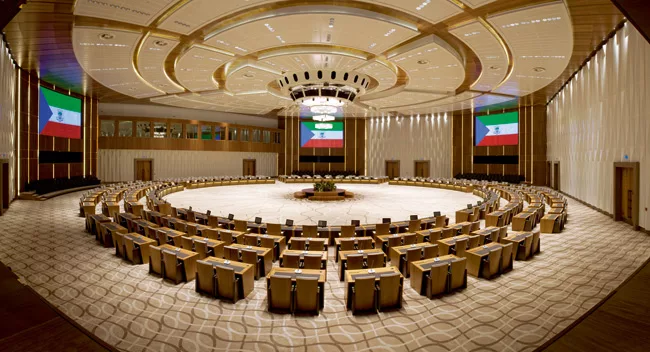
They lined sections of the central meeting hall with perforated acoustical panels.
 
Photo © Emre D'rter
Sipopo Congress Center
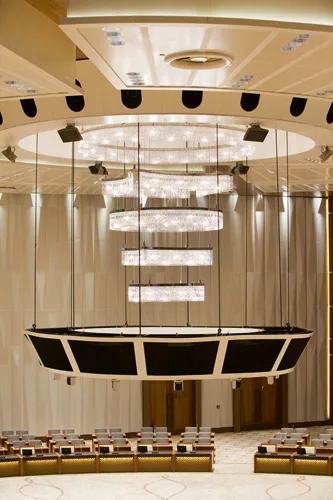
Tabanlıoğlu Architects custom-designed most of the Sipopo center’s interior finishes, including the raindrop-inspired lighting fixtures found throughout the project.
 
Photo © Emre D'rter
Sipopo Congress Center
August 16, 2012

Architects & Firms

Tabanlıoğlu Architects

Equatorial Guinea

People/Products

Firms working everywhere from China to Saudi Arabia have to navigate the often grandiose ambitions of authoritarian regimes. With the Sipopo Congress Center, Murat Tabanlıoğlu says his Istanbul-based firm used the challenge to design “a showcase” for Equatorial Guinea as an opportunity to promote peace and development across Africa. A glass box wrapped in a geometric painted aluminum screen, the project was built in 2011 to house meetings of the Assembly of the African Union, an annual gathering of heads of state from the organization's 54 member countries. Equatorial Guinea's long-ruling leader, Teodoro Obiang Nguema Mbasogo, had been struck two years earlier by the luminous hall that Tabanlıoğlu Architects designed for Tripoli, Libya, when it hosted the Assembly, and he asked the firm to create a similarly impressive structure for the Union's meetings in his country. (The Tripoli building survived the revolution that toppled Muammar Gaddafi, though work stopped on a nearby conference center there by Zaha Hadid.)

Tabanlıoğlu agreed his firm would take the commission, focusing, he says, less on working for another autocratic government than on promoting the African Union. “We were aiming to create a scene for negotiations and peace among many countries,” he says. “Nature and harmony were the elemental inspirations for the building.”

A two-story steel structure, the 148,000-square-foot congress center positions three gathering spaces and a restaurant around a central meeting hall. Raised on a plinth, it is connected by a narrow, glass-enclosed bridge to a separate, existing convention center (built by the China State Construction Engineering Corporation a few years earlier). The congress center's most distinguishing feature is the shimmering metal screen that veils its glazed facade in a curtain of geometric filigree. To be ready in time for the African Union meetings in June 2011, the entire building was designed and built in six months by Tabanlıoğlu and the large Turkish construction firm Summa. Obiang was pleased with the result. “The building was like an Olympic stadium,” says Tabanlıoğlu. “It was important for him to show it off to the other African leaders.” The building is currently used for a rotating program of conferences.

Located in the coastal curve of West Africa, Equatorial Guinea consists of three primary islands and a mainland swatch wedged between Cameroon and Gabon. The capital, Malabo, sits on the northern tip of Bioko, the largest of the islands. Obiang took power in a 1979 coup and has presided over an economic boom since the discovery of large oil reserves—estimated at 1.1 billion barrels—in the mid-1990s. The Sipopo center is part of an oceanside development on the capital city's northeastern edge that also includes a cluster of hotels and recently built infrastructure, all primarily financed by oil revenue. (Travel to Equatorial Guinea by foreigners can be difficult, and Record was unable to send a reporter to view the project in person.)

The building's glazed envelope provides views to the ocean on one side and a forest on the other. Tabanlıoğlu made preliminary sketches for the metal screen's angular bands based on the canopies of surrounding ceiba trees. “When you go there, you see buildings made by local people without architects, you see colonial buildings that came from the French and the Spanish, and you see new hotels and office buildings that look like they came from Europe and landed on the island,” he says. “It was important for us to distinguish our building by making it part of the surrounding nature.”

Working with an Istanbul fabricator, the firm made several mock-ups of the screen before settling on a series of triangular units that could be shipped to the project site and bolted to the facade. The screen's hatching is densest on the upper portions and at the angles where the equatorial sun shines most directly into the glass. The pattern becomes more open as it moves down the facade to allow unobstructed views to the landscape.

Inside, the glass-enclosed bridge from the existing convention center brings visitors into a double-height space, where a reception desk stands below an illuminated map of Africa—backlit by LEDs, its glass domes perforate a metal silhouette of the continent with a red lens indicating Malabo's location. The map hangs against a textured chevron pattern of metal and teaklike afrormosia panels that runs the length of the wall. Similar finishes designed by the firm continue in the other double-height spaces that ring the central meeting room, including a restaurant with ocean views on the north side and lounges for visiting dignitaries on the south.

At the core of the building, a box inside a box encloses the 420-seat meeting room. Rings of desks emanate from the open center of the space. Suspended from the ceiling, an array of video monitors can be raised and lowered around a tiered chandelier. Tabanlıoğlu designed it and other lighting fixtures with rainlike droplets of crystal. “Normally these conference centers are very chic places,” says Tabanlıoğlu. “We tried to find a way to incorporate natural forms with that expectation.” He and his team buried audiovisual equipment and the restaurant's back of house, as well as cooling and other mechanicals, in the building's basement and plinth.

The contractor, Summa, had to import all of the building materials—except concrete—from abroad, which forced Tabanlıoğlu to keep the constraints of shipping containers and cargo planes in mind and to do it all on the tight, six-month timeline. But the resources of Equatorial Guinea's leader kept pushing the project forward. “There were no constraints on the budget,” he says. “We don't normally work that way.”


People

Client:
Oficina Nacional de Planification Y Seguimiento de Proyectos de Guinea Ecuatorial “GE-Proyectos”

Architect:
Tabanlıoğlu Architects
Melkan Gürsel & Murat Tabanlıoğlu

Personnel in architect's firm who should receive special credit:
Architectural Project Team:
Salih Yılgörür, Ali Çalışkan, Sertaç Tümer, Utkan Yonter, Emre Çetinel, Elvin Erkut, Tugce Güleç, Selcen Tuncer Özer, Serzan Gök

Interior Design:
Tabanlıoğlu Architects
Hacer Akgun Marino, Eda Lerzan Tuçbil, Esra Çanakkale, Gonca Yılmaz, Anday Bodur,  Stajer, Banu Dasargöl

General Contractor:
ONUR-SUMMA J.V.

Landscape Consultant:
Tabanlıoğlu Architects

General Coordinator:
Envar Şayan

Project Manager:
Tamer Cevren

Engineers:
Structural Engineer:
Emir Mühendislik, Adnan Öğüt

Mechanical Engineer:
DT Mühendislik ve Taahhüt A.Ş.

Electrical Engineer:
DT Mühendislik ve Taahhüt A.Ş.

Consultants:
Fire Consultant:
Prof. Dr. Abdurrahman Kılıç

Acoustic Consultant:
STD, Sorgun Akkor

Architectural Lighting Consulting: ZKLD Studio Sound & Media Screen Systems

Consultancy:
Ateksis Dış Tic. Ltd. Şti.

Photography: Emre Dörter

Cost:

withheld

Size:

148,000 square feet (gross)

Completion date:

June 2011


Products

Exterior cladding:
Glass & Alum. Facade:
Arte Yapı Sistemleri

Metal Mesh Cladding:
Arte Yapı Sistemleri

Steel Works:
Modül Çelik / UMD

Furnishings:
Wood Works & Furniture:
Nurus

 
KEYWORDS: Africa humanitarian design

Share This Story

Looking for a reprint of this article?
From high-res PDFs to custom plaques, order your copy today!

Post a comment to this article

Report Abusive Comment

Subscription Center
  • Create an Account
  • Start a Subscription
  • Manage My Account
  • Sign Up for Newsletters
  • Visit Customer Service
  • Update Preferences

More Videos

Sponsored Content

Sponsored Content is a special paid section where industry companies provide high quality, objective, non-commercial content around topics of interest to the Architectural Record audience. All Sponsored Content is supplied by the advertising company and any opinions expressed in this article are those of the author and not necessarily reflect the views of Architectural Record or its parent company, BNP Media. Interested in participating in our Sponsored Content section? Contact your local rep!

close
  • TAMLYN XtremeTrim Exterior Trim
    Sponsored byTamlyn

    Designing Cleaner Panel Facades: Why Exterior Trim Details Matter

  • Building with Vapor Barriers
    Sponsored byReef Industries, Inc.

    Vapor Barriers Help Control Moisture in Tighter Building Designs

  • Duct Interior with Prodeq System
    Sponsored byHenry, a Carlisle Company

    Designing Resilient Water Containment Systems

DESIGN:ED Podcast
Listen to Architectural Record’s DESIGN:ED Podcast

Events

June 10, 2026

Rethinking Stormwater – The Power of Porous Paving

Credits: 1 AIA LU/HSW; 1 AIBD P-CE; 0.1 ICC CEU

Learn how porous paving systems support stormwater management, reduce heat island effects, and enhance sustainable site design performance.

June 11, 2026

Very Early Warning Fire Detection for Mission-Critical Facilities

Credits: 1 AIA LU/HSW; 1 AIBD P-CE; 0.1 ICC CEU

Examine advanced fire detection strategies that support uptime and enhance safety in data centers and other mission-critical facilities.

View All Submit An Event

Products

2026 Architect's Square Foot Costbook

2026 Architect's Square Foot Costbook

See More Products

Popular Stories

Practice Matters illustration

What’s in a (Firm’s) Name? Thinking About Succession and Legacy

Coronado Bridge

The Architect’s Guide to San Diego

Practice Matters illustration

By the Numbers: Counting America's Architects

Riverdale House by Studio Lau

Riverdale House by Studio Lau

House on a Hill

Design Vanguard 2026: Forma

Broader Sustainability of CMU - Free Webinar - May 21, 2026

Related Articles

  • El Greco Congress Center

    See More
  • El B Auditorium and Congress Hall by SelgasCano

    See More
  • Mons International Congress Xperience

    See More
×

The latest news and information

#1 Source for Architectural Design, News and Products

SUBSCRIBE
  • RESOURCES
    • Advertise
    • Contact Us
    • Submit
    • Store
  • ACCOUNT CENTER
    • Create an Account
    • Start a Subscription
    • Manage My Account
    • Sign Up for Newsletters
    • Visit Customer Service
    • Update Preferences
  • PRIVACY
    • PRIVACY POLICY
    • TERMS & CONDITIONS
    • DO NOT SELL MY PERSONAL INFORMATION
    • PRIVACY REQUEST
    • ACCESSIBILITY
  • SERVICES
    • Marketing Services
    • Reprints
    • Market Research
    • List Rental
    • Survey/Respondent Access
  • STAY CONNECTED
    • Linkedin
    • Facebook
    • Instagram
    • YouTube
    • X (Twitter)

Copyright ©2026. All Rights Reserved BNP Media, Inc. and BNP Media II, LLC.

Design, CMS, Hosting & Web Development :: ePublishing