Pearl River Tower
Towering Ambition: The architects and engineers behind an office building in rapidly expanding Guangzhou put super green before supertall.




Architects & Firms
Guangzhou, China
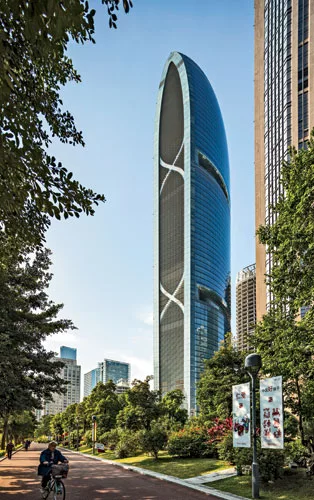
In the realm of supertall skyscrapers, the recently completed Pearl River Tower (PRT) in Guangzhou, China, isn't that tall. At 1,020 feet, it is the 59th-tallest tower in the world, and just 36 feet taller than the 300-meter (984 feet) minimum that constitutes one widely held definition of a supertall building. It isn't even the tallest in Guangzhou's new business district, where shiny office and hotel towers are arranged—much like tchotchkes on a coffee table—around a park that covers a subway station and a vast underground shopping mall.
They developed this goal well before the architecture and engineering professions had reached consensus about what the term net zero energy meant. But they say their objective was a building that generates the same amount of energy as it uses on an annual basis, taking into account the energy that is lost in power transmission. Their ambition was a tower that had no impact on overall fuel consumption, explains Roger Frechette, SOM's former mechanical engineering lead on the project and now a principal at Interface Engineering.
As it turns out, the project faced several technical and regulatory challenges that made the net zero goal elusive. Furthermore, almost all of the PRT's 71 floors remain empty, even though the tower was completed last April: the Guangdong Tobacco Corporation's planned move into 10 floors near the top of the tower, as well as the leasing of the rest of the building, is on hold as a result of a government reevaluation of its policies regarding state-owned enterprises.
But even in its currently almost empty state, the building merits a close look for its highly integrated approach to sustainability—an approach that helped the PRT earn LEED Platinum—one of only a handful of supertall towers to attain this status. According to its LEED scorecard, the building is estimated to use an impressive 44 percent less energy than a similar tower built to the American energy standard ASHRAE 90.1-2007.
Curiously, the project's competition did not call for an ultra-green, or even a sustainable or energy-efficient building. Instead, it stated that the tower should allow “nature and mankind to exist in harmony,” says Zhiming Ye, managing director Guangzhou Pearl River Tower Properties, a subsidiary of the tobacco company. The net zero target came from SOM, in part, as a means of differentiating its entry, says Frechette. The “goal galvanized the team,” he says.
In their quest for net zero, the designers questioned conventional thinking about energy efficiency. “We unpacked everything we normally assume about buildings,” says Gordon Gill, senior design architect on the project until late 2006, when he founded a new firm with Adrian Smith, also formerly with SOM.
The PRT team proposed 18 tightly coordinated strategies for shaving the tower's energy use, for recovering energy, and for generating power, using technologies that were state-of-the-art. “It wasn't that they hadn't been implemented elsewhere,” says Richard Tomlinson, SOM managing partner, “but we put them together in a way that hadn't been done before.”
The ultimately realized building has a double-story lobby handsomely outfitted with a fritted glass ceiling and suspended metal panels that reflect daylight deep into its interior. On top of this are five floors of restaurants and other amenities for workers and for visitors to an adjacent conference center, and then four zones of office floors.
The glass-clad, composite structure of concrete and steel incorporates most, but not all of SOM's originally proposed strategies. It has generally rectangular floor plates and a subtly concave south elevation, a slightly convex north elevation, and a bullet-shaped roof. The PRT is further sculpted to provide inlets or ports for what arguably is the project's only truly exotic technology—two pairs of building-integrated vertical axis wind turbines (VAWTs) inserted at floors 25 and 50.
The result is a tower that resembles an outsize smart phone or some other sleekly designed consumer electronic. But the shape is not arbitrary, insist the designers. The PRT's contours, along with its orientation (13.6 degrees off the new business district's orthogonal grid), are intended to capture prevailing southerly winds to maximize the VAWTs' electricity generation. It is also meant to make the most of the performance of photovoltaic (PV) panels that are integrated into the glazed roof and incorporated into shading louvers mounted on the narrow east and west facades. In addition, the configuration serves to minimize exposure of the broad south face to intense late-day sun. With the PRT, “form follows performance,” says Gill.
Early plans for the building included a third system for generating electricity—natural-gas-fired microturbines— on top of the two renewable-energy technologies. But even though they were essential to the net zero goal, the microturbines were one of a handful of technologies eventually eliminated from the final scheme (a geothermal heat-exchange system was also abandoned because testing revealed that the groundwater was too warm).
The microturbines proved impractical because local regulations prohibited the PRT from selling excess power back to the grid. Without them, the building is expected to produce about 332 megawatt-hours per year (132 from the VAWTs and 200 from the PVs), offsetting just a portion of its energy load.
In addition to the highly visible VAWTs and the PVs, the building incorporates less immediately apparent measures that should make substantial contributions to the building's performance. One example is a set of integrated technologies for controlling the climate on the office floors. These include a raised-floor displacement ventilation system, a double-wall facade with a 9-inch-wide cavity, and a radiant ceiling made of coved metal panels that elegantly house daylight- responsive LED lighting. The elements are designed to work in concert to keep temperatures and humidity in check, even during Guangzhou's sticky summers, but use significantly less energy than a typical variable air volume (VAV) system.
This combination of systems cools the office floors by circulating chilled water through copper tubing in the ceiling panels. It ventilates the spaces from below, through the raised floor. And, by drawing return room air through the curtain wall cavity, directing it through ceiling ducts to the air-handling units, it prevents the sun from heating up the interior surface of the facade. The use of a low-E coated insulated glazing unit for the double-skin wall's outer lite, as well as automated blinds enclosed within the cavity, also helps mitigate solar gain.
These systems are designed to deliver other benefits, in addition to saving energy. Elements such as the vaulted ceiling and the curve of the north and south facades should make for architecturally interesting work spaces once the office floors are fitted out. And features like the double-skin curtain wall should improve the occupants' comfort. Not only does it help maintain tolerable temperature and humidity levels, it also reduces the penetration of noise from the exterior. The skin provides health benefits as well, since it is less prone to air leakage than a conventional curtain wall. This is a particular concern in China's cities, where air quality is poor, points out mechanical engineer Luke Leung, an SOM director. If outdoor air does leak into the vented cavity, it is simply returned to the exhaust airstream, where it is flushed of contaminants, he explains.
The approach to cooling and ventilating the tower also helped the owner more effectively take advantage of the allowed zoning envelope. Because the PRT's climate control systems required little ductwork, the designers were able to reduce the typical floor-to-floor height by almost 12 inches without sacrificing ceiling height. This in turn permitted the addition of five floors the owner would not otherwise have been able to build.
Other features also perform double duty. For instance, the PVs on the building's west and east faces provide shade while generating electricity. The four inlets containing the VAWTs offer another example. Their shape and location were determined primarily with the aim of taking advantage of the Venturi effect to accelerate the velocity of the wind rushing through them, and therefore increase their power generation potential. However, the holes also serve to reduce the pressure differential between the building's windward and leeward facades—a phenomenon that was confirmed by wind-tunnel testing, says Shean Chien, SOM project manager. This reduction allowed the use of less steel and concrete, saving both money and embodied energy (the energy consumed in the manufacture of building materials and in construction).
This level of integration, with sustainability measures serving multiple purposes, is what makes the PRT noteworthy, even if it is—for the time being at least—almost empty, and even if it falls short of the original net zero goal. Net zero, according to many of those involved in the project, is a particularly tough mark for a tall building to reach, not to mention a supertall building.
According to Leung, as a building grows taller, it generally consumes more energy per unit area. Elevators and other building systems, such as those for plumbing and HVAC, require more power in taller structures, he explains. Several sources point to challenges on the power-generation side: skyscrapers do not offer the type of large, unobstructed horizontal surfaces that are best suited for mounting PVs.
In contrast, Frechette maintains that there is no technical reason that a skyscraper can't be net zero. However, he notes that there are important financial considerations. “Tall buildings are typically a bigger investment and therefore represent a much larger risk,” he says. “It is easier to test new ideas on a smaller scale.”
For his part, the client, Ye from Guangzhou Pearl River Properties, is clearly proud of the tower. He is especially pleased with those features, like the quality of its air, that should improve the working environment of its occupants. If he were to have the chance to build another supertall building, he says he would strive to achieve an even more sustainable design. “There is always room for improvement,” he notes. However, better energy performance would not be achieved at the expense of its users. “We'd want to make sure the building would be practical and that it would meet the functional needs of tenants.”
People
Client:
Owner:
Architect:
Personnel in architect's firm who should receive special credit:
Architect of record:
Interior designer:
Engineers:
Consultant(s):
Vertical Transportation:
Building Maintenance/Window Washing:
Lighting:
Life/Fire Safety:
Wind Tunnel Testing:
General Contractor:
Photographer(s): Size: 2.3 million square feet Cost: withheld Completion date: April 2013 |
Products
Structural system
Exterior cladding Metal/glass curtain wall: JiangHo Curtain wall: JiangHo
Windows
Glazing Skylights: Southern China Glass
Other unique products that contribute to sustainability: Chilled Ceiling System: TROX
Add any additional building components or special equipment that made a significant contribution to this project: Building Façade Maintenance System: Cox |
Looking for a reprint of this article?
From high-res PDFs to custom plaques, order your copy today!