Architectural Record
search
cart
facebook twitter linkedin youtube
  • Sign In
  • Subscribe
  • Sign Out
  • My Account
Architectural Record
  • NEWS
    • Latest News
    • Awards
    • Interviews
    • Obituaries
    • Podcasts
      • Design:Ed Podcast
      • Sponsored Podcasts
  • OPINION
    • Book Reviews / Excerpts
    • Exhibition Reviews
    • Forum
  • EXCLUSIVES
    • Videos
    • Design Vanguard
    • Top 300 Firms
    • Sponsored Content
    • Sponsored eBooks
    • From the Archives
  • CONTINUING ED
    • Editorial Continuing Ed
    • CE Center
    • CE Academies
  • PROJECTS
    • Buildings By Type
    • Reuse & Renovation
    • Museums & Arts Centers
    • Colleges & Universities
    • Multifamily Housing
    • Interiors
    • Lighting
    • Kitchen & Bath
  • HOUSES
    • Record Houses
    • House of the Month
    • Featured Houses
  • PRODUCTS
    • Products by Category
    • Record Products of the Year
    • Latest Products
  • EVENTS
    • Dates & Events
    • Record on the Road
    • Innovation Conference
    • Sustainability in Practice
    • Women In Architecture
    • Webinars
    • Ad Excellence Awards
    • Submit an Event
  • CONNECT
    • Ask RECORD AI
    • Newsletters
    • Contact
    • Advertise
    • Editorial Calendar
    • Store
    • Customer Service
  • SUBMIT
    • Submission Guidelines
    • RECORD Competitions
  • MAGAZINE
    • Subscribe
    • My Account
    • Digital Edition
    • Current Issue
    • Firm Pass
    • Historic Archive
ProjectsSpiritual Projects

Sancaklar Mosque

Call to Prayer: Using rugged materials and a modern design vocabulary, an architect creates a place of worship that connects the essence of Islam with contemporary life.
By Clifford A. Pearson
Sancaklar Mosque
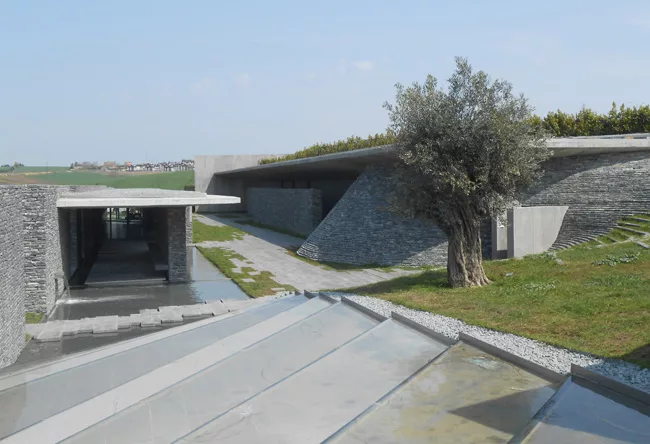
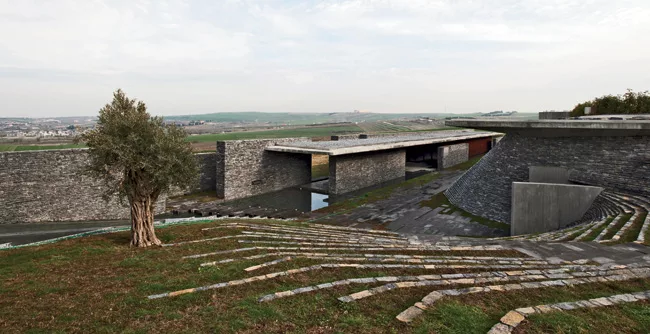
Stone steps in a hillside lead to a courtyard with a library pavilion facing the entrance to the mosque. An old olive tree adds a sense of time to the landscape.
 
Photo © Thomas Mayer
Sancaklar Mosque
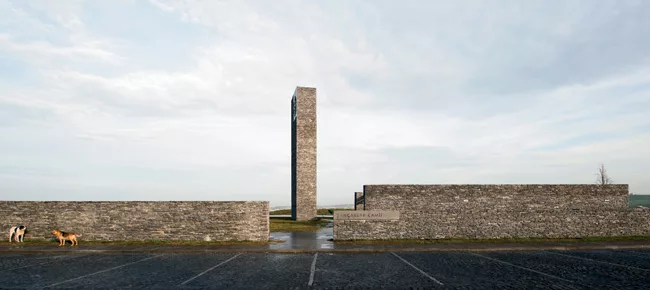
From the parking lot, only the minaret and a few stone walls are visible.
 
Photo © Thomas Mayer
Sancaklar Mosque
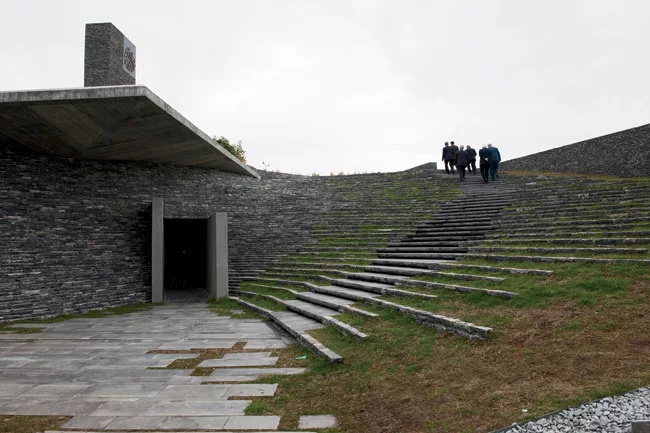
Clad in a local slate and pushed against a hillside, the mosque seems to emerge from the earth almost as a natural formation. The board-formed concrete roof serves as a canopy over the women’s entrance.
 
Photo © Thomas Mayer
Sancaklar Mosque
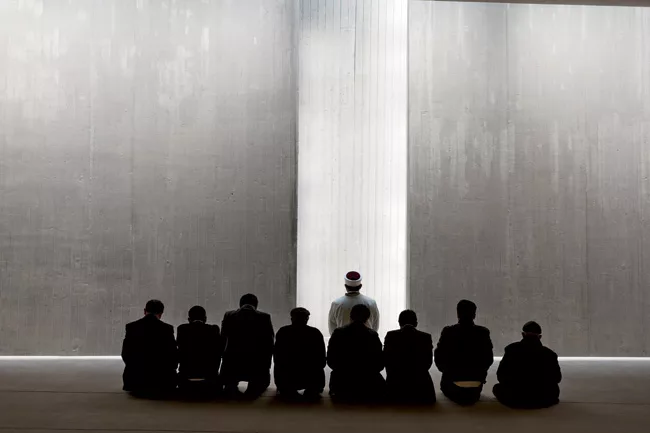
Daylight above the concrete wall facing Mecca slides in to illuminate one side of the prayer hall (right in photo), while a black glass wall perpendicular to it reflects the space.
 
Photo © Thomas Mayer
Sancaklar Mosque
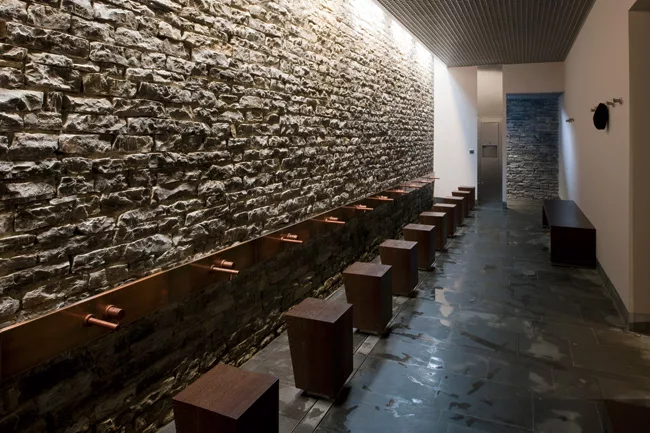
The architect used daylight streaming from above to draw special attention to important elements, such as the mihrab, or prayer niche (left), in the main hall and the ablutions area, where worshippers wash their hands and feet.
 
Photo © Thomas Mayer
Sancaklar Mosque
The architect used daylight streaming from above to draw special attention to important elements, such as the mihrab, or prayer niche, in the main hall and the ablutions area (left), where worshippers wash their hands and feet.
 
Photo © Thomas Mayer
Sancaklar Mosque
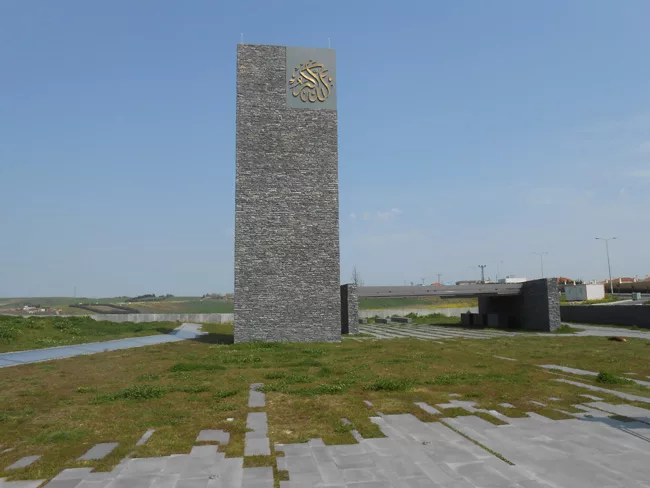
View of the minaret with calligraphy by Mehmed 'z'ay, who also did calligraphy for inside the mosque. The pergola adjacent to the minaret can provide shade during funerals.
 
Photo © Clifford Pearson
Sancaklar Mosque
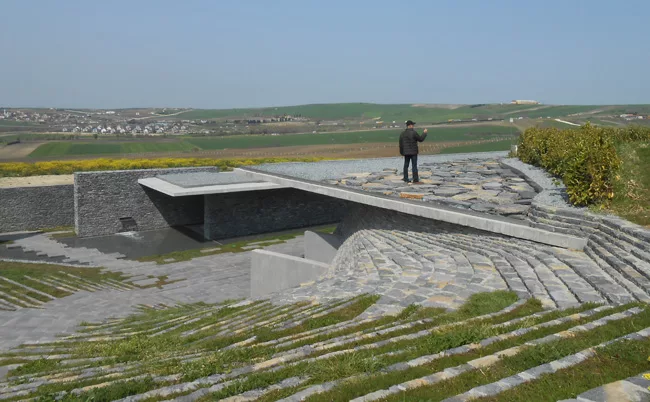
From the upper courtyard, visitors can walk on the mosque's roof and look down at the lower courtyard.
 
Photo © Clifford Pearson
Sancaklar Mosque
Water terraces cascade down the hill, while a reflecting pool surrounds the library pavilion.
 
Photo © Clifford Pearson
Sancaklar Mosque
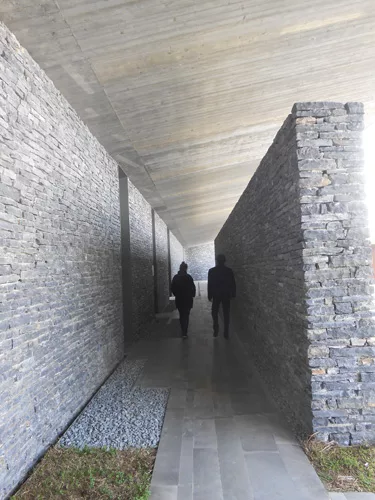
Visitors enter the mosque or the ablutions room through a stone wall on the left side of a covered corridor.
 
Photo © Clifford Pearson
Sancaklar Mosque
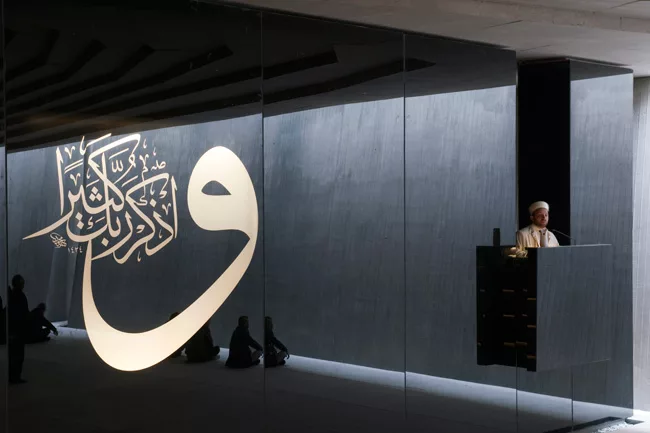
The sermon podium projects beyond a reflective black-glass wall at one end of the prayer hall.
 
Photo © Thomas Mayer
Sancaklar Mosque
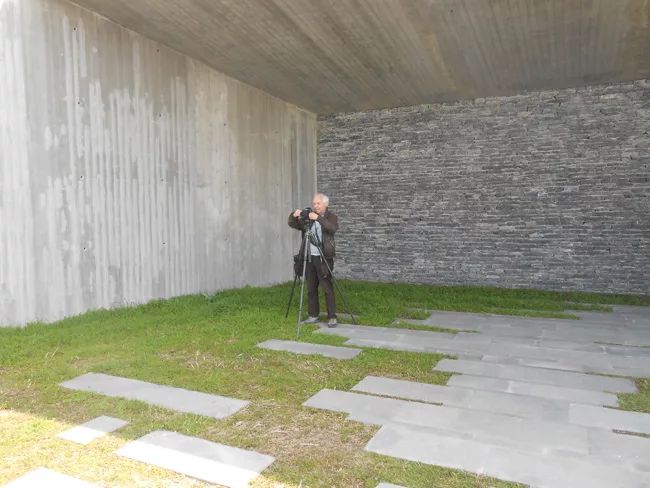
Photographer Thomas Mayer at work.
 
Photo © Clifford Pearson
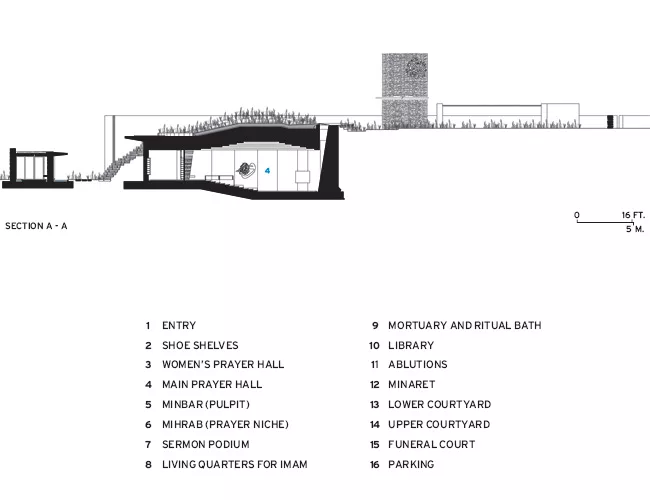
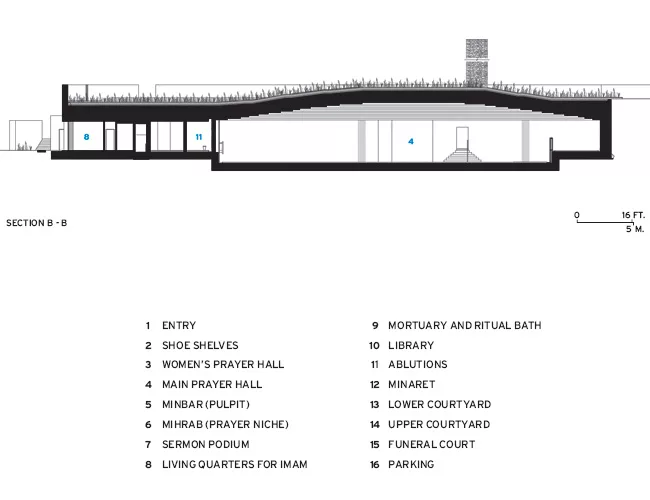
Sancaklar Mosque
Sancaklar Mosque
Emre Arolat Architects
Istanbul
Image courtesy Emre Arolat Architects
Sancaklar Mosque
Image courtesy Emre Arolat Architects
Sancaklar Mosque
Image courtesy Emre Arolat Architects
Sancaklar Mosque
Image courtesy Emre Arolat Architects
Sancaklar Mosque
Sancaklar Mosque
Sancaklar Mosque
Sancaklar Mosque
Sancaklar Mosque
Sancaklar Mosque
Sancaklar Mosque
Sancaklar Mosque
Sancaklar Mosque
Sancaklar Mosque
Sancaklar Mosque
Sancaklar Mosque
Sancaklar Mosque
Sancaklar Mosque
Sancaklar Mosque
Sancaklar Mosque
May 16, 2014

Architects & Firms

Emre Arolat Architecture

Istanbul

People/Products

In most of the Muslim world, the dome and minaret signify the mosque, acting as symbols that transcend linguistic and cultural barriers. In Istanbul, with its haunting skyline of historic domes and towers, the association between these traditional forms and religion is especially strong. So Emre Arolat’s design strategy for the Sancaklar Mosque on the outskirts of the city challenged long-held assumptions and popular images. “We wanted to get rid of the form,” says Arolat, the 50-year-old Istanbul-based architect who set up his own firm with Gonca Paşolar in 2004, after working in his parents’ practice since 1987. His parents—Neşet and Şaziment—have since joined Emre Arolat Architects (EAA), keeping the business a family affair.

For this, the firm’s first mosque, Arolat, a nonobservant Muslim, relied on primary elements—strong materials like stone and concrete, contrasts of shadow and light, and an integration of building and site. The result is a simple but powerful place with a calm heart that encourages contemplation and prayer. At a time when conservative factions in Turkey are favoring buildings that look back to Ottoman sources, Arolat’s affirmation of Modernism as a basis for contemporary Turkish architecture makes an important statement.

Though not known for religious buildings, Arolat had designed two housing projects in Izmir for the Sancaklar family, the developers whose nonprofit foundation commissioned the mosque. Set adjacent to new gated communities and overlooking Çekmece Lake, in a suburban area 15 miles west of Istanbul’s historic core, the project straddles the boundary between the man-made and the natural. Across the road sit neo-Mediterranean houses and a shopping mall one might find in southern California. In the other direction, open fields slope down to the lake. Dealing with this awkward edge condition drove much of the design process.

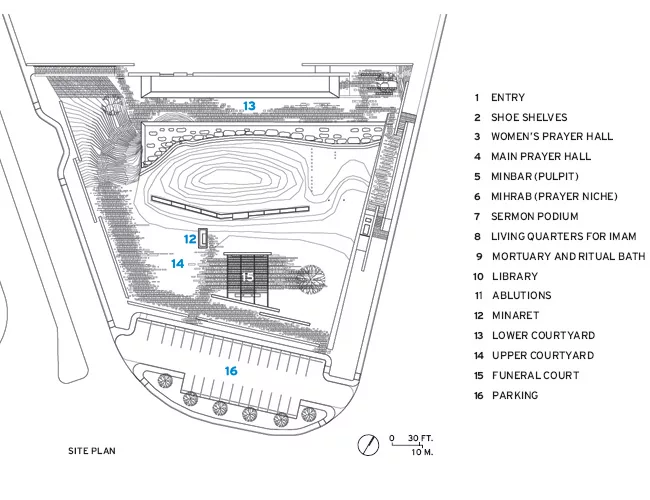
“We realized that if we adjusted the topography just a little, we could make the building a part of the land,” says Arolat. So he and his team inserted the 13,000-square-foot mosque in the side of the hill and erected a series of freestanding stone walls to buffer it from the adjacent road and parking lot. Leaving their cars, worshippers walk through one of two openings in a 4-foot-high, slate-clad wall and into a courtyard on the upper portion of the property. A canvas covering can be pulled along a steel pergola here to create a shaded space for funerals. The courtyard—partially paved with the same gray kayrak slate as the walls, though given a smooth finish—extends out to the lake, acting as an open terrace from which to enjoy the view.

From the street and the courtyard, the only enclosed structure visible is a rectangular minaret—also made of kayrak stone. To find the mosque proper, you need to walk down slate steps embedded in the grassy hillside, then go along a lower courtyard lined in the back with cascading water terraces flowing into a long reflecting pool. The sound of moving water helps block out any noise from the street, enveloping the outdoor space in a calming aural blanket.

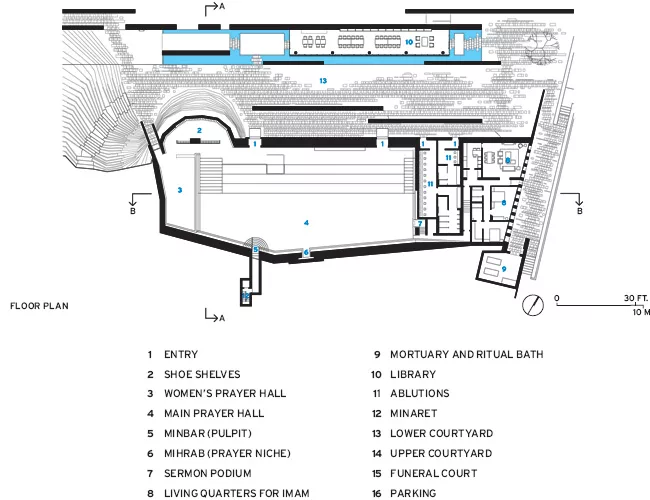
On the north side of the courtyard, a long pavilion that serves as a library and meeting space seems to float above the reflecting pool. On the south, the mosque itself beckons quietly to worshippers—a poured-concrete slab roof emerging from the hillside to form a welcoming canopy and, at one end, a steeply raked curving stone wall, bulging mysteriously and looking a bit out of place. Women enter the prayer hall through a portal announced by a pair of concrete walls projecting out to the courtyard, while men walk along an outdoor corridor defined by a freestanding stone wall underneath the mosque’s gently sloped concrete canopy. Almost hidden and utterly simple, the main entry expresses a humility that goes to the core of the project.

Instead of looking to the soaring spaces and elaborate geometric ornamentation of Ottoman-era mosques, Arolat found inspiration in the Cave of Hira, in present-day Saudi Arabia, where the Prophet Muhammad received the first revelations of the Quran. “We wanted to get away from any sense of spectacle, and reach the essence of the ritual of prayer,” says the architect. The prayer hall is a long 700-square-foot open space with plain gray carpeting; one of its main walls is surfaced with the ever-present slate, and the other is made of poured concrete. These facing walls slope almost imperceptibly in the same direction, adding a subtle motion that echoes angled bodies bowing in devotion. At one of the short ends of the hall, a perforated metal screen separates women from men, while at the other, a glass wall painted black on the back reflects the image of the space and the worshippers in it. A piece of modern calligraphy by Mehmed Özçay glows from the black wall, its bold letters done in clear glass and lit from behind.

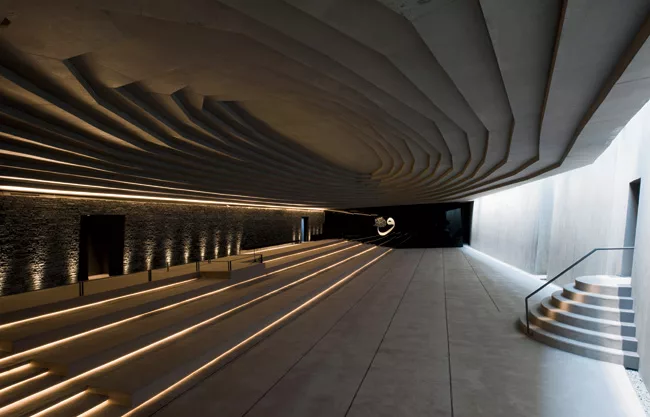
Swirling above the sanctuary, a vortex of stepped concrete layers forms the ceiling. Shaped like contour lines on a topographic map, the ceiling recalls both a cave and a shallow dome, but in an abstract way. To erect the complex ceiling, the contractor used hundreds of CNC-milled wood forms for the poured concrete and attached it to the rest of the building’s concrete frame with a set of beams running above the prayer hall.

Eschewing decoration other than the roughly textured slate and the smooth concrete imprinted with the grain of its wood formwork, the architects at EAA used daylight to add drama to the interiors. The boldest example of this is the narrow skylight running above and illuminating the prayer hall’s south wall, or qiblah, which faces Mecca. The concrete beams supporting the sanctuary ceiling run below this skylight, separating the flow of light into shafts at certain times of the day.

At most mosques, worshippers leave their shoes at the entrance. But here, Arolat got the footwear out of sight by tucking shoe shelves behind the curving stone wall that bulges out toward the lower courtyard. It may be a small move, but it’s indicative of a larger effort to use minimalism to shape a contemplative place. Ali Elmaci, the imam of the mosque, appreciates the architect’s effort to hone the building to its essentials. “There are no distractions to the worshippers,” says the imam. “You have a closer, more peaceful relationship with the Creator.”


People

Owner:
Republic of Turkey Presidency of Religious Affairs

Architect:
Emre Arolat Architects,
Nispetiye Mah. Aytar Cad. No: 24 Floor 3-4
34340 1.Levent
Istanbul, TR
Tel: +90 212 284 7073
Fax: +90 212 284 7063

Architect of record:
Emre Arolat

Associate architect(s):
Emre Arolat, Uygar Y'ksel, Leyla Kori, Nil Aynali, Fatih Tezman, Nurdan G'rlesin

Engineers:
Structural:
Balkar Engineering

Mechanical:
Setta Engineering

Electrical:
HB teknik

Consultant(s):
Landscape:
Emre Arolat Architects, Medosa

Lighting:
SLD ' Piero Castiglioni

Acoustical:
Sey Consulting

General contractor:
Sancaklar Foundation

Photographer(s):
Cemal Emden
Thomas Mayer

Calligraphy:
Mehmed 'z'ay

Size:

13,000 square feet

Construction cost:

$1.125 million

Completion date:

January 2014


Products

Structural system
Concrete

Exterior cladding
Masonry:
Boyut Yapi Mimarlik

Moisture barrier:
Detay Yapi

Curtain wall:
'zcem Yapi

Windows
Metal frame:
BSM Aluminium

Glazing
Glass:
BSM Aluminium

Doors
Entrances:
Natural Ahsap

Wood doors:
Natural Ahsap

Interior finishes
Cabinetwork and custom woodwork:
Bay Ahsap

Paints and stains:
Boyut Yapi

Solid surfacing:
BMG

Carpet:
Golden Hali

Furnishings
Chairs:
Koleksiyon Mobilya

Tables:
Koleksiyon Mobilya

Lighting
Downlights:
Vetas Electric & Lighting

Task lighting:
Vetas Electric & Lighting

Exterior:
Vetas Electric & Lighting

Dimming System or other lighting controls:
Vetas Electric & Lighting

Conveyance
Accessibility provision:
MER Asans'r

Add any additional building components or special equipment that made a significant contribution to this project:
Timber formwork:
Peri Kalip

 
KEYWORDS: Istanbul Turkey

Share This Story

Looking for a reprint of this article?
From high-res PDFs to custom plaques, order your copy today!

Cliff portrait 2 0t5a1761 0031

Contributing editor Clifford Pearson is the co-author, with A. Eugene Kohn, of The World By Design, and writes about architecture and urbanism.

Post a comment to this article

Report Abusive Comment

Subscription Center
  • Create an Account
  • Start a Subscription
  • Manage My Account
  • Sign Up for Newsletters
  • Visit Customer Service
  • Update Preferences

More Videos

Sponsored Content

Sponsored Content is a special paid section where industry companies provide high quality, objective, non-commercial content around topics of interest to the Architectural Record audience. All Sponsored Content is supplied by the advertising company and any opinions expressed in this article are those of the author and not necessarily reflect the views of Architectural Record or its parent company, BNP Media. Interested in participating in our Sponsored Content section? Contact your local rep!

close
  • cold storage facility
    Sponsored byCarlisle SynTec Systems

    How Architects Can Design More Continuous Cold Storage Envelopes

  • TAMLYN XtremeTrim Exterior Trim
    Sponsored byTamlyn

    Designing Cleaner Panel Facades: Why Exterior Trim Details Matter

  • Building with Vapor Barriers
    Sponsored byReef Industries, Inc.

    Vapor Barriers Help Control Moisture in Tighter Building Designs

DESIGN:ED Podcast
Listen to Architectural Record’s DESIGN:ED Podcast

Events

June 25, 2026

Designing Glass Railing Systems that Enhance Aesthetics and Meet Code

Credits: 1 AIA LU/HSW; 1 AIBD P-CE; 0.1 ICC CEU

Upon course completion, participants will possess a deeper understanding of glass railings to help ensure that safety, aesthetic, and performance objectives are achieved.

June 30, 2026

Generator Selection and Sizing for Outage-Ready Homes

Credits: 1 AIA LU/HSW; 1 AIBD P-CE; 0.1 ICC CEU

Explore how propane-powered systems and whole-home generators can improve energy resilience, reduce electrical loads, and lower long-term residential costs.

View All Submit An Event

Products

2026 Architect's Square Foot Costbook

2026 Architect's Square Foot Costbook

See More Products

Popular Stories

Lorcan O' Herilhy

California Architect Lorcan O’Herlihy Has Died, Age 66

Obama Presidential Center, Chicago

The Obama Presidential Center Opens on Chicago’s South Side

Spoonbill Ranch

Johnsen Schmaling Architects Integrates Spoonbill Ranch into a Pristine Landscape

Image of Bruce Springsteen Center for American Music

The CookFox-designed Bruce Springsteen Center for American Music Opens in New Jersey

Three Courtyards House

Design Vanguard 2026: Balsa Crosetto Piazzi

Designing Glass Railing Systems that Enhance Aesthetics and Meet Code - Free Webinar - June 25, 2026

Related Articles

  • Jumaa Mosque

    Jumaa Mosque and Sacred Heart Cathedral by John McAslan + Partners

    See More
  • Baitul Futuh Mosque

    A Campus Revamp Brings Renewed Optimism to Worshippers at London’s Baitul Futuh Mosque

    See More
  • Thom Mayne, SOM Admired by Developer of Controversial NYC Mosque

    See More

Related Products

See More Products
  • Architectural Record - December 2025

    Architectural Record Decvember 2025 Issue

  • manual

    2026 National Building Cost Manual

  • bni book

    BNi Building News Remodeling Costbook 2026 (Print Edition)

See More Products
×

The latest news and information

#1 Source for Architectural Design, News and Products

SUBSCRIBE
  • RESOURCES
    • Advertise
    • Contact Us
    • Submit
    • Store
  • ACCOUNT CENTER
    • Create an Account
    • Start a Subscription
    • Manage My Account
    • Sign Up for Newsletters
    • Visit Customer Service
    • Update Preferences
  • PRIVACY
    • PRIVACY POLICY
    • TERMS & CONDITIONS
    • DO NOT SELL MY PERSONAL INFORMATION
    • PRIVACY REQUEST
    • ACCESSIBILITY
  • SERVICES
    • Marketing Services
    • Reprints
    • Market Research
    • List Rental
    • Survey/Respondent Access
  • STAY CONNECTED
    • Linkedin
    • Facebook
    • Instagram
    • YouTube
    • X (Twitter)

Copyright ©2026. All Rights Reserved BNP Media, Inc. and BNP Media II, LLC.

Design, CMS, Hosting & Web Development :: ePublishing