Jumaa Mosque and Sacred Heart Cathedral by John McAslan + Partners
Doha, Qatar and Kericho, Kenya

Jumaa Mosque
A freestanding minaret, nearly 83 feet tall, signals the mosque’s presence.
Photo © Hufton + Crow

Jumaa Mosque
In the courtyard, filigreed cast-bronze doors are amplified by similarly patterned carved-stone surrounds.
Photo © Hufton + Crow

Jumaa Mosque
Both the sacred Qibla wall and the skylit “veil” over- head integrate layers of CNC-cut wood panels. Females occupy the screened mezzanine.
Photo © Hufton + Crow

Jumaa Mosque
Leading from the courtyard into the prayer hall are two layers of doors: a grand, perforated bronze pair, followed by a set of solid, but similarly patterned, inner ones.
Photo © Hufton + Crow

Sacred Heart Cathedral
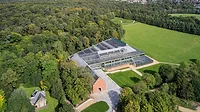
The cathedral is in a lush tea-growing area.
Photo © Edmund Sumner

Sacred Heart Cathedral
Nairobi bluestone wraps an outside end of the sanctuary. The separate bell tower, clad in terrazzo, reuses the bell from the congregation’s previous church.
Photo © Edmund Sumner

Sacred Heart Cathedral
Congregants spill from the side-aisle portals after services. Overflow turnout can be accommodated for Mass on the terraces.
Photo © Edmund Sumner

Sacred Heart Cathedral
The altar’s wood crucifix is made from a podocarpus tree that was felled to clear the site for the cathedral.
Photo © Edmund Sumner

Jumaa Mosque & Sacred Heart Cathedral
Image courtesy John McAslan + Partners

Jumaa Mosque & Sacred Heart Cathedral
Image courtesy John McAslan + Partners
Architects & Firms
At two very different houses of worship—the Jumaa Mosque, in urban Qatar, and the Sacred Heart Cathedral, in rural Kenya—there’s a moment of revelation at the threshold of sacred space. That critical transition from the outside world “can be awe-inspiring,” says architect John McAslan, whose London-based firm, John McAslan + Partners (JM+P), recently completed both projects. “Yet it’s not about ostentation, but about something far more humble and profound.”
At Jumaa, the journey inward—physically and spiritually—proceeds from traffic-filled streets in the labyrinthine historic core of Doha, the Qatari capital, an area currently undergoing extensive regeneration (including JM+A’s renovation of historic houses around the Jumaa site). Signaling the sacred building’s presence is a freestanding minaret, nearly 83 feet tall and unadorned except for a ring of carved screens near its base. Clad in the same pale, luminous Omani limestone as the minaret is the mosque itself, ornamented solely with recessed, geometrically patterned, cast-bronze entryway panels: a discreet glint suggesting the inner realm. Otherwise, all that punctuates the 50,000-square-foot structure’s simple massing—two rectangular volumes joined by a courtyard—are a few essential openings and the shadow-casting rhythms of rectangular columns and roof-edge castellation. Yet this quiet, balanced composition has a powerful, serene presence.
The route for worshipers follows an axial sequence largely prescribed by Islamic ritual. Here, each successive space, leading from ablution and shoe-removal areas to the prayer hall, seems calmer and more contemplative than the last. As is typical of mosques, male-female segregation was required, with separate entrances. At Jumaa, men cross a courtyard, centered on a reflecting pool, before reaching the sanctuary portal.
Accentuating this threshold’s significance are geometrically filigreed cast-bronze doors, 23½ feet tall, amplified by similarly patterned carvedstone surrounds. The 16,200-square-foot prayer hall is nearly cubic, precisely echoing the courtyard’s proportions. Within the inner sanctum, this outwardly austere stone box glows, its boundaries simultan- eously defined and dematerialized by daylight filtering through the ceiling’s delicate wood veil. The carpeting is printed with a pattern of rows indicating individual prayer mats. Directly ahead is the hallowed and intricately carved Qibla wall, oriented toward Mecca, with the imam, the worship leader, near its center. (The women’s mezzanine, screened yet included in the larger space more than at most mosques, overlooks the prayer hall and the imam.) CNC-fabrication of layered ornamental surfaces—for the Qibla wall, ceiling screen, minaret, and portals—taps into local 21st-century practices, combining modern technology with ancient craft.
Creating a “specifically Qatari mosque—not a generic or even just a Gulf one—was important,” says project director Fanos Panayides. Here, traditions of sparse exterior decoration and pure form dovetailed with JA+P’s clean-lined modernism. “Qatari mosques,” Panayides adds, “have changed little over time, retaining a simplicity that most closely represents the Prophet Muhammad’s own [courtyard] house.”
Ritual—and the specific context of culture and place—also had architectural implications for Kericho’s Sacred Heart Cathedral, a church as rooted in Kenya’s Great Rift Valley as the Jumaa Mosque is in historic Doha. About 155 miles northwest of Nairobi, Kericho is a hilly tea-growing area, where a large, vibrant Roman Catholic population had made the most of a dilapidated church-hut. Then, a miracle happened: a family from abroad anonymously gave the community a reported $3 million to build a cathedral there.
Completed in late 2015, the lofty hillside cathedral is a landmark from afar, with its separate bell tower and huge, uptilted gable roof. Seen closer in, its locally made clay roof tiles reveal patterns echoing nearby fields, and it becomes clear how the building is embedded in, almost stitched into, this lush landscape. Tiered terraces extend outward under deep eaves that bend from the pitched roof like a fedora’s brim. Exterior grandeur comes from the 45,000-square-foot building’s scale and expressive riff on a familiar form, rather than ornamental flourishes. This humility reflects not only frugality in budgeting—though low construction costs made it possible “to do a lot here with a little,” as project leader Peter McLaughlin says—but also the desire to harmonize with the surrounding structures built with a modesty of means.
Looking for quick answers on architecture and design topics?
Try Ask RECORD, our new smart AI search tool.
Ask RECORD →
Inside, an unpretentious majesty reveals itself with a crescendo more unabashedly exuberant than the mosque’s culminating thresholds. “Bishop [Emmanuel] Okombo wanted the cathedral to embrace the community with open arms—with the intimacy of a family at a dinner table,” recalls McAslan. “He envisioned a strong visual and physical connection between congregants and the altar.” So, in plan and section, the sanctuary expands toward the altar, splaying in width and ascending in height, as its succession of concrete arches—an exposed structural skeleton analogous to Gothic vaults—telescopes down the nave. The pews, accommodating 1,000 seated, are radial. Running the length of the central aisle, a skylight filters rays through rustic cypress screens (recalling—yet distinct from—the mosque’s overhead radiance).
With operable louvers, the cathedral’s skylight refreshes its vast, non-air-conditioned interior with a natural stack effect. Double side-aisle doors in each structural bay also open the sanctuary to cross breezes, views, birdsong, and overflow crowds. (Similarly, in the mosque’s protected courtyard, Qatari limestone paving extends the prayer-rug rows outside.) And to accommodate Kericho’s “extraordinarily colorful, flamboyant, and joyful celebration of the Mass,” as McLaughlin describes it, the architects created “wide aisles and ample space for even the choir to dance.”
As at Jumaa, the design also drew on such place-specific influences and resources as regional materials and construction methods and traditionally sustainable measures (as with airflow). The cypress for the ceiling was harvested from the nearby Finlays tea plantation, which also runs a timber business. “And concrete is one of the things they do best here,” says McLaughlin, “but we pushed them farther than they’d ever taken it.”
The cathedral is, however, intentionally lower in tone than typical churches in the area. “We chose to accommodate ornamental flamboyance more through artwork than architecture,” explains McLaughlin. (An example is the long exterior-wall mosaic by regional Rastafarian artists, portraying the creation narrative with fragments of construction- waste stone.)
Before building the Jumaa Mosque and Kericho cathedral, JM+P’s only prior “sacred architecture” had been the renovation of a Quaker meetinghouse in Britain. But beyond their disparate contexts and circumstances, these sacred spaces share essential aspects, says McAlsan (whose firm is now designing Western Europe’s largest mosque). “It’s the aspiration to have nothing be superfluous. Everything is there for a purpose: authentic, practical, legible, and symbolic. It’s a sense of solidity and permanence with, at the same time, fleeting qualities of light and space.” Perhaps within that paradox of what is both substantial and ethereal, we experience the intangible, the ineffable, and the sublime.
PeopleArchitect: John McAslan + Partners 7-9 William Road, London, NW1 3ER Executive Architect: Triad Architects (Sacred Heart Cathedral)
Engineers: Arup, Eng Plan, EAMS (Sacred Heart Cathedral)
Jumaa MosquePersonnel in architect's firm who should receive special credit: Project Director: Fanos Panayides (Project Leader) / Registered Architect Engineers: Project Manager:TiME Qatar Local Consultant: Arab Engineering Bureau Photographer: Hufton + Crow
Sacred Heart CathedralExecutive Architect Triad Architects Ltd TRIAD HOUSE Personnel in architect's firm who should receive special credit: Peter McLaughlin (Project Leader) - Registered Architect Engineers: Structural Engineers: Eng Plan (Kenya) Photographer:
Sumner Partnership Ltd - Edmund Sumner - 07957 141018 |
ProductsJumaa MosqueExterior Cladding Masonry: Sultan Beige Limestone, Nassar Stone, Oman Metal panels: Cast bronze metal screens, doors and panels, AIL Industries, Wood: All joinery custom made - Almana Maples, Qatar Windows Wood frame: Schueco framing, Schueco UK Limited Glazing Glass: Saint Gobain Glazing Doors Entrances: All joinery custom made - Al Mana Maples, Qatar Hardware Other special hardware: Scott Bevan, Giesse Interior Finishes Cabinetwork and custom woodwork: All joinery custom made - Al Mana Maples, Qatar Solid surfacing Wall coverings: Earth Plaster finish to prayer hall walls, cast bronze Mirhab Floor and wall tile: Floor tiles - Sultan Beige Limestone, Nassar Stone, Omani Carpet: Specialist mosque carpet - Desso Raised flooring: Partitions - Expamet, Gyproc Special interior finishes unique to this project: Partitions - Expamet, Gyproc Lighting Interior ambient lighting: Interior lighting - Zumtobel Exterior: Exterior lighting - Iguzzini Energy Add any additional building components or special equipment that made a significantcontribution to this project: Vertical Transport - Kone
Sacred Heart CathedralStructural System Concrete frame and with concrete shear walls and cut stone hand laid block infill panels Exterior Cladding Wood: Findlays milled the wood into rough sizes – the ceiling work which is a major component was fabricated and erected by H-Tes Roofing Built-up roofing: Tiles by Kenya Clayworks Windows Wood frame: Ironart Doors Entrances: H –TES – timber doors Stained Glass and Artworks: John Clark, Glasspainter (Germany) Interior Finishes Acoustical ceilings: Acoustic System Demountable partitions: Esteel in blockwork but very little Cabinetwork and custom woodwork: Ebony Timber Designs which included the pews Floor and wall tile: Esteel cut from natural stone. Granite surfaces on Sacristy by Kenya Marble Raised flooring: Washed terrazzo finish by Jeen Construction Ltd Special interior finishes unique to this project: Washed terrazzo finish by Jeen Construction Ltd Furnishings Other furniture: Ebony – Altar by Kenya Marble to designs by the architects Lighting Lighting (interior and exterior) - Mehta Electrical – principle electrical contractors. |
Looking for a reprint of this article?
From high-res PDFs to custom plaques, order your copy today!