Architectural Record
search
cart
facebook twitter linkedin youtube
  • Sign In
  • Subscribe
  • Sign Out
  • My Account
Architectural Record
  • NEWS
    • Latest News
    • Awards
    • Interviews
    • Obituaries
    • Podcasts
      • Design:Ed Podcast
      • Sponsored Podcasts
  • OPINION
    • Book Reviews / Excerpts
    • Exhibition Reviews
    • Forum
  • EXCLUSIVES
    • Videos
    • Design Vanguard
    • Top 300 Firms
    • Sponsored Content
    • Sponsored eBooks
    • From the Archives
  • CONTINUING ED
    • Editorial Continuing Ed
    • CE Center
    • CE Academies
  • PROJECTS
    • Buildings By Type
    • Reuse & Renovation
    • Museums & Arts Centers
    • Colleges & Universities
    • Multifamily Housing
    • Interiors
    • Lighting
    • Kitchen & Bath
  • HOUSES
    • Record Houses
    • House of the Month
    • Featured Houses
  • PRODUCTS
    • Products by Category
    • Record Products of the Year
    • Latest Products
  • EVENTS
    • Dates & Events
    • Record on the Road
    • Innovation Conference
    • Sustainability in Practice
    • Women In Architecture
    • Webinars
    • Ad Excellence Awards
    • Submit an Event
  • CONNECT
    • Ask RECORD AI
    • Newsletters
    • Contact
    • Advertise
    • Editorial Calendar
    • Store
    • Customer Service
  • SUBMIT
    • Submission Guidelines
    • RECORD Competitions
  • MAGAZINE
    • Subscribe
    • My Account
    • Digital Edition
    • Current Issue
    • Firm Pass
    • Historic Archive
ProjectsBuildings by TypeWood Projects

Soft House by Kennedy & Violich Architecture

Hamburg, Germany
By Hugh Pearman
Soft House
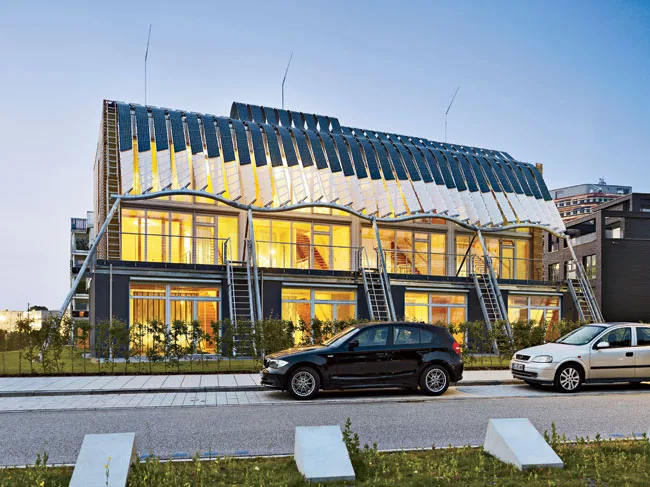
The Soft House’s flexible PV-shading ribbons, which rotate and twist to track the path of the sun, allow the extensive use of glass on the south facade.
 
Photo © Michael Moser
Soft House
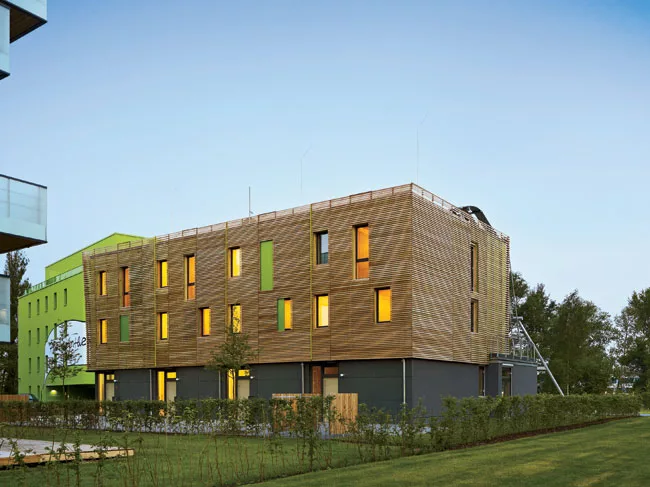
The building’s other, mostly solid, elevations are clad primarily with open-jointed Douglas-fir slats and contain small windows protected by sliding aluminum shutters.
 
Photo © Michael Moser
Soft House
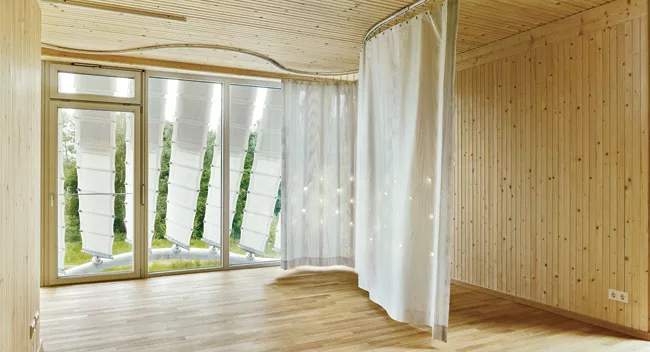
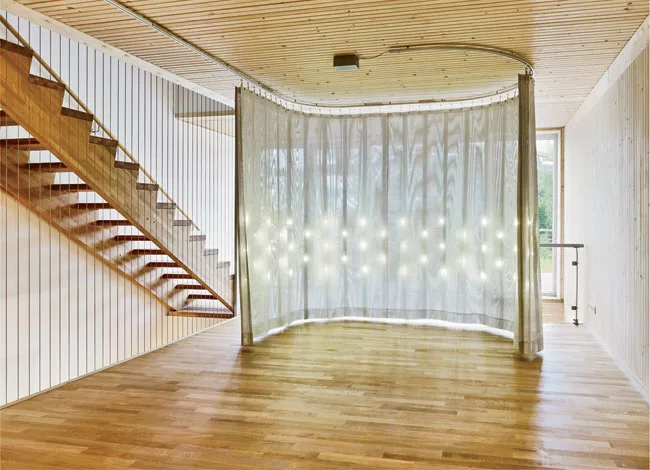
The solid-wood structural system, made of spruce pieces pegged together, serves as the finished ceilings and walls, reducing the need for other materials such as drywall. Interior curtains, which have integrated LEDs, are powered by DC current supplied by the PV ribbons that rise from the houses’ terrace level, visible out the window.
 
Photo © Michael Moser
Soft House
The solid-wood structural system, made of spruce pieces pegged together, serves as the finished ceilings and walls, reducing the need for other materials such as drywall. Interior curtains, which have integrated LEDs, are powered by DC current supplied by the PV ribbons that rise from the houses’ terrace level, visible out the window.
 
Photo © Michael Moser
Soft House
Image courtesy Kennedy & Violich Architecture (KVA Matx)
Soft House
Image courtesy Kennedy & Violich Architecture (KVA Matx)
Soft House
Image courtesy Kennedy & Violich Architecture (KVA Matx)
Soft House
Soft House
Soft House
Soft House
Soft House
Soft House
Soft House
July 16, 2014

Architects & Firms

Kennedy & Violich Architecture

People/Products

The Hamburg IBA (for International BauAustellung, or “building exhibition”) is the latest iteration of a long-running German tradition: a showcase of experimental housing, intended to display new thinking in domestic architecture but built to be permanent and sold on the open market. In Hamburg's case, the aim was to demonstrate how the city could expand in a sustainable fashion into the relatively underdeveloped Elbe islands. These are separated from the city center by HafenCity, the docklands that are being transformed into a mixed-use neighborhood. The Soft House, by the KVA Matx team led by Boston-based Kennedy and Violich Architecture, couples a traditional solid softwood-construction technique with advanced technology, expressed in its architectural form.

The Soft House is in fact four rowhouses, each about 2,100 square feet, intended as live-work units and designed to exceed the Passivhaus standard (a rigorous performance standard for very low-energy buildings). As you walk into this new part of the Wilhelmsburg district (where both this part of the IBA and a garden festival, another popular German tradition, were held last year), you see Soft House's distinction from the orthogonal blocks of the other demonstration apartment buildings. They are generally four or five stories tall, while Soft House rises only three stories. But its most unusual feature is its undulating carapace–comprising tensioned ribbons of flexible photovoltaic (PV) panels at the top and solar-shading mesh lower down–described as “energy-harvesting textile cladding” by the architects.

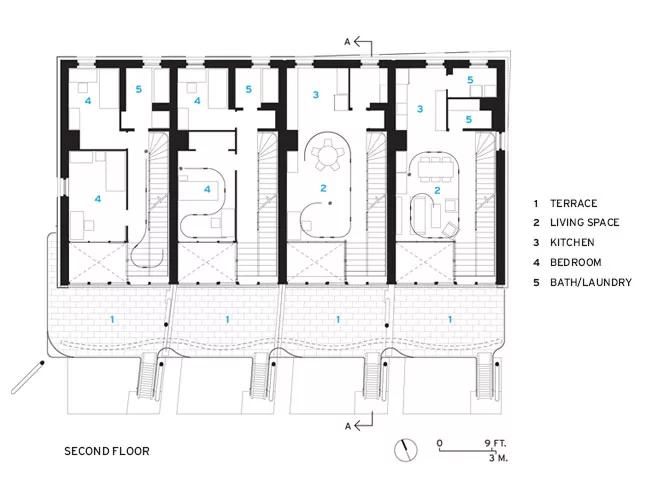
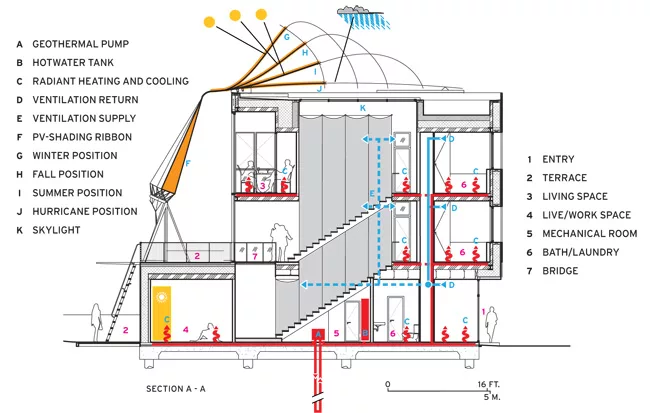
The cross-section of a typical unit is L-shaped, with a deep ground floor giving way to shallower upper floors, providing each house a section of a shared second-floor terrace. The architects' aim was to allow for flexibility: the ground floor could be a workspace, for instance, entered from the rear, since exterior steel stairs provide separate access from the small front gardens to the terrace level.

The garden side of the Soft House is partially enclosed by the PV ribbons, which are mounted on a beefy steel armature rising from the terrace and tensioned by fiber- reinforced composite boards anchored at roof level. Servo motors rotate the ribbons to follow the course of the sun, while pistons adjust the overall geometry of the array, pulling it flat to the roof during high winds.

The shading and energy-generating ribbons allow the extensive use of south-facing glass, maximizing the penetration of daylight while minimizing heat gain and glare. In addition to the PVs, the Soft House has ground-source heat pumps, convection ventilation via an atrium, and heat recovery. These features, combined with super-insulation and triple glazing, produce a building that is so efficient it can export electricity. The brettstapel jointed softwood panel and deck construction also contributes to the building's green credentials: it sequesters carbon and, because it is exposed on the interior, serves double duty as both structure and interior-finish material. Since it is pegged together, without glue or nails, it can readily be recycled at the end of the building's life.

Although demonstration-housing enclaves are not always commercially viable, the German model seems to work well enough and includes some concessions to the demands of the market. For instance, these houses are organized in a familiar suburban layout with ample provision for cars, both in open-air lots and garages. Now that the exhibition is officially over, families are moving in; one of the houses at the end of the Soft House row is looking comfortably lived in, its terrace bedecked with potted plants and a bird feeder.

Perhaps the greatest achievement of the Soft House is that it feels like a very adaptable home rather than an experiment in ultra-insulation. “Although there are innovations of a technical nature in the Soft House, the most important innovation is that of creating a lifestyle experience for low-carbon living,” says Sheila Kennedy, KVA principal. “The infrastructure is not hidden,” she says. “It is transformed and made materially soft to take on a responsive, space-making role as part of the architecture.” As to the durability of this moving soft shell, time will tell how well it responds to the needs of residents and to changing technology.

Hugh Pearman is architecture critic of the Sunday Times, London, and editor of the Riba Journal.


People

Formal name of building: Soft House

Location: Hamburg, Germany

Client: International BauAustellung (IBA); PATRIZIA Projektentwicklung GmbH

Owner: PATRIZIA Projektentwicklung GmbH

Architect:
Kennedy & Violich Architecture (KVA Matx)
10 Farnham Street
Boston, MA 02119
617-442-0800
617-442-0808

Personnel in architect's firm who should receive special credit:
Sheila Kennedy AIA, Principal
Frano Violich FAIA , Principal
Veit Kugel, Dipl Ing, Senior Associate
Kyle Altman, Jeremy Burke, Stephen Clipp, Iman Fayyad, Patricia Gruits, Katherine Heinrich, Heather Micka-Smith, Chris Popa, Shevy Rockcastle, Phillip Seaton, Alex Shelly, Nyima Smith, Sean Tang, Diana Tomova, Sasa Zivkovic

Architect of record: 360grad+ architekten

Engineers:
Structural engineer:Knippers Helbig Advanced Engineering

Heating, ventilation & mechanical engineers: Buro Happold

Consultant(s):
Landscape: G2 Landschaft

Other:
Climate planning: Steinbeis Forschungsinstitut für Solare und Zukunftsfähige Thermische Energiesysteme

Soft house manufacturing consortium: Global Solar Energy, Inc; Svensson Global, AG; Philips Color Kinetics Headquarters; Philips Eindhoven Lighting; Automatic Devices Company, Inc.; L-tronics, Inc.; Holzbau Merkle; Textilbau Gmbh.

General Contractor:
Holzbau Merkle

Photographer(s):
Michael Moser Images
0049.(0)177.55.70.174

Size:

10,000 gross square feet

Construction cost:

$2.8 million

Completion date:

April 2013


Products

Structural system
All-Wood Structure (Brettstapel)
The Soft House design features a traditional all-wood structure that utilizes sustainable soft wood spruce pieces pegged together without glue or nails. Fabricated by a local builder, the solid wood panels were shipped to the site and lifted into place quickly.

Manufacturer of any structural components unique to this project:
Brettstapel: Holzbau Merkle

Exterior cladding
Rainscreen: Douglas Fir Slats

Precast concrete: Lithon Plus – Travertino Precast Concrete Terrace Pavers

EIFS, ACM, or other: EIFS

Moisture barrier: Polyethylene film vapor barrier and air tightness membrane

Other cladding unique to this project:
Stamisol Color – Textile Façade
Trespa Meteon – Façade Panels

Roofing
Gravel or planting substrate
10mm rubber granulate mat
Wolfin - permeable roof waterproofing membrane
Tapered extruded polystyrene insulation 
OSB board taped as vapor barrier and roof diaphragm 
Acoustical Profile Brettstapel roof slab

Windows
Wood frame: Heinrich Buck GmbH – Passivhaus Wood Windows

Shutters: Baier – “New York” Sliding Aluminum Shutters.

Doors
Entrances:  Heinrich Buck GmbH – Vörde Passiv Wood Front Door

Wood doors: Interior hollow core door paint grade

Upswinging doors, other: Sectional upward-lifting, manually operated garage door with Trespa resin-panel cladding

Interior finishes
Floor and wall tile:
Two-layer oak strip industrial palette flooring;
MOSA wall tile white glazed (Bathroom)
MOSA porcelain thru-colour large-scale floor tile, gray (Bathroom)

Special interior finishes unique to this project: 
The solid-wood structure (Brettstapel) is left exposed. It doubles as the interior finish on many walls and ceilings.

Energy
Energy management or building automation system:
Uponor radiant-floor heating distribution with ground source heating and cooling

Photovoltaic system:
Twisters (Designed by KVA)
Photovoltaics – Global Solar Energy, Inc
PTFE Shade – Verseidag Duraskin 18909 PTFE Mesh Membrane

Add any additional building components or special equipment that made a significant contribution to this project:
Smart curtains (Designed by KVA)
Curtain Track with integrated data & power transmission – Fabricated by L-Tronics Inc.
Aluminum Curtain Hangers – Fabricated by Automatic Devices Company, Inc.
Curtain Textiles – Fabricated by Svensson Global, AG.
LED Lighting – Fabricated by Philips Color Kinetics


Looking for quick answers on architecture and design topics?
Try Ask RECORD, our new smart AI search tool.
Ask RECORD →

KEYWORDS: Germany

Share This Story

Looking for a reprint of this article?
From high-res PDFs to custom plaques, order your copy today!
London-based Hugh Pearman is the editor of the RIBA Journal.

Post a comment to this article

Report Abusive Comment

Subscription Center
  • Create an Account
  • Start a Subscription
  • Manage My Account
  • Sign Up for Newsletters
  • Visit Customer Service
  • Update Preferences

More Videos

Sponsored Content

Sponsored Content is a special paid section where industry companies provide high quality, objective, non-commercial content around topics of interest to the Architectural Record audience. All Sponsored Content is supplied by the advertising company and any opinions expressed in this article are those of the author and not necessarily reflect the views of Architectural Record or its parent company, BNP Media. Interested in participating in our Sponsored Content section? Contact your local rep!

close
  • TAMLYN XtremeTrim Exterior Trim
    Sponsored byTamlyn

    Designing Cleaner Panel Facades: Why Exterior Trim Details Matter

  • Building with Vapor Barriers
    Sponsored byReef Industries, Inc.

    Vapor Barriers Help Control Moisture in Tighter Building Designs

  • Duct Interior with Prodeq System
    Sponsored byHenry, a Carlisle Company

    Designing Resilient Water Containment Systems

DESIGN:ED Podcast
Listen to Architectural Record’s DESIGN:ED Podcast

Events

June 10, 2026

Rethinking Stormwater – The Power of Porous Paving

Credits: 1 AIA LU/HSW; 1 AIBD P-CE; 0.1 ICC CEU

Learn how porous paving systems support stormwater management, reduce heat island effects, and enhance sustainable site design performance.

June 11, 2026

Very Early Warning Fire Detection for Mission-Critical Facilities

Credits: 1 AIA LU/HSW; 1 AIBD P-CE; 0.1 ICC CEU

Examine advanced fire detection strategies that support uptime and enhance safety in data centers and other mission-critical facilities.

View All Submit An Event

Products

2026 Architect's Square Foot Costbook

2026 Architect's Square Foot Costbook

See More Products

Popular Stories

Coronado Bridge

The Architect’s Guide to San Diego

Practice Matters illustration

What’s in a (Firm’s) Name? Thinking About Succession and Legacy

Practice Matters illustration

By the Numbers: Counting America's Architects

Inward House

Inward House by VeeV Design Studio

Riverdale House by Studio Lau

Riverdale House by Studio Lau

Broader Sustainability of CMU - Free Webinar - May 21, 2026

Related Articles

  • MIT Hayden Memorial Library.

    MIT Hayden Memorial Library by Kennedy & Violich Architecture

    See More
  • Kennedy & Violich Architecture Sculpture Studio and Barn Project Portfolio

    See More
  • Honnen Arts

    Kennedy & Violich Revive a Disused Colorado Ice Arena as a Light-Filled Arts Hub

    See More

Related Products

See More Products
  • 3dthinking.jpg

    3D Thinking in Design and Architecture: From Antiquity to the Future

  • american arch.jpg

    American Architecture: An Illustrated Encyclopedia

  • ribbonarch.jpg

    Ribbon Architecture: Light, Shadow, and Reflection in Architecture

See More Products
×

The latest news and information

#1 Source for Architectural Design, News and Products

SUBSCRIBE
  • RESOURCES
    • Advertise
    • Contact Us
    • Submit
    • Store
  • ACCOUNT CENTER
    • Create an Account
    • Start a Subscription
    • Manage My Account
    • Sign Up for Newsletters
    • Visit Customer Service
    • Update Preferences
  • PRIVACY
    • PRIVACY POLICY
    • TERMS & CONDITIONS
    • DO NOT SELL MY PERSONAL INFORMATION
    • PRIVACY REQUEST
    • ACCESSIBILITY
  • SERVICES
    • Marketing Services
    • Reprints
    • Market Research
    • List Rental
    • Survey/Respondent Access
  • STAY CONNECTED
    • Linkedin
    • Facebook
    • Instagram
    • YouTube
    • X (Twitter)

Copyright ©2026. All Rights Reserved BNP Media, Inc. and BNP Media II, LLC.

Design, CMS, Hosting & Web Development :: ePublishing