Architectural Record
search
cart
facebook twitter linkedin youtube
  • Sign In
  • Subscribe
  • Sign Out
  • My Account
Architectural Record
  • NEWS
    • Latest News
    • Awards
    • Interviews
    • Obituaries
    • Podcasts
      • Design:Ed Podcast
      • Sponsored Podcasts
  • OPINION
    • Book Reviews / Excerpts
    • Exhibition Reviews
    • Forum
  • EXCLUSIVES
    • Videos
    • Design Vanguard
    • Top 300 Firms
    • Sponsored Content
    • Sponsored eBooks
    • From the Archives
  • CONTINUING ED
    • Editorial Continuing Ed
    • CE Center
    • CE Academies
  • PROJECTS
    • Buildings By Type
    • Reuse & Renovation
    • Museums & Arts Centers
    • Colleges & Universities
    • Multifamily Housing
    • Interiors
    • Lighting
    • Kitchen & Bath
  • HOUSES
    • Record Houses
    • House of the Month
    • Featured Houses
  • PRODUCTS
    • Products by Category
    • Record Products of the Year
    • Latest Products
  • EVENTS
    • Dates & Events
    • Record on the Road
    • Innovation Conference
    • Sustainability in Practice
    • Women In Architecture
    • Webinars
    • Ad Excellence Awards
    • Submit an Event
  • CONNECT
    • Ask RECORD AI
    • Newsletters
    • Contact
    • Advertise
    • Editorial Calendar
    • Store
    • Customer Service
  • SUBMIT
    • Submission Guidelines
    • RECORD Competitions
  • MAGAZINE
    • Subscribe
    • My Account
    • Digital Edition
    • Current Issue
    • Firm Pass
    • Historic Archive
ProjectsSpiritual Projects

Australian Pavilion

Drama in the Giardini: A dark and mysterious pavilion-the first new arrival in two decades-shakes up the Venice Biennale.

By Fred A. Bernstein
Australian Pavilion
Every component of the steel-framed pavilion was floated under a low bridge onto the Rio dei Giardini.
 
Photo © John Gollings
Australian Pavilion
Of the 12 large panels of African black granite cladding the canal-side facade, 10 are statioinary. Two open, one to reveal a window, another, an LED screen.
 
Photo © John Gollings
Australian Pavilion
The prominent Australian artist Fiona Hall painted the interior of the 'white box' gallery black as part of her installation for the current Venice Art Biennale, a kind of 'cabinet of curiosities.'
 
Photo © John Gollings
Australian Pavilion
Outside, a zigzag ramp leads to a square terrace in front of the gallery entrance.
 
Photo © John Gollings
Australian Pavilion
The building's carefully resolved geometry includes many squares or near-squares (the gallery itself is about 45 by 48 feet). The panel that forms a canopy over the entrance can be lowered in winter, sealing the building against vandals and inclement weather.
 
Photo © John Gollings
Australian Pavilion
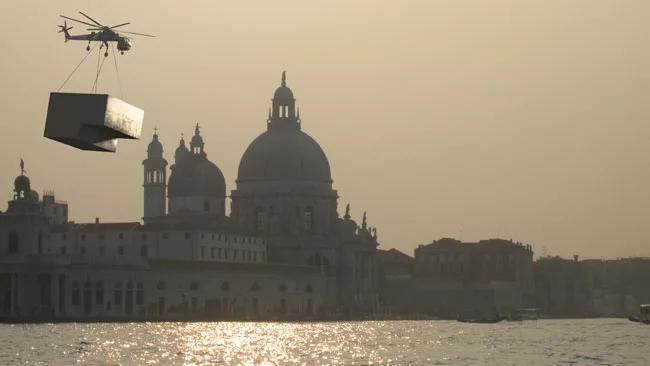
A composite image showing a fictitious scene of the pavilion being transported to its home in Venice's Giardini.
 
Image courtesy Denton Corker Marshall
Australian Pavilion
A composite image showing a fictitious scene of the pavilion being transported to its home in Venice's Giardini.
 
Image courtesy Denton Corker Marshall
Australian Pavilion
A composite image showing a fictitious scene of the pavilion being transported to its home in Venice's Giardini.
 
Image courtesy Denton Corker Marshall
Australian Pavilion
A composite image showing a fictitious scene of the pavilion in a desert setting.
 
Image courtesy Denton Corker Marshall
Australian Pavilion
Image courtesy Denton Corker Marshall
Australian Pavilion
Image courtesy Denton Corker Marshall
Australian Pavilion
Image courtesy Denton Corker Marshall
Australian Pavilion
Australian Pavilion
Australian Pavilion
Australian Pavilion
Australian Pavilion
Australian Pavilion
Australian Pavilion
Australian Pavilion
Australian Pavilion
Australian Pavilion
Australian Pavilion
Australian Pavilion
July 16, 2015

Architects & Firms

Denton Corker Marshall

Venice

People/Products

In a series of images released to the press last year, the Australian architects Denton Corker Marshall showed their country's new pavilion for the Venice Biennale'a mysterious black granite box'being floated on a barge past Andrea Palladio's white marble church of San Giorgio Maggiore. The images turned out to be fictions, created with the help of Photoshop. In fact, the building wasn't floated into town but built from scratch on-site in the Venice Giardini.

But the effect of the pavilion's completion was almost as dramatic as if it had sailed into Venice in one piece. That's because the Giardini, the park created for the art and architecture biennales in 1895, is a sedate place, where little changes from decade to decade'Korea's building was the last to be erected there, in 1995.

That the first pavilion of the 21st century was built at all was something of a fluke: most of the Giardini is under heritage protection. But the old Australian pavilion, a white metal box designed by Philip Cox and assembled from a kit of parts in 1988, was classified as temporary. That designation allowed it to be disassembled at the behest of the Australia Council for the Arts, which was ready to retire the Cox building. Among other problems, its entrance was all but hidden between the French and Czech pavilions and, inside, tight proportions stymied artists. (It will be re-erected in Australia.)

The council chose one of the best-known firms in Australia to design the new pavilion, but didn't seem to leave the architects much room for creativity. When it came to the footprint of the building, 'We were given a map with a line on the ground,' recalls principal John Denton. As for the interior, he and his partner Barrie Marshall were asked to provide a white-box gallery. Moreover, Denton says, they were determined not to compete with the art by 'crossing the line into architectural expression.'

All of this left the architects dependent on just a few moves. The first was to shift the entrance of the 3,600-square-foot building from the south to the north end of the site, where it would be easily accessible from a main walkway. The second was to place the steel-framed 50-foot-square gallery atop a much smaller lower level devoted to back-of-house functions. This approach gives the pavilion an 'inverted L' shape, a deep cantilever that seems to project the building toward an adjacent canal.

But the architects' boldest move may have been to place this white box inside a black box. The building's exterior is made almost entirely of African granite honed to a soft finish. 'We wanted to create an enigmatic building,' Denton says'and it worked: the black granite, which can be aggressive when shiny, has been made as recessive as possible. Walking through the Giardini, catching glimpses of the pavilion through the trees, one wonders if it is an object or merely a shadow.

Yet the $6 million structure (for which most of the funds were privately raised) isn't entirely featureless. Four large hatches swing open at the touch of a button, creating connections between inside and out while relieving the otherwise supremely flat facades. Two of the hatches conceal LED screens, which can serve as billboards or as extensions of video pieces, a feature intended to spark artists' imaginations. For the debut exhibition, which opened in May, the artist Fiona Hall painted the interior'the so-called white-box gallery'black and hung pieces created in collaboration with Aboriginal weavers. For the 2016 Architecture Biennale, architect Aileen Sage and urban designer Michelle Tabet will flood the gallery with water, in a tribute to Australia's coastal saltwater swimming pools.

The attention to Aboriginal weaving and Australian pool typologies introduces a note of irony, since to at least one critic the pavilion's key feature is a lack of Australian-ness. Wrote John McDonald in the Sydney Morning Herald, 'The building could represent any nation on earth with equal efficiency. It is a statement of our contemporaneity; of our willingness to shed the clich's of Australian identity.' Thus the pavilion, a beautiful object and a cleverly conceived container, highlights a difference between art and architecture: as currently practiced, the former can explore national differences, while it appears that the latter, in order to seem contemporary, must avoid them at all costs.


People

Owner: Australian Council for the Arts

Architect:
Denton Corker Marshall
49 Exhibition Street
Melbourne, Victoria
Australia 3000
Phone: +61 3 9012 3600

Personnel in architect's firm who should receive special credit:
Denton Corker Marshall has a policy whereby we don’t name individual project team members – we prefer that the practice be credited as a whole.

Associate architect(s):
FAREstudio

Interior designer: Denton Corker Marshall

Engineer(s):
Italy: STEAM (Services and Structural Engineers)

Australia: Arup (Services and Structural Engineers)

Australia: Advanced Design Innovations (Engineering consultant for operable panels)

Consultant(s):
Other: Project Manager: InTeA Srl

General contractor:
Joint venture group of companies:
SICOP Costruzioni Srl
S.I.R.CO. Srl
FIEL S.p.A.

Photographer(s):
John Gollings
Phone +61 414 537 073
Email john.gollings@gollings.com.au

Renderer(s):
Denton Corker Marshall

Size:

6,100 square feet

Construction cost:

$5.7 million

Completion date:

March 2015


Products

Structural system
Steel frame combined with concrete walls and slabs

Final design produced by Boaretto e Associati Srl

Exterior cladding
Metal/glass curtain wall: Aluminium cladding and exterior ceiling produced and installed by Monetti Group

Curtain wall: Metal sub-structure with Genius System designed and produced by Fischer Italia Srl

Other cladding unique to this project:
Stone cladding [product: granite, Nero Assoluto, thk. 30mm]; worked and installed by Zanet Srl

Stone for the operable panels [product: granite, Nero Assoluto, thk. 5mm with thk. 20mm honeycomb]; worked by Arte Marmi Srl and installed by Zanet Srl

Roofing
Elastomeric: Waterproofing membrane, SIKA Italia SpA [product: Sarnafil G 410-18EL Felt]

Windows
Metal frame: Aluminium frame, Schueco International Italia Srl [product: ADS 65]

Glazing
Glass: External parapet produced by Faraone Srl [product: NINFA 3]

Doors
Entrances: Sliding door, DORMA Italia Srl [product: ST‐G ES200 2D]

Wood doors: Scrigno SpA [product: Filo parete ESSENTIAL]

Fire-control doors, security grilles: Schueco International Italia Srl [product: ADS 65] with push-bar CISA SpA [product: Fast-Touch]

Special doors: Operable panels produced and installed by Alfa System S.a.s. di Galante C. & C.

Interior finishes
Acoustical ceilings: KNAUF [product: Cleaneo R8/18]

Suspension grid: KNAUF [product: System D112]

Paints and stains: Sikkens [various products]

Paneling: Internal external plastering KNAUF [GKI, GKB, Aquapanel Outdoor, MagiZink structure 8/10]

Floor and wall tile: Graniti Fiandre [products: Pietra di Bedonia and Taxos Extra]

Furnishings
Reception furniture: Amatori Architettura d’Interni

Other furniture: Kitchen and other fittings produced by Amatori Architettura d’Interni

Lighting
Interior ambient lighting: Erco, Tridonic, Zumtobel, iGuzzini, Disano

Downlights: Zumtobel, iGuzzini

Task lighting: Erco

Exterior: iGuzzini

Dimming System or other lighting controls: Tridonic

Conveyance
Elevators/Escalators: DomusLift

Platform: Ecospace Srl

Plumbing
Drainage Ventilation Valves: Studor

Hot Sanitary Preparator Heat Pump: Ariston

Water softner: SIS

Sanitary Fixtures: Catalano, Bocchi

Energy
Photovoltaic system: General Membrane

Energy management or building automation system: Honeywell

Photovoltaic system: General Solar PV

Circulation pumps: DAB Water Technology

Exhibition Room Air Handling Units: Rhoss SpA

Amenities - Cross flow air heat exchangers: Officine Volta SpA

Integrated Slot Air Diffuser: Officine Volta SpA

Air condensed Reversible Heat Pump: Rhoss SpA, Officine Volta SpA

Adiabatic Humidifier: Carel SpA

Amenities VRF System: Samsung

Add any additional building components or special equipment that made a significant contribution to this project:
Fire detection system: Notifier

Sound diffusion system: RCF

Closed Circuit Television: Samsung

Intrusion detection system: Honeywell

 
KEYWORDS: Italy

Share This Story

Looking for a reprint of this article?
From high-res PDFs to custom plaques, order your copy today!
Fred Bernstein studied architecture at Princeton and law at NYU and writes about both subjects.

Post a comment to this article

Report Abusive Comment

Subscription Center
  • Create an Account
  • Start a Subscription
  • Manage My Account
  • Sign Up for Newsletters
  • Visit Customer Service
  • Update Preferences

More Videos

Sponsored Content

Sponsored Content is a special paid section where industry companies provide high quality, objective, non-commercial content around topics of interest to the Architectural Record audience. All Sponsored Content is supplied by the advertising company and any opinions expressed in this article are those of the author and not necessarily reflect the views of Architectural Record or its parent company, BNP Media. Interested in participating in our Sponsored Content section? Contact your local rep!

close
  • TAMLYN XtremeTrim Exterior Trim
    Sponsored byTamlyn

    Designing Cleaner Panel Facades: Why Exterior Trim Details Matter

  • Building with Vapor Barriers
    Sponsored byReef Industries, Inc.

    Vapor Barriers Help Control Moisture in Tighter Building Designs

  • Duct Interior with Prodeq System
    Sponsored byHenry, a Carlisle Company

    Designing Resilient Water Containment Systems

DESIGN:ED Podcast
Listen to Architectural Record’s DESIGN:ED Podcast

Events

June 16, 2026

Focus on the Façade: Exploring Steel, Timber & Fire-Rated Curtain Walls and Channel Glass Systems

Credits: 1 AIA LU/HSW; 1 AIBD P-CE; 0.1 ICC CEU

Explore modern façade and glazing systems that enhance daylighting, fire safety, and thermal performance while expanding architectural design possibilities.

June 18, 2026

Rebooting the Aging Office Building

Credits: 1 AIA LU/HSW; 1 AIBD P-CE; 0.1 ICC CEU; 1 PDH

Explore façade retrofit strategies and award-winning design concepts that can transform aging office buildings into healthier, higher-performing workplaces for today’s hybrid workforce.

View All Submit An Event

Products

2026 Architect's Square Foot Costbook

2026 Architect's Square Foot Costbook

See More Products

Popular Stories

Coronado Bridge

The Architect’s Guide to San Diego

SanDiegoAirport

Top 300 Architecture Firms of 2026

Crane Cove, ONO

Design Vanguard 2026 Winners

House on a Hill

Design Vanguard 2026: Forma

House A on a Hill

Design Vanguard 2026: Santiago Valdivieso

Focus on the Facade - Free Webinar - June 16, 2026

Related Articles

  • MPavilion

    OMA’s Australian Debut, MPavilion 2017, Opens to the Public

    See More
  • Australian Retreat

    Australian Retreat by Matthew Woodward

    See More
  • Beauty and the Bath

    Australian Maker Victoria + Albert Experiments with New Tub Design

    See More

Related Products

See More Products
  • Architectural Record - July 2025

    Architectural Record July 2025 Issue

See More Products
×

The latest news and information

#1 Source for Architectural Design, News and Products

SUBSCRIBE
  • RESOURCES
    • Advertise
    • Contact Us
    • Submit
    • Store
  • ACCOUNT CENTER
    • Create an Account
    • Start a Subscription
    • Manage My Account
    • Sign Up for Newsletters
    • Visit Customer Service
    • Update Preferences
  • PRIVACY
    • PRIVACY POLICY
    • TERMS & CONDITIONS
    • DO NOT SELL MY PERSONAL INFORMATION
    • PRIVACY REQUEST
    • ACCESSIBILITY
  • SERVICES
    • Marketing Services
    • Reprints
    • Market Research
    • List Rental
    • Survey/Respondent Access
  • STAY CONNECTED
    • Linkedin
    • Facebook
    • Instagram
    • YouTube
    • X (Twitter)

Copyright ©2026. All Rights Reserved BNP Media, Inc. and BNP Media II, LLC.

Design, CMS, Hosting & Web Development :: ePublishing