Architectural Record
search
cart
facebook twitter linkedin youtube
  • Sign In
  • Subscribe
  • Sign Out
  • My Account
Architectural Record
  • NEWS
    • Latest News
    • Awards
    • Interviews
    • Obituaries
    • Podcasts
      • Design:Ed Podcast
      • Sponsored Podcasts
  • OPINION
    • Book Reviews / Excerpts
    • Exhibition Reviews
    • Forum
  • EXCLUSIVES
    • Videos
    • Design Vanguard
    • Top 300 Firms
    • Sponsored Content
    • Sponsored eBooks
    • From the Archives
  • CONTINUING ED
    • Editorial Continuing Ed
    • CE Center
    • CE Academies
  • PROJECTS
    • Buildings By Type
    • Reuse & Renovation
    • Museums & Arts Centers
    • Colleges & Universities
    • Multifamily Housing
    • Interiors
    • Lighting
    • Kitchen & Bath
  • HOUSES
    • Record Houses
    • House of the Month
    • Featured Houses
  • PRODUCTS
    • Products by Category
    • Record Products of the Year
    • Latest Products
  • EVENTS
    • Dates & Events
    • Record on the Road
    • Innovation Conference
    • Sustainability in Practice
    • Women In Architecture
    • Webinars
    • Ad Excellence Awards
    • Submit an Event
  • CONNECT
    • Ask RECORD AI
    • Newsletters
    • Contact
    • Advertise
    • Editorial Calendar
    • Store
    • Customer Service
  • SUBMIT
    • Submission Guidelines
    • RECORD Competitions
  • MAGAZINE
    • Subscribe
    • My Account
    • Digital Edition
    • Current Issue
    • Firm Pass
    • Historic Archive
ProjectsTransportation Architecture

Portland Aerial Tram by agps architecture and Arup

Portland, Oregon
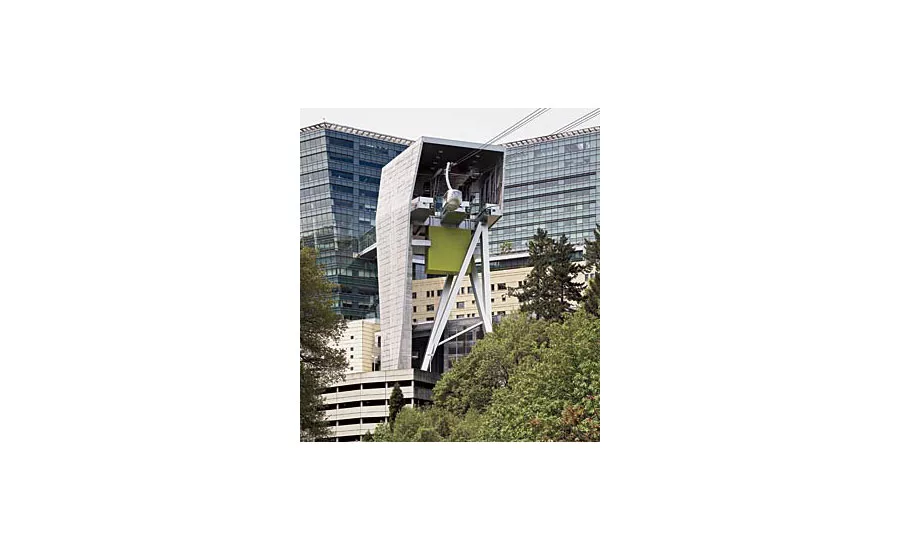
By Randy Gragg
Portland Tram

Photo © Eric Staudenmaier

August 19, 2007

Architects & Firms

agps architecture

Instead of landing on a mountainside and anchoring into bedrock, Portland, Oregon’s new aerial tram soars between two 200-foot towers, representing Olympian engineering gymnastics. Similarly sized high-rise buildings, with no tram, might require a dozen load cases. By contrast, the Portland tram’s structural engineers, Arup, calculated more than 2,000 separate cases for such structural feats as bracing the 165 million pounds of overturning moment caused by holding 1 million pounds of cars and cables in the air; the 20,000 tons of torque triggered by the tram cars passing one another; and the 80 tons of wind load carried by the cables stretching along the 3,300-foot route. 

In addition to constructing sky bridges and buildings that span ravines, the hilltop Oregon Health and Science University added the aerial tram as its newest connecting structure. Given that the tram cars would fly over Portland’s oldest national historic district, two parks, 13 streets, and eight freeway lanes, the architecture needed to be compelling. The developers, university, and city organized an international design competition, which the Los Angeles/Zurich firm Angelil/Graham/Pfenninger/Scholl (agps architecture) and Arup’s Los Angeles office won over three other teams. Inspired by the work of celebrated Swiss timber engineer Julius Natterer, as well as the region’s tradition of loggers’ yarding poles, the agps/Arup team initially proposed towers made of high-tech wood laminates and mirror-finished tram cars shaped like bubbles. 

Reality quickly intruded. To fully integrate with the campus’s so-called ninth floor—a single-level series of corridors and sky bridges connecting all of the hilly campus’s patient-care and research facilities—the tram needed to land at a new hospital expansion already under construction. University officials worried the tram’s 470-kilowatt motor turning an 8-foot “bullwheel” coupled with a 40-ton concrete counterweight constantly moving up and down would vibrate the hospital’s microsurgery facilities. This led the engineering team to structurally separate the tram from the hospital. Thus, a freestanding tower had to serve as the upper station while holding 1 million pounds of tram cars and cables aloft.

Graham describes the tram’s design as “all engineering.” Budget cuts, for instance, nixed photovoltaic cells, glass, and polycarbonate for the tram stations’ windscreens. So, working with facade engineering specialists Dewhurst MacFarlane and Partners of New York, Graham switched to the coarsest available expanded-aluminum mesh. This first-ever application of the material as cladding required extensive wind testing. The result blankets the muscular, no-nonsense docks in ethereal shadows and shimmering moiré patterns.


People

Architect:

agps architecture
2413 Ripple St. Los Angeles, Ca. 90039
t.323 668 1526
f.323 668 9362

Sarah Graham, partner in charge, AIA.


Project Team:

Marc Angélil, Moshik Mah, Mark Motonaga, Joe Baldwin, Scott Utterstrom and Chet Callahan


Engineer(s):

Arup, Los Angeles:
structural, mechanical, electrical, plumbing

Dewhurst Macfarlane and Partners:
façade engineering

Geo Design Inc.:
geo technical

W&H Pacific:
civil


Consultant(s):

Landscape:

agps architecture


Lighting:

HLB lighting design

Project Management:

Portland Office of Transportation,Ethos Development


General contractor:

Kiewit Pacific Co.


Photographer:

Eric Staudenmaier
t.(626) 826 4258

Andrea Helbling Arazebra
t.(01141) 44 241 14 06  (Switzerland)


Products

Exterior Cladding

High Performance Coating (Exterior Paint on Steel Structures)
Wasser
Tnemec

Concrete Fiber Board Cladding
James Hardi


Elevator

Schindler Elevators


Waterproofing

American Hydrotech


Interior/Exterior Paint

Sherwin Williams


Glass

Oldcastle Glass


Storefront System

Kawneer

Louvers
United Enertech


Light Fixtures

Bega
Omeaglux
Prudential
Lithonia

Flood Barrier
Presray

Gypsum Sheathing
GP

Expanded Aluminum Cladding Panels
Dramex

Expanded Aluminum Cladding Fastening System
AIG

Structural Steel Fabrication
Thompson Metal Fabrications

 
KEYWORDS: Oregon

Share This Story

Looking for a reprint of this article?
From high-res PDFs to custom plaques, order your copy today!
Randy Gragg is a Portland, Oregon-based writer on landscape, urban design, and architecture.

Post a comment to this article

Report Abusive Comment

Subscription Center
  • Create an Account
  • Start a Subscription
  • Manage My Account
  • Sign Up for Newsletters
  • Visit Customer Service
  • Update Preferences

More Videos

Sponsored Content

Sponsored Content is a special paid section where industry companies provide high quality, objective, non-commercial content around topics of interest to the Architectural Record audience. All Sponsored Content is supplied by the advertising company and any opinions expressed in this article are those of the author and not necessarily reflect the views of Architectural Record or its parent company, BNP Media. Interested in participating in our Sponsored Content section? Contact your local rep!

close
  • TAMLYN XtremeTrim Exterior Trim
    Sponsored byTamlyn

    Designing Cleaner Panel Facades: Why Exterior Trim Details Matter

  • Building with Vapor Barriers
    Sponsored byReef Industries, Inc.

    Vapor Barriers Help Control Moisture in Tighter Building Designs

  • Duct Interior with Prodeq System
    Sponsored byHenry, a Carlisle Company

    Designing Resilient Water Containment Systems

DESIGN:ED Podcast
Listen to Architectural Record’s DESIGN:ED Podcast

Events

June 10, 2026

Rethinking Stormwater – The Power of Porous Paving

Credits: 1 AIA LU/HSW; 1 AIBD P-CE; 0.1 ICC CEU

Learn how porous paving systems support stormwater management, reduce heat island effects, and enhance sustainable site design performance.

June 11, 2026

Very Early Warning Fire Detection for Mission-Critical Facilities

Credits: 1 AIA LU/HSW; 1 AIBD P-CE; 0.1 ICC CEU

Examine advanced fire detection strategies that support uptime and enhance safety in data centers and other mission-critical facilities.

View All Submit An Event

Products

2026 Architect's Square Foot Costbook

2026 Architect's Square Foot Costbook

See More Products

Popular Stories

Coronado Bridge

The Architect’s Guide to San Diego

Practice Matters illustration

What’s in a (Firm’s) Name? Thinking About Succession and Legacy

Practice Matters illustration

By the Numbers: Counting America's Architects

Inward House

Inward House by VeeV Design Studio

Riverdale House by Studio Lau

Riverdale House by Studio Lau

Broader Sustainability of CMU - Free Webinar - May 21, 2026

Related Articles

  • 200-Foot-High Living Wall Proposed for Portland Federal Building

    See More
  • Highland Hall

    An Adaptive Reuse Project by Lever Architecture Makes the Grade at the University of Oregon’s New Portland Campus

    See More

Related Products

See More Products
  • 3dthinking.jpg

    3D Thinking in Design and Architecture: From Antiquity to the Future

  • american arch.jpg

    American Architecture: An Illustrated Encyclopedia

  • ribbonarch.jpg

    Ribbon Architecture: Light, Shadow, and Reflection in Architecture

See More Products
×

The latest news and information

#1 Source for Architectural Design, News and Products

SUBSCRIBE
  • RESOURCES
    • Advertise
    • Contact Us
    • Submit
    • Store
  • ACCOUNT CENTER
    • Create an Account
    • Start a Subscription
    • Manage My Account
    • Sign Up for Newsletters
    • Visit Customer Service
    • Update Preferences
  • PRIVACY
    • PRIVACY POLICY
    • TERMS & CONDITIONS
    • DO NOT SELL MY PERSONAL INFORMATION
    • PRIVACY REQUEST
    • ACCESSIBILITY
  • SERVICES
    • Marketing Services
    • Reprints
    • Market Research
    • List Rental
    • Survey/Respondent Access
  • STAY CONNECTED
    • Linkedin
    • Facebook
    • Instagram
    • YouTube
    • X (Twitter)

Copyright ©2026. All Rights Reserved BNP Media, Inc. and BNP Media II, LLC.

Design, CMS, Hosting & Web Development :: ePublishing