Museum of the Roman Theater of Cartagena
Rafael Moneo weaves the past and the present in an intricate intervention for the Museum of the Roman Theater of Cartagena.
Cartagena, Spain
Jos' Rafael Moneo
Located on the Mediterranean coast almost 300 miles southeast of Madrid, the port city of Cartagena is rich in a history that dates back more than 2,000 years, when it was a stronghold of ancient Carthage. More recently, the five hills of that Carthaginian settlement, a subsequent Roman colony and Byzantine outpost, are largely bare—the decaying streets between them housing the city’s poorest residents. In 1988, while carrying out a routine archaeological probe for a construction site on the most prominent of these hills, archaeologists stumbled upon the remains of a sumptuous Roman theater that, inscriptions revealed, had been built on orders of the Roman Emperor Augustus near the end of the first century B.C. Eleven years later, in 1999, after securing adequate funds, local officials enlisted architect Rafael Moneo’s collaboration not only to restore the site but to make it the centerpiece of efforts to renew the city and attract tourism.
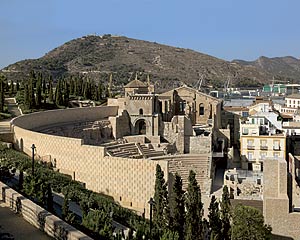

Rather than simply building a museum and visitors’ center for the theater’s excavations, Moneo has undertaken a project of civic and historic suture. By organizing his intervention as an urban sequence through two museum buildings, a series of tunnels, and a wall of escalators, visitors are transported from the central City Hall Plaza near the waterfront to the hillside ruins 56 feet above. In Moneo’s own words, “The museum … has been designed as a ‘promenade’ from sea level to the higher ground of the city, climaxing with the unexpected appearance of the theater’s imposing space.”
Best understood in section, Moneo’s promenade bores through different historic layers of the city, uncovering surprising juxtapositions of different epochs. He took as a starting point a ruined 19th-century palace facing the city hall, which he gutted and rebuilt with an addition as the museum complex’s entry (comprising offices, a library, and a sidewalk café). From the ground floor of the palace, a wide passage leads under the street behind it to a new exhibition building with two gallery floors. A series of switchback mechanical stairs at the back of this building climbs to a tunnel that takes visitors on a zigzagging route under the ruins of the medieval Santa María la Vieja Church, destroyed in Spain’s Civil War, which the excavators discovered to be built over part of the theater’s seating. Following a trajectory determined by the archaeological discoveries encountered on its path, the tunnel passes through a crypt with early mosaic paving from a Roman house, and emerges onto a midair catwalk leading into the theater. Once visitors have left the theater precinct, they can descend existing streets back to the city hall, or turn and climb to a lookout terrace on the roof of the exhibition building, with views over the harbor, and to a hillside park designed by Moneo.
With its facade of chisel-faced local limestone and the elaborate spatial play of its interiors, the exhibition building is Moneo’s contemporary contribution to the museum’s promenade. It is designed to display the most important and well-preserved elements recovered from the theater, including Corinthian capitals of Carrara marble carved in Rome, red travertine column shafts, altars, and commemorative plaques. But the structure is also an elaborate stair tower with its back dug into the hillside, and the architect emphasizes its verticality with two light shafts that descend from its roof to the exhibition floors. On the southern party wall, one light shaft descends 72 feet to illuminate the lower gallery, a feat possible due to Cartagena’s strong southern sun. The other, above the main facade, is interrupted at midpoint by a vitrine that displays a Corinthian capital to the street and the gallery, and folds into the receding and intersecting planes of a large window opening that frames the reproduction of a Roman statue.
Moneo worked with archaeologists Sebastián Ramallo and Elena Ruiz, director of the museum, and the restoration specialist Isabel García-Galán, in consolidating the theater’s ruins. In Spain, it is common for generalists like Moneo to take on important restoration projects, although he jokingly describes his role here as “the archaeologists’ enforcer,” defending and carrying out their aims. The archaeological team rebuilt part of the original scaena, or stage house, supporting original stones and fragments with rubblework walls designed by Moneo, and stucco-finished infill. They left another section of the stage as they found it, where stones from the theater had been reused for a 5th-century market. They rebuilt a missing section of the cavea, or seating area, in rubblework, but left the highly eroded surviving areas basically untouched, making contemporary use of the theater impossible.
Hanging over these decisions was the court case ordering the demolition of Giorgio Grassi’s reconstruction of the Roman theater in Sagunto, Spain [record, March 2008, page 32]. The court found that Grassi had breached the 1985 Historic Patrimony Law prohibiting the reconstruction of protected ruins except for work of consolidation and when original elements are used. Carla Bovio, one of Moneo’s collaborating architects on the project, explains that, in interpreting the vague terms of the law, “we had to develop a clear theory and argument for the project, which then had to be approved” by local cultural authorities supervising the work.
Moneo’s strategy in Cartagena is strikingly similar to that of his enlargement of the Prado Museum in Madrid, which opened in 2007 [record, March 2008, page 118]. In both, he sets a new building between two historic structures at different elevations and links them internally through tunnels and escalators. And in both projects, the new building, without direct street access, presents itself to passersby as an exquisitely wrought jewel box. In urban terms, the spatial promenade that Moneo fashions, crossing over and under the conventional ground plane of the urban fabric, transforms its area of impact into a three-dimensional “collage city,” in the spirit of Colin Rowe’s 1978 book of the same name. In other works, too, Moneo undercuts the apparently conservative, tectonic solidity of his designs, most memorably in the
Museum of Roman Art in Mérida, Spain (1984), where thin concrete floor slabs float incongruously through massive brick walls, or in Madrid’s Atocha Railroad Station (1992), whose underground commuter station finds expression at ground level through a domed entry pavilion that is essentially floorless. In Cartagena, this subtle subversion of construction’s gravity-bound conventions finds a new dimension of expression as urban and historic collage.
Looking for a reprint of this article?
From high-res PDFs to custom plaques, order your copy today!