Architectural Record
search
cart
facebook twitter linkedin youtube
  • Sign In
  • Subscribe
  • Sign Out
  • My Account
Architectural Record
  • NEWS
    • Latest News
    • Awards
    • Interviews
    • Obituaries
    • Podcasts
      • Design:Ed Podcast
      • Sponsored Podcasts
  • OPINION
    • Book Reviews / Excerpts
    • Exhibition Reviews
    • Forum
  • EXCLUSIVES
    • Videos
    • Design Vanguard
    • Top 300 Firms
    • Sponsored Content
    • Sponsored eBooks
    • From the Archives
  • CONTINUING ED
    • Editorial Continuing Ed
    • CE Center
    • CE Academies
  • PROJECTS
    • Buildings By Type
    • Reuse & Renovation
    • Museums & Arts Centers
    • Colleges & Universities
    • Multifamily Housing
    • Interiors
    • Lighting
    • Kitchen & Bath
  • HOUSES
    • Record Houses
    • House of the Month
    • Featured Houses
  • PRODUCTS
    • Products by Category
    • Record Products of the Year
    • Latest Products
  • EVENTS
    • Dates & Events
    • Record on the Road
    • Innovation Conference
    • Sustainability in Practice
    • Women In Architecture
    • Webinars
    • Ad Excellence Awards
    • Submit an Event
  • CONNECT
    • Ask RECORD AI
    • Newsletters
    • Contact
    • Advertise
    • Editorial Calendar
    • Store
    • Customer Service
  • SUBMIT
    • Submission Guidelines
    • RECORD Competitions
  • MAGAZINE
    • Subscribe
    • My Account
    • Digital Edition
    • Current Issue
    • Firm Pass
    • Historic Archive
ProjectsBuildings by TypeAdaptive Reuse and RenovationSpiritual Projects

St. Bartholom'us Church

Heaven and Earth: A firm turns a 1960s church into a place of final repose and, once again, worship.

By Mary Pepchinski
St. Bartholom'us Church
The chapel, in addition to a new bronze and steel pulpit and concrete altar, houses the original pine benches.
 
Photo © Dietmar Strauss
St. Bartholom'us Church
Because the Catholic faith prohibits services in cemeteries, the architects inserted an ethereal bronze mesh enclosure to separate the columbarium from the sanctuary.
 
Photo © Dietmar Strauss
St. Bartholom'us Church
The church of St. Bartholomäus, designed by modernist architect Hans Schwippert in 1960, shut down in 2006. It was revived as a columbarium last January by Kissler + Effgen Architects at the request of the church's parishioners.
 
Photo © Dietmar Strauss
St. Bartholom'us Church
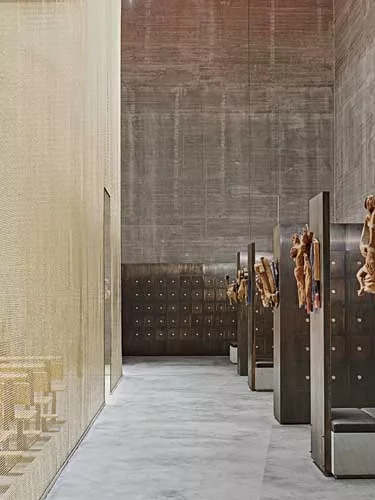
Custom black-steel cabinets, which contain 1,600 niches for some 2,400 urns, line the periphery of the sanctuary.
 
Photo © Dietmar Strauss
St. Bartholom'us Church
Sculptures carved in 1988 by Ludêk Tichý ornament the sides of these cabinets.
 
Photo © Dietmar Strauss
St. Bartholom'us Church
Bronze plaques seal each niche when filled.
 
Photo © Dietmar Strauss
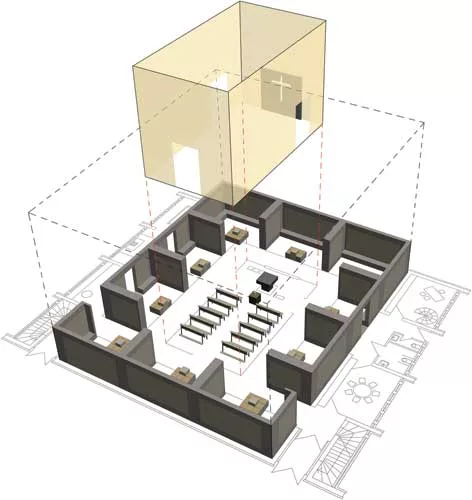
The mesh partition, measuring 23 by 33 feet, stretches from floor tracks to steel bars attached to the church's concrete ceiling beams.
 
Image courtesy Kissler + Effgen Architects
St. Bartholom'us Church
The sections, which cut through the sanctuary, show the stained-glass windows on the east wall.
 
Image courtesy Kissler + Effgen Architects
St. Bartholom'us Church
The sections, which cut through the sanctuary, show the sanctuary's cross in front of the north wall.
 
Image courtesy Kissler + Effgen Architects
St. Bartholom'us Church
The mesh partition, measuring 23 by 33 feet, stretches from floor tracks to steel bars attached to the church's concrete ceiling beams.
St. Bartholom'us Church
February 15, 2015

Architects & Firms

Kissler + Effgen Architects

Cologne, Germany

People/Products

Dwindling congregations and shifting demographics have led to church closings throughout Germany, as elsewhere, in recent years. Yet some, such as Saint Bartholom'us, a Roman Catholic church in Cologne, are deconsecrated and repurposed as columbaria housing the ashes of the deceased. After it shut down in 2006, the congregation wanted Saint Bartholom'us's building to retain a sacred space to hold funeral services in addition to a de-sanctified area to house the urns. Because Catholic doctrine permits burial within church walls only for popes, emperors, and archbishops, and it prohibits the celebration of the Mass in cemeteries, the task required the interior to be divided into two spaces, one sacred and the other secular.

Modernist Hans Schwippert designed St. Bartholom'us, a stark, brick-faced concrete cube, in 1960, and it was declared a historic monument in 1995. (Buildings can be landmarked in Germany after one generation, or roughly 30 years.) Located among multi-family housing and light industry near downtown Cologne, the abandoned church possessed, recalls architect Hans-Peter Kissler, 'a dark interior with a graveyard quality that was perfect for this task. I only wanted to reinforce it.'

To define the sanctified area, he inserted into the church's center an architectural bronze mesh enclosure, measuring 23 by 33 feet in plan. The mesh stretches between a track in the floor and a rectangular frame located 33 feet above. Steel bars secure the frame to the church's concrete ceiling beams. Adjustable LED luminaires, which are attached to the frame, shine on the mesh, wrapping the sacred area in an ethereal glow. Depending on their angle, the LEDs cause the mesh to appear either transparent or translucent. Furnishings include both new pieces (the bronze and steel pulpit and urn stand, the concrete altar) and recycled ones (the church's original pine benches).

Six-foot-high black-steel cabinets, which house the urns, form 10 alcoves around the sanctified area. The cabinets contain 1,600 niches for a total of 2,400 urns (800 in single and 1,600 in double compartments). After an urn is installed, a bronze plaque with a shelf for commemorative items seals the niche; a single light bulb, suspended from the ceiling, illuminates each alcove.

Other alterations draw attention to the church's religious art. Expressively carved figures, depicting the Stations of the Cross (1988) by sculptor Ludek Tich', formerly located along the interior walls, now adorn the ends of the urn cabinets. Red spotlights accentuate the concrete ceiling and complement Giselbert H'ke's stained-glass windows (1978) depicting the Resurrection.

To reduce costs, heating was eliminated, except in the vestibule on the west facade, which is newly equipped with offices and restrooms. The highly emotive quality of this church-cum-columbarium notwithstanding, a prolonged visit on a recent December midday left one with cold feet and a chill. Temperature aside, the dusky space feels welcoming and surprisingly uplifting. The urn cabinets seem to disappear into the shadows, in contrast to the sacred area's radiance, which beckons, like a clearing in a forest. Small, gleaming accents throughout'the suspended light bulbs in each alcove, the glinting bronze seals adorning the niches holding the urns'inject visual warmth and a sense of enchantment into this sober setting.

The dual areas'one sanctified, the other merely solemn'were intended to maintain the church's relevance and to ensure that a respectful consideration of death plays a role in the everyday life of this urban neighborhood. This strategy is succeeding: 'It is surprising,' notes columbarium administrator David Blumann, 'how many people have come by just to take a look.'


People

Owner: Katholische Kirchengemeinde Zu den Heiligen Rochus, Dreikönigen und Bartholomäus

Architect:
Kissler + Effgen Architects
Wilhelminenstr. 1a
D-65193 Wiesbaden
phone: +49 611 53290-0
fax: +49 611 53290-66

Personnel in architect's firm who should receive special credit:
Consultant(s):
Lighting: Corinna Arens + Dorette Faulhaber Schanzenstrasse 36, 51063 Köln
phone: +49 6221 9469884
mail@arens-faulhaber.de

Photographer(s):
Dietmar Strauß
Eberhardstraße 14
74354 Besigheim
phone: +497143 965341
mail@dietmar-strauss.de

CAD system, project management, or other software used: Nemetschek, Allplan 2014

Size:

6,450 square feet

Construction Cost:

$1.2 million

Completion Date:

January 2014


Products

Structural system
concrete structure

Exterior cladding
Masonry: brick walls

Windows
Metal frame: steel windows

Glazing
Glass: colored, designed by the artist Giselbert Hoke, Austria

Doors
Metal doors: Main entrance doors in bronzed copper

Wood doors: side entrance door in oakwood

Interior finishes
Bronze Mesh enclosing sanctuary: Alphamesh

Ground floor: screed, sharpened

Mausoleum: steel construction with burnished brass plate exterior. 890 double and 700 individual graves with a total of 2,480 urn chambers: Schlosserei und Metallbau Venino

Furnishings
Urns/ columbarium

Chairs: wooden benches

Other furniture:
Principal Furnishings:
Altar: exposed concrete

Ambon, Paschal candle holder, urn pedestal: Steel structures with adorned burnished and plank brass plate

Way of the Cross:  expressive wood reliefs designed by the artist Ludek Tichy

Lighting
Single lights: Viabizzuno

Dimming System or other lighting controls:
LED: Philips Lighting

The top edge of the approximately 7-metre high net will be equipped with LED lights arranged and installed on both sides with an angle of approximately 3 degrees allowing the entire length of the net to be evenly illuminated.

Each urn cabinet within the bronze urn complex will be accentuated by a pendant lamp. The whole space, inspired by the window design, will be dimly lit and, supported by candle light, give the sepulchre the desired contemplative mood.

 
KEYWORDS: Germany

Share This Story

Looking for a reprint of this article?
From high-res PDFs to custom plaques, order your copy today!

Mary Pepchinski is a writer, curator, and former professor of architectural theory at the Technical University Dresden.

Post a comment to this article

Report Abusive Comment

Subscription Center
  • Create an Account
  • Start a Subscription
  • Manage My Account
  • Sign Up for Newsletters
  • Visit Customer Service
  • Update Preferences

More Videos

Sponsored Content

Sponsored Content is a special paid section where industry companies provide high quality, objective, non-commercial content around topics of interest to the Architectural Record audience. All Sponsored Content is supplied by the advertising company and any opinions expressed in this article are those of the author and not necessarily reflect the views of Architectural Record or its parent company, BNP Media. Interested in participating in our Sponsored Content section? Contact your local rep!

close
  • cold storage facility
    Sponsored byCarlisle SynTec Systems

    How Architects Can Design More Continuous Cold Storage Envelopes

  • TAMLYN XtremeTrim Exterior Trim
    Sponsored byTamlyn

    Designing Cleaner Panel Facades: Why Exterior Trim Details Matter

  • Building with Vapor Barriers
    Sponsored byReef Industries, Inc.

    Vapor Barriers Help Control Moisture in Tighter Building Designs

DESIGN:ED Podcast
Listen to Architectural Record’s DESIGN:ED Podcast

Events

June 23, 2026

Enhancing Fire Resistance with Advanced PVC Solutions

Credits: 1 AIA LU/HSW; 1 AIBD P-CE; 0.1 ICC CEU; 1 IIBEC CEH

Evaluate advanced PVC solutions that improve fire resistance, support WUI compliance, and enhance resilience in residential and commercial building design.

June 25, 2026

Designing Glass Railing Systems that Enhance Aesthetics and Meet Code

Credits: 1 AIA LU/HSW; 1 AIBD P-CE; 0.1 ICC CEU

Upon course completion, participants will possess a deeper understanding of glass railings to help ensure that safety, aesthetic, and performance objectives are achieved.

View All Submit An Event

Products

2026 Architect's Square Foot Costbook

2026 Architect's Square Foot Costbook

See More Products

Popular Stories

SanDiegoAirport

Top 300 Architecture Firms of 2026

Lorcan O' Herilhy

California Architect Lorcan O’Herlihy Has Died, Age 66

Obama Presidential Center, Chicago

The Obama Presidential Center Opens on Chicago’s South Side

Spoonbill Ranch

Johnsen Schmaling Architects Integrates Spoonbill Ranch into a Pristine Landscape

CCA, Studio Gang

The Winners of the AIA’s 2026 Architecture Award Range from Collegiate Rowing Hubs to Housing for the Homeless

Enhancing Fire Resistance with Advanced PVC Solutions - Free Webinar - June 23, 2026

Related Articles

  • St. Paulus Catholic Church

    St. Paulus Catholic Church

    See More
  • Christus Church

    Christus Church by ahrens & grabenhorst

    See More
  • St. Moritz Church by John Pawson

    See More
×

The latest news and information

#1 Source for Architectural Design, News and Products

SUBSCRIBE
  • RESOURCES
    • Advertise
    • Contact Us
    • Submit
    • Store
  • ACCOUNT CENTER
    • Create an Account
    • Start a Subscription
    • Manage My Account
    • Sign Up for Newsletters
    • Visit Customer Service
    • Update Preferences
  • PRIVACY
    • PRIVACY POLICY
    • TERMS & CONDITIONS
    • DO NOT SELL MY PERSONAL INFORMATION
    • PRIVACY REQUEST
    • ACCESSIBILITY
  • SERVICES
    • Marketing Services
    • Reprints
    • Market Research
    • List Rental
    • Survey/Respondent Access
  • STAY CONNECTED
    • Linkedin
    • Facebook
    • Instagram
    • YouTube
    • X (Twitter)

Copyright ©2026. All Rights Reserved BNP Media, Inc. and BNP Media II, LLC.

Design, CMS, Hosting & Web Development :: ePublishing