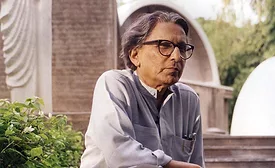
The first Indian architect to win the accolade, Doshi’s 70-year career has been characterized by dignified designs that respect the people they serve and the contexts in which they exist.
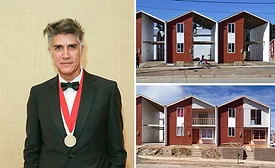
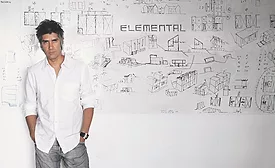
This year’s Pritzker Architecture Prize winner, the Chilean architect Alejandro Aravena, is known for his socially-minded design. Since establishing his Santiago firm ELEMENTAL in 2001, Aravena has designed some 2,500 units of housing.
The announcement of the 2016 Pritzker Prize winner last month came as something of a shock. Rather than select a precertified star, the jury picked Alejandro Aravena, best known for building smart, extremely low-cost social housing in his native Chile.
When Chilean architect Alejandro Aravena speaks about designing buildings, he invokes the language of governments and institutes: “investing in brains over bricks”; turning “forces into forms.” But unlike the abstract ideas that may emerge from a policy institute, Aravena, with his Santiago-based firm ELEMENTAL, is keen on designing solutions that not solely aid, but empower society’s neediest.
The German architect, who died yesterday, will receive the award posthumously. Roofing for main sports facilities in the Munich Olympic Park for the 1972 Summer Olympics, 1968–1972, Munich, Germany German architect Frei Otto, renowned for his lightweight, tensile structures, today was named the winner of the 2015 Pritzker Architecture Prize. The abrupt announcement came a day after Otto died at the age of 89 in Germany. “Throughout his life, Frei Otto has produced imaginative, fresh, unprecedented spaces, and constructions,” wrote the Jury in their citation. “He has also created knowledge. Herein resides his deep influence: not in forms to