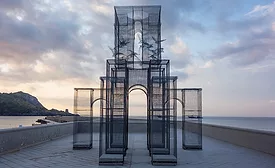
In the Cilento region of southern Italy, on the coast of the Tyrrhenian Sea, Edoardo Tresoldi created Incipit from rolls of wire mesh for the 19th annual Meeting del Mare music festival last June.
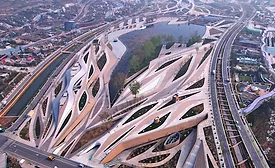
“In search of organized complexity” is the motto of Beijing-based firm HHD_FUN, and that’s just what founders Zhenfei Wang, Luming Wang, and principal architect Hongyu Li created with this new park for the 2014 International Horticultural Exposition in Qingdao, on China’s eastern coast.
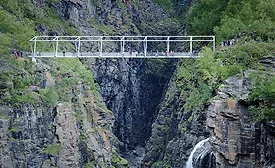
in the the northern Norwegian village of Birtavarre, the Sabetjohk Pedestrian Bridge spans 147 feet across the 500-foot-deep Gorsa Gorge—northern Europe’s deepest canyon.
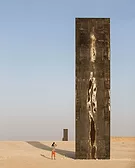
In the middle of the desert in Qatar, four enormous steel plates rise from the bleak landscape, oriented along an east-west axis over a half-mile stretch.
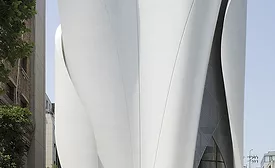
Eleven billowing white fiberglass panels, each stretching more than 65 feet high, fold around the front of Christian de Portzamparc’s flagship store for Christian Dior in Seoul." A narrow gap in the draped facade reveals the glazed entrance framed by a delicately perforated metal skin.
Named for the visual phenomenon of a mirage suspended just above the horizon, the installation Fata Morgana by Brooklyn-based artist Teresita Fernández hovers above New York's Madison Square Park.
Essex, England Grayson Perry and FAT Architecture A House for Essex This whimsical vacation house is styled as a secular chapel. The strange brief was requested by Living Architecture, a nonprofit that commissions notable architects and rents the buildings to the public. The house, designed by artist Grayson Perry and now-disbanded architecture firm FAT, mixes formal and informal, sacred and nonreligious precedents, canonizing a fictional local woman by using architectural details. These include the eclectic symbols on the exterior's green and white tiles, each of which represents aspects of her identity, and tapestries inside that commemorate events in her life.
Cantilevered almost 100 feet to the main avenue of Expo 2015 Milan, the canopy of the Russian Federation Pavilion dramatically invites visitors into the building's exhibition space.
 RSS
RSS