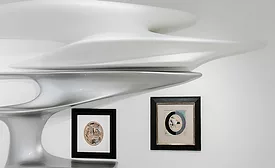
In Zurich, the walls of Galerie Gmurzynska’s latest exhibition, Kurt Schwitters: Merz, ripple and swell with the last art installation designed by Zaha Hadid.
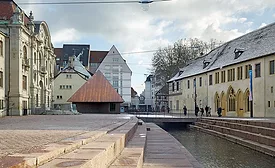
Rumor has it that the quaint town inspired the architecture in Disney’s animated film Beauty and the Beast. But in a recent renovation of the city’s Musée Unterlinden, Herzog & de Meuron made a conscious effort to avoid the preciousness of a Disney film.
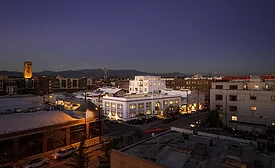
The newly opened Hauser Wirth & Schimmel gallery, the latest addition to the Downtown Los Angeles Arts District commercial boom, is a behemoth, occupying all 116,000 square feet of a former Pillsbury flour mill complex.
Superpowers of 10, a play by architect Andrés Jaque and his Madrid-based Office for Political Innovation, starts innocuously enough—the stage-ready version of the iconic Eames’ 1977 short film Powers of 10, performed during the opening weekend of the Chicago Architecture Biennial, reenacts an idyllic picnic on Lake Shore Drive and a journey through space and subatomic particles, using the adorable medium of papier-mâché props on wheels.
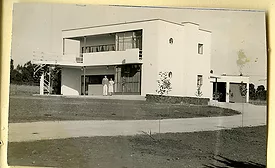
I grew up with what Peter Smithson described as a whiff of the powder of Modernism, and with a passion for its architecture – plus a presumption that architecture was women’s work,” Denise Scott Brown said in a recent interview with architecture curator Clare Farrow, recalling her Norman Hanson-designed childhood Johannesburg home and how it helped steer her towards her venerated career.
In contrast to the excitement of the inaugural Chicago Architecture Biennial’s opening weekend, artist and Chicago native Theaster Gates addressed the press in a decidedly less enthusiastic tone. “As excited as I am about the history of Chicago architecture,” he said, “we also have an amazing history of racism, segregation, [and] a history of redlining and housing covenants that work against the poor, and against black and brown people.” Gates’ contribution to the biennial, the transformation of a derelict 1923 neoclassical building into a community cultural center called the Stony Island Arts Bank, embodies the effects of redlining very succinctly.
For the first exhibition in its newly minted facility, A+D commissions architects to propose new ways to shelter the city. wHY built a model of Wilshire Boulevard in which houses occupy the spaces previously devoted to cars. Los Angeles is currently “reaching a saturation point,” says Sam Lubell, who with fellow curator Danielle Rago created Shelter: Rethinking How We Live in Los Angeles, the inaugural exhibition for the Architecture + Design (A+D) Museum’s new home in the city’s Downtown Arts District (on view now through November 6). Decades of migration to L.A.'s sunny skies have led to unprecedented strain: The
UP Express Union Station in Toronto by Zeidler Partnership Architects. A rail link that can transport travelers directly from the airport to downtown is a simple concept, yet one that has never come to fruition in North America until now. On June 6, Toronto began service of its new Union Pearson Express, a train that connects Canada’s two busiest transportation hubs, Pearson International Airport and the downtown Union Station, every 15 minutes in fewer than 25 minutes. The new railway was, of course, in need of new stations, and the transit authorities at Toronto’s Metrolinx commissioned Canadian firm Zeidler Partnership
Resulting exhibition to include architectural models and an architectural version of eHarmony. Renderings of the six finalist designs for the Guggenheim Helsinki. These renderings are unmarked to preserve the anonymity mandated by Finnish law. Guggenheim Helsinki Now: Six Finalist Designs Unveiled, on view at Kunsthalle Helsinki this spring, marks the second phase of the embattled Guggenheim Helsinki design competition. The exhibition, following the announcement this December that a whopping 1,715 design submissions had been whittled down to six, highlights fully-developed proposals by the firms AGPS Architecture Ltd., Asif Khan Ltd., Fake Industries Architectural Agonism, Haas Cook Zemmrich STUDIO2050, Moreau Kusunoki