Asking Mr. Big
Foster+Partners has designed megaprojects around the globe, from airports to skyscrapers. How are super-size buildings, such as Apple's future headquarters, shaped for the people who will use them?

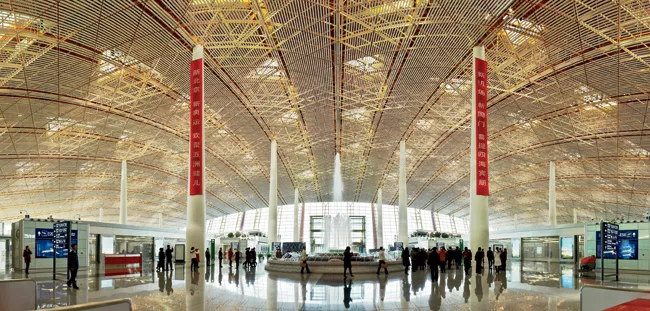
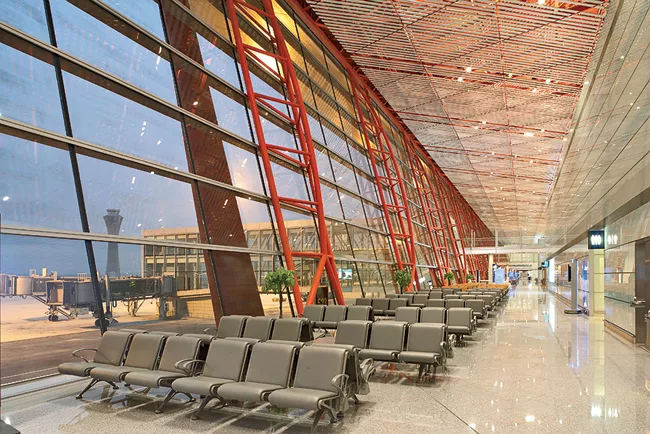
As founder and chairman of Foster+Partners, Norman Foster has created projects at every scale but may be best known for such innovative tall buildings as the Hong Kong and Shanghai Bank Headquarters in Hong Kong (1986), the Swiss Re tower in London, a.k.a. “the Gherkin” (2004), and the Hearst Tower in New York (2006). The firm's airport projects include Hong Kong's Chek Lap Kok (1998) and Terminal 3 in Beijing International Airport (2008), which is one of the largest buildings in the world. Foster spoke with record editor in chief Cathleen McGuigan about large-scale architecture and the human experience.
Architectural Record: For much of your career, you've grappled with the issue of scale in very big buildings. The Beijing airport is nearly 14 million square feet. How did you manipulate the scale to make it a place people can navigate?
Norman Foster: Beijing is clearly an enormous building, but everybody I know who's been through it sees it as a very friendly building. That comes from the handling of light and color and level changes. And it comes from the feeling that you're connected to the outside. You have a reference to the sky through the natural lighting. You also have this color spectrum on the interior, where the roof canopy changes from orange and reds through to gold and yellow—evocative colors—and the same color range echoes in reverse order across the width of the building. Then, as I say, there is the constant reference to the outside—the fact that you don't feel you're being led down blind alleys. You always have this sense of knowing where you are—you always have a sense of space.
As airports got bigger and bigger, you reversed the idea of separate terminals and made the roof a unifying structure. That was very bold, if you think about it, because it makes the building so immense.
Yes. I usually get hoots of derision when I say this, but the Hong Kong and Beijing airports are essentially compact buildings. I'll try and explain what I mean. Heathrow is now five terminals. Landing at one and having to be trucked to another is not the greatest experience in the world. In actual fact, it's probably one of the worst, the most alienating. So although these buildings we're talking about are enormous, they're actually quite compact compared with the experience of five or six separated terminals.
If you compare these very large buildings in terms of the area enclosed by the amount of external wall, they're very efficient, so they consume less energy.
They're also a better experience, because you're not leaving one terminal, going outside, onto a road, or into a tunnel, or onto a train to get to another terminal. You're not worrying about what the hell is happening to your bags as they leave one place and you hope that they end up in the other place. Overall, it's a better experience—it's more sustainable, it's more economic. And, architecturally, it's more interesting. The same is true with the very large Apple building.
Looking for quick answers on architecture and design topics?
Try Ask RECORD, our new smart AI search tool.
Ask RECORD →
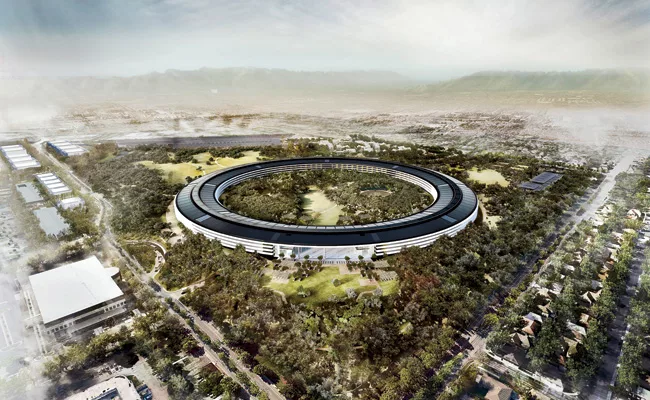
Yes, the Apple headquarters you've designed for Cupertino, California, will have 12,000 employees in one building.
You could compare that with a typical university of the same size. Traditionally, you're probably talking at least 16 or 17 buildings. The Apple building will occupy the site much more tightly than what was there. It was the former Hewlett-Packard site, and, just in the last month, we demolished all the buildings that were there. It was a large number of them. [The new Apple construction will cover 13 percent of the site, while the two dozen former HP buildings, in total, covered much more, according to Foster's office.]
So what made the form of a ring the logical choice for this building?
It's interesting how it evolved. First of all, there was a smaller site. Then, as the project developed, and the Hewlett-Packard site became available, the scale of the project changed.
Meanwhile, the reference point for Steve [Jobs] was always the large space on the Stanford campus—the Main Quad—which Steve knew intimately. Also, he would reminisce about the time when he was young, and California was still the fruit bowl of the United States. It was still orchards.
We did a continuous series of base planning studies. One idea which came out of it is that you can get high density by building around the perimeter of a site, as in the squares of London. And in the case of a London square, you create a mini-park in the center. So a series of organic segments in the early studies started to form enclosures, all of which were in turn related to the scale of the Stanford campus. These studies finally morphed into a circular building that would enclose the private space in the middle—essentially a park that would replicate the original California landscape, and parts of it would also recapture the orchards of the past. The car would visually be banished, and tarmac would be replaced by greenery, and car parks by jogging and bicycle trails.
Remember, the main building caters to 12,000 people, but the wellness center—the fitness center—is probably responding to the needs of the entire Apple community in Silicon Valley, which is 20,000-something. Also, another building on the site is the presentation center, which will allow Apple to do the kind of things like product launches that otherwise would require space in San Francisco or wherever. And, a bit like the airport, where you have one building—although it is in itself quite large—it is essentially compact.
I understand what you're saying about the efficiencies. But how do you bring a sense of human scale, and how will people move around? In an airport, you have people movers. At Apple, they will be able to cross the center of the park to get to the other side, but how will people move around the almost mile-long circumference of the ring?
If you take the 176-acre site, it is much closer to move around or across a space in one very large building than it would be to walk to the other end of a 170-plus-acre site to another building. Although in the extreme cases the distances might be large, they are not really when compared with a conventional campus, where you're walking from one building to another.
Of course, you have got an enormous range of skills in this building—from software programmers, from designers, marketing, retail—but you can move vertically in the building as well as horizontally. The proximity, the adjacencies are very, very carefully considered.
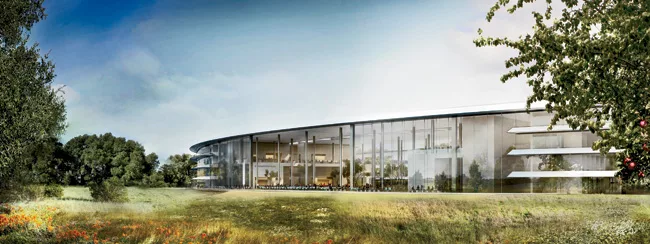
Remember also that the scale is broken down by cafés and lobbies and entrances. Then, a significant segment of that circle is the restaurant, which opens up to the landscape. You have four-story-high glass walls, which can literally move sideways and just open up into the landscape. So the social facilities break down the scale.
And of course you have the benefit of jogging and cycling trails—more than a thousand bikes will be kept on the site—and also pathways and landscaping connections.
There's also the buried car park. You won't look out of your window and see row after row of parked cars.
Although they are polar opposites, in terms of functions and their forms, the scale of an airport as an experience is broken down rather like the city itself—you do get contrast, you do get variety. And the same is true in the Apple building. You do enter a lobby that relates to the spaces in that segment of the circle. There's easy seating, there's a café outside, and it's got its own bicycle park. It has its own connections to the landscape and has certain things that will be close in terms of the inner park—it might be adjacent to a pool, for example.
You said these enormous buildings are like cities in microcosm, but these places we're discussing are not in city centers. What about big buildings in the urban context?
Yes, whenever there is an intervention of a building in a city, we try to see whether that building can in some way give something back to the city of which it's a part. With Swiss Re, it tightens at the base to create a very pleasurable space, which is shared as an open-air café in that very dense part of the city.
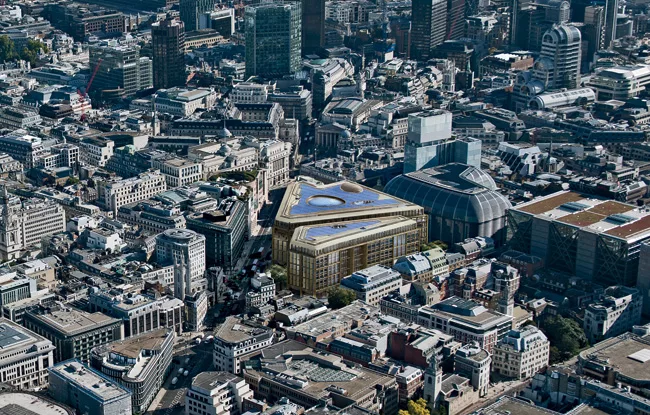
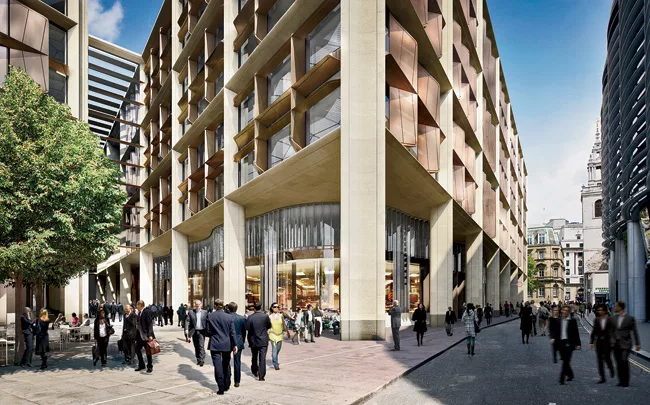
With Bloomberg in London, we are creating a pedestrian arcade again, which is a continuation of an historic route that had been obliterated by an early 1960s building, since demolished. [The Bloomberg European headquarters in London is a block-long stone structure with bronze details. It is designed in two parts connected by sky bridges, which will cross the arcade. Now under construction, it is scheduled to open in 2016.]
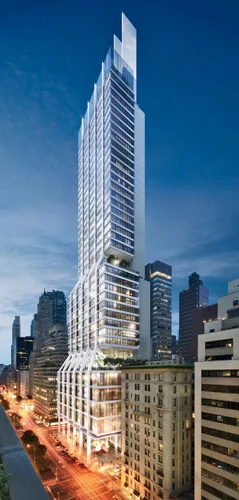
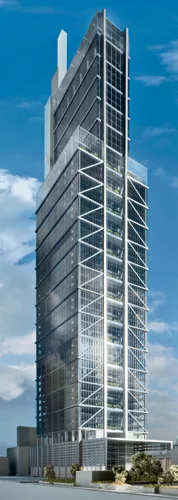
The Bloomberg building is not so tall—10 stories. But what about taller buildings? There's a difference between managing the scale of an airport design or the Apple project, with vast horizontal spaces, versus the scale in a skyscraper. You're currently developing 425 Park in New York, at 687 feet, and Comcast in Philadelphia, which, at 1,121 feet, will be the highest building outside New York or Chicago. How do you manage human scale in the high-rise, so that it is not just a stack of pancakes?
If you look at both 425 Park and Comcast, they're very different buildings and quite different functions. Comcast is a vertical series of Silicon Valley'style lofts for working, and 425 is an office building.
Yes, yet both have public amenities on the ground floor. Comcast will have a flexible civic space; 425 Park will have an outdoor space in front of the lobby to showcase contemporary art. Also 425 has three setbacks as the building goes up 41 stories—with sky gardens or event spaces that mark those shifts.
What are some other strategies you've employed in tall buildings to break up the scale and monotony of the floor plates and make varied spaces that engage the people who use them?
All of these tall buildings, back to the Hong Kong and Shanghai Bank, invoke devices which are socially generated but which in turn consciously destroy the totally anonymous stack of offices and engage with the human systems—the internal views, the cafés, the landscaping, the gardens in some cases. The spiral in Swiss Re, for example, which is continuous and laps around, intervenes with the regular stack of the floors. On a smaller scale, at the base of the Hearst Tower is an internal plaza, which everybody who comes into the building has to pass through, alongside a waterfall. These are all scale devices. They all come back to your key word: scale.
Looking for a reprint of this article?
From high-res PDFs to custom plaques, order your copy today!