Chicago: The Place Between
A modern masterpiece collides with a literary gem—that's Chicago.
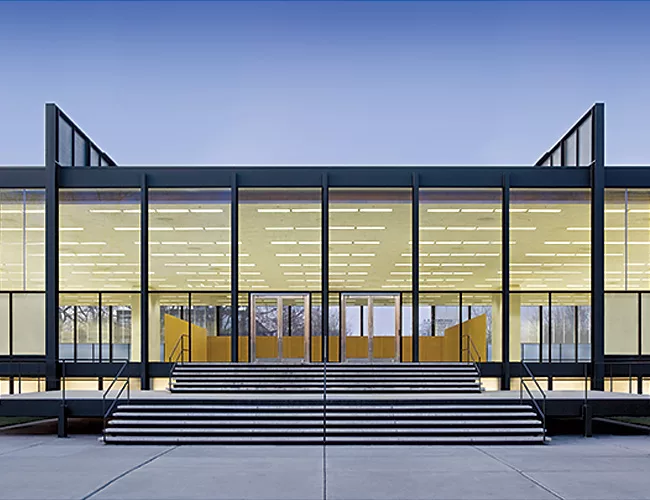
Like those Gothic cathedral builders who created the illusion of heaven, Mies expressed his own ultimate truth here: monastic and modern, wide like the Illinois prairie, made of hard Chicago steel. I am struck silent in its presence. It is glorious, utterly in repose, essential to itself—essential, it seems, to the collection of transcendent things we humans have created.
For all the tall buildings in Chicago (skyscrapers were born here, after all—don’t you dare forget it!), the city’s modern history is best expressed by this one-story building at 34th and State.
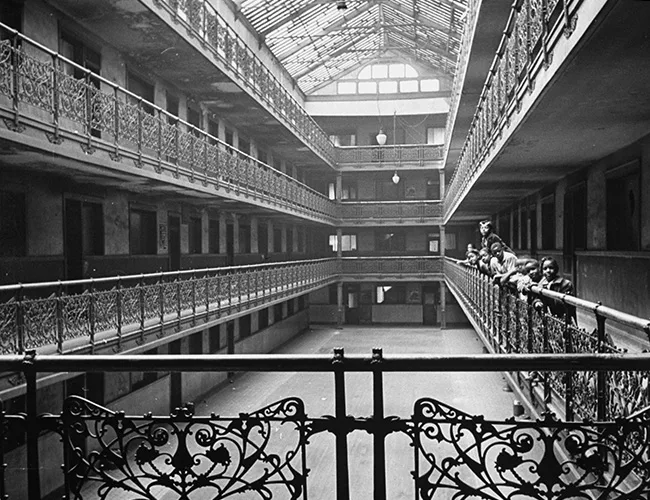
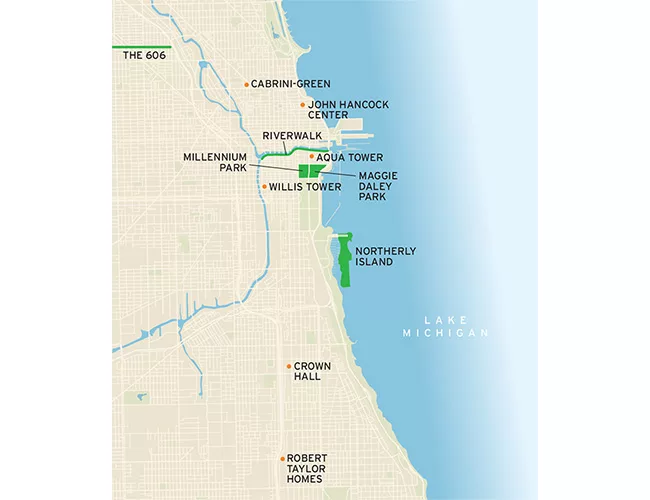
Crown Hall represents a battle. It stands where an apartment building called the Mecca once anchored Bronzeville, the heart of black Chicago and prime destination of the Great Migration north. Louis Armstrong first improvised on his horn in Bronzeville; its sharp, ambitious men and women, like Jesse Binga, John Johnson, and Ida B. Wells, established Chicago as the nation’s center of black business and journalism. The teeming Mecca, with its soaring atriums and intricate ironwork, was central to the scene. “To touch every note in the life of this block-long block-wide building,” wrote the poet Gwendolyn Brooks, “would be to capsulize the gist of black humanity in general.”
But it was also right in the middle of Mies’s plan for the new IIT campus. The school took ownership of the building in 1938. For the next 13 years, while much of the surrounding Near South Side was bulldozed and remade, residents fought IIT’s efforts to evict them until the wrecking ball finally struck on the last day of 1951. Brooks saw the grand new structure that rose on the site as an “erasure.” Her epic 1968 poem “In the Mecca,” arguably her masterpiece, recalls the building she had known:
firm arms surround
disorders, bruising ruses and small hells,
small semiheavens: hug barbarous rhetoric
built of buzz, coma and petite pell mells.
All buried now under tons of steel.
If Crown Hall is indeed a temple, as Saarinen said, it’s the sort Romans built in conquered territory, a statement that civilization as they knew it had finally taken control.
Chicago is the city America built when it turned away from Europe and asked itself what it really wanted to be. Through the days of Manifest Destiny and into the American Century, this was the national crossroads and meeting place. Between 1932 and 1960, nine out of 16 political conventions were held in Chicago; freight, people, and ideas all came through on their way east and west, north and south, bumping shoulders hard and often drawing blood. Big labor battled big business at Haymarket Square and Republic Steel; cops bludgeoned hippies on Michigan Avenue. The city’s wealth came from agriculture as much as industry, but the stockyards are gone and the smokestacks are mostly cold. Poverty sprawls in sight of opulence, suburban Babbitts still bumble through the aisles of Orchestra Hall, elementary schools fail minutes away from world-class universities. Barack Obama and Hillary Clinton came out of Chicago; so did Donald Rumsfeld and Milton Friedman. It could be priggish—the art students here rioted against the Armory Show in 1913—and it could be raw. Both the striptease and Hugh Hefner’s Playboy magazine are Chicago inventions.
But every city has rich and poor, light and dark. Chicago is at its best when it’s in the middle, bridging contrasts, as Louis Sullivan’s massive, delicate buildings do, winding tendrils around sharp corners, mediating between man’s need to build and the natural world. Nelson Algren turned the shattered glass of vacant lots into diamonds with his prose, the pain of tired losers into drama, while a blacklisted radio-show host and a high diva of the church—Studs Terkel and Mahalia Jackson—brought gospel music into the mainstream. When Muddy Waters plugged his guitar into an amp, he shot electricity through the old country blues (though they really weren’t that old—Robert Johnson recorded “Sweet Home Chicago” in 1937, the same year that László Moholy-Nagy, with Walter Gropius’s blessing, restarted the Bauhaus in the Field family mansion).
Chicago’s arts have a tradition of putting people ahead of theories. Realism and the individual voice have been central, from Terkel’s oral histories and the poems of Carl Sandburg, the plays of Lorraine Hansberry, David Mamet, and Tracy Letts to the fiction of Sandra Cisneros, Aleksandar Hemon, and Stuart Dybek, and the comedy of Second City. Its approach to television in the ’50s stressed intimacy and improvisation, a style compared to “fresh bread out of the oven” just when Jackie Gleason was threatening to knock Alice to the moon. Visit the Bungalow Districts to see how the Arts and Crafts movement here went beyond tiles and vases and became a part of daily life. That Chicago, the city of Jane Addams, Clarence Darrow, and Saul Alinsky—plainspoken, deeply concerned with the value of every person—their stories, their talents, their dreams—continues to show the battered American soul its dignity and its potential.
But in 1956, S.R. Crown Hall landed like a spaceship on that weary African-American community that was being demolished to make way for a future they were not invited to share. As the factories closed, the jobs seeped away, and the whites raced to the suburbs, Mayor Richard J. Daley broke ground on the vast complex of public housing that would institutionalize segregation in Chicago and warehouse thousands of African-Americans. In the 1990s, his son Richard M., then mayor, tore them down in what seemed at first an act of liberation, until the empty lots left behind grew over with ragweed, and those who’d survived the Robert Taylor Homes and Cabrini-Green found neighborhoods like Austin and Grand Crossing just as hopeless as the projects. Meanwhile, the gorgeous lakefront became even more gorgeous. Frank Gehry’s bandshell and Anish Kapoor’s iconic Bean shone in the sun. The same Clinton-era Empowerment Zones that in Harlem drew billions of dollars withered up on the streets of Bronzeville.
We were left with something unique at State and 34th. Two geniuses created masterpieces in a sort of opposition, but today Crown Hall and “In the Mecca” need each other to fully express their aspirations. I can’t see the building without hearing the words of Brooks, or read the poem without picturing the glory of Crown Hall. And this, I think, is how it should be. Time and the city have turned that half block into a single work of art, an unconscious, unwilling collaboration between two brilliant people who together commemorate and transcend what Chicago was, while teaching—in the most cautionary terms—that sharing space and resources, sharing beauty, sharing lives, is the key to Chicago’s future.
Thomas Dyja is the author of the award-winning The Third Coast: When Chicago Built the American Dream, this year’s title in the Chicago Public Library’s One Book, One Chicago program. © 2015 by Kelmscott Ink, Inc.
Looking for a reprint of this article?
From high-res PDFs to custom plaques, order your copy today!
.webp?height=200&t=1687999486&width=200 "MartExterior-Neocon (1).jpg")