Architectural Record
search
cart
facebook twitter linkedin youtube
  • Sign In
  • Subscribe
  • Sign Out
  • My Account
Architectural Record
  • NEWS
    • Latest News
    • Awards
    • Interviews
    • Obituaries
    • Podcasts
      • Design:Ed Podcast
      • Sponsored Podcasts
  • OPINION
    • Book Reviews / Excerpts
    • Exhibition Reviews
    • Forum
  • EXCLUSIVES
    • Videos
    • Design Vanguard
    • Top 300 Firms
    • Sponsored Content
    • Sponsored eBooks
    • From the Archives
  • CONTINUING ED
    • Editorial Continuing Ed
    • CE Center
    • CE Academies
  • PROJECTS
    • Buildings By Type
    • Reuse & Renovation
    • Museums & Arts Centers
    • Colleges & Universities
    • Multifamily Housing
    • Interiors
    • Lighting
    • Kitchen & Bath
  • HOUSES
    • Record Houses
    • House of the Month
    • Featured Houses
  • PRODUCTS
    • Products by Category
    • Record Products of the Year
    • Latest Products
  • EVENTS
    • Dates & Events
    • Record on the Road
    • Innovation Conference
    • Sustainability in Practice
    • Women In Architecture
    • Webinars
    • Ad Excellence Awards
    • Submit an Event
  • CONNECT
    • Ask RECORD AI
    • Newsletters
    • Contact
    • Advertise
    • Editorial Calendar
    • Store
    • Customer Service
  • SUBMIT
    • Submission Guidelines
    • RECORD Competitions
  • MAGAZINE
    • Subscribe
    • My Account
    • Digital Edition
    • Current Issue
    • Firm Pass
    • Historic Archive
Commentary & Criticism

Some suggestions on how to spend $800 billion

By Michael Sorkin
January 16, 2009

Dear President Obama,

I am extremely heartened that you are planning to address our miserable economic situation with a massive investment in infrastructure. This is not simply a logical and efficient way of translating dollars into jobs (although it’s always important to ask for whom), it is an investment in the long-term future of the country. Although I am writing this in December and don’t know precisely what the shape of your program will be, I appreciate that it will be of a magnitude commensurate with the problems at hand. You’ve already suggested that it will be the largest investment in public works since the building of the interstate highway system in the Eisenhower days, and that in the interest of speed you will be seeking “shovel-ready” projects. While I understand that the Eisenhower analogy is meant to suggest magnitude and “shovel-ready” efficiency, I urge you to be cautious about additional implications. The last thing we need is more highways, and those “shovel ready” projects will tend to reflect old priorities, not the change we need and can believe in.
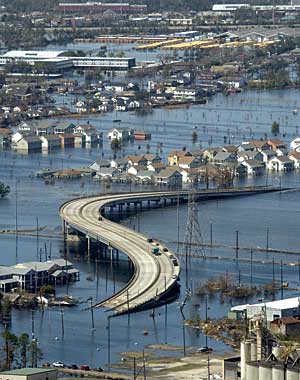
Flooded after Hurricane Katrina in 2005, New Orleans still has areas that need to be rebuilt.
Photo ' Michael Goodman
Flooded after Hurricane Katrina in 2005, New Orleans still has areas that need to be rebuilt.

Here are 10 suggestions for a stimulus program that will help remake our cities and take them into the new century.

1. Prepare for the postautomotive urban environment. After taking care of the most pressing repairs to bridges and roadways, initiate a massive aid program for the creation of a postautomotive urbanism. This will mean enormous investment in urban mass transit, intercity rail, as well as a planning and design regime that puts human locomotion — on foot, on bicycles — at the very top of the transit hierarchy. Both our cities and suburbs need radical redesign to incorporate systems that are in fundamental sympathy with urbanity. Instead of offering subsidies to convenience cars (look at the damage done to cities by the availability of irresistible financing in which the feds pick up 90 percent of the tab for the construction of interstates), the government should encourage compact cities that consume less energy and offer a good mix of uses. Subsidies should go for removing traffic lanes, not adding them. The effects of such “greenfill” would be to increase urban greenery (mitigating the heat-island effect and refreshing the air), offer space for pedestrians and public transit, and rebalance the use of what is far and away the largest component of our public built space.

2. Reconceive the automobile industry. Do not simply bail out the car companies, but force them to rebuild based on a new paradigm. This should include both their involvement in sustainable forms of mass transportation as well as a dramatic reconsideration of what an automobile should be in our era. Although moving rapidly away from fossil power is crucial, so is the production of cars that are specifically designed for cities. Instead of the large, dangerous vehicles optimized for the highway, we need a new class of small, slow, nonaggressive, clean cars for the urban environment — cars that fit comfortably with reduced roadways and the expansion of the pedestrian realm.

3. Rebuild the sewers. We need a massive program to reconstruct our water and sewage systems. Money should flow to eliminate sewers that mix storm and waste water in order to reduce pollution and conserve and appropriately reuse scarce water resources. We must also introduce gray-water systems and bioremediation facilities everywhere possible to further manage this life-giving asset.

4. Green America’s buildings. Raising standards for insulation and weatherization and greening the roofs of our buildings is perhaps the single most efficient expenditure we can quickly make to reduce energy consumption. Because such work does not require large organizations, it is most likely to benefit smaller businesses. Moreover, what could be a more suitable activity than a WPA-like intervention in both training and implementation? America has an obscenely large prison population. Instead of allowing it to languish, why not institute a large-scale program to train inmates in the skills necessary to green the country, creating a CCC work-relief program for the new century and a new cadre of small entrepreneurs. Imagine this huge cohort insulating, green-roofing, planting urban forests, repairing and expanding parks, managing urban agriculture, organizing recycling and reuse programs, and then returning to their neighborhoods to act in the vanguard of their sustainable transformation.

5. Convert rapidly to renewable energy. Undertake a Manhattan Project—scaled effort to convert our energy systems to renewable sources. After decades of palaver, it’s time to put up or shut up about this. We have come to understand that there is no silver bullet — no single system — that will move us beyond petroleum. And it has likewise become clear that much of the technology for rapid conversion already exists: wind-, hydro-, tidal-, gradient-, and solar-energy systems are ready to go and ready to be applied at all scales, not simply concentrated in the hands of giant utilities. Let us subsidize a vast conversion (and vastly discourage the use of such disproportionately dangerous, expensive, and dirty technologies as oil, coal, and nuclear energy). Let us also dramatically increase investment in research on the next generation of possibilities. Such expenditure is one of the most efficient ways of leveraging investment.

Share This Story

Looking for a reprint of this article?
From high-res PDFs to custom plaques, order your copy today!

Post a comment to this article

Report Abusive Comment

Subscription Center
  • Create an Account
  • Start a Subscription
  • Manage My Account
  • Sign Up for Newsletters
  • Visit Customer Service
  • Update Preferences

More Videos

Sponsored Content

Sponsored Content is a special paid section where industry companies provide high quality, objective, non-commercial content around topics of interest to the Architectural Record audience. All Sponsored Content is supplied by the advertising company and any opinions expressed in this article are those of the author and not necessarily reflect the views of Architectural Record or its parent company, BNP Media. Interested in participating in our Sponsored Content section? Contact your local rep!

close
  • TAMLYN XtremeTrim Exterior Trim
    Sponsored byTamlyn

    Designing Cleaner Panel Facades: Why Exterior Trim Details Matter

  • Building with Vapor Barriers
    Sponsored byReef Industries, Inc.

    Vapor Barriers Help Control Moisture in Tighter Building Designs

  • Duct Interior with Prodeq System
    Sponsored byHenry, a Carlisle Company

    Designing Resilient Water Containment Systems

DESIGN:ED Podcast
Listen to Architectural Record’s DESIGN:ED Podcast

Events

June 10, 2026

Rethinking Stormwater – The Power of Porous Paving

Credits: 1 AIA LU/HSW; 1 AIBD P-CE; 0.1 ICC CEU

Learn how porous paving systems support stormwater management, reduce heat island effects, and enhance sustainable site design performance.

June 11, 2026

Very Early Warning Fire Detection for Mission-Critical Facilities

Credits: 1 AIA LU/HSW; 1 AIBD P-CE; 0.1 ICC CEU

Examine advanced fire detection strategies that support uptime and enhance safety in data centers and other mission-critical facilities.

View All Submit An Event

Products

2026 Architect's Square Foot Costbook

2026 Architect's Square Foot Costbook

See More Products

Popular Stories

Practice Matters illustration

What’s in a (Firm’s) Name? Thinking About Succession and Legacy

Coronado Bridge

The Architect’s Guide to San Diego

Practice Matters illustration

By the Numbers: Counting America's Architects

Riverdale House by Studio Lau

Riverdale House by Studio Lau

KRESA by DLR

In Kalamazoo, DLR Group Completes a Mass-Timber Hub for Career and Technical Education Programs

Broader Sustainability of CMU - Free Webinar - May 21, 2026

Related Articles

  • Some suggestions on how to spend $800 billion

    See More
  • How to Avoid a Climate Disaster

    Bill Gates's Book on How to Save the Planet

    See More
  • Nbar-BIG-1.jpg

    DESIGN:ED Podcast: Bjarke Ingels On How His New Company Is Building Pathways to Affordable Housing

    See More

Related Products

See More Products
  • GlobalData_logo_blue_header.png

    Construction in the US - Key Trends and Opportunities to 2023

  • 3dthinking.jpg

    3D Thinking in Design and Architecture: From Antiquity to the Future

  • 9 ways.jpg

    9 Ways To Make Housing for People

See More Products
×

The latest news and information

#1 Source for Architectural Design, News and Products

SUBSCRIBE
  • RESOURCES
    • Advertise
    • Contact Us
    • Submit
    • Store
  • ACCOUNT CENTER
    • Create an Account
    • Start a Subscription
    • Manage My Account
    • Sign Up for Newsletters
    • Visit Customer Service
    • Update Preferences
  • PRIVACY
    • PRIVACY POLICY
    • TERMS & CONDITIONS
    • DO NOT SELL MY PERSONAL INFORMATION
    • PRIVACY REQUEST
    • ACCESSIBILITY
  • SERVICES
    • Marketing Services
    • Reprints
    • Market Research
    • List Rental
    • Survey/Respondent Access
  • STAY CONNECTED
    • Linkedin
    • Facebook
    • Instagram
    • YouTube
    • X (Twitter)

Copyright ©2026. All Rights Reserved BNP Media, Inc. and BNP Media II, LLC.

Design, CMS, Hosting & Web Development :: ePublishing