Architectural Record
search
cart
facebook twitter linkedin youtube
  • Sign In
  • Subscribe
  • Sign Out
  • My Account
Architectural Record
  • NEWS
    • Latest News
    • Awards
    • Interviews
    • Obituaries
    • Podcasts
      • Design:Ed Podcast
      • Sponsored Podcasts
  • OPINION
    • Book Reviews / Excerpts
    • Exhibition Reviews
    • Forum
  • EXCLUSIVES
    • Videos
    • Design Vanguard
    • Top 300 Firms
    • Sponsored Content
    • Sponsored eBooks
    • From the Archives
  • CONTINUING ED
    • Editorial Continuing Ed
    • CE Center
    • CE Academies
  • PROJECTS
    • Buildings By Type
    • Reuse & Renovation
    • Museums & Arts Centers
    • Colleges & Universities
    • Multifamily Housing
    • Interiors
    • Lighting
    • Kitchen & Bath
  • HOUSES
    • Record Houses
    • House of the Month
    • Featured Houses
  • PRODUCTS
    • Products by Category
    • Record Products of the Year
    • Latest Products
  • EVENTS
    • Dates & Events
    • Record on the Road
    • Innovation Conference
    • Sustainability in Practice
    • Women In Architecture
    • Webinars
    • Ad Excellence Awards
    • Submit an Event
  • CONNECT
    • Ask RECORD AI
    • Newsletters
    • Contact
    • Advertise
    • Editorial Calendar
    • Store
    • Customer Service
  • SUBMIT
    • Submission Guidelines
    • RECORD Competitions
  • MAGAZINE
    • Subscribe
    • My Account
    • Digital Edition
    • Current Issue
    • Firm Pass
    • Historic Archive
Commentary & Criticism

Temporary openings in the city fabric tempt a critic to imagine

By Michael Sorkin
May 16, 2009

Not long ago, a small midblock building was demolished not far from my office in SoHo. The excision was a revelation. Because of a sequence of low buildings in succeeding blocks, it was suddenly possible to look through a remarkable cut in the city that reconfigured the backs of buildings with their principal facades on the avenues into a long series of fronts. The space is like none other in New York in its proportions and architectonic character, the elegant austerity of the backs of buildings with ornamented facades making a place both lyrical and tough. Looking at it, it’s easy to imagine further transformations, an accessible swath of public space stretching five blocks through the heart of town.
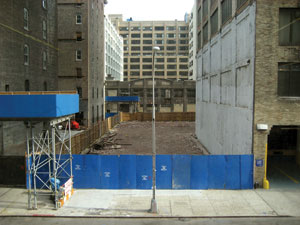
A midblock cut in SoHo offers a chance to rethink urban open space.
Photo ' Aleksandr Bierig
A midblock cut in SoHo offers a chance to rethink urban open space.

The uneven development of the city—its cycles of boom and bust—drive the production of innumerable morphological accidents, yielding spaces of unexpected character. Behind the building where I had my office several years ago was a parking lot, flanked by an old cobbled street. My building, 14 stories high, was on the eastern side of the space. The other sides were flanked by much lower structures—two-to-six stories—and the accidental plaza that resulted was of a rare proportion. It would have made a superb public space, easily captured and configured.

Unfortunately, nature and real estate abhor a vacuum: This space was eventually occupied by another 14-story building designed to look like the twin of the first, and the plaza was lost forever. It will also be the fate of the demolished site that launched the view of the blocks-long cut here in SoHo to be refilled by a rising tower. These evanescent states are both part of the genius of the development system, poignant short-lived urban phenomena, and tragic exemplars of its limits. Caught in a situation that both produces and destroys its own greatness, we are too often unable to value this kind of revelatory anomaly until it is too late. Who can save it?

Part of the problem is that our planning is done with instruments too blunt and sluggish to properly accommodate unexpected or serendipitous circumstances, events we simply do not see. Landmarking can’t save these spaces because, even though they may occur in historic districts, they are new, not part of an already legible pattern. Nor can zoning, which is a system for managing the upper limits of use and density help. In economically robust times, everything presses this envelope.

An opportunity in D.C.

The conundrum was made especially clear to me at a recent conference at Cornell organized to discuss the “NoMa” (North of Massachusetts Avenue) development in Washington, D.C. This is a concerted effort to build out a series of largely derelict blocks just north of Union Station and a stone’s throw from the U.S. Capitol. The project has been in various stages of deal-making and development for 17 years and was propelled forward by an eminently sensible move: the creation of a new station in the district along the existing Metro line. This, coupled with a bike route of suburban reach and location next to the city’s expanding downtown, has created the nexus for a classic transit-oriented development.

Unfortunately, because of a lack of resources and municipal planning chops that are part of the disenfranchising legacy of the District’s lack of home rule, the opportunity to plan creatively has been largely lost. The morphological possibilities of the site remain hemmed by the demands of the block pattern of the L’Enfant plan, the early-20th-century imposition of a citywide 130-foot height limit, a uniform FAR of 10, and the giant infrastructure of the railway as it fans out in approach to the station. The result is a plan that treats the literal blank slate of the site as an infill problem, with each developer taking its parcel to the physical limits and letting function be dictated by market forces. Thus, what was heading toward a reasonably harmonized mix of housing and offices was first skewed dramatically to offices and will now fall into a state of arrested development as the result of the national economic collapse.

Share This Story

Looking for a reprint of this article?
From high-res PDFs to custom plaques, order your copy today!

Post a comment to this article

Report Abusive Comment

Subscription Center
  • Create an Account
  • Start a Subscription
  • Manage My Account
  • Sign Up for Newsletters
  • Visit Customer Service
  • Update Preferences

More Videos

Sponsored Content

Sponsored Content is a special paid section where industry companies provide high quality, objective, non-commercial content around topics of interest to the Architectural Record audience. All Sponsored Content is supplied by the advertising company and any opinions expressed in this article are those of the author and not necessarily reflect the views of Architectural Record or its parent company, BNP Media. Interested in participating in our Sponsored Content section? Contact your local rep!

close
  • TAMLYN XtremeTrim Exterior Trim
    Sponsored byTamlyn

    Designing Cleaner Panel Facades: Why Exterior Trim Details Matter

  • Building with Vapor Barriers
    Sponsored byReef Industries, Inc.

    Vapor Barriers Help Control Moisture in Tighter Building Designs

  • Duct Interior with Prodeq System
    Sponsored byHenry, a Carlisle Company

    Designing Resilient Water Containment Systems

DESIGN:ED Podcast
Listen to Architectural Record’s DESIGN:ED Podcast

Events

June 10, 2026

Rethinking Stormwater – The Power of Porous Paving

Credits: 1 AIA LU/HSW; 1 AIBD P-CE; 0.1 ICC CEU

Learn how porous paving systems support stormwater management, reduce heat island effects, and enhance sustainable site design performance.

June 11, 2026

Very Early Warning Fire Detection for Mission-Critical Facilities

Credits: 1 AIA LU/HSW; 1 AIBD P-CE; 0.1 ICC CEU

Examine advanced fire detection strategies that support uptime and enhance safety in data centers and other mission-critical facilities.

View All Submit An Event

Products

2026 Architect's Square Foot Costbook

2026 Architect's Square Foot Costbook

See More Products

Popular Stories

Practice Matters illustration

What’s in a (Firm’s) Name? Thinking About Succession and Legacy

Practice Matters illustration

By the Numbers: Counting America's Architects

Riverdale House by Studio Lau

Riverdale House by Studio Lau

House on a Hill

Design Vanguard 2026: Forma

Crane Cove, ONO

Design Vanguard 2026 Winners

Broader Sustainability of CMU - Free Webinar - May 21, 2026

Related Articles

  • Temporary openings in the city fabric tempt a critic to imagine

    See More
  • Who is the City For

    A Chicago Architecture Critic Interrogates the Role of Design in Constructing the City's History

    See More
  • Summer in the City

    See More

Related Products

See More Products
  • GlobalData_logo_blue_header.png

    Construction in the US - Key Trends and Opportunities to 2023

  • 3dthinking.jpg

    3D Thinking in Design and Architecture: From Antiquity to the Future

See More Products
×

The latest news and information

#1 Source for Architectural Design, News and Products

SUBSCRIBE
  • RESOURCES
    • Advertise
    • Contact Us
    • Submit
    • Store
  • ACCOUNT CENTER
    • Create an Account
    • Start a Subscription
    • Manage My Account
    • Sign Up for Newsletters
    • Visit Customer Service
    • Update Preferences
  • PRIVACY
    • PRIVACY POLICY
    • TERMS & CONDITIONS
    • DO NOT SELL MY PERSONAL INFORMATION
    • PRIVACY REQUEST
    • ACCESSIBILITY
  • SERVICES
    • Marketing Services
    • Reprints
    • Market Research
    • List Rental
    • Survey/Respondent Access
  • STAY CONNECTED
    • Linkedin
    • Facebook
    • Instagram
    • YouTube
    • X (Twitter)

Copyright ©2026. All Rights Reserved BNP Media, Inc. and BNP Media II, LLC.

Design, CMS, Hosting & Web Development :: ePublishing