Architectural Record
search
cart
facebook twitter linkedin youtube
  • Sign In
  • Subscribe
  • Sign Out
  • My Account
Architectural Record
  • NEWS
    • Latest News
    • Awards
    • Interviews
    • Obituaries
    • Podcasts
      • Design:Ed Podcast
      • Sponsored Podcasts
  • OPINION
    • Book Reviews / Excerpts
    • Exhibition Reviews
    • Forum
  • EXCLUSIVES
    • Videos
    • Design Vanguard
    • Top 300 Firms
    • Sponsored Content
    • Sponsored eBooks
    • From the Archives
  • CONTINUING ED
    • Editorial Continuing Ed
    • CE Center
    • CE Academies
  • PROJECTS
    • Buildings By Type
    • Reuse & Renovation
    • Museums & Arts Centers
    • Colleges & Universities
    • Multifamily Housing
    • Interiors
    • Lighting
    • Kitchen & Bath
  • HOUSES
    • Record Houses
    • House of the Month
    • Featured Houses
  • PRODUCTS
    • Products by Category
    • Record Products of the Year
    • Latest Products
  • EVENTS
    • Dates & Events
    • Record on the Road
    • Innovation Conference
    • Sustainability in Practice
    • Women In Architecture
    • Webinars
    • Ad Excellence Awards
    • Submit an Event
  • CONNECT
    • Ask RECORD AI
    • Newsletters
    • Contact
    • Advertise
    • Editorial Calendar
    • Store
    • Customer Service
  • SUBMIT
    • Submission Guidelines
    • RECORD Competitions
  • MAGAZINE
    • Subscribe
    • My Account
    • Digital Edition
    • Current Issue
    • Firm Pass
    • Historic Archive
Commentary & Criticism

Temporary openings in the city fabric tempt a critic to imagine

By Michael Sorkin
May 16, 2009

The end state of this project will be seriously constrained by its failure to “capitalize” on the spatial possibilities opened up by its strong relationship to transportation and its rare anything-possible beginning state. And although all the actors involved diligently tithe the idea of a mixed-use, green, and design-intensive neighborhood, they all claim to be powerless to achieve anything beyond the alleged market constraints and planning default. Nevertheless, the D.C. planning department—which now has unusually enlightened leadership—continues to struggle to retrofit the unbuilt project with decent streetscapes and a set of secondary uses beyond mere retail. Stay tuned.

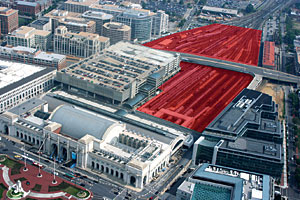
Developers have drawn up plans to build a mixed-use neighborhood in the NoMA area in Washington, D.C.
Renderings Courtesy NoMA Business Improvement District
Developers have drawn up plans to build a mixed-use neighborhood in the NoMA area in Washington, D.C.

The irony of the accidental plaza suppressed in New York and the impossibility of producing any plaza, legible center, or sense of hierarchy and variety in Washington lies in the fact that while the founding physical conditions are opposites, the conceptual cage in which both sets of circumstances are locked is identical. Most of us can recognize decent urbanity when we see it, but we are constrained by the inefficiencies and limits of paradigms that are too narrow, too limited, too unimaginative.

Whether it’s the treacly reproduction of historic forms devolved from any meaningful context, the brutalizing celebration of capital’s “creative” destruction as unassailable spirit guide, the slavish futures of current fashion, or the devil-made-me-do-it obedience to the “as-of-right” city, the results too consistently fail to satisfy the basic tenets of good city life.

Relying on the collective

Like many others, I am both wonderfully impressed by the energy of the new Obama administration and increasingly skeptical of the flow of stimulus funds to the big banks and corporations whose ineptitude and greed got us into this mess. After years of seething at the Republican and “new” Democrat mantra of government incompetence and irrelevance, it is stunning to see how quickly the fat cats and indifferent libertarians have turned to the collectivity to pull the singed chestnuts of flaming capital out of the fire. And yet, the application of stimulus structurally repeats the old Republican fantasy of wealth’s distribution: By making life agreeable for the rich, benefit will trickle down to those less empowered.

Our cities need a stimulus package that works from the bottom up and—from us—a mighty stimulus package for the imagination. At NoMa, it is only the disenfranchised government, left without powerful enough administrative tools, without funds, and with influence too diminished, that can and should act to secure the genuinely highest and best use of the site. While build-out (when it eventually occurs) will certainly result in a greatly enhanced revenue stream, and while many argue that this money should return to the site in the form of improvements, this is both too late and contravenes the larger fiduciary obligations of the public sector, which must always balance the competing claims of the citizenry as a whole. The tax-increment-financing model, and the Business Improvement District overlay, masquerade as a kind of community empowerment but actually function to sustain the disproportionate enabling of the already empowered.

While I have deep skepticism about top-down approaches to planning and the too-frequent privileging of the formal over the social in dealing with questions of the city, there are many occasions in which government must decisively step in and set the agenda, the standard, and the solution. To invariably associate such intervention with the dystopian stylings of Robert Moses, Albert Speer, or Walt Disney, is to be stupid about the real obligations and possibilities of the collectivity. How tired I am of hearing endlessly about the so-called “public-private” model (as if there were any other in a democracy) when all it amounts to is a cover for the public’s giving away the store, acting on the same grasping profit model as those corporations whose only idea of public interest is sucker rates on adjustable mortgages and credit cards.

Now that the government has moved so swiftly and insistently to plan the economy, has embraced its role in providing medical care for all, is ponying up untold billions to save Afghanistan, perhaps the same kind of bold responsibility might be taken for the mess at home. Bailing out General Motors is not exactly transit-oriented development.

Share This Story

Looking for a reprint of this article?
From high-res PDFs to custom plaques, order your copy today!


Post a comment to this article

Report Abusive Comment

Subscription Center
  • Create an Account
  • Start a Subscription
  • Manage My Account
  • Sign Up for Newsletters
  • Visit Customer Service
  • Update Preferences

More Videos

Sponsored Content

Sponsored Content is a special paid section where industry companies provide high quality, objective, non-commercial content around topics of interest to the Architectural Record audience. All Sponsored Content is supplied by the advertising company and any opinions expressed in this article are those of the author and not necessarily reflect the views of Architectural Record or its parent company, BNP Media. Interested in participating in our Sponsored Content section? Contact your local rep!

close
  • TAMLYN XtremeTrim Exterior Trim
    Sponsored byTamlyn

    Designing Cleaner Panel Facades: Why Exterior Trim Details Matter

  • Building with Vapor Barriers
    Sponsored byReef Industries, Inc.

    Vapor Barriers Help Control Moisture in Tighter Building Designs

  • Duct Interior with Prodeq System
    Sponsored byHenry, a Carlisle Company

    Designing Resilient Water Containment Systems

DESIGN:ED Podcast
Listen to Architectural Record’s DESIGN:ED Podcast

Events

June 10, 2026

Rethinking Stormwater – The Power of Porous Paving

Credits: 1 AIA LU/HSW; 1 AIBD P-CE; 0.1 ICC CEU

Learn how porous paving systems support stormwater management, reduce heat island effects, and enhance sustainable site design performance.

June 11, 2026

Very Early Warning Fire Detection for Mission-Critical Facilities

Credits: 1 AIA LU/HSW; 1 AIBD P-CE; 0.1 ICC CEU

Examine advanced fire detection strategies that support uptime and enhance safety in data centers and other mission-critical facilities.

View All Submit An Event

Products

2026 Architect's Square Foot Costbook

2026 Architect's Square Foot Costbook

See More Products

Popular Stories

Practice Matters illustration

What’s in a (Firm’s) Name? Thinking About Succession and Legacy

Coronado Bridge

The Architect’s Guide to San Diego

Practice Matters illustration

By the Numbers: Counting America's Architects

House on a Hill

Design Vanguard 2026: Forma

Crane Cove, ONO

Design Vanguard 2026 Winners

Broader Sustainability of CMU - Free Webinar - May 21, 2026

Related Articles

  • Temporary openings in the city fabric tempt a critic to imagine

    See More
  • Who is the City For

    A Chicago Architecture Critic Interrogates the Role of Design in Constructing the City's History

    See More
  • Summer in the City

    See More

Related Products

See More Products
  • GlobalData_logo_blue_header.png

    Construction in the US - Key Trends and Opportunities to 2023

  • 3dthinking.jpg

    3D Thinking in Design and Architecture: From Antiquity to the Future

See More Products
×

The latest news and information

#1 Source for Architectural Design, News and Products

SUBSCRIBE
  • RESOURCES
    • Advertise
    • Contact Us
    • Submit
    • Store
  • ACCOUNT CENTER
    • Create an Account
    • Start a Subscription
    • Manage My Account
    • Sign Up for Newsletters
    • Visit Customer Service
    • Update Preferences
  • PRIVACY
    • PRIVACY POLICY
    • TERMS & CONDITIONS
    • DO NOT SELL MY PERSONAL INFORMATION
    • PRIVACY REQUEST
    • ACCESSIBILITY
  • SERVICES
    • Marketing Services
    • Reprints
    • Market Research
    • List Rental
    • Survey/Respondent Access
  • STAY CONNECTED
    • Linkedin
    • Facebook
    • Instagram
    • YouTube
    • X (Twitter)

Copyright ©2026. All Rights Reserved BNP Media, Inc. and BNP Media II, LLC.

Design, CMS, Hosting & Web Development :: ePublishing