Architectural Record
search
cart
facebook twitter linkedin youtube
  • Sign In
  • Subscribe
  • Sign Out
  • My Account
Architectural Record
  • NEWS
    • Latest News
    • Awards
    • Interviews
    • Obituaries
    • Podcasts
      • Design:Ed Podcast
      • Sponsored Podcasts
  • OPINION
    • Book Reviews / Excerpts
    • Exhibition Reviews
    • Forum
  • EXCLUSIVES
    • Videos
    • Design Vanguard
    • Top 300 Firms
    • Sponsored Content
    • Sponsored eBooks
    • From the Archives
  • CONTINUING ED
    • Editorial Continuing Ed
    • CE Center
    • CE Academies
  • PROJECTS
    • Buildings By Type
    • Reuse & Renovation
    • Museums & Arts Centers
    • Colleges & Universities
    • Multifamily Housing
    • Interiors
    • Lighting
    • Kitchen & Bath
  • HOUSES
    • Record Houses
    • House of the Month
    • Featured Houses
  • PRODUCTS
    • Products by Category
    • Record Products of the Year
    • Latest Products
  • EVENTS
    • Dates & Events
    • Record on the Road
    • Innovation Conference
    • Sustainability in Practice
    • Women In Architecture
    • Webinars
    • Ad Excellence Awards
    • Submit an Event
  • CONNECT
    • Ask RECORD AI
    • Newsletters
    • Contact
    • Advertise
    • Editorial Calendar
    • Store
    • Customer Service
  • SUBMIT
    • Submission Guidelines
    • RECORD Competitions
  • MAGAZINE
    • Subscribe
    • My Account
    • Digital Edition
    • Current Issue
    • Firm Pass
    • Historic Archive
Architecture NewsInterviews

Newsmaker Interview: Ennead's Richard Olcott Designs a New Museum for Stanford University
By Eric Bryant
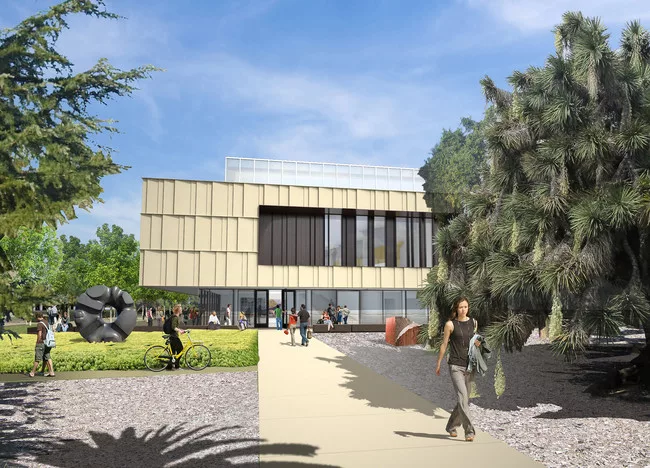
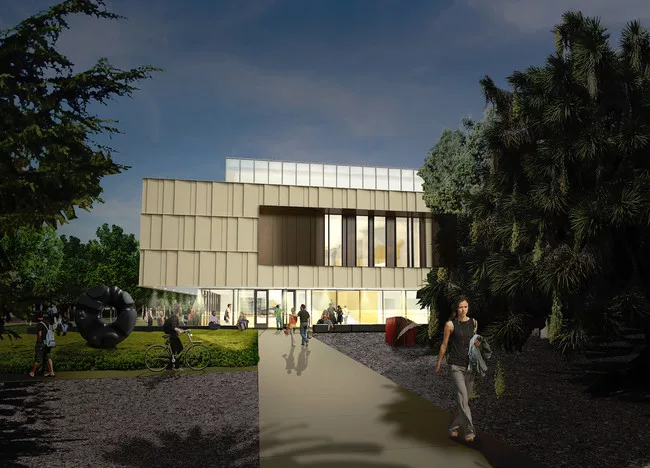
Construction is underway on a building to house “Hunk” and “Moo” Anderson’s significant collection of postwar American art.
Newsmaker Interview: Ennead’s Richard Olcott Designs a New Museum for Stanford University
Construction is underway on a building to house “Hunk” and “Moo” Anderson’s significant collection of postwar American art.
Image courtesy Ennead Architects
Construction is underway on a building to house “Hunk” and “Moo” Anderson’s significant collection of postwar American art.
Newsmaker Interview: Ennead’s Richard Olcott Designs a New Museum for Stanford University
Construction is underway on a building to house “Hunk” and “Moo” Anderson’s significant collection of postwar American art.
Image courtesy Ennead Architects
Construction is underway on a building to house “Hunk” and “Moo” Anderson’s significant collection of postwar American art.
Newsmaker Interview: Ennead’s Richard Olcott Designs a New Museum for Stanford University
Construction is underway on a building to house “Hunk” and “Moo” Anderson’s significant collection of postwar American art.
Image courtesy Ennead Architects
Construction is underway on a building to house “Hunk” and “Moo” Anderson’s significant collection of postwar American art.
Newsmaker Interview: Ennead’s Richard Olcott Designs a New Museum for Stanford University
Construction is underway on a building to house “Hunk” and “Moo” Anderson’s significant collection of postwar American art.
Image courtesy Ennead Architects
Construction is underway on a building to house “Hunk” and “Moo” Anderson’s significant collection of postwar American art.
Newsmaker Interview: Ennead’s Richard Olcott Designs a New Museum for Stanford University
Construction is underway on a building to house “Hunk” and “Moo” Anderson’s significant collection of postwar American art.
Image courtesy Ennead Architects
Construction is underway on a building to house “Hunk” and “Moo” Anderson’s significant collection of postwar American art.
Newsmaker Interview: Ennead’s Richard Olcott Designs a New Museum for Stanford University
Construction is underway on a building to house “Hunk” and “Moo” Anderson’s significant collection of postwar American art.
Image courtesy Ennead Architects
Construction is underway on a building to house “Hunk” and “Moo” Anderson’s significant collection of postwar American art.
December 1, 2013

Construction is underway on a building to house “Hunk” and “Moo” Anderson’s significant collection of postwar American art.

In the spring of 2011, Stanford University reached out to Richard Olcott, partner at Ennead Architects, asking him to design a new museum space for a major collection of artwork recently acquired by the school. A gift from Harry “Hunk” and Mary Margaret “Moo” Anderson—as well as their daughter Mary Patricia “Putter” Anderson Pence—the 121 masterworks by 86 artists represent a comprehensive catalog of postwar American movements: Abstract Expressionism, Post-Minimalism, Bay-Area Figurative Art, and Light and Space, among them. Highlights include Jackson Pollock’s Lucifer (1947), Willem de Kooning’s Woman Standing—Pink (1954-55), Clyfford Still’s 1957-J No. 1 (1957), and Ellsworth Kelly’s Black Ripe (1955).

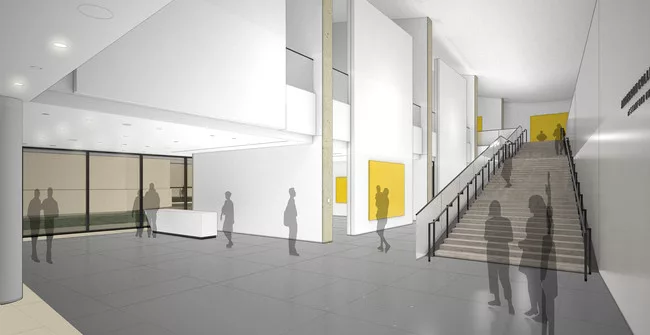
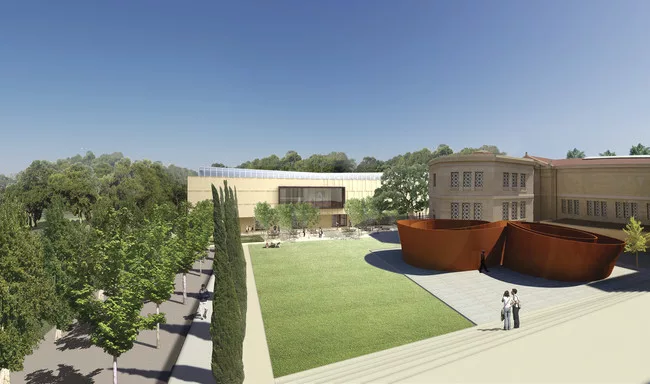
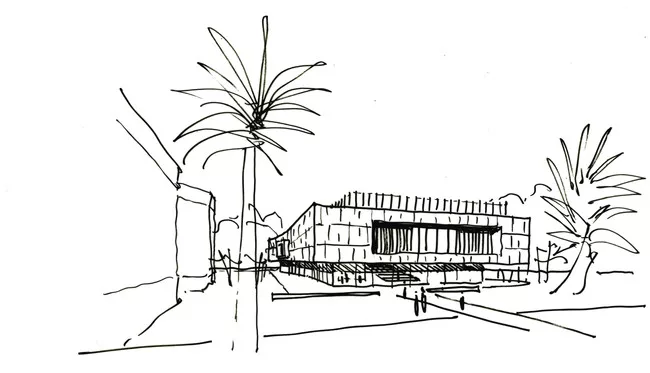
To house the trove of work, Olcott devised a lantern-like box floating above a glass-enclosed lobby and capped by a rectangular band clearstory windows. The ground floor of the two-story building houses all of the museum’s supplemental spaces—a foyer and restrooms, loading docks and storage, and a teaching space—while the second floor is comprised of galleries arrayed around a wide central stair. Exterior construction on the 33,000-square-foot structure has just been finished, and when it opens in September 2014, the building will complete a new arts district at the entrance to the campus.

While some of the work in the Anderson Collection is quite large, many have been housed for decades in the family’s Atherton, California, home, which Olcott has described as a “classic postwar California ‘ranch’ house: a series of interconnected spaces that embrace the site, extending out into the landscape under spreading shallow pitched roofs.” Within that setting, the art was lived with in a casual way. The architect recalls noticing on his first visit how candlesticks on the dining room buffet stood directly in front of the Pollock and how a Rothko squeezed in the entryway was hung just inches off the floor. With his design, Olcott aimed to capture the sense of both openness to the landscape and intimacy with the artworks he found in the Anderson’s home.

This is Olcott’s third turn designing for Stanford's arts district. In 1994, he and James Polshek (Ennead was then known as Polshek and Partners) undertook the renovation and expansion of the Cantor Center for the Visual Arts, which was built in 1891 and anchors the cluster of arts buildings. He and the firm also designed the Bing Concert Hall, which opened in January 2013. RECORD recently spoke with Olcott about the Anderson project and its campus context.

Eric Bryant: Where did the design process begin?

Richard Olcott: We started by going to the Andersons’ house to see the collection and then to Hunk’s two office buildings, where another 800 pieces were on view. So from those first visits, we knew that the work was of a certain scale and we determined that we wanted natural light that could echo those environments.

We also knew that the family had pledged 121 of those artworks, and the director of the Cantor, Connie Wolf, came up with 15,000 square feet as the amount of space necessary for that number of paintings. The site [adjacent to the 1891 building] also played an important role because we knew we didn’t want to make a tall building.

Given those constraints, we started by testing the waters with the team from Stanford—the Andersons, the university architect, the director of the Cantor, and a representative from the president’s office. We asked, "What kind of museums do you like?" and showed them a bunch of typologies of museum structures: a big box, a series or parallel halls with light at the ends, a group of pavilions, an amalgam of little rooms. All these were based on places like the Louisiana Museum outside Copenhagen [by Jørgen Bo and Wilhelm Wohlert] and David Chipperfield’s design for the Barbara Hepworth Museum in the U.K., as well as the Twombly building at the Menil Collection in Houston, the Fondation Beyeler in Basel, Switzerland, and the Nasher Sculpture Center in Dallas [all designed by Renzo Piano]. Eventually we coalesced around the current assortment of rooms around a central open stair.

EB: Did knowing the specific works in this collection provide the parameters for this design?

RO: We avoided thinking in terms of the placement of specific works in the collection. The curators wanted a variety of spaces, some large and some small. At one point, there was a conversation about putting the most important pieces in one place, so we have this large, daylit room at the top of the stairs, but that can change with different shows. There are also a couple spaces around the perimeter of that space with lower light levels, in case they want to do shows of sensitive works on paper.

Around the galleries there is no clear path; you can take it in any way you want. But we are hoping that after you come up the stair, you will see a big window to your left and you will be reconnected to the landscape.

EB: Light seems key to the design.

RO: Light comes in through windows on all four sides of the building, but the strip of clearstory windows, which also continues around all four sides, are the most important feature. They have two layers of glass, and in between, what is basically a system of venetian blinds that will be mechanically adjusted depending on what the sun is doing. We have one sensor on the roof, but we also have a number of sensors inside the gallery that automatically calibrates the daylight in 12 different zones.

To help spread the light, the ceiling above the clearstories is bowed—raised at the edges and very low in the center, at the top of the stairs. The idea is that it gradually compresses as you ascend the stairs, and then it pushes you out to the galleries. But the form also works to bounce light back down into the galleries. We are trying to get the ceiling and daylight to do the work, providing natural light throughout the building, while on a good day the electric lights will be off.

EB: How did you try to make this tie in with or stand out from the other structures in the arts district?

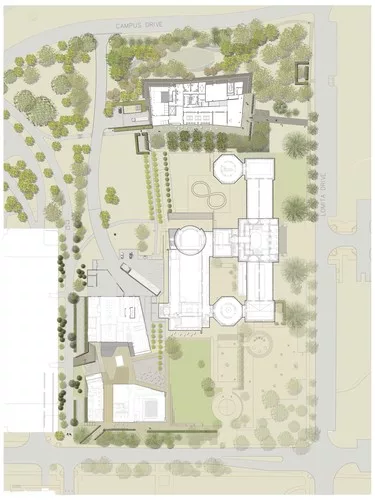
We went through some wilder things—we said “What if we made it out of CorTen steel?” and administrators said “No.” Some at the university were very concerned that if we were not going to blend in style, we should relate through colors and materials. So the style is distinct, but there are cues that connect to the other buildings, especially with the Cantor. We wanted to reinforce an axial relationship with the Cantor just to the south. (Click on the slide show to view a site plan.) The 1994 Cantor addition that we designed has a big drum on the north end. Its second floor is a sculpture terrace that looks toward the Anderson site at about the same elevation as the Anderson’s galleries. The main window at the left of the top of the stairs in the Anderson looks back toward the drum.

In terms of materials, the original Cantor is made from reinforced, cast-in-place concrete—it was one of the first reinforced concrete buildings in America. The tiles on the exterior of the second story of the Anderson, on the other hand, are precast, but the colors are a close match. The Anderson’s windows are trimmed in zinc, which is intended to pick up on the black window grills in the Cantor.

Ultimately, we had to stick close to the older building’s palette because the university had to go to the historic preservation office and explain how the new structure would relate to its landmarked neighbor. Once preservation officials saw the materials and colors, they bought in and signed off on the design.

Share This Story

Looking for a reprint of this article?
From high-res PDFs to custom plaques, order your copy today!

Post a comment to this article

Report Abusive Comment

Subscription Center
  • Create an Account
  • Start a Subscription
  • Manage My Account
  • Sign Up for Newsletters
  • Visit Customer Service
  • Update Preferences

More Videos

Sponsored Content

Sponsored Content is a special paid section where industry companies provide high quality, objective, non-commercial content around topics of interest to the Architectural Record audience. All Sponsored Content is supplied by the advertising company and any opinions expressed in this article are those of the author and not necessarily reflect the views of Architectural Record or its parent company, BNP Media. Interested in participating in our Sponsored Content section? Contact your local rep!

close
  • TAMLYN XtremeTrim Exterior Trim
    Sponsored byTamlyn

    Designing Cleaner Panel Facades: Why Exterior Trim Details Matter

  • Building with Vapor Barriers
    Sponsored byReef Industries, Inc.

    Vapor Barriers Help Control Moisture in Tighter Building Designs

  • Duct Interior with Prodeq System
    Sponsored byHenry, a Carlisle Company

    Designing Resilient Water Containment Systems

DESIGN:ED Podcast
Listen to Architectural Record’s DESIGN:ED Podcast

Events

June 18, 2026

Rebooting the Aging Office Building

Credits: 1 AIA LU/HSW; 1 AIBD P-CE; 0.1 ICC CEU; 1 PDH

Explore façade retrofit strategies and award-winning design concepts that can transform aging office buildings into healthier, higher-performing workplaces for today’s hybrid workforce.

June 23, 2026

Enhancing Fire Resistance with Advanced PVC Solutions

Credits: 1 AIA LU/HSW; 1 AIBD P-CE; 0.1 ICC CEU; 1 IIBEC CEH

Evaluate advanced PVC solutions that improve fire resistance, support WUI compliance, and enhance resilience in residential and commercial building design.

View All Submit An Event

Products

2026 Architect's Square Foot Costbook

2026 Architect's Square Foot Costbook

See More Products

Popular Stories

SanDiegoAirport

Top 300 Architecture Firms of 2026

Coronado Bridge

The Architect’s Guide to San Diego

Lorcan O' Herilhy

California Architect Lorcan O’Herlihy Has Died, Age 66

CCA, Studio Gang

The Winners of the AIA’s 2026 Architecture Award Range from Collegiate Rowing Hubs to Housing for the Homeless

Dusk House

Design Vanguard 2026: ONO

Rebooting the Aging Office Building - Free Webinar - June 18, 2026

Related Articles

  • Anderson Collection at Stanford University

    See More
  • Buffalo Albright-Knox Art Gallery

    OMA Designs a New Wing for Buffalo’s Albright-Knox Art Gallery

    See More
  • Thomas Jefferson University Medical Archives

    Studio Modh Designs a Modern New Home for Thomas Jefferson University’s Medical Archives

    See More

Related Products

See More Products
  • WC_-SCA.png

    Building Great Schools for a Great City

  • 0470126736.gif

    Modern Sustainable Residential Design: A Guide for Design Professionals

See More Products
×

The latest news and information

#1 Source for Architectural Design, News and Products

SUBSCRIBE
  • RESOURCES
    • Advertise
    • Contact Us
    • Submit
    • Store
  • ACCOUNT CENTER
    • Create an Account
    • Start a Subscription
    • Manage My Account
    • Sign Up for Newsletters
    • Visit Customer Service
    • Update Preferences
  • PRIVACY
    • PRIVACY POLICY
    • TERMS & CONDITIONS
    • DO NOT SELL MY PERSONAL INFORMATION
    • PRIVACY REQUEST
    • ACCESSIBILITY
  • SERVICES
    • Marketing Services
    • Reprints
    • Market Research
    • List Rental
    • Survey/Respondent Access
  • STAY CONNECTED
    • Linkedin
    • Facebook
    • Instagram
    • YouTube
    • X (Twitter)

Copyright ©2026. All Rights Reserved BNP Media, Inc. and BNP Media II, LLC.

Design, CMS, Hosting & Web Development :: ePublishing