A Stimulus Success Story
Long-term planning pays off for a D.C. firm
A Stimulus Success Story
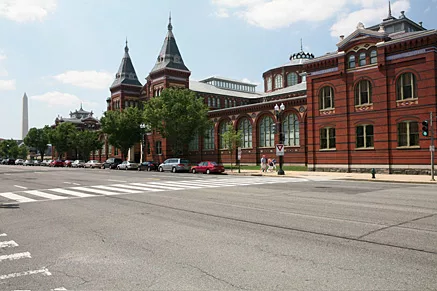
SmithGroup is working on restoring and modernizing the Arts & Industries Building on the National Mall, a $24 million project that received the go-ahead last summer thanks to ARRA money. The firm is working on two additional stimulus-funded projects: a window replacement and facade thermal/security performance improvement for the John F. Kennedy Federal Building in Boston, and a $25 million renovation of the 27-story Patrick V. McNamara Federal Building in Detroit (the building was designed by SmithGroup in 1976).
Image courtesy SmithGroup

A Stimulus Success Story
RATIO Architects, in Indianapolis, was called in last spring to work on construction documents for a $32 million multimodal facility in Normal, Illinois, that had been put on hold but was revived due to the ARRA. The documents are scheduled to be finished this month. The firm is also looking to play a role in some stimulus-funded preservation and urban-planning projects.
Image courtesy RATIO Architects

A Stimulus Success Story
The GSA has allocated $121 million in ARRA funding for the design, renovation, and seismic upgrading of 50 UN Plaza, a 350,000-square-foot Beaux-Arts building in San Francisco’s Civic Center area. In August, the agency hired HKS and Architectural Resources Group to oversee the first phase of the project. Design work is expected to be completed by September 2010.
Image courtesy Takashi Fukada/Architectural Resources Group

A Stimulus Success Story
Construction of a new, $107 million U.S. District Courthouse is under way in downtown Austin thanks to federal stimulus funds. The seven-story concrete building will house eight courtrooms and jury assembly rooms, along with offices for the district clerk, federal attorney, and public defender. The 212,000-square-foot project is designed to earn LEED Silver certification.
Image courtesy White Construction Company

A Stimulus Success Story
Thanks to $500,000 in ARRA money, the firm is able to integrate a more energy-efficient HVAC system into a 30,000-square-foot, $15 million library it has designed for Santa Clarita. Two additional LPA projects in California — a 42,500-square-foot police facility in Hesperia and a 40,000-square-foot city hall in Laguna Niguel — received stimulus funding; the money will be used to purchase and install photovoltaic panels for the buildings.
Image courtesy LPA
 Stimulus Roundup
While opportunities have been limited, some architects are getting work thanks to the American Recovery and Reinvestment Act
Still, the firm had to craft a résumé that would meet the necessary qualifications to be considered for government work. It expanded its institutional portfolio by pursuing more nonfederal design-build projects, including the $80 million Oakland Hall at the University of Maryland in College Park.
“Design firms have to be smart about this,” Lowe says. “The Army Corps [of Engineers’] provisions say you have to have relevant projects within a certain time frame to qualify. That can be a significant barrier to entry to firms like us. If you don’t have that experience, you won’t get past the first step in the selection process.”
Ultimately, it was the strength of relationships in the private sector that gave WDG its big break in the federal world. The firm had worked extensively with Maryland-based developer Foulger-Pratt on commercial and mixed-use projects since the late 1960s. Three years ago, WDG began discussions with the developer’s construction division to team up and pursue federal work. The plan paid off in the fall of 2008, when the duo was awarded a design-build contract for the Army’s $33 million Missile Defense Agency Headquarters building at Ft. Belvoir, Virginia. The 99,000-square-foot administrative building is scheduled for completion in 2010. This past spring, the two firms followed up with a design-build contract for the new $50 million, 141,000-square-foot Army Test Evaluation Command Headquarters in Maryland, which is scheduled to be completed in 2011.
In August, the firm landed its biggest federal commission yet: a prominent role in construction of the new U.S. Coast Guard Headquarters, the largest stimulus-funded project to date. Four architecture firms are part of the design-build team, all led by contractor Clark Construction Group of Maryland — another long-time partner of WDG.
Building off a concept originally conceived by Perkins+Will before it was bridged over to the new team, WDG serves as architect of record for the 1.3-million-square-foot project. St. Louis—based HOK is providing interior, landscape, and sustainable design; Quinn Evans Architects will handle historic preservation duties; and McKissack and McKissack is architect of record for a 1,000-car garage and central utility plant. Completion is slated for 2013.
“This win is a stabilizing force that enables us to confidently move forward over the next couple of years, even as architects in general continue to face so many challenges in this market,” Liebmann says, noting that, after cutting staff in early 2009, the firm is now hiring back some positions. He adds that federal work is helping keep the firm afloat. “Most of our private sector clients are on the sidelines,” he adds. “They are positioning for the future, but that doesn’t pay the bills today.”
Although WDG has seen numerous federal-sector wins in short succession, Lowe notes that transformation can’t be made overnight. “Just because you’re a successful architect doesn’t mean you can go in and just start doing this type of work,” he says. “It’s a process. It’s about understanding the [federal agencies’] programs, knowing how to match that with your strengths, and having a good partnership with a contractor that knows how the game is played and how not to make mistakes.”
Looking for a reprint of this article?
From high-res PDFs to custom plaques, order your copy today!