Architectural Record
search
cart
facebook twitter linkedin youtube
  • Sign In
  • Subscribe
  • Sign Out
  • My Account
Architectural Record
  • NEWS
    • Latest News
    • Awards
    • Interviews
    • Obituaries
    • Podcasts
      • Design:Ed Podcast
      • Sponsored Podcasts
  • OPINION
    • Book Reviews / Excerpts
    • Exhibition Reviews
    • Forum
  • EXCLUSIVES
    • Videos
    • Design Vanguard
    • Top 300 Firms
    • Sponsored Content
    • Sponsored eBooks
    • From the Archives
  • CONTINUING ED
    • Editorial Continuing Ed
    • CE Center
    • CE Academies
  • PROJECTS
    • Buildings By Type
    • Reuse & Renovation
    • Museums & Arts Centers
    • Colleges & Universities
    • Multifamily Housing
    • Interiors
    • Lighting
    • Kitchen & Bath
  • HOUSES
    • Record Houses
    • House of the Month
    • Featured Houses
  • PRODUCTS
    • Products by Category
    • Record Products of the Year
    • Latest Products
  • EVENTS
    • Dates & Events
    • Record on the Road
    • Innovation Conference
    • Sustainability in Practice
    • Women In Architecture
    • Webinars
    • Ad Excellence Awards
    • Submit an Event
  • CONNECT
    • Ask RECORD AI
    • Newsletters
    • Contact
    • Advertise
    • Editorial Calendar
    • Store
    • Customer Service
  • SUBMIT
    • Submission Guidelines
    • RECORD Competitions
  • MAGAZINE
    • Subscribe
    • My Account
    • Digital Edition
    • Current Issue
    • Firm Pass
    • Historic Archive
ProjectsBuildings by TypeStadium Design

Olympic Stadium

A Landmark Reinvented: GMP transforms Kiev's storied Olympic Stadium by sheltering it under an elegant cable-supported roof.

By Chris Foges
Kiev's Olympic Stadium is surrounded by raised terraces, a plaza to the west with a garage below, and a recently landscaped park. The lobby of an adjacent hotel serves as the stadium's VIP entrance.
Olympic Stadium
Gerkan, Marg und Partner (GMP)
Kiev, Ukraine
Kiev's Olympic Stadium is surrounded by raised terraces, a plaza to the west with a garage below, and a recently landscaped park. The lobby of an adjacent hotel serves as the stadium's VIP entrance.
Photo © Marcus Bredt
The originally open-air stadium is now under the cover of a cable-net-supported roof that includes 640 domed skylights.
Olympic Stadium
Gerkan, Marg und Partner (GMP)
Kiev, Ukraine
The originally open-air stadium is now under the cover of a cable-net-supported roof that includes 640 domed skylights.
Photo © Marcus Bredt
The facility's prerenovation capacity of 83,450 was reduced to 68,000 with the incorporation of boxes in the west stand and the replacement of benches by individual seats on the upper tier. Seats on t
Olympic Stadium
Gerkan, Marg und Partner (GMP)
Kiev, Ukraine
The facility's prerenovation capacity of 83,450 was reduced to 68,000 with the incorporation of boxes in the west stand and the replacement of benches by individual seats on the upper tier. Seats on the lower tier were respaced at 19.7 inches on center, and heights adjusted to ensure good sightlines. The seats in six shades of blue and yellow—Ukraine's national colors—are arranged in a digitally generated “pixel” pattern that camouflages any empty blocks, particularly when the stadium is seen on TV.
Photo © Marcus Bredt
Flying masts support the roof domes.
Olympic Stadium
Gerkan, Marg und Partner (GMP)
Kiev, Ukraine
Flying masts support the roof domes.
Photo © Marcus Bredt
Perimeter steel columns were fabricated in Ukraine, the PTFE-coated glass-fiber textile that forms the self-cleaning roof, the cables, and the connecting components were manufactured elsewhere.
Olympic Stadium
Gerkan, Marg und Partner (GMP)
Kiev, Ukraine
Perimeter steel columns were fabricated in Ukraine, the PTFE-coated glass-fiber textile that forms the self-cleaning roof, the cables, and the connecting components were manufactured elsewhere.
Photo © Marcus Bredt
Star-shaped textile panels reinforce the PTFE roof at each domed skylight.
Olympic Stadium
Gerkan, Marg und Partner (GMP)
Kiev, Ukraine
Star-shaped textile panels reinforce the PTFE roof at each domed skylight.
Photo © Marcus Bredt
Faceted 50-foot-tall glass facades preserve views of the existing stadium structure from the street and shelter new circulation galleries set against the concrete upper tier. On the east side, the top
Olympic Stadium
Gerkan, Marg und Partner (GMP)
Kiev, Ukraine
Faceted 50-foot-tall glass facades preserve views of the existing stadium structure from the street and shelter new circulation galleries set against the concrete upper tier. On the east side, the top tier is accessed both by stairs from the main entrance level and by bridges from the park that rises behind the building.
Photo © Marcus Bredt
An Italianate entrance court, built in the 1950s, links the stadium and the hotel.
Olympic Stadium
Gerkan, Marg und Partner (GMP)
Kiev, Ukraine
An Italianate entrance court, built in the 1950s, links the stadium and the hotel.
Photo © Marcus Bredt
Rigid joints between the perimeter steel columns and the compression rings obviate the need for diagonal bracing. The new structure is generally aligned to the existing concrete frame, but exceptions
Olympic Stadium
Gerkan, Marg und Partner (GMP)
Kiev, Ukraine
Rigid joints between the perimeter steel columns and the compression rings obviate the need for diagonal bracing. The new structure is generally aligned to the existing concrete frame, but exceptions were made to create the symmetry required by the cable-net roof. Likewise, due to the varying depth of the canopy, the inclined tops of columns around the ends of the stadium are at a steeper angle than those along its long sides.
Photo © Marcus Bredt
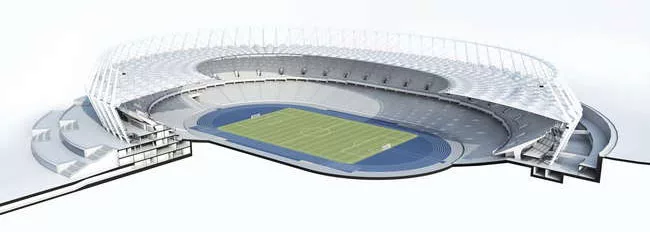
Section-Perspective
Olympic Stadium
Gerkan, Marg und Partner (GMP)
Kiev, Ukraine
Section-Perspective
Image courtesy GMP
Section-Perspective
Olympic Stadium
Gerkan, Marg und Partner (GMP)
Kiev, Ukraine
Section-Perspective
Image courtesy GMP
Section-Perspective
Olympic Stadium
Gerkan, Marg und Partner (GMP)
Kiev, Ukraine
Section-Perspective
Image courtesy GMP
Kiev's Olympic Stadium is surrounded by raised terraces, a plaza to the west with a garage below, and a recently landscaped park. The lobby of an adjacent hotel serves as the stadium's VIP entrance.
The originally open-air stadium is now under the cover of a cable-net-supported roof that includes 640 domed skylights.
The facility's prerenovation capacity of 83,450 was reduced to 68,000 with the incorporation of boxes in the west stand and the replacement of benches by individual seats on the upper tier. Seats on t
Flying masts support the roof domes.
Perimeter steel columns were fabricated in Ukraine, the PTFE-coated glass-fiber textile that forms the self-cleaning roof, the cables, and the connecting components were manufactured elsewhere.
Star-shaped textile panels reinforce the PTFE roof at each domed skylight.
Faceted 50-foot-tall glass facades preserve views of the existing stadium structure from the street and shelter new circulation galleries set against the concrete upper tier. On the east side, the top
An Italianate entrance court, built in the 1950s, links the stadium and the hotel.
Rigid joints between the perimeter steel columns and the compression rings obviate the need for diagonal bracing. The new structure is generally aligned to the existing concrete frame, but exceptions
Section-Perspective
Section-Perspective
Section-Perspective
December 16, 2012

Architects & Firms

Gerkan, Marg und Partner (GMP)

Kiev, Ukraine

The tumult of Kiev's postwar history is evident in its architecture: The bombast of Stalin's elephantine classicism was abruptly superseded by swaths of grimly utilitarian housing after Khrushchev's turn against “unnecessary excess.” Following the disintegration of the U.S.S.R., speculative developers in the Ukrainian capital reacted to these drab slabs with crass Postmodernism. The pendulum may have swung again with the $380 million renovation of the city's Olympic Stadium. Its design, by the German architectural firm von Gerkan, Marg und Partner (GMP), harks back to what project director Christian Hoffmann sees as the better qualities of Kiev's 1960s rationalist architecture: technical ingenuity and tectonic clarity.

The stadium was renovated to host a major soccer tournament, Euro 2012—seen as an important way of improving Ukraine's image. However, the building's role as a national symbol is balanced against its responsibilities as a piece of the city. “We have designed stadia elsewhere that are more spectacular,” says Hoffmann, “but here we are in the middle of the city and didn't want to be so 'noisy.' ”

The open-air Olympic Stadium, named for its supporting role in the 1980 Moscow Games, developed in stages. The lower tier was built in 1936 against a hillside. The east stand cut into the slope; to the west, terraces bridged the gap between the bowl and the ground. A prestressed-concrete upper tier was added in 1968. Its delicate waffle slab and sharply angled beams balance on a single row of columns around the lip of the lower bowl. Although this elegant structure could not take the load of a roof, GMP wanted to retain the upper bowl “out of respect for the intelligence and the aesthetic sense of its engineers,” says Hoffmann. Kievans also identified strongly with the building, “so we weren't forced to bring something new. Instead we saved it, and tried to show it in a good light.”

The upper tier is now encased like an exhibit in a giant vitrine. An exoskeleton of 80 slender steel columns stands up to 42 feet clear of the concrete, supporting a cable-net roof over seating areas. This complex but economical structure works like a bicycle wheel: Radial spokes tie the central tension ring to a pair of perimeter compression rings. Glass screens between the uprights shelter circulation spaces and give the frame a “body.”

Even in its enhanced state, the 1,015-foot-long-by-722-foot-wide stadium remains largely hidden by buildings and the city's topography until one turns onto a new plaza to the west. The glass-and-steel enclosure sits like a crown above a new granite-clad plinth that wraps the lower bowl and merges with an adjacent hotel, designed by local firms. Sixty steps up, a terrace surrounds the stadium, from which spectators enter through 40 gates.

Movement from peripheral circulation spaces into the arena generates a sense of compression and release. Crowds funnel through a narrowing gap between tiers, or through the tight confines of upper-tier vomitories, into what is now a giant interior. White steel and gray concrete give way to the brilliant green field and a blur of blue and yellow seats lining the vast sweep of the bowl.

The sensation is heightened by the near-miraculous lightness of the canopy, an undulating polymer-coated membrane dimpled with 640 transparent domes, each the size of a small car, supported by flying masts. Star-shaped textile panels reinforce each opening, but the impression of a twinkling night sky is apparently the happy by-product of a strictly rational pursuit of structural efficiency; legible order and the absence of “expressionist” caprices are consistent principles in GMP's work.

Scale lends a sense of occasion, but two key decisions—to preserve the shallow, 31-degree angle of the 80-foot-wide upper tier and to retain the running track (required for a national stadium)—place spectators up to 300 feet from the field, albeit with improved sightlines throughout. Many fans believe that the best atmosphere is found in soccer stadiums with steep, pitch-hugging stands, but Hoffmann argues that the size and passion of the crowd are what counts. Wide, shallow bowls also allow heat to escape and sunlight to reach the grass, and are kinder to vertigo sufferers.

Other improvements are less visible: The partially reconstructed west stand incorporates press areas, corporate hospitality, and players' facilities. A glazed roof over a curious Italianate entrance court, built in the 1950s, links the stadium and hotel. It is remarkable that the few largely superficial alterations to GMP's design demanded after a 2010 change in government were restricted to these areas. A holistic approach to structure, form, and function was the project's defense in challenging political and economic circumstances, suggests Hoffmann, but is rooted in a conviction that buildings should withstand changes in fashion or use over time. Kiev's new stadium should wear well; it may not be loud, but it is very strong.

Chris Foges is editor of the London-based journal Architecture Today.

Completion Date: November 2011

Gross square footage: 1.6 million

Total construction cost: $380 million

Architect:
GMP Generalplanungsgesellschaft mbH Aachen
Rennbahn 5-7 , 52062 Aachen
Phone: +49-241-474470
Fax +49-241-4744799

People

Owner: National Sports Complex Olimpiysky, Ukraine

Architect:
GMP Generalplanungsgesellschaft mbH Aachen
Rennbahn 5-7 , 52062 Aachen
Phone: +49-241-474470
Fax +49-241-4744799

Personnel in architect's firm who should receive special credit:
Design:
Prof. Dr.-Ing.h.c. Volkwin Marg, Partner
Dipl. Ing. Christian Hoffmann, Associate Partner
Dipl. Ing. Marek Nowak
Project Management Chief Architect:
Dipl. Ing. Martin Bleckmann
Dipl. Ing. Roman Hepp
 Architects Design Phase:
Dipl. Ing. Heiko Faber
Dipl. Ing. Michael König
Dipl. Ing. Sebastian Möller
Dipl. Ing. Olaf Peters
Dipl. Ing. Christoph Salentin
Architects Execution Phase:
Dipl. Ing. Anke Appel
Dipl. Ing. Irina Bohlender
Dipl. Ing. Clemens Dost
Dipl. Ing. Natalia Gerasimenko
Dipl. Ing. Jonathan Gerlach
Dipl. Ing. (FH) Jörg Greuel
Dipl. Ing. Dominik Heizmann
Dipl. Ing. Sebastian Hilke
Dipl. Ing. Stephanie  Krämer-Hilke
Dipl. Ing. Franz Lensing
Dipl. Ing. Irina Stoyanova
Dipl. Ing. Phillip Weber
Dipl. Ing. Christiane Wermers
Dipl. Ing Andreas Wietheger
Private Creative Architectural Bureau Y. Serjogin LLC, Kiew

Consultant(s):
 Landscape:  St raum a.-Gesellschaft von Landschaftsarchitekten mbH
 Lighting: Conceptlicht, Traunreut
 Structural design roof and façade:  Schlaich Bergermann und Partner Stuttgart
 Wayfinding System:  formkombinat, Nina Marg, Hamburg

General contractor:
Kyivmiskbud, Kiev; AK Engineering, Kiev; Master Profi Ukraine Dnepropetrovsk

Photographer: 
Marcus Bredt

Renderer:
Rendertaxi, GMP


Products

Structural design, roof and façade: 
Schlaich Bergermann Und Partner, Stuttgart
Knut Göppert with Markus Balz and Thomas Moschner

Structural design, concrete and masonry works: KKIG Aachen, KEMPEN KRAUSE INGENIEURGESELLSCHAFT bR

Masonry: see above

Metal Panels: Non-standard metal panels, 2mm, anodized

Other cladding unique to this project:  Granite slabs with “Hilti” anchor fittings

Other:  Stadium membrane roof: Versaidag, PTFE / Glass Fabrics, Duraskin B18089 GF

Glazing 
Glass: Main stadium façade: Guardian Europe, heat-strengthened LSG, 2x8mm Float-Glas ExtraClear, with foil of film EVOSAFE

Shops and office area: Pilkington Sun Protect 70/40

Doors
Entrances: Rayners

Metal doors: Novoferm

Wood doors:  Neuform

Fire-control doors, security grilles: Novoferm

Interior finishes
 Acoustical ceilings: AMF, Thermatex Acoustic VT-S-15F, 60x60, 60x120cm

Paints and stains: Caparol

Plastic laminate: Team area: Nora, norament grano 

Shops: Armstrong, 2mm

Solid surfacing: VIP area: Granite slabs, nero assoluto, leather surface, 500x250;

Italian court: Marble, verono rosso, perlino, 600x600

Floor and wall tile: Washroom and sanitary: floor: Vileroy&Boch (2200 PN83, 97x97x6, dark grey); wall: Lasselsberger (Czech. rep.) (GAA2 J023; 297x297x8, white)

VIP washroom: Seranit serena “Super black”

Lighting 
Interior ambient lighting: Beka (Cubo; Tubus; LEDbeam;) Birke (DPPS00-K1; non-standard lights)

Downlights: Beka (Cubo; Tubus); Birke (non-standard lights)

Task lighting: Beka (Cubo; Tubus); Birke (non-standard lights)

Exterior: Hess (City Elements 230AAL1.3HIT 35W modified); Birke (non-standard lights)

Conveyance
Accessibility provision: Otis Ukraine


Share This Story

Looking for a reprint of this article?
From high-res PDFs to custom plaques, order your copy today!
Chris Foges is a writer and editor working in architecture and the built environment, based in London. He is contributing editor at the RIBA Journal and was formerly editor of Architecture Today magazine. His books include Imagination and The City Works.

Post a comment to this article

Report Abusive Comment

Subscription Center
  • Create an Account
  • Start a Subscription
  • Manage My Account
  • Sign Up for Newsletters
  • Visit Customer Service
  • Update Preferences

More Videos

Sponsored Content

Sponsored Content is a special paid section where industry companies provide high quality, objective, non-commercial content around topics of interest to the Architectural Record audience. All Sponsored Content is supplied by the advertising company and any opinions expressed in this article are those of the author and not necessarily reflect the views of Architectural Record or its parent company, BNP Media. Interested in participating in our Sponsored Content section? Contact your local rep!

close
  • TAMLYN XtremeTrim Exterior Trim
    Sponsored byTamlyn

    Designing Cleaner Panel Facades: Why Exterior Trim Details Matter

  • Building with Vapor Barriers
    Sponsored byReef Industries, Inc.

    Vapor Barriers Help Control Moisture in Tighter Building Designs

  • Duct Interior with Prodeq System
    Sponsored byHenry, a Carlisle Company

    Designing Resilient Water Containment Systems

DESIGN:ED Podcast
Listen to Architectural Record’s DESIGN:ED Podcast

Events

June 16, 2026

Focus on the Façade: Exploring Steel, Timber & Fire-Rated Curtain Walls and Channel Glass Systems

Credits: 1 AIA LU/HSW; 1 AIBD P-CE; 0.1 ICC CEU

Explore modern façade and glazing systems that enhance daylighting, fire safety, and thermal performance while expanding architectural design possibilities.

June 18, 2026

Rebooting the Aging Office Building

Credits: 1 AIA LU/HSW; 1 AIBD P-CE; 0.1 ICC CEU; 1 PDH

Explore façade retrofit strategies and award-winning design concepts that can transform aging office buildings into healthier, higher-performing workplaces for today’s hybrid workforce.

View All Submit An Event

Products

2026 Architect's Square Foot Costbook

2026 Architect's Square Foot Costbook

See More Products

Popular Stories

Coronado Bridge

The Architect’s Guide to San Diego

SanDiegoAirport

Top 300 Architecture Firms of 2026

Crane Cove, ONO

Design Vanguard 2026 Winners

House on a Hill

Design Vanguard 2026: Forma

House A on a Hill

Design Vanguard 2026: Santiago Valdivieso

Focus on the Facade - Free Webinar - June 16, 2026

Related Articles

  • 01.png

    Renderings Released for New 2020 Tokyo Olympic Stadium

    See More
  • Zaha Hadid Quits Tokyo Olympic Stadium Competition

    Zaha Hadid Quits Tokyo Olympic Stadium Competition

    See More
  • 01.png

    Kengo Kuma to Design Tokyo Olympic Stadium

    See More
×

The latest news and information

#1 Source for Architectural Design, News and Products

SUBSCRIBE
  • RESOURCES
    • Advertise
    • Contact Us
    • Submit
    • Store
  • ACCOUNT CENTER
    • Create an Account
    • Start a Subscription
    • Manage My Account
    • Sign Up for Newsletters
    • Visit Customer Service
    • Update Preferences
  • PRIVACY
    • PRIVACY POLICY
    • TERMS & CONDITIONS
    • DO NOT SELL MY PERSONAL INFORMATION
    • PRIVACY REQUEST
    • ACCESSIBILITY
  • SERVICES
    • Marketing Services
    • Reprints
    • Market Research
    • List Rental
    • Survey/Respondent Access
  • STAY CONNECTED
    • Linkedin
    • Facebook
    • Instagram
    • YouTube
    • X (Twitter)

Copyright ©2026. All Rights Reserved BNP Media, Inc. and BNP Media II, LLC.

Design, CMS, Hosting & Web Development :: ePublishing