Arthouse at the Jones Center

The front facade engages the street with its open lobby, anamorphic sign, and large second-floor window that doubles as a projection screen.
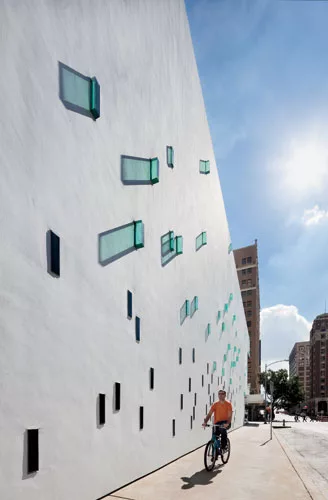
Laminated blocks of glass are lodged into the masonry of the south and east walls. The glass transmits some light but not the sun’s heat.
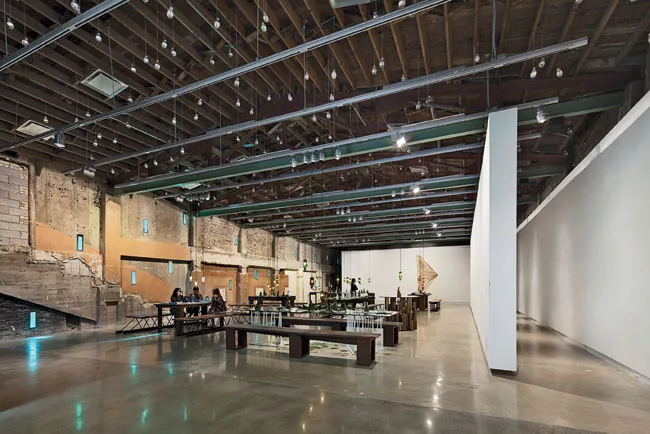
Traces of the building’s past life — frescoes and ceiling trusses — were kept in the single-volume second-floor gallery, and a 16,000-pound movable wall was added to create a white-box exhibition space if needed.
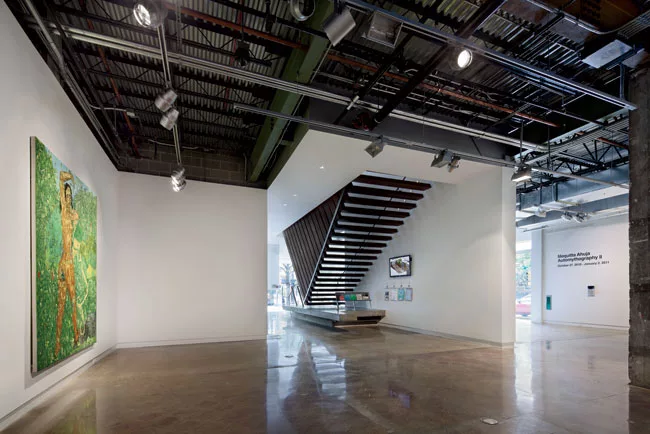
Behind the central stair, a more traditional gallery space was inserted, as well as a visual arts room.
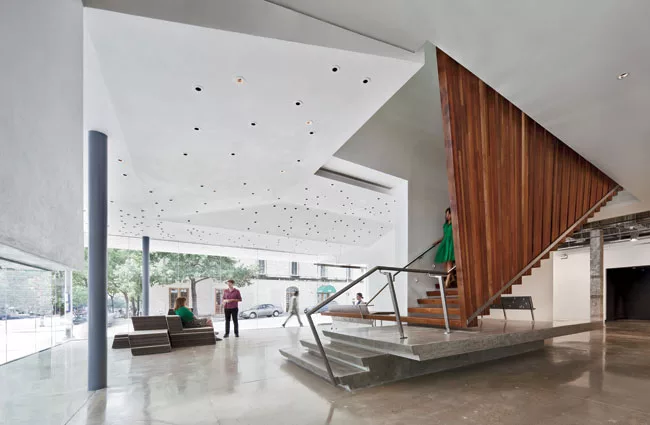
The lobby’s sitting area is dominated by a stacked-felt sofa and the lower portion of the central stair, which is made of precast concrete planks. The upper stair is composed of 21 L-shaped ipé treads, each 500 to 700 pounds.
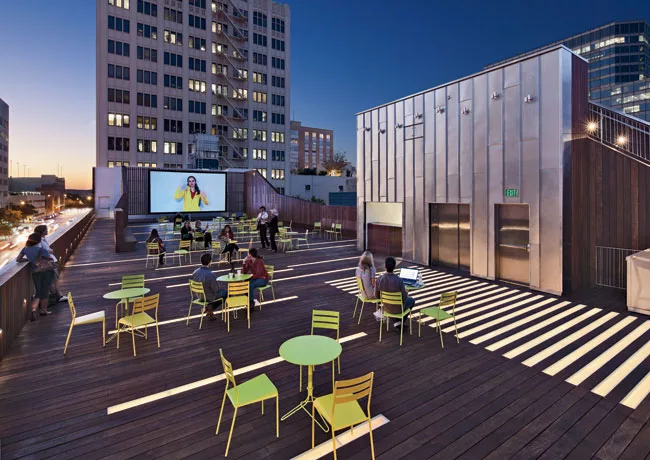
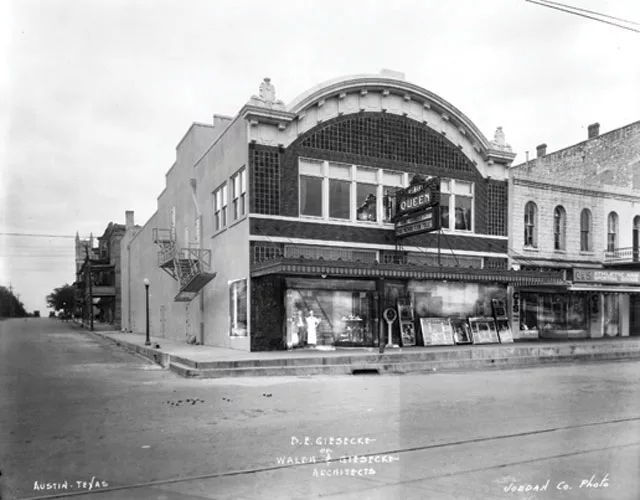
Photo courtesy Lewis.Tsurumaki.Lewis Architects
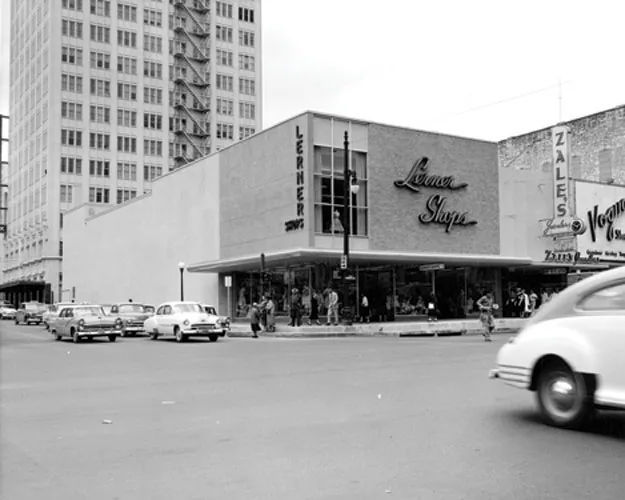
Photo courtesy Lewis.Tsurumaki.Lewis Architects
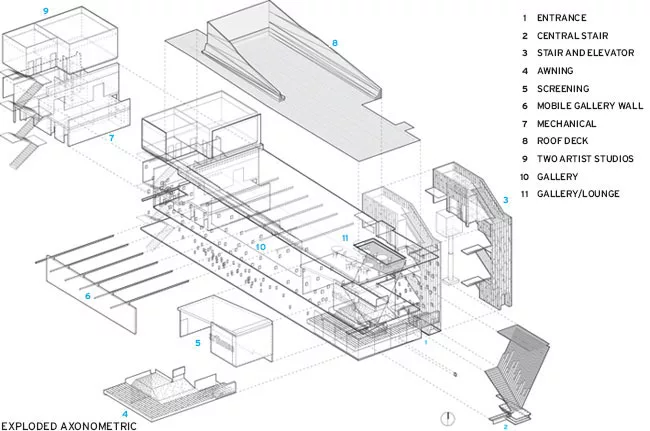
Image courtesy Lewis.Tsurumaki.Lewis Architects
Architects & Firms
Austin, Texas
The ubiquitous “Keep Austin Weird” movement seems more defined by what it’s against — big-box stores, Mediterranean-style buildings, Hummers — than what it’s for. This kind of excess and a mainstream, cookie-cutter aesthetic the slogan’s proponents think Austin can do without. Going by this very unscientific exhortation, it would seem that the Arthouse at the Jones Center building in downtown Austin, newly renovated and expanded by the New York City–based firm Lewis.Tsurumaki.Lewis Architects (LTL), should be heralded by Austinites as happily weird and wonderful enough to grace their downtown. And it is.
More than 4,000 people attended the four days of opening events in October, confirming that Austin is hungry for more cultural as well as visual arts venues. Arthouse may be Austin’s oldest arts organization — it was founded in 1911 as the Texas Fine Arts Association (TFAA) — but it has never been old-fashioned. As an independent, privately funded nonprofit contemporary arts institution, Arthouse shows the work of new artists but does not collect like a museum or represent artists for profit like a gallery. Its programs create opportunities for showing contemporary art and involving the community.
“Having a physical structure that has some meaning was crucial to our mission,” says Arthouse executive director Sue Graze. “We had a building in a great location, and wanted to preserve its history. But we also wanted the renovation to be as expressive as the art we show.”
In a city still smarting from the blow that occurred in 1999 when Herzog & de Meuron resigned the commission to design the $84 million Blanton Museum — subsequently given to Kallmann McKinnell & Wood, which resulted in the not-so-weird (or wonderful) building that opened in 2006 — Arthouse’s redo shines. Or, more accurately, it glows from the light of the 177 punched-out 4-by-16-inch LED-lit glass blocks that perforate the south and east walls. The seemingly random placement of rectangular elements is a bit of an LTL signature move — the firm has used similar perforations in its designs for Lozoo and Xing restaurants in New York City, for example. “We’re interested in the accumulation of discrete parts,” says LTL principal Paul Lewis.
“In this case, it’s not so much that we’re inserting forms, but that we’re extruding from the whole.” The blocks are just one of several strategic additions and adjustments that LTL used to intensify the amalgamation of history in the existing three-story brick structure, built in 1851. It did this while tripling the usable space to 20,830 square feet and radically revamping the building as an inviting presence for contemporary art on Congress Avenue, only a few blocks from the Texas State Capitol.
The building began its life in Austin as the Queen Theater, a large, open space with a balcony and proscenium stage. In 1956 it became a department store — Lerner Shops — and a second floor was added, as well as storefront windows and a new facade on Congress Avenue that included an awning extending over the sidewalk. TFAA bought the building in 1995, changed its name to Arthouse at the Jones Center, and gave it a slight renovation that closed off the second floor, which was not up to code. “There were a number of factors that the history of the building set up for us,” says Lewis. “For most historic preservation projects, there’s a single moment in the building’s history where it was at its best, and you want to get it back there. But with this project, it was a trajectory. The architecture was pulled in two directions — as a theater toward the stage at the west side, and as a store it engaged the street at the east. We decided not to whitewash any of that but to honor it all.”
The building is in a historic district but is not designated a historic building, so nothing was sacred. Still, preservation was critical to the organization and to the architects. Inserted within the envelope are an entry lounge, a video/projects room, a large open gallery, multipurpose room, two artist studios, and art preparation areas. The architects added a 5,500-square-foot ipé-wood roof deck for open-air performances, with a 17-by-33-foot screen that can be set up for films. Administrative office areas on the first floor were largely left alone.
The lobby, wrapped in floor-to-ceiling glazing, opens the building up to the street. LTL resurfaced the awning in plaster, shearing and stretching its geometry to continue it inside and to create an anamorphic sign proclaiming “Arthouse” on the street. A central stair with 21 L-shaped ipé treads over a diamond-polished cast-concrete base connects the lobby to the main second-floor gallery, and is designed so the first wood tread extends to the side to form a reception desk.
Rather than create a white-box gallery space on the existing second floor, the architects chose to let traces of the past — frescoes on the south wall, remains of the theater balcony, ornamental plaster work, and paint from the building’s days as a department store — remain, while the glass blocks lodged into the masonry bring light into the interior. Practicality suggested that the south wall be used for art, so a 16,000-pound movable wall was added inside the room to give the space more flexibility. The building’s original structure is a concrete frame with a steel-truss roof into which a concrete and steel deck floor was inserted during the Lerner years. When LTL decided to add a flat roof on top of the existing pitched-roof frame, the firm supported the new roof with steel members attached to the top chords of the trusses. To further help carry the load of the new roof, the team stiffened the trusses’ bottom chords with I-beams. This strategy allowed the architects to use the flanges of the I-beams as tracks for the movable wall, which is operated by two motors.
Every space, from the elevator to the rooftop, is a place where an artist can interact with the building. The first show in the upstairs gallery did just that with the movable wall, which was pushed to the north side to display a huge drawing of 177 family recipes submitted by the public for artist James Middlebrook’s exhibit, More Art about Buildings and Food.
“The building reflects us completely,” says Graze. “As an organization we are nimble, flexible, responsive. We’ve never wanted to be monumental. We think this structure expresses the nature of contemporary art, and we think it’s a game changer for contemporary art in Austin and beyond.”
Location: 700 Congress Avenue, Austin TX 78701
Completion Date: October 2010
Gross square footage: 20,830 sq.ft.
Total construction cost: $4.4 million
PeopleClient: Arthouse at the Jones Center; Sue Graze, Executive Director; Zydeco Development, Owner Representative
Architect:
Personnel in architect's firm who should receive special credit: Interior designer: Lewis.Tsurumaki.Lewis Architects
Engineer(s): MEP Engineer: Kent Consulting Engineers – Gil Kent, Bill Ball, Oscar Royuela, Debora Dean, Mike Jeter, Judy Stewart Civil Engineer: Garrett-Ihnen Civil Engineers
Consultant(s):
Other: General contractor: Structura, Inc. Photographer(s): © Michael Moran Renderer(s): © Lewis.Tsurumaki.Lewis Architects CAD system, project management, or other software used: AutoCAD, Rhinoceros, Adobe Creative Suite, Microsoft Office |
Products
Exterior cladding Precast concrete: (parapet cap) - Advanced Cast Stone, Inc. Wood: Ipe(deck & screen wall) Stucco: LaHabra Wall® w/ Parex 415 Elastomeric Coating Moisture barrier: BASF HLM 5000® Liquid Cold Applied Elastomeric Waterproofing Membrane System
Roofing Other: Johns Manville TPO Roofing Membrane (at certain locations)
Windows
Glazing Skylights: Skyline Sky-lights (large skylight); Solatube 750 DS-0 (studios) Other: Custom glass blocks developed by LTL Architects with M3 Glass Technologies – varying glass thickness w/ Dupont™ SentryGlas™ Plus interlayer – glass block frames developed by LTL Architects with Veyko, Inc.; custom glass pavers by Dependable Glass in custom site-assembled housings
Doors Upswinging doors, other: Vertical Lift Doors – Renlita Overhead Doors
Hardware Pulls: EPCO (millwork) Security devices: Pelco (entry cameras) & American Dynamics (gallery cameras)
Interior finishes Paints and stains: ICI Dulux paint (interior walls), Bona Naturale (main stair), Prime-A-Pell H20 (exposed existing walls) Paneling: Acoustical Surfaces, Inc. Sound Silencer™ foam (offices, video-projects room entry) Plastic laminate: Formica (kitchen counters, shared work surfaces) Solid surfacing: Dupont Zodiac (restroom counters) Floor and wall tile: Daltile Ceramic Field Tile (restroom walls) Resilient flooring: The Mat King Original Metal Studded Rubber Flooring (elevator), Expanko Cork Flooring (offices), Capri Cork (mezzanine loft) Carpet: Interface FLOR (community room) Special interior finishes unique to this project: USG Diamond Veneer Plaster (entry lounge awning)
Furnishings Reception furniture: custom designed by LTL Architects Chairs: felt lounge furniture custom designed and fabricated by LTL Architects, SitOnIt Seating (office and reception chair), Fermob (roof furniture), 40/4 Chairs OSI/Howe (stacking conference) Tables: Steelcase Akira (conference tables). Upholstery: Maharam Other furniture: Knoll File Cabinets, Ikea Kitchen Cabinets
Lighting Gallery Lighting: Lighting Services, Inc. Accent/Downlights: USA Illumination, Edison Price, Lucifer Lighting, Amerlux Lighting Solutions, Se’Lux (various locations), Winona Lighting (ipe stair) Task lighting: Humanscale (desks), Alkco (undercabinet) Exterior: Matirical/Lumen Architecture (custom glass block façade lights), HK Lighting Group (egress accent lights), Designplan (floodlight), Winona Lighting (ipe parapet) Dimming System or other lighting controls: Lutron
Conveyance Accessibility provision (lifts, ramping, etc.): ThyssenKrupp
Plumbing
Energy
Add any additional building components or special equipment that made a significant contribution to this project: Custom Main Staircase: Fabrication by Buda Woodworks Gerriets International (Blackout Curtains & Rear Projection Curtain), Da-Lite Screen Company (Roof & Community Room Front Projection Screens), Samsung Electronics (Lounge & Gallery Display Screens), 3M Electronics (community room rear projector), Epson Electronics (community room front projector), Panasonic Electronics (film & video project room projectors), Extron Electronics (AV controls) Curator: Elizabeth Dunbar
Opening Exhibitions: |
Looking for a reprint of this article?
From high-res PDFs to custom plaques, order your copy today!