Architectural Record
search
cart
facebook twitter linkedin youtube
  • Sign In
  • Subscribe
  • Sign Out
  • My Account
Architectural Record
  • NEWS
    • Latest News
    • Awards
    • Interviews
    • Obituaries
    • Podcasts
      • Design:Ed Podcast
      • Sponsored Podcasts
  • OPINION
    • Book Reviews / Excerpts
    • Exhibition Reviews
    • Forum
  • EXCLUSIVES
    • Videos
    • Design Vanguard
    • Top 300 Firms
    • Sponsored Content
    • Sponsored eBooks
    • From the Archives
  • CONTINUING ED
    • Editorial Continuing Ed
    • CE Center
    • CE Academies
  • PROJECTS
    • Buildings By Type
    • Reuse & Renovation
    • Museums & Arts Centers
    • Colleges & Universities
    • Multifamily Housing
    • Interiors
    • Lighting
    • Kitchen & Bath
  • HOUSES
    • Record Houses
    • House of the Month
    • Featured Houses
  • PRODUCTS
    • Products by Category
    • Record Products of the Year
    • Latest Products
  • EVENTS
    • Dates & Events
    • Record on the Road
    • Innovation Conference
    • Sustainability in Practice
    • Women In Architecture
    • Webinars
    • Ad Excellence Awards
    • Submit an Event
  • CONNECT
    • Ask RECORD AI
    • Newsletters
    • Contact
    • Advertise
    • Editorial Calendar
    • Store
    • Customer Service
  • SUBMIT
    • Submission Guidelines
    • RECORD Competitions
  • MAGAZINE
    • Subscribe
    • My Account
    • Digital Edition
    • Current Issue
    • Firm Pass
    • Historic Archive
Projects

Museo Jumex

Alone In The Crowd: Surrounded by buildings that compete for attention, a home for a huge contemporary art collection strikes a quiet but assertive note amid the architectural clamor.
By Edwin Heathcote
Museo Jumex
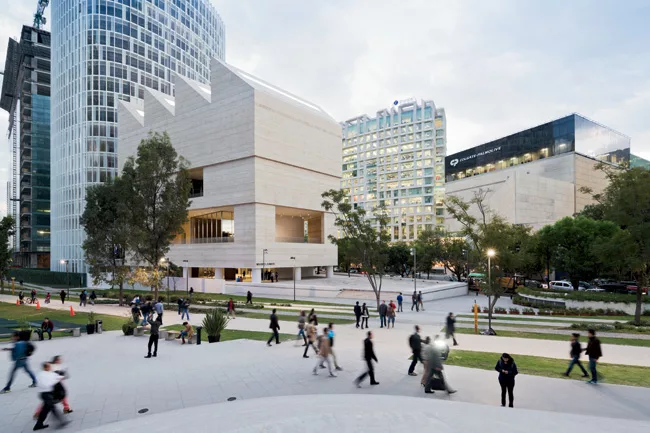
The travertine-clad Museo Jumex stands on a public plaza that connects it to pedestrian traffic among a cluster of new buildings adjacent to Polanco, a tony district near the center of Mexico City.
 
Photo © Iwan Baan
Museo Jumex
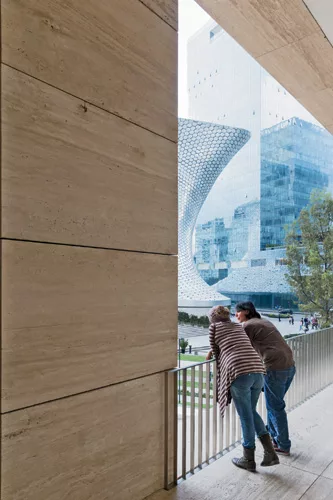
A second-floor terrace provides views of the surrounding cityscape, including the looming Museo Soumaya, by Fernando Romero, that anchors the development.
 
Photo © Iwan Baan
Museo Jumex
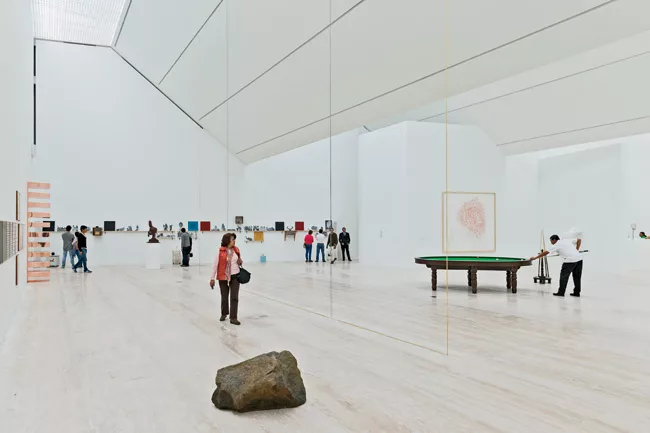
It culminates at a daylit top-floor gallery, where the museum’s distinctive sawtooth roofline digs deep into the interior before rising to its highest point, 30 feet above the floor. Translucent plexiglass panels striped with white louvers even out the light admitted by skylights in each ridge.
 
Photo © Iwan Baan
Museo Jumex
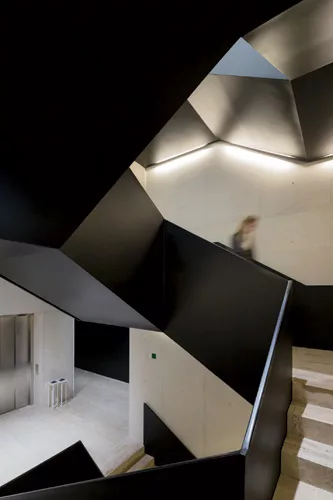
A stair defined by a ribbon of black steel spirals up through the museum.
 
Photo © Iwan Baan
Museo Jumex
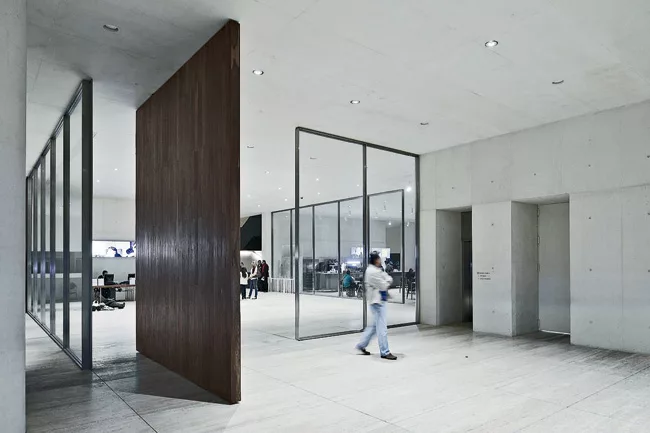
Large wooden doors pivot open to join the Museo Jumex’s lobby with the surrounding plaza.
 
Photo © Iwan Baan
Museo Jumex
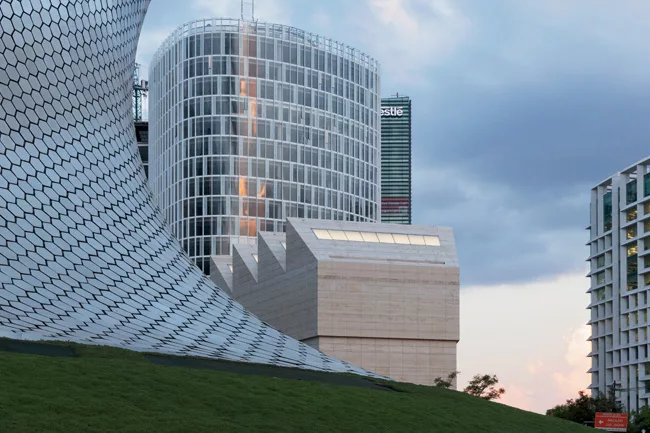
The museum’s handsome cladding stands in contrast to the showy curves of the Museo Soumaya’s metal skin, while its jagged crown cuts an attention-grabbing silhouette against the elliptical Torre Cervantes.
 
Photo © Iwan Baan
Museo Jumex
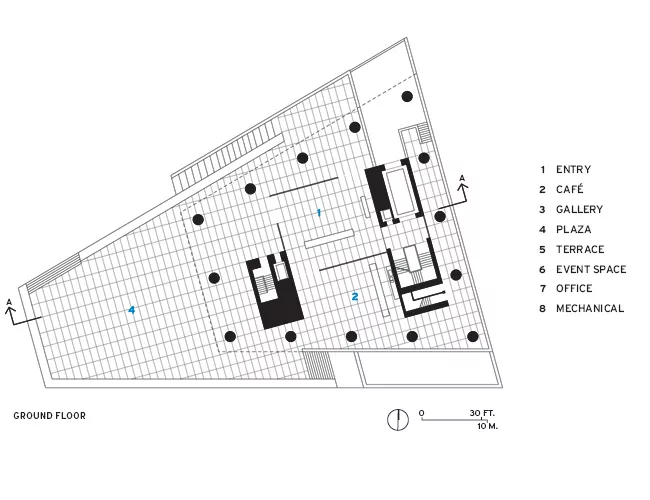
Image courtesy David Chipperfield Architects
Museo Jumex
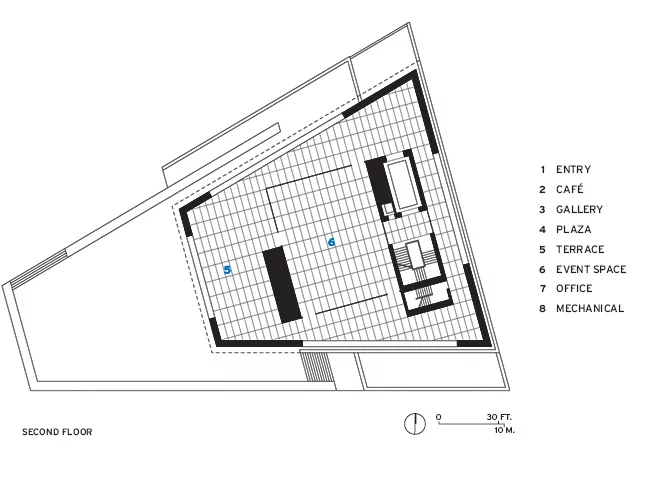
Image courtesy David Chipperfield Architects
Museo Jumex
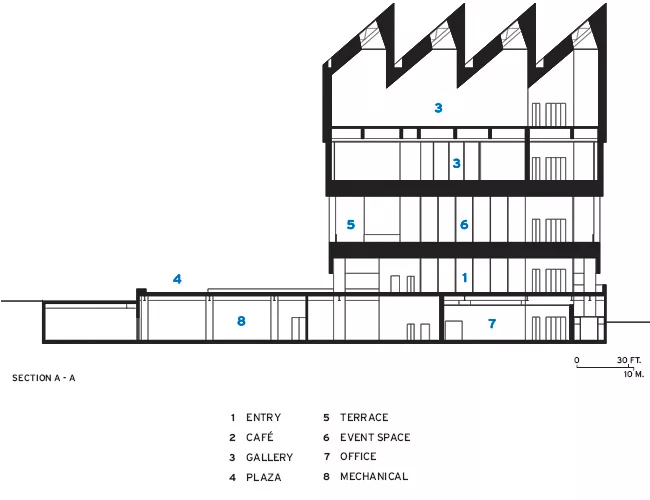
Image courtesy David Chipperfield Architects
Museo Jumex
Museo Jumex
Museo Jumex
Museo Jumex
Museo Jumex
Museo Jumex
Museo Jumex
Museo Jumex
Museo Jumex
May 16, 2014

Architects & Firms

David Chipperfield Architects

Mexico City

People/Products

The first exhibition space for the Colección Jumex—the private art collection of the company behind the ubiquitous Mexican juice brand—sat in the middle of the company’s manufacturing facility on the northern outskirts of Mexico City. It was a curious location for a museum—not a converted industrial space, as with so many contemporary art venues, but a minimalist insertion into a working, and thus high-security, factory. But the Colección’s new David Chipperfield–designed building, which opened last fall, couldn’t be farther from the slum-surrounded factory setting.

Far more accessible than its predecessor, the new Museo Jumex, a marble-clad box capped with a jagged crown, sits in a still-emerging development at the edge of Polanco, a fashionable quarter near the heart of Mexico City. The new museum’s neighborhood is a kind of architectural zoo, with the most exotic creature, the Museo Soumaya, at its center: designed by Fernando Romero, of the firm FR-EE, and containing the art collection of his father-in-law, magnate Carlos Slim, it is the ultimate self-conscious sculptural icon, with a cresting wave of reflective metal scales—the opposite of Chipperfield’s restrained, Modernist-influenced body of work. Among other nearby attractions are a folded, angular black-steel-framed theater canopy designed by Madrid-based Ensamble Studio, a tower (also by Romero) with an elliptical plan, and a big-box mall.

The 43,000-square-foot museum is not small, yet it struggles to compete with the monsters surrounding it. In an effort to maintain a presence on a hemmed-in site, Chipperfield built up, stacking five stories above four levels of subterranean parking. A raised plaza leads into the entry, concealing a bookstore and administrative facilities below, while the levels above contain gallery and event space. Chipperfield also built solid—the heavily reinforced concrete structure is designed to exceed seismic standards in earthquake-prone Mexico City, while a steel frame forms the building’s distinctive sawtooth roofline. The walls, clad in Mexican travertine, do their best to resist the architectural cacophony outside and to evoke something as tough as a castle keep. “When you’re building in a context like this,” says Chipperfield, “you want the buildings to work together, to lean against each other, and to interweave. But you also need to ask, ’How can this particular building assert its place in the city?’ ”

The museum houses what is reputed to be one of the largest private collections of contemporary art in Latin America—overseen by Jumex scion Eugenio López Alonso—but it is open to the public, and one of the ways in which it stakes a claim in the neighborhood is by advertising its accessibility. “The challenge was how to make this building, which is quasi-public, more civic,” says Chipperfield. “What made it easier was the unusual climate of this city.”

Huge pivoting timber doors set in glass walls comprise the building’s main entrance and open the lobby to the outdoors to such an extent that it ceases to feel like a lobby at all. The first floor is really an extension of the plaza on which the building sits. “We wanted to enjoy the climate and play with the notion of the threshold,” says Chipperfield.

The second floor is equally open, effectively a glass box set within the travertine carapace of the elevations. Its broad terraces look out to the city, but the interior is pure Mies. From the richly figured marble to the slender mullions, the Barcelona Pavilion echoes around the space, as it does throughout the project.

On the top floor, the building comes most fully to life. Here, under 30-foot-high ceilings, the museum’s exaggerated roofline lends its character to the interior. UV-filtering skylights on the west-facing pitched side of each ridge bring in daylight, while sheets of translucent plexiglass inside each spike disperse it into the exhibition space as an even glow. The dips in the roof profile dig deep into temporary partitions inside the gallery, so that the character of the ceiling is expressed in the volume of the space. With this move and others, Chipperfield attempted to strike a balance between a building that serves the art and one that has sculptural drama in its own right. “We had the classic museum problem,” says the architect: “we wanted static galleries in which to look at work, but we also wanted spaces that could be more expressive.”

Chipperfield has succeeded in creating a building that addresses both concerns. A black-steel-clad stair connecting each floor deposits visitors in surprising settings—from the lobby to the terraces, each level is distinct from the last—while the culmination in the daylight-filled top-floor gallery is a sheer delight. The architect has made his name with museums, including the celebrated Neues Museum in Berlin and the exquisite St. Louis Art Museum expansion, working within extraordinarily diverse geographical and political contexts. This new neighborhood—unpredictable and over-scaled—is among the least hospitable, yet the Museo Jumex is robust enough to resist it and beautiful enough to keep drawing people in.


People

Owner:
Eugenio Lopez

Architect:
David Chipperfield Architects
11 York Road
London SE1 7NX
T +44 20 7620 4800
F +44 20 7620 4801

Personnel in architect's firm who should receive special credit:
Principal
David Chipperfield

Director
Andrew Phillips

Project architect
Peter Jurschitzka

Project team
Jonathan Cohen, Robert Trent Davies, Johannes Feder, Christian Felgendreher, Sara Hengsbach, Alessandro Milani, Diana Su

Associate architect(s):
TAAU/Oscar Rodriguez

Project team:
Cocoy Arenas, Alejandro Casta'eda, Rub'n Ocampo, Alejandro Rojas, Rafael Sevilla

Engineer(s):
Strucutural
Arup / Alonso y Asociados

Services
Arup / Iacsa

Electrical
Asociados A

Consultant(s):
Facade:
Soluciones en Piedra Franco

Lighting:
Arup

Fire protection:
BMSi

Building management sytem:
BMSi

Project management:
Inpros

Graphics:
John Morgan studio

Quantity surveyor:
Intercost

General contractor:
PC Constructores

Photographer(s):
IWAN BAAN

Size:

43,000 square feet

Construction cost:

withheld

Completion date:

November 2013


Products

Structural system
In-situ concrete walls, columns and slabs (white concrete where exposed), steel frame for roof

Exterior cladding
Mexican Travertine in nominal 1000mm x 2000mm plates, hung on a Fischer undercut anchor system, fixed to the concrete walls

Roofing
Mexican Travertine in nominal 1000mm x 2000mm plates, hung on a Fischer undercut anchor system, fixed to a steel frame with a composite roofing system underneath

Windows
Solid stainless steel frames, custom made, up to 6000mm tall

Glazing
Low iron laminated glass with UV filter

Doors
Solid Chechen hardwood on steel frames for entrance doors, 4500mm x 4500mm

Interior finishes
Mexican Travertine floors
White concrete walls and soffits except second and third floor galleries
White plasterboard backed with plywood in galleries for walls and soffit

Furnishings
Vitra Joyn for offices
All other furniture custom made

Lighting
Zumtobel Arcos spot lights
Zumtobel recessed downlights

Conveyance
Kone lift

 
KEYWORDS: Mexico City

Share This Story

Looking for a reprint of this article?
From high-res PDFs to custom plaques, order your copy today!


Post a comment to this article

Report Abusive Comment

Subscription Center
  • Create an Account
  • Start a Subscription
  • Manage My Account
  • Sign Up for Newsletters
  • Visit Customer Service
  • Update Preferences

More Videos

Sponsored Content

Sponsored Content is a special paid section where industry companies provide high quality, objective, non-commercial content around topics of interest to the Architectural Record audience. All Sponsored Content is supplied by the advertising company and any opinions expressed in this article are those of the author and not necessarily reflect the views of Architectural Record or its parent company, BNP Media. Interested in participating in our Sponsored Content section? Contact your local rep!

close
  • TAMLYN XtremeTrim Exterior Trim
    Sponsored byTamlyn

    Designing Cleaner Panel Facades: Why Exterior Trim Details Matter

  • Building with Vapor Barriers
    Sponsored byReef Industries, Inc.

    Vapor Barriers Help Control Moisture in Tighter Building Designs

  • Duct Interior with Prodeq System
    Sponsored byHenry, a Carlisle Company

    Designing Resilient Water Containment Systems

DESIGN:ED Podcast
Listen to Architectural Record’s DESIGN:ED Podcast

Events

June 16, 2026

Focus on the Façade: Exploring Steel, Timber & Fire-Rated Curtain Walls and Channel Glass Systems

Credits: 1 AIA LU/HSW; 1 AIBD P-CE; 0.1 ICC CEU

Explore modern façade and glazing systems that enhance daylighting, fire safety, and thermal performance while expanding architectural design possibilities.

June 18, 2026

Rebooting the Aging Office Building

Credits: 1 AIA LU/HSW; 1 AIBD P-CE; 0.1 ICC CEU; 1 PDH

Explore façade retrofit strategies and award-winning design concepts that can transform aging office buildings into healthier, higher-performing workplaces for today’s hybrid workforce.

View All Submit An Event

Products

2026 Architect's Square Foot Costbook

2026 Architect's Square Foot Costbook

See More Products

Popular Stories

SanDiegoAirport

Top 300 Architecture Firms of 2026

Coronado Bridge

The Architect’s Guide to San Diego

House A on a Hill

Design Vanguard 2026: Santiago Valdivieso

Dusk House

Design Vanguard 2026: ONO

Crystal Bridges Museum of American Art expansion

Safdie Architects Returns to the Crystal Bridges Museum of American Art for Major Expansion

Focus on the Facade - Free Webinar - June 16, 2026

Related Articles

  • Museo del Acero Horno³

    See More
  • Museo Novecento

    Museo Novecento

    See More
  • Kolumba, Art Museum of the Archdiocese of Cologne Project Portfolio

    See More

Related Products

See More Products
  • manual

    2026 National Building Cost Manual

  • bni book

    BNi Building News Remodeling Costbook 2026 (Print Edition)

  • screen_shot_.png

    Casting Architecture: Ventilation Blocks

See More Products
×

The latest news and information

#1 Source for Architectural Design, News and Products

SUBSCRIBE
  • RESOURCES
    • Advertise
    • Contact Us
    • Submit
    • Store
  • ACCOUNT CENTER
    • Create an Account
    • Start a Subscription
    • Manage My Account
    • Sign Up for Newsletters
    • Visit Customer Service
    • Update Preferences
  • PRIVACY
    • PRIVACY POLICY
    • TERMS & CONDITIONS
    • DO NOT SELL MY PERSONAL INFORMATION
    • PRIVACY REQUEST
    • ACCESSIBILITY
  • SERVICES
    • Marketing Services
    • Reprints
    • Market Research
    • List Rental
    • Survey/Respondent Access
  • STAY CONNECTED
    • Linkedin
    • Facebook
    • Instagram
    • YouTube
    • X (Twitter)

Copyright ©2026. All Rights Reserved BNP Media, Inc. and BNP Media II, LLC.

Design, CMS, Hosting & Web Development :: ePublishing