Ibere Camargo Museum
'lvaro Siza shows how architecture can be a journey at the Iber' Camargo Museum.
Porto Alegre, Brazil
'lvaro Siza Vieira
Given an awkward site squeezed between an 80-foot-high cliff and a busy avenue, Álvaro Siza Vieira’s design for the Iberê Camargo Museum (ICM) secures the building to its particular setting while reaching out both physically and metaphorically to a larger notion of place and culture. The first building in Brazil by the Pritzker Award–winning Portuguese architect, the museum houses the work of Iberê Camargo, a 20th-century painter who came from Porto Alegre, the city of 1.5 million in the south of Brazil where the museum is located.
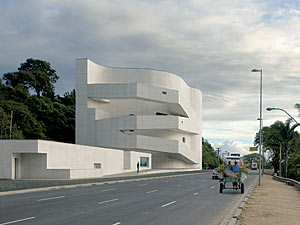

To appreciate the ICM, one must understand both its physical and cultural context. Just as its site feels separated yet connected to the town around it, Porto Alegre has a complex relationship with Brazil as a whole. Closer to Montevideo, Uruguay, and Buenos Aires, Argentina, than to São Paulo and Rio de Janeiro, it enjoys influences from the entire region. Originally named Porto dos Casais (Couple’s Harbor) for all the married people sent by Portugal to colonize the region in the 17th century, Porto Alegre hosted waves of immigrants from Germany, Poland, Spain, Italy, and other countries during the following three centuries, becoming a cosmopolitan melting pot in the process.
In the 1930s, collapsing coffee prices shifted power from the plantations around São Paulo and Rio de Janeiro to the cattle ranchers in Rio Grande do Sul, the state where Porto Alegre is located. At the same time, Brazilian Modernism began to assert itself with the patronage of enlightened intellectuals such as Rodrigo Mello Franco de Andrade and work by architects like Lucio Costa. While architects in Rio de Janeiro—such as Oscar Niemeyer and Affonso Reidy—created sinuous, free-form buildings, and those in São Paulo—including Vilanova Artigas and Lina Bo Bardi—developed a Brutalist style, designers in Porto Alegre took a more pragmatic approach. In the 1980s, Porto Alegre’s architects were again at the center of national debates, reinterpreting Modernism’s rich Brazilian heritage and using it as a jumping-off point for new work. A similar approach drove the designs of their colleagues in São Paulo such as Pritzker Prize– winner Paulo Mendes da Rocha and a younger generation including Angelo Bucci, Alvaro Puntoni, MMBB, and UNA Architects.
During the past two decades, ties between the Brazilian and Portuguese design communities have grown, creating fertile ground for Portugal’s most famous architect (and the winner this year of the Royal Institute of British Architect’s Royal Gold Medal) to undertake a project on the western side of the Atlantic. Siza’s biggest challenge with the Iberê Camargo Museum was dealing with the peculiar site—a narrow piece of land that had once been a quarry but enjoys excellent views of the Guaiba River. Siza has written, “Because of the steepness of the slope, the museum had to be developed as a vertical construction.” So he arranged exhibition spaces on three floors around a tall atrium and put a café and teaching spaces in a pair of one-story annexes on the narrowest end of the site. Below grade, he connected the annexes to the museum and inserted storage, archives, and a small auditorium. Finding room for parking was particularly difficult. In the end, the architect was able to convince the client and the city to build a parking structure for 100 cars underneath the avenue.
A pragmatic Modernist, Siza creates memorable buildings by finding the vitality in their contexts. While responding to topography, as well as local materials and building culture, he also brings his own sensibility to every project. Rafael Moneo has praised Siza for his ability to “accept realities, knowing their ins and outs, and … transform them from within.”
For the ICM, Siza choreographed a series of unexpected moments, starting with an entry plaza that plays with ambiguous notions of outdoor space and enclosure. While the portion of the plaza leading to the café and the workshop building flows seamlessly from the sidewalk, the architect defined the plaza area adjacent to the museum with a trio of concrete arms extending overhead from the second, third, and fourth floors of the main building. The arms, which house ramps between the gallery levels, embrace the plaza below without ever touching it and create an outdoor room that reads as a vertical space open to the sky. Inside the museum, Siza carved out a second vertical void, this one serving as the central atrium for the poured-in-place concrete structure.
Although relatively small—just 88,000 square feet—the museum has a discreet monumentality that makes it impressive yet approachable. After entering, visitors take an elevator to the top floor, then walk down the spiraling series of ramps. Siza separated exhibition spaces from circulation, creating a double tempo: andante largo for the nine art galleries on three floors, and allegro presto for the movement along the ramps. He provided only a few windows in the circulation spaces, but each opening offers a carefully framed view of the river or the avenue. Using a version of Adolf Loos’s raumplan, he varied the height of gallery floors, then negotiated these differences with the building’s distinctive ramps. The clever sequencing of exhibition spaces on two sides of the central atrium give the building the remarkable impression of being larger inside than outside. While almost all surfaces inside the museum are white, caramel-colored wood floors and strategically controlled daylighting give the interiors a warm, sensual glow.
The ICM bears a familial resemblance to other Siza works, but its bold approach to structure acknowledges the intelligence of Lina Bo Bardi and the Brutalist forms of other Paulista architects—so different from the freewheeling designs of Carioca Modernism. It’s a light and clear building housing the work of an artist whose work was sometimes dark. With its flowing ramps, it embodies Siza’s view of architecture as movement, as a journey. Cinematic in nature, it takes visitors from grand spaces to tight corridors, from the practical to the extraordinary.
Looking for a reprint of this article?
From high-res PDFs to custom plaques, order your copy today!
