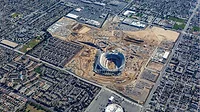
National Stadium of Sports Affairs Council
Toyo Ito raises the bar for sports facilities with his graceful, sustainable design for the National Stadium in Kaohsiung, Taiwan.
Architects & Firms
In a fitting match of design and program, Toyo Ito performed a feat of architectural athleticism with his National Stadium of the Sports Affairs Council in Taiwan. Combining the grace of a ballet dancer with the strength of a body builder, its lithe, sinewy form encircles a playing field, while its brawny concrete and steel components do the heavy lifting. Located in Kaohsiung, a city of 1.5 million people 234 miles south of Taipei, the 40,000-seat arena (Ito’s first work in Taiwan) opened in time for the 2009 World Games, which took place from July 16 through 26.

Having teamed up with the Japanese design and construction company Takenaka Corporation plus architects Ricky Liu & Associates and Fu Tsu Construction Company, both of Taiwan, Ito won an international competition held in 2005. The objective of the clients, Taiwan’s National Council on Physical Fitness and Sports and the Kaohsiung Bureau of Public Works, was to erect a stadium with a 1,300-foot-long track and a soccer field that met the specifications of the Fédération Internationale de Football Association and the International Association of Athletics Federation while complying with local government guidelines for integrating green building technology.
In addition to satisfying these criteria, Ito’s goal was to revamp the typology’s closed, concentric parti by opening the arena to the landscape and loosening up its form. “Usually stadiums are very static and symmetrical, but this time we wanted to make a more fluid and dynamic shape,” explains Ito.
Located on the grounds of a former navy base north of downtown Kaohsiung, the stadium begins with a long “tail” that greets sports fans, who mostly approach from the subway station nearby. Containing ticket booths and concessions shops, this appendage starts out small in section but expands steadily as it ascends the ground’s gentle slope. When the land levels off, the tail merges with the arena’s top-heavy body: a soaring, C-shaped grandstand that whips around the field and terminates abruptly at the “head.”
Holding upper and lower seating areas (plus room for an additional 15,000 temporary chairs), the arena opens to an internal lawn on the south, and the main gate connects to a broad terrace fanning out in front. “You can stand outside and still sense what is happening on the field,” says Chih Hsun Su, deputy chief engineer in the Construction Office of the city’s Public Works Bureau. The stands’ energetic form is secured in place by a concrete base containing two partially underground levels, both below grade at the building perimeter but open to the sunken playing field in the middle. The upper basement contains parking, administrative offices, and VIP suites that open onto box seats; the lower basement has prep areas for the athletes and more parking.
As in many Ito-designed buildings, the stadium’s architecture and structure are essentially one. Since the arena has little need for full enclosure, a series of massive structural elements, each one clearly articulated and connected to the next, defines the building. The sequence begins with the piles and raft foundations. These support the basements’ reinforced-concrete slabs and walls, which provide lateral stability as well as vertical load distribution. Most of the downward force comes from the concrete saddles above. Interspersed with openings and aligned like vertebrae, these monumental arches create the stadium’s double-decker circulation spine. Their irregular forms—nine different types in the body of the building alone—were made of poured-in-place concrete, as were the shoulder-angled beams supporting the upper seat decks and the roof.
Bolted to the saddles and the beams are 159 cantilevered steel trusses. Arranged radially, they extend out over the seats and hold up the roof. Tying the trusses together, 32 oscillating spirals of steel pipe stand out as the exterior’s most distinctive feature. Composed from hollow pieces measuring 13 inches in diameter and 20 feet in length, the tubes were factory made to Ito’s 3D specifications. Once welded together on-site, the pipes take on an entirely new character. Crossing over and under the trusses, they imbue the entire stadium with a sense of movement.
In addition to their strong visual impact, the coiled steel members act as lateral bracing that holds the framework for the 229,314-square-foot roof. This intricate, scalelike surface shades the spectators with its 6,482 aluminum-framed glazed units. It is also a massive solar collector, as 4,482 of these sections contain pairs of 4-foot-square solar panels. Tempered glass plate of variable length mediates the energy-gathering units’ rigid flat shape and the stadium’s irregular, curved geometry.
“Connecting these 2D and 3D elements was extremely difficult,” says L.P. Lin of Fu Tsu Construction. In locations unsuitable for solar-energy collection, the glazing is made entirely of tempered glass. Rubber gaskets smooth out the roof’s plane, while narrow troughs (or gutters) gather rainwater and direct it to underground cisterns supplying the soccer field’s irrigation system.
The largest solar-energy-generating stadium in the world, the building produces 1.1 million kilowatt hours annually—many times more energy than it needs. As a result, the system funnels the excess directly to the Taiwan Power Company, eliminating the need for costly and space-consuming storage batteries. When the stadium hosts a major event, it simply buys back extra electricity for lights, air-conditioning, and twin JumboTron screens. Furthermore, according to Fu Tsu Construction, the solar panels are responsible for reducing the building’s CO2 emissions by as much as 660 tons annually.
Another beneficiary of the sun is the grass field. To ensure that the lawn gets its required daily exposure of 5½ hours, the stadium’s long axis tilts 15 degrees north-northwest. This orientation also keeps most of the bright rays out of the athletes’ eyes—an important consideration that could impact the outcome of the game. Of equal concern was the ability to control the wind. Because the stadium opens to the south, it is able to corral the strong gusts that buffet the site during Kaohsiung’s scorching summers. While the resulting natural ventilation maintains comfortable temperatures for spectators, breezes are likely to disturb play. To prevent such mishaps as the ball blowing around during a game, the architects embedded the field into the earth.
Visually, the verdant plain relates to the grass-covered slope inside the stadium as well as the grounds outside—a mixture of existing and newly planted trees. “We wanted to attract the public with a new urban park typology,” explains Ito.
Nevertheless, while landscaping mollifies its impact, the voluminous building hardly blends with the residential neighborhood around it. Yet no one seems to mind. On the contrary, Ito’s landmark has invigorated the area and is a big score for Kaohsiung.
Looking for a reprint of this article?
From high-res PDFs to custom plaques, order your copy today!