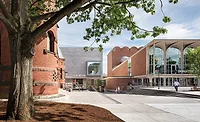
Neues Museum
Berlin
Architects & Firms
Until the Neues Museum reopened last fall in Berlin, few visitors knew about this quietly palatial edifice built between 1843 and 1859. Located to the north of Karl Friedrich Schinkel’s magnificent Neoclassical Altes Museum (1824–30) on Museum Island, a UNESCO World Heritage Site, this conventionally dignified four-story museum was designed by Friedrich August Stüler, one of Schinkel’s leading pupils, to didactically display archaeological finds of the prehistoric, ancient Egyptian, and Classical eras. Stüler had a good client: Frederick William IV, who took over the Prussian kingdom in 1840, also studied architecture with Schinkel, as Joseph Rykwert recounts in Neues Museum Berlin: David Chipperfield Architects in Collaboration with Julian Harrap (2009). It was the king’s idea to devote a part of an island surrounded by the Spree River in central Berlin to a monumental architectural ensemble that attested to Germany’s intellectual and artistic stature.
Additional Content:
Jump to credits & specifications
Unfortunately, the Neues Museum was heavily bombed in World War II and halfheartedly repaired by the East German government before the country’s reunification in 1990. After decades of disuse, it is now conserved, rehabilitated, reconstructed, and remodeled by Chipperfield, with Harrap as the restoration architect. Since its October 2009 opening, the Neues has been drawing crowds to the cluster of five 19th-century museums on the island, including the Bode, the Pergamon, the Alte Nationalgalerie (Old National Gallery), and Schinkel’s Altes. In 2013, a Chipperfield-designed visitors’ center, the James Simon Center, will open to the west of the Neues as part of the architect’s master plan.
Chipperfield and Harrap’s accomplishment with the Neues is prodigious. Their approach, like that of the 1964 International Charter of Conservation and Restoration of Monuments (aka the Venice Charter) calls for exposing changes that have occurred through time, rather than returning a building to its original condition, often as a facsimile. Scores of architects and consultants have labored on the $255 million project since 1997, when Chipperfield won the commission, after a drawn-out competition process that began in 1993. The result is a stunningly haunting setting that brings to the foreground fragile traces of history in the palimpsest of its walls, ceilings, floors, and columns. The ensemble offers a richly layered and sometimes coolly austere backdrop for Berlin State Museums’ Egyptian Museum and Papyrus Collection, the Museum of Pre- and Early History, and artifacts from the Collection of Classical Antiquities that the building houses. With one or two cavils (more about these later), the restoration/modeling and installation design reflect the influence of the pathbreaking direction set forth by Franco Albini and Carlo Scarpa in their postwar museum renovations in Italy, such as Scarpa’s Castelvecchio in Verona (1964).
The Neues and its contents suffered a number of changes since it first opened, including a gallery modernization in the 1920s (which featured hung ceilings) and, more traumatically, the Allied bombings in 1943 and 1945. The war destruction left the stair hall as one big hole and the northwest wing and domed southeast corner a shambles. In the postwar years, repairs and shoring up of the structure kept the unused ruin intact.
In working with the approximately 220,660-square-foot palatial block, where galleries are organized around two courtyards flanking the monumental stair hall at the center (which Chipperfield rebuilt), the architects didn’t want to draw a hard line between what Chipperfield did with the new and Harrap with the old. Their collaboration demonstrates they could work out an approach that incorporates a certain philosophy about fragments (“They needed to be put back in a meaningful context,” says Chipperfield), and about gaps in the original building fabric (“We realized when a gap is about 10 centimeters [4 inches], it’s quite easy. When it’s 2 meters [6½ feet], it’s a bit more difficult; and when it’s 20 meters [65½ feet], it’s something completely different”). In filling in the gaps, Chipperfield sought to retain a sense of unity by introducing a concrete aggregate that would both identify and link the new interventions. This precast concrete, formed of white cement, sand, and Saxonian marble chips, provides the dominant material for galleries in the northwest wing, the main stair hall and its enclosing walls, and the post-and-lintel platform structure inserted in the Egyptian Courtyard. (The Greek Courtyard, on the eastern side of the museum, has been left pretty much intact, although like the Egyptian Courtyard, it receives daylight from an expansive glass-and-steel roof.)
In addition, a number of new walls and ceilings needed to be reconstructed. To do so, the team found 1,350,000 bricks from buildings throughout Europe to create the now-exposed surfaces, often supported by a new poured-in-place concrete structure. The most effective use of masonry occurs in the stair hall, where reddish industrial brick and edge-laid terra-cotta tiles animate upper walls once dominated by historically themed murals, since destroyed. Both new exterior and interior brick walls are treated with a thin mortar slurry to give the brick a muted tone, a coloration approach found elsewhere in variegated wall finishes that highlight differences in the ages of the surfaces. An impressive display of the recycled brick occurs in the rebuilt southeast dome, where beehive corbeling surrounds majestic Roman statues. Topped by a lantern of sandblasted glass and metal, the space in the daytime seems suffused with the eerie half-light of the interior of Schinkel’s nearby Neue Wacht (Royal Guard House).
Elsewhere, Chipperfield and Harrap have re-created the shallow, lightweight domes made of clay pots that Stüler had introduced to lighten the load on the foundations resting on marshy soil. Harrap, who is incidentally the restoration architect for Sir John Soane’s Museum in London, notes that when Schinkel traveled to England in 1826, he took Stüler along. The two visited Soane’s house-museum and his Bank of England, where they were particularly taken with the hollow clay pots Soane used for his lightweight vaults. Years later, Stüler put them to use in the Neues. But since many of the clay pots were missing by the time Chipperfield and Harrap arrived on the scene, they had to find a company that would produce 40,000 in order to rebuild the domes, which, now exposed, enliven a number of galleries. In addition to the domes, Chipperfield and Harrap restored the cast- and wrought-iron bowstring trusses in second- and third-floor galleries. These are yet again examples of Stüler’s interest in the new technologies of the 19th century, as Kenneth Frampton points out in an essay in Neues Museum Berlin.
“We had a rule at the outset,” says Chipperfield. “No false walls, no ducts, no false ceilings.” Naturally, there are exceptions: “If a new room needed a roof and ceiling, then services could be inserted in them. But if the historic ceiling remained, the team found another way to solve the air handling and electricity.” The insertions are subtle, and like the overall approach, differ thoughtfully and dramatically from room to room.
Chipperfield’s architecture in Germany, as shown by his austerely elegant Modern Literature Museum in Marbach [record, February 2007, page 102], reveals an affinity for the principles of the Romantic Classical masters Friedrich Gilly, Leo von Klenze, and, of course, Schinkel. In Marbach, Chipperfield also used precast concrete, but with an aggregate formed of limestone, instead of marble. Oddly, the Neues concrete, with its sandblasted marble chips, appears dead. Where it is polished—such as the balustrades and stair treads—the aggregate contains larger marble chips and emanates a warm glow. However, the deadliness of the sandblasted concrete dominates. It may change according to the light—but this observer saw the concrete aggregate at different times on several wintry gray days. And at night, the electric light from spots embedded in the oak trusses of the stair hall is unfortunately bleak. So the concrete aggregate, in all its asperity, looks morguelike. Elsewhere, lighting fixtures installed in concrete ceilings evoke an office-park ambience. That said, the lighting, particularly in Michele de Lucchi’s bronze vitrines, generally works to great effect.
All in all, the contrast between the new (austere, sometimes too cold) and the old (intellectual, romantic, richly layered with history) at least allows you to know what came before and what did not. But it is the old that grabs you.
Looking for a reprint of this article?
From high-res PDFs to custom plaques, order your copy today!