Architectural Record
search
cart
facebook twitter linkedin youtube
  • Sign In
  • Subscribe
  • Sign Out
  • My Account
Architectural Record
  • NEWS
    • Latest News
    • Awards
    • Interviews
    • Obituaries
    • Podcasts
      • Design:Ed Podcast
      • Sponsored Podcasts
  • OPINION
    • Book Reviews / Excerpts
    • Exhibition Reviews
    • Forum
  • EXCLUSIVES
    • Videos
    • Design Vanguard
    • Top 300 Firms
    • Sponsored Content
    • Sponsored eBooks
    • From the Archives
  • CONTINUING ED
    • Editorial Continuing Ed
    • CE Center
    • CE Academies
  • PROJECTS
    • Buildings By Type
    • Reuse & Renovation
    • Museums & Arts Centers
    • Colleges & Universities
    • Multifamily Housing
    • Interiors
    • Lighting
    • Kitchen & Bath
  • HOUSES
    • Record Houses
    • House of the Month
    • Featured Houses
  • PRODUCTS
    • Products by Category
    • Record Products of the Year
    • Latest Products
  • EVENTS
    • Dates & Events
    • Record on the Road
    • Innovation Conference
    • Sustainability in Practice
    • Women In Architecture
    • Webinars
    • Ad Excellence Awards
    • Submit an Event
  • CONNECT
    • Ask RECORD AI
    • Newsletters
    • Contact
    • Advertise
    • Editorial Calendar
    • Store
    • Customer Service
  • SUBMIT
    • Submission Guidelines
    • RECORD Competitions
  • MAGAZINE
    • Subscribe
    • My Account
    • Digital Edition
    • Current Issue
    • Firm Pass
    • Historic Archive
Projects

North Carolina Museum of Art

Shedding Light: Thomas Phifer and Partners turns a simple structure into a stunning expansion of the North Carolina Museum of Art.

By Josephine Minutillo
July 19, 2010

Architects & Firms

Thomas Phifer and Partners

Raleigh, North Carolina

Tom Phifer said that he wants his new building for the North Carolina Museum of Art (NCMA), in Raleigh, to disappear into the landscape. By saying so, he is daring you to take a closer look, knowing full well that his first museum, like the art that hangs on its walls, will stand up to the scrutiny.


From a distance, it looks hardly more than a warehouse, an impression that did not sit well with some locals, who for endless months during construction could see only a squat concrete box. Certainly they would have preferred the bold civic gesture, a splashy concoction to bring attention to the Raleigh community. But the focus here is on the art, and the visitor’s interaction with it. So while the museum’s strong permanent collection, which occupies all the galleries, is not teeming with masterpieces like those of some larger institutions, under the soft light of day, it shines.

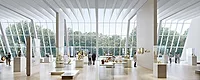
Three decisive elements transform what might easily have passed for an ordinary shed into this stunning house for art. Massive aluminum panels, arranged like pleats, clad the precast-concrete wall panels of the steel frame structure. A series of courtyards and reflecting pools cuts into each face of its rectangular form. Topping everything is a spectacular array of coffered skylights that combines with the glazed courtyard openings to bathe the galleries in controlled natural light and bring the outside emphatically in.

And since the one-story structure has no place for a soaring atrium or grand staircase, de rigueur in museum buildings both Classical and Modern, Phifer’s singular gesture is to demarcate the main entry with a steel-and-glass canopy beside an allée of American elms. Just past the threshold, the visitor is immediately confronted with art, the reception desk slightly askew. While this entry shares an outdoor plaza with NCMA’s existing Edward Durell Stone building, now home to temporary exhibitions and offices, visitors can access the new building, which is free to the public, from its courtyards as well. “There is a brilliant new thinking about buildings for art,” says NCMA director Lawrence Wheeler. “Ours reflects these democratic values.” (Security cameras monitor the building and grounds.)

It’s a way of thinking that leaves visitors to experience the art, both inside and scattered throughout the surrounding landscape (NCMA’s museum park, the largest in the country, includes a popular outdoor amphitheater by Smith-Miller + Hawkinson and artist Barbara Kruger) on their own terms.

Happily, the exhibition galleries, laid out over 65,000 square feet according to a 26-foot module, do not follow a tightly controlled path of strict chronological or thematic sequences. The fairly open floor plan allows visitors to weave in and out of them, passing by the figurative sculptural works that delineate the building’s spine. Curators take advantage of this freedom to experiment with how they display the art. Devorah Sperber’s After the Mona Lisa 2, a 2005 work that recreates da Vinci’s famous portrait with 5,184 hanging spools of thread, is an unexpected delight beside works from the Italian Renaissance. In another gallery, Josef Albers’s colorful, mid-20th-century studies for Homage to the Square are juxtaposed with American Impressionist Frederick Carl Frieseke’s The Garden Parasol from 1910.

Of course, everything looks good beneath the ceiling’s 360 oculi, the building’s only sculptural element and the source of the glorious daylight that shines down on the collection. Phifer took Louis Kahn’s skylight detail in the Kimbell Art Museum as a point of departure, finalizing the ellipsoid shape of the NCMA’s ceiling coffers after numerous light studies conducted by Arup’s London and New York offices. A local boat builder advised on resin technologies for the fiberglass vaults, which rise 5 1⁄2 feet above the ceiling plane.

While sunlight shines down, it by no means pours in. North-facing louvers and removable scrims limit the amount and type of light that penetrates an oculus and reaches an artwork. Three layers of curtains do the same for light coming in from the courtyard openings. Photocells on the roof measure daylight; the information they gather is used to adjust track lighting within the galleries.

These efforts control the quantity of light inside the museum, but the quality of light is undeniable, particularly as it changes over the course of a day. Outside the museum, the changing light produces equally dazzling effects on the 25-foot-high anodized aluminum panels, which at times appear golden, their jagged outline clearly visible, while at other times they seem to dissolve completely.

This is not groundbreaking stuff. But the sum of these small but thoughtful moves erodes boundaries between building and landscape, outside and inside, and even between different genres of art. By avoiding the all-too-easy tendency toward architectural bravado—to the dismay of some—and instead focusing on good design, Phifer has created something beyond just a remarkable building. It is a remarkable place.

KEYWORDS: North Carolina

Share This Story

Looking for a reprint of this article?
From high-res PDFs to custom plaques, order your copy today!


Josephine minutillo

Josephine Minutillo is editor in chief of Architectural Record. Trained as an architect, she began writing for RECORD in 2001 while practicing architecture, and has held several positions at the magazine over the past two decades. Her articles have appeared in many international publications. She has been an invited critic at Washington University in St. Louis, The Cooper Union, Columbia GSAPP, Pratt Institute, The City College of New York, and Yale University.
Instagram: @josephineminutillo_

Post a comment to this article

Report Abusive Comment

Subscription Center
  • Create an Account
  • Start a Subscription
  • Manage My Account
  • Sign Up for Newsletters
  • Visit Customer Service
  • Update Preferences

More Videos

Sponsored Content

Sponsored Content is a special paid section where industry companies provide high quality, objective, non-commercial content around topics of interest to the Architectural Record audience. All Sponsored Content is supplied by the advertising company and any opinions expressed in this article are those of the author and not necessarily reflect the views of Architectural Record or its parent company, BNP Media. Interested in participating in our Sponsored Content section? Contact your local rep!

close
  • TAMLYN XtremeTrim Exterior Trim
    Sponsored byTamlyn

    Designing Cleaner Panel Facades: Why Exterior Trim Details Matter

  • Building with Vapor Barriers
    Sponsored byReef Industries, Inc.

    Vapor Barriers Help Control Moisture in Tighter Building Designs

  • Duct Interior with Prodeq System
    Sponsored byHenry, a Carlisle Company

    Designing Resilient Water Containment Systems

DESIGN:ED Podcast
Listen to Architectural Record’s DESIGN:ED Podcast

Events

June 10, 2026

Rethinking Stormwater – The Power of Porous Paving

Credits: 1 AIA LU/HSW; 1 AIBD P-CE; 0.1 ICC CEU

Learn how porous paving systems support stormwater management, reduce heat island effects, and enhance sustainable site design performance.

June 11, 2026

Very Early Warning Fire Detection for Mission-Critical Facilities

Credits: 1 AIA LU/HSW; 1 AIBD P-CE; 0.1 ICC CEU

Examine advanced fire detection strategies that support uptime and enhance safety in data centers and other mission-critical facilities.

View All Submit An Event

Products

2026 Architect's Square Foot Costbook

2026 Architect's Square Foot Costbook

See More Products

Popular Stories

Practice Matters illustration

What’s in a (Firm’s) Name? Thinking About Succession and Legacy

Practice Matters illustration

By the Numbers: Counting America's Architects

House on a Hill

Design Vanguard 2026: Forma

Crane Cove, ONO

Design Vanguard 2026 Winners

KRESA by DLR

In Kalamazoo, DLR Group Completes a Mass-Timber Hub for Career and Technical Education Programs

Broader Sustainability of CMU - Free Webinar - May 21, 2026

Related Articles

  • Thomas Phifer and Partners North Carolina Museum of Art Project Portfolio

    See More
  • UC Davis Shrem Museum

    The Manetti Shrem Museum of Art by SO — IL & Bohlin Cywinski Jackson

    See More
  • wHY Met Renovation

    New Design Revealed for Major Wing at New York’s Metropolitan Museum of Art

    See More
×

The latest news and information

#1 Source for Architectural Design, News and Products

SUBSCRIBE
  • RESOURCES
    • Advertise
    • Contact Us
    • Submit
    • Store
  • ACCOUNT CENTER
    • Create an Account
    • Start a Subscription
    • Manage My Account
    • Sign Up for Newsletters
    • Visit Customer Service
    • Update Preferences
  • PRIVACY
    • PRIVACY POLICY
    • TERMS & CONDITIONS
    • DO NOT SELL MY PERSONAL INFORMATION
    • PRIVACY REQUEST
    • ACCESSIBILITY
  • SERVICES
    • Marketing Services
    • Reprints
    • Market Research
    • List Rental
    • Survey/Respondent Access
  • STAY CONNECTED
    • Linkedin
    • Facebook
    • Instagram
    • YouTube
    • X (Twitter)

Copyright ©2026. All Rights Reserved BNP Media, Inc. and BNP Media II, LLC.

Design, CMS, Hosting & Web Development :: ePublishing