Architectural Record
search
cart
facebook twitter linkedin youtube
  • Sign In
  • Subscribe
  • Sign Out
  • My Account
Architectural Record
  • NEWS
    • Latest News
    • Awards
    • Interviews
    • Obituaries
    • Podcasts
      • Design:Ed Podcast
      • Sponsored Podcasts
  • OPINION
    • Book Reviews / Excerpts
    • Exhibition Reviews
    • Forum
  • EXCLUSIVES
    • Videos
    • Design Vanguard
    • Top 300 Firms
    • Sponsored Content
    • Sponsored eBooks
    • From the Archives
  • CONTINUING ED
    • Editorial Continuing Ed
    • CE Center
    • CE Academies
  • PROJECTS
    • Buildings By Type
    • Reuse & Renovation
    • Museums & Arts Centers
    • Colleges & Universities
    • Multifamily Housing
    • Interiors
    • Lighting
    • Kitchen & Bath
  • HOUSES
    • Record Houses
    • House of the Month
    • Featured Houses
  • PRODUCTS
    • Products by Category
    • Record Products of the Year
    • Latest Products
  • EVENTS
    • Dates & Events
    • Record on the Road
    • Innovation Conference
    • Sustainability in Practice
    • Women In Architecture
    • Webinars
    • Ad Excellence Awards
    • Submit an Event
  • CONNECT
    • Ask RECORD AI
    • Newsletters
    • Contact
    • Advertise
    • Editorial Calendar
    • Store
    • Customer Service
  • SUBMIT
    • Submission Guidelines
    • RECORD Competitions
  • MAGAZINE
    • Subscribe
    • My Account
    • Digital Edition
    • Current Issue
    • Firm Pass
    • Historic Archive
Residential ArchitectureRecord Houses

House in the Rockies

Point of Departure: For his first house, Renzo Piano crafts a finely rendered family portrait.

By Beth Broome
House in the Rockies
The steel and Douglas fir structure is exposed throughout the interiors and flows outside, supporting broad overhangs. Its 18-inch grid carries over to the facade which, with its laminated insulated glass and thermally isolated stainless steel mullions, forms a robust envelope. The house terminates in prow-like acute angles at the east and west ends, maximizing views to the valley below.
 
Photo © Nic Lehoux
House in the Rockies
The brightly hued standing-seam roof caps a standard membrane system. “I love the idea of the red color flying between the aspen trees,” says Piano. A 510-foot-long concrete wall behind the house redirects avalanche debris flow.
 
Photo © Nic Lehoux
House in the Rockies
The brightly hued standing-seam roof caps a standard membrane system. “I love the idea of the red color flying between the aspen trees,” says Piano. A 510-foot-long concrete wall behind the house redirects avalanche debris flow.
 
Photo © Nic Lehoux
House in the Rockies
The kitchen and living room open out onto a broad deck.
 
Photo © Nic Lehoux
House in the Rockies
A courtyard visually links his-and-hers studies with the library. (A second-level guest suite can be seen on the right.)
 
Photo © Nic Lehoux
House in the Rockies
At its midpoint, the central axis widens into a 'piazza', dominated by a walnut dining table and benches, crafted from a single log by New York'based Hisao Hanafusa. At the left, a hearth made from boulders found on the site marks the house's center.
 
Photo © Nic Lehoux
House in the Rockies
The living room is visible from the master suite's deck.
 
Photo © Nic Lehoux
House in the Rockies
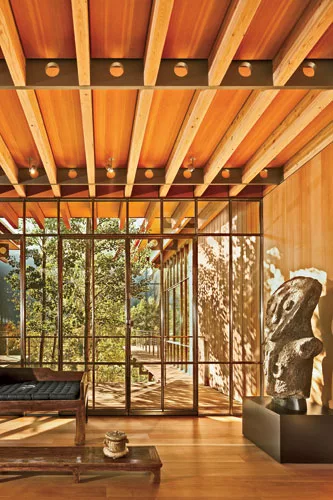
Douglas fir, which clads the exterior, extends inside in a buttery veneer grade, with a minimum of 15 rings per inch. Holes in the steel beams lighten them visually. The team eschewed the option of valueengineering the finished quality of the structure behind dropped ceilings, where it is not visible.
 
Photo © Nic Lehoux
House in the Rockies
 
Image courtesy Renzo Piano Building Workshop
House in the Rockies
 
Image courtesy Renzo Piano Building Workshop
House in the Rockies
April 16, 2014

Architects & Firms

Renzo Piano Building Workshop

Colorado

People/Products

Renzo Piano never wanted to build a house. With a portfolio of museums, towers, and other award-winning buildings across the world, his mind was elsewhere. But in 2005 a friend approached the architect asking if he would design a home for his family in Colorado's Rocky Mountains. Piano was resolute: he had never done residential work and had no intention of starting now. Hoping to entice the architect, the friend invited him to visit the site—a 183-acre ranch on a mountainside along a breathtaking valley veiled with aspen and scrub oak—via Google Earth. “That was the end,” says Piano. “I went flying in a little spaceship and then landed on that mountain with a light touch, floating a bit above the ground—then we started to dream together.”

Within days, Renzo Piano Building Workshop (RPBW) partner in charge Giorgio Bianchi was on-site with the client and his wife. Piano visited soon after, joining the search for the center of the future house—a ritual country people have practiced for centuries, he notes. “You walk the property with your hammer in your right hand, in your left hand you have a stick and, almost inevitably, after a few hours, you have your place.” “The land forms a kind of panettone,” says Bianchi, referring to the Italian sweet bread as he describes a bubble-like rise on the site, between a meadow and where the mountain shoots up. Here the party found the spot. Proclaiming it the axis mundi, they tapped the stick into the ground.

Piano became intrigued by the potential of a project outside the large, institutional realm. While the programmatic needs of a house are straightforward, “Everything about it is more subtle, more personal,” he says. “It's about the culture and desires of the specific person. The clients have to tell you about the emotion they want to communicate. Then you have to translate this into a building.”

The husband and wife, who have grown children, had a straightforward brief: “Please build us a house where we live outside but don't get wet when it rains.” And they hoped to capture the essence and simplicity of traditional Japanese design. But Piano spoke in terms of rhythm, of music and poetry, which at first threw them off. “But he was right,” acknowledges the husband. “In the end, it was a more holistic experience we were after—that of quiet and vibration. The millions of details achieve that objective.”

Through a gate and past the caretaker's residence and a large barn, the drive meanders below the house's decks shooting out toward the valley, and then winds up to the entrance on the east. Except for the emphatic red metal roofs—which Piano painted his trademark ruby red to inject color as well as highlight the fragmentation of the house—the glass and wood forms nestle quietly into the slope. And, in winter, the roofs disappear under a blanket of snow.

The architects say they were drawn to timber by the fact that the west was built out of lumber. “America has had a tradition of building beautifully with wood,” says Piano. “This house is a little homage to that.” Honey-colored Douglas fir, which flows from the exterior to the interior walls, ceilings, and floors in a silken veneer grade is hardly the stuff of pioneer days, but it imbues the house with a glowing warmth. Using one primary material gives the building integrity and a sense of coherence, notes Piano. Another goal was to show how the house was made “without being too exhibitionistic,” he says, referring to the wood and steel structure, which is expressed—with restraint—both inside and out.

Not wanting a single monolithic building, the architects conceived the 13,800-square-foot house as a composition of seven volumes that correspond with the programmatic elements and are articulated by the separate roofs. “The form took shape as we maximized the views out to the south,” says Bianchi. Initially, the team envisioned the roofs as a system of wings lifting out toward both the north and south. But local building-height limitations prevented them from using steep pitches on the valley-facing side. So, instead, they designed flat roofs there, and used steeply pitched ones for the two upper-level guest suites, emphasizing the views toward the slope. The plan is simple and rational. A broad 130-foot-long central corridor runs east to west, connecting the various elements: the “kids' ” wing and guest rooms, the living spaces, and the master bedroom, whose acutely angled facade directs the gaze from the living room out to a dramatic mountain bookending the dale. At its center, this main “street” widens into a “piazza” that functions as a dining room, setting an informal tone and marking the heart of the house. The organization, points out Piano, is like a little village, with the central spine connecting the pieces. The journey along this path is punctuated by glimpses into jewel-box courtyards and through the house's multiple layers, and then the surprise as the tableau of the valley gloriously comes into view through the long south-facing facade.

“We're not talking about anything too cerebral or complicated. We're talking about compression and expansion of the space, about transparency and intimacy,” says Piano. When the house is not bustling with the activity of family and friends, a penetrating silence inside breeds introspection. At the same time, you are linked to the outside world through a sequence of planes that begins with the facade—a sublime Italian custom stainless-steel window system that forms the walls. The next layer is the stand of aspen, which shifts moods as it crosses the seasons with sprightly greens, flaming autumnal displays, and, in winter, lacy scrims. The final plane is the majestic peaks beyond.

The desire for this layered effect helped determine the house's 18-inch grid (a three-month discussion, say the architects), which is reflected in the mullion spacing. With too much glass, the first plane would be lost. And 18 inches granted more freedom than, say, 16 inches. The rigor of the dimensional grid and the tightness of the tolerances are mind-blowing. The centerlines between the deck boards align with the centerlines of the mullions, which align with the centerlines between floor planks, which align with the centerlines of the glue-laminated wood beams, which align with the standing seams on the metal roof. “When you try to have the world line up, it answers the questions but presents a lot of problems,” says Patrick Leeds, formerly with the executive architect Harry Teague, sounding a pragmatic note. “Where it comes to bear is in construction and whether we have contractors who are OCD enough.” They did. The result is that the connections and component pieces fade and you are left with an essence, which is the emotion—a calming frisson—that rings through the house.

With its museum projects, RPBW is known for understated design and “putting the art first.” Here, too, the architects have deferred to the program: the owners wanted an open, warm environment that matched their outlook and lifestyle. After all, notes Piano, “a house is not a mirror of the architect. It is a portrait of a family.”


People

Client: Private

Architect:
Renzo Piano Building Workshop
34, rue des Archives
75004 Paris - France

In collaboration with

Harry Teague Architects, Inc. (HTA)
129 Emma Rd.
Basalt, Colorado 81621

Personnel in architect's firm who should receive special credit:
Design Team of Renzo Piano Building Workshop:
G.Bianchi (partner in charge), S.Doerflinger (project architect), V.Laffineur, T.Sahlmann, C.Trentesaux; O.Aubert, C.Colson, Y.Kyrkos (models)

Executive Architect’s team of HTA: Patrick Leeds (project architect), Galen Hoover, Eric Westerman

Consultants: Robert Silman Associates (structural engineering); Beaudin Ganze (mep engineering); Front (facade consultant); Fisher Marantz Stone (lighting design); Schmueser Gordon Meyer (civil engineering); Deborah Nevins & Associates (landscape design); Designrealization (interiors)

Photographer(s): Nic Lehoux

Size:

13,800 square feet

Total construction cost:

withheld

Completion date:

December 2010


Products

Structural system
Composite wood and steel frame, Cast-in-Place Concrete foundation and site walls.

Exterior cladding
Metal/glass curtain wall: Customized Stainless Steel Glass Façade, Capoferri Serramenti

Wood: Douglas fir (walls, floors, beams), Cumaru (exterior decking )

Roofing
Metal: standing seam painted metal

Windows 
Metal frame: Custom Fabrication

Doors
Entrances: Custom Fabrication

Wood doors: Custom Fabrication

Sliding doors: Custom Fabrication

Interior finishes
Cabinetwork and custom woodwork: Custom Fabrication, Douglas Fir

Special interior millwork / finishes unique to this project: Bulthaup Kitchen

Other unique products that contribute to sustainability: Geothermal System
 
KEYWORDS: Colorado

Share This Story

Looking for a reprint of this article?
From high-res PDFs to custom plaques, order your copy today!
Former Architectural Record managing editor Beth Broome is a freelance writer based in Brooklyn, New York.

Post a comment to this article

Report Abusive Comment

Subscription Center
  • Create an Account
  • Start a Subscription
  • Manage My Account
  • Sign Up for Newsletters
  • Visit Customer Service
  • Update Preferences

More Videos

Sponsored Content

Sponsored Content is a special paid section where industry companies provide high quality, objective, non-commercial content around topics of interest to the Architectural Record audience. All Sponsored Content is supplied by the advertising company and any opinions expressed in this article are those of the author and not necessarily reflect the views of Architectural Record or its parent company, BNP Media. Interested in participating in our Sponsored Content section? Contact your local rep!

close
  • TAMLYN XtremeTrim Exterior Trim
    Sponsored byTamlyn

    Designing Cleaner Panel Facades: Why Exterior Trim Details Matter

  • Building with Vapor Barriers
    Sponsored byReef Industries, Inc.

    Vapor Barriers Help Control Moisture in Tighter Building Designs

  • Duct Interior with Prodeq System
    Sponsored byHenry, a Carlisle Company

    Designing Resilient Water Containment Systems

DESIGN:ED Podcast
Listen to Architectural Record’s DESIGN:ED Podcast

Events

June 10, 2026

Rethinking Stormwater – The Power of Porous Paving

Credits: 1 AIA LU/HSW; 1 AIBD P-CE; 0.1 ICC CEU

Learn how porous paving systems support stormwater management, reduce heat island effects, and enhance sustainable site design performance.

June 11, 2026

Very Early Warning Fire Detection for Mission-Critical Facilities

Credits: 1 AIA LU/HSW; 1 AIBD P-CE; 0.1 ICC CEU

Examine advanced fire detection strategies that support uptime and enhance safety in data centers and other mission-critical facilities.

View All Submit An Event

Products

2026 Architect's Square Foot Costbook

2026 Architect's Square Foot Costbook

See More Products

Popular Stories

Practice Matters illustration

What’s in a (Firm’s) Name? Thinking About Succession and Legacy

Coronado Bridge

The Architect’s Guide to San Diego

Practice Matters illustration

By the Numbers: Counting America's Architects

Riverdale House by Studio Lau

Riverdale House by Studio Lau

KRESA by DLR

In Kalamazoo, DLR Group Completes a Mass-Timber Hub for Career and Technical Education Programs

Broader Sustainability of CMU - Free Webinar - May 21, 2026

Related Articles

  • Enso House II

    HW Studio's Mies-Inspired House in the Mexican Desert Draws Lines in the Sand

    See More
  • House in the Mountains

    See More
  • Aspen Home

    F&M Architects Blends New and Old in a Three-Volume House in the Rocky Mountains

    See More

Related Products

See More Products
  • GlobalData_logo_blue_header.png

    Construction in the US - Key Trends and Opportunities to 2023

  • iconic house.jpg

    The Iconic House

See More Products
×

The latest news and information

#1 Source for Architectural Design, News and Products

SUBSCRIBE
  • RESOURCES
    • Advertise
    • Contact Us
    • Submit
    • Store
  • ACCOUNT CENTER
    • Create an Account
    • Start a Subscription
    • Manage My Account
    • Sign Up for Newsletters
    • Visit Customer Service
    • Update Preferences
  • PRIVACY
    • PRIVACY POLICY
    • TERMS & CONDITIONS
    • DO NOT SELL MY PERSONAL INFORMATION
    • PRIVACY REQUEST
    • ACCESSIBILITY
  • SERVICES
    • Marketing Services
    • Reprints
    • Market Research
    • List Rental
    • Survey/Respondent Access
  • STAY CONNECTED
    • Linkedin
    • Facebook
    • Instagram
    • YouTube
    • X (Twitter)

Copyright ©2026. All Rights Reserved BNP Media, Inc. and BNP Media II, LLC.

Design, CMS, Hosting & Web Development :: ePublishing