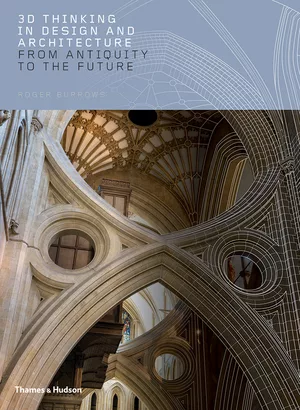
Dee and Charles Wyly Theatre by REX/OMA
Dallas, Texas
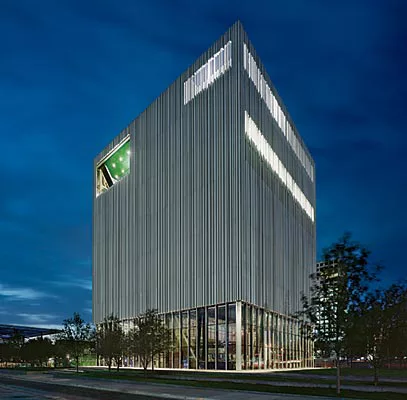
Dee and Charles Wyly Theatre
Photo © Timothy Hursley
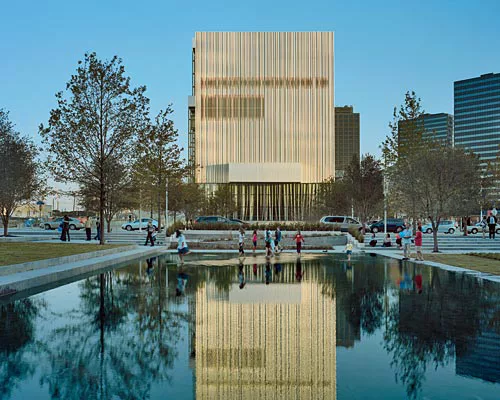
Dee and Charles Wyly Theatre
Photo © Timothy Hursley
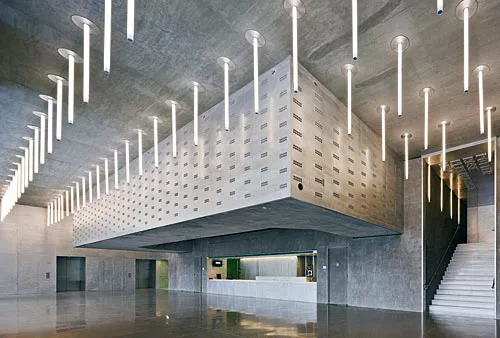
Dee and Charles Wyly Theatre
Photo © Iwan Baan
Dee and Charles Wyly Theatre
Photo © Iwan Baan
Dee and Charles Wyly Theatre
Photo © Iwan Baan
Dee and Charles Wyly Theatre
Photo © Iwan Baan
Dee and Charles Wyly Theatre
Photo © Timothy Hursley
Dee and Charles Wyly Theatre
Photo © Iwan Baan
Performing Arts Centers: Dallas Arts District  Winspear Opera House Wyly Theatre Copenhagen Concert Hall
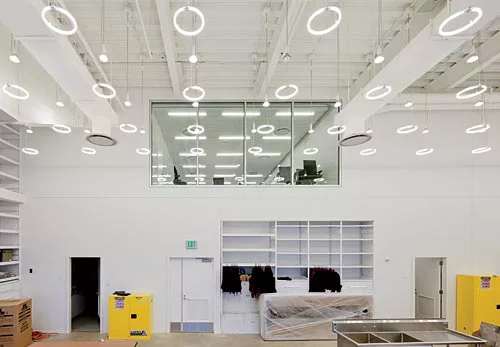
Winspear Opera House Wyly Theatre Copenhagen Concert Hall With its rippling aluminum facade and crisp cubic form, the Dee and Charles Wyly Theatre is an edgy presence in Dallas’s refined brick-and-stone Arts District. Corners peel back to expose massive X braces; floors cantilever at gravity-defying angles. Instead of flowing out like a traditional theater, with the stage in the center and support spaces to the sides, the Wyly pushes up, nine stories, with the lobby in the basement, the stage on the street, and rehearsal studio, costume shop, offices, and classrooms snapped together above like a transformer. The “vertical city” meets the Texas prairie.
A centerpiece of the $354 million AT&T Performing Arts Center, the Wyly is a surprisingly small building, barely 90,000 square feet. Across the street stand I.M. Pei’s swirling Meyerson Symphony Center and Foster + Partners’ Winspear Opera House, with its thrusting sunscreen and blood-red performance drum. Knowing that their building would be upstaged by its more flamboyant neighbors, Joshua Prince-Ramus and Rem Koolhaas opted to play to the office towers behind instead of the low-slung cultural buildings in front.
“Verticality helped us acquire an identity,” says Koolhaas. “The building belongs both to the cultural complex and to the rest of the city.”
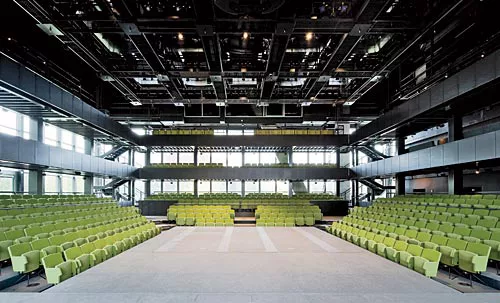
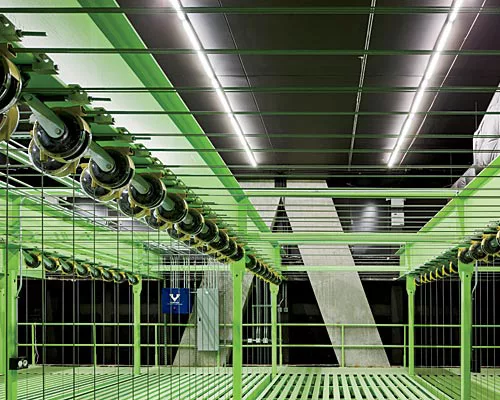
The Wyly’s tubular aluminum skin, reminiscent of a pleated theater curtain, transforms it into a Minimalist sculpture on a low, grassy pedestal. But the rain-screen skin is only one part of the story. The architects set out to reinvent the contemporary theater by designing a performance machine. Equipped with an elaborate system of winches, pulleys, lifts, tracks, and catwalks, the structure can be reconfigured from a proscenium stage to thrust or flat floor in a matter of hours instead of days, dramatically reducing labor costs. While this is common in sports arenas and convention centers, the technology has never been used quite this way. Balconies fly up into the ceiling at the touch of a button; aisles can be rearranged between acts; the audience may sit on the floor at the beginning of a performance and on stage at the end.
“Going up allowed us to free the ground plane so that control of how the play is seen or changed passes to the director instead of the building,” explains Prince-Ramus.
Early reports have been enthusiastic. “Everything you’ve heard about the flexibility of the space is true,” wrote Dallas Morning News theater critic Lawson Taitte. “The machinery has worked beautifully.”
“It is exactly what we were hoping for,” adds Wyly artistic director Kevin Moriarty, “which is not to say that it will appeal to everyone or that it will work for any play. It was certainly not conceived as a home for 19th-century-style productions.”
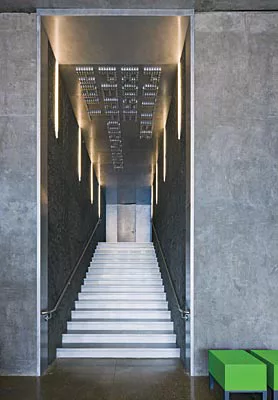
The only complaints so far have been butt-bruising seats, poor sight lines in parts of the balcony, and, more frequently, the building’s perverse Chutes and Ladders entrance. Instead of entering directly from the street, patrons must walk down a sloping concrete ramp to the lobby, then back up a narrow interior staircase to their seats. This sequence stemmed from the architects’ desire for a totally flexible performance space, which meant that the lobby had to go below. (An early scheme showed the glass walls wrapping the stage folded up like garage doors, allowing patrons to spill out onto the plaza at intermission.) “Their thinking was that five minutes of inconvenience in the lobby was worth two hours of excitement onstage,” says Kevin Moriarty.
Yet the ramp is steep, hard, and unwelcoming, and with cars entering and exiting, dangerous as well. It also makes a large curb cut on Flora Street, the district’s main drag, while eclipsing views of the Winspear and the Meyerson on the other side.
Once inside, however, patrons find a sophisticated high-tech space. No sofas, velvet drapes, and warm, soothing colors here—only mute concrete floors and walls; sleek, stainless-steel-paneled overhangs; and bare fluorescent tubes suspended from the ceiling like light sabers. This is tough, “take that’’ interior architecture, occasionally crude in its execution yet carried through with the consistency of a serious aesthetic rather than a glib decorator flourish.
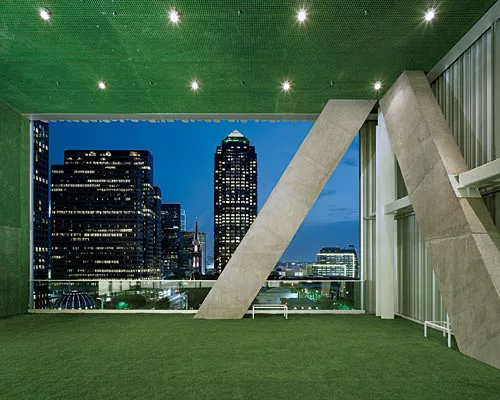
And in spite of its aloof, self-absorbed attitude, the Wyly still manages to engage the city at several levels. When a performance ends and the curtains part, audiences get a framed view of the passing parade on Ross Avenue, a major gateway to the Arts District. Likewise, the black-box theater on the sixth floor offers a synoptic glimpse of the rest of the district, with the Winspear bracketed by the Meyerson and Allied Works’ new Booker T. Washington High School for the Performing and Visual Arts [record, January 2010, page 100]—classical music, opera, and theater doing a line dance. And from the balcony of the 9th-floor rehearsal hall, trimmed out in green artifical-grass carpet and fiberglass trellises, visitors have a panoramic view of downtown Dallas, with the historic Guadalupe Cathedral in the foreground and the skeletons of spec office buildings off in the distance. Past, present, and future, art and commerce are compressed into a single image.
With only two productions so far, one the opening gala, it is too early to say how the Wyly will ultimately perform. Kevin Moriarty predicts it will take five years to know what it can and cannot do. “We’re going to assault the building relentlessly to discover its limits,” he says.
It is clearly a director’s theater, a laboratory for the new and surprising, and it will certainly redefine what a night at the theater means for Dallas audiences. Like much of both architects’ work, it is provocative rather than pretty, a gutsy roll of the dice. In a 21st-century arts district, that’s a good role to play.
Looking for a reprint of this article?
From high-res PDFs to custom plaques, order your copy today!