Architectural Record
search
cart
facebook twitter linkedin youtube
  • Sign In
  • Subscribe
  • Sign Out
  • My Account
Architectural Record
  • NEWS
    • Latest News
    • Awards
    • Interviews
    • Obituaries
    • Podcasts
      • Design:Ed Podcast
      • Sponsored Podcasts
  • OPINION
    • Book Reviews / Excerpts
    • Exhibition Reviews
    • Forum
  • EXCLUSIVES
    • Videos
    • Design Vanguard
    • Top 300 Firms
    • Sponsored Content
    • Sponsored eBooks
    • From the Archives
  • CONTINUING ED
    • Editorial Continuing Ed
    • CE Center
    • CE Academies
  • PROJECTS
    • Buildings By Type
    • Reuse & Renovation
    • Museums & Arts Centers
    • Colleges & Universities
    • Multifamily Housing
    • Interiors
    • Lighting
    • Kitchen & Bath
  • HOUSES
    • Record Houses
    • House of the Month
    • Featured Houses
  • PRODUCTS
    • Products by Category
    • Record Products of the Year
    • Latest Products
  • EVENTS
    • Dates & Events
    • Record on the Road
    • Innovation Conference
    • Sustainability in Practice
    • Women In Architecture
    • Webinars
    • Ad Excellence Awards
    • Submit an Event
  • CONNECT
    • Ask RECORD AI
    • Newsletters
    • Contact
    • Advertise
    • Editorial Calendar
    • Store
    • Customer Service
  • SUBMIT
    • Submission Guidelines
    • RECORD Competitions
  • MAGAZINE
    • Subscribe
    • My Account
    • Digital Edition
    • Current Issue
    • Firm Pass
    • Historic Archive
Projects

Margot and Bill Winspear Opera House by Foster + Partners

Dallas
By Victoria Newhouse
Margot and Bill Winspear Opera House

Photo © Timothy Hursley

Margot and Bill Winspear Opera House

Photo © Nigel Young/Foster + Partners
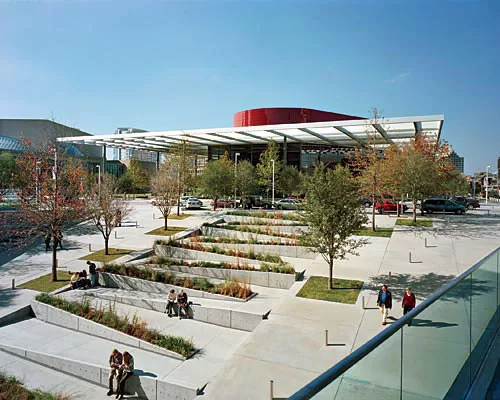
Margot and Bill Winspear Opera House

Photo © Timothy Hursley

Margot and Bill Winspear Opera House

Photo © Timothy Hursley

Margot and Bill Winspear Opera House

Photo © Iwan Baan

Margot and Bill Winspear Opera House

Photo © Timothy Hursley

Margot and Bill Winspear Opera House

Photo © Timothy Hursley

Margot and Bill Winspear Opera House

Photo © Iwan Baan

Margot and Bill Winspear Opera House

Photo © Iwan Baan

Margot and Bill Winspear Opera House

Image courtesy Foster + Partners

Margot and Bill Winspear Opera House

Image courtesy Foster + Partners

Margot and Bill Winspear Opera House

Image courtesy Foster + Partners

Margot and Bill Winspear Opera House

Image courtesy Foster + Partners

Margot and Bill Winspear Opera House
February 19, 2010

Architects & Firms

Foster + Partners
With a steel-frame canopy stretching well beyond its performance hall, the Winspear Opera House reaches out to other constituents of the AT&T Performing Arts Center. As designed by Foster + Partners, the building reflects the values of Bill Winspear, the Canadian-born entrepreneur who donated $43 million to the approximately $150 million project to share his passion for music with as many people as possible and make sure the hall’s acoustics would be excellent. Certainly, the second goal has been realized, and the opera house’s design encourages the first.

Additional Content:
Jump to credits & specifications

Attitudes toward the arts have changed radically since the initial plan for the center respectfully aligned each institution along a single street (Flora). Today, generous open spaces intended to attract crowds of nontheatergoers are considered as important as the buildings themselves. To encourage this democratization, the architects enlivened the plan with new axes that link the buildings with plazas and the surrounding streets—notably a north–south path perpendicular to Flora. Consequently, the Winspear now shares with I.M. Pei’s Meyerson Symphony Center (1989) an inviting 10-acre park and an orientation rotated 30 degrees from the street.

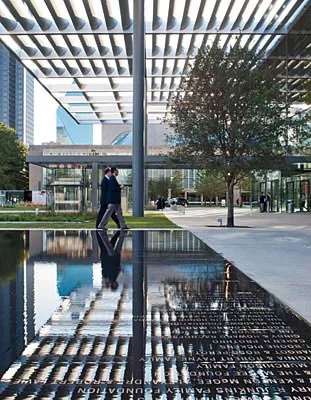
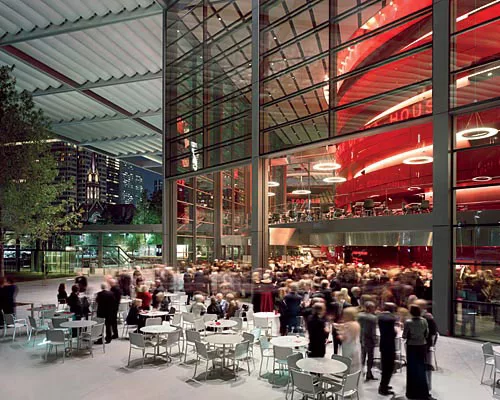
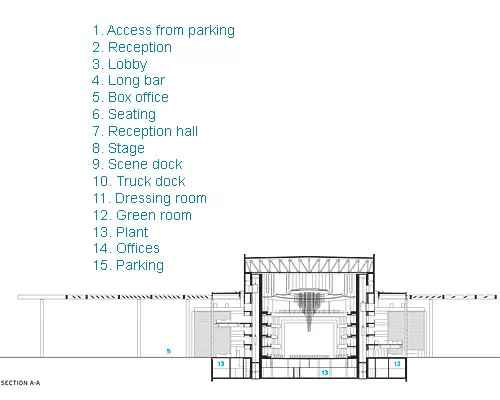
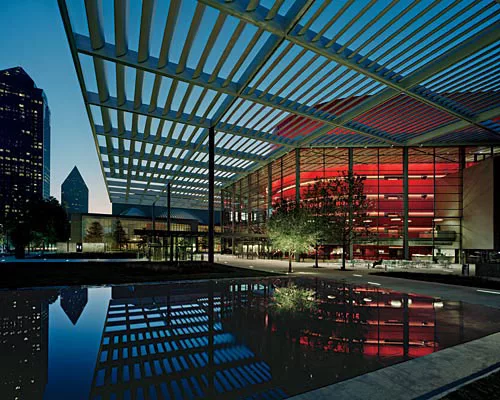
The horizontal thrust of the Winspear’s massive solar canopy provides a nice contrast to the verticality of the Wyly Theatre by REX/OMA across Flora Street. Stretching 463 by 378 feet, the canopy surrounds the red-glass drum that encloses the building’s auditorium, stage, fly tower, and cooling towers. A steel structure with anodized-aluminum louvers set at various angles to follow the sun’s path, it offers solar protection for a public plaza and the 60-foot-high glass walls wrapping around the building’s lobby. In good weather, sliding glass panels running the entire length of the east side of the lobby open so visitors in the restaurant and café can sit or mingle outside.

By creating a temperate outdoor oasis, the canopy reduces heating and cooling loads on indoor spaces. The architects employed a number of other energy-saving strategies, including a displacement ventilation system in the hall that pumps air from the floor—cooling people but not all the space above them. They also landscaped the shady refuge under the pergolalike structure with squares of lawn and wildflower plantings and a black-granite reflecting pool where a film of water hovers above the names of donors, flush with the surrounding pavement. While the canopy’s enormous grid extends the building’s reach outdoors and helps to define an enlarged public realm, its scale and rigidity are oppressive.

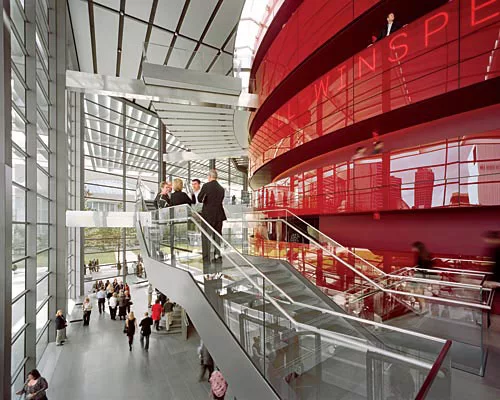
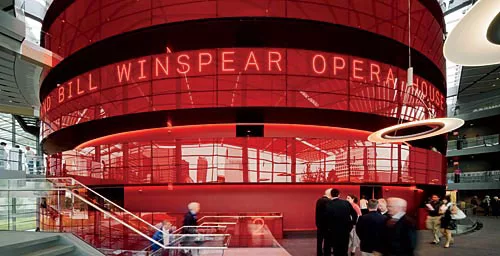
Reversing the traditional color scheme for opera houses, Foster put red on the outside, not the inside, of the hall, making it the district’s most prominent constituent. The firm clad the Winspear’s concrete drum with bright ruby PVB (polyvinyl butyral) interlayers laminated between two sheets of glass. By illuminating the colorful skin from both the back and front, the designers were able to create bold signage in the daytime and at night, when the house is washed in a red glow of light.

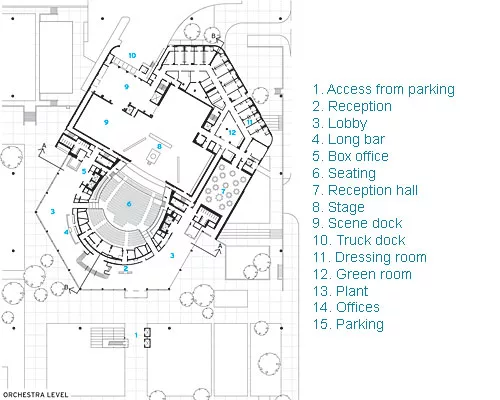
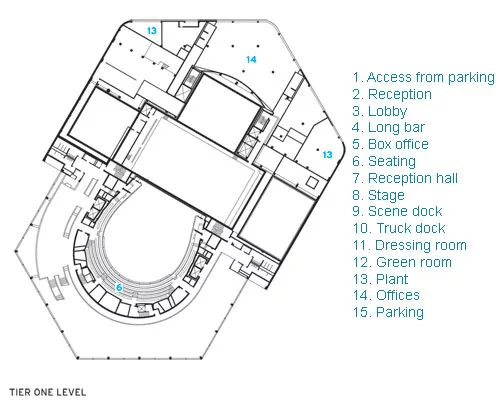
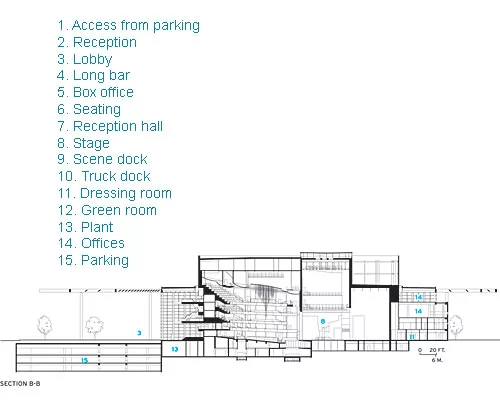
In a daring gesture in car-centric Dallas, the architects placed egress from underground parking in the landscaped plaza outside the building, forcing all patrons to enter through the same set of doors on grade. However, what might have been a dramatic processional fails to materialize because the entrance aligns with the arts center’s new north–south axis rather than the opera house’s main axis. So visitors enter to one side of the grand stairway that anchors the enormous lobby, an arrangement akin to slipping in the side door. Furthermore, the performance hall’s red-glass panels, while effective from the exterior, fail to warm up the rather cool feeling of the lofty glass-and-aluminum lobby. Circulation nevertheless appears to be efficient, via elevators and wide stairs that hug the theater’s curve, with bars and cafés on the first and second levels.

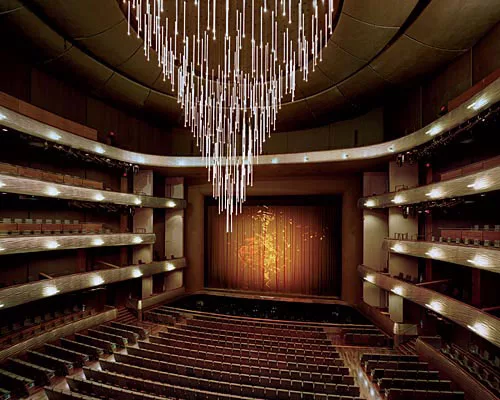
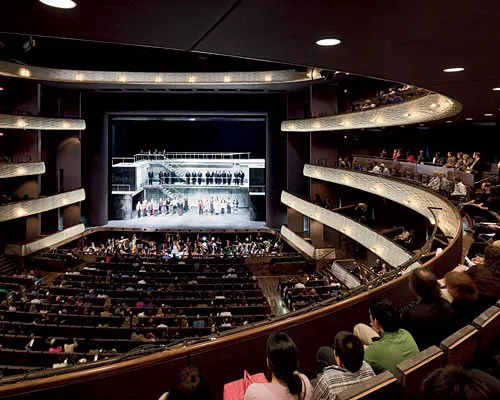
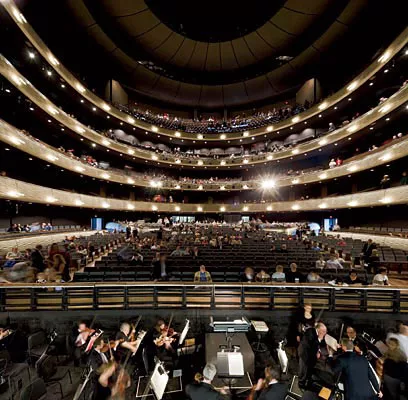
The theater itself offers a warmer environment. Like many new auditoriums, it has double doors to isolate sound at every level. It employs a traditional horseshoe configuration, which Bob Essert, the opera’s acoustical consultant, deems “a guarantee of good acoustics.” Four gently sloped tiers of seating only 90 feet from the stage make the hall feel exceptionally intimate. The glass-fiber-reinforced-concrete fronts of these balconies, which look like crinkled ribbons when illuminated, stand out against the dark brown, textured-plaster peripheral walls and make the 2,200-seat theater feel smaller than it is. By continuing the balconies’ top tier in a ring in front of the barely noticeable proscenium, the architects further enhanced this effect. A fire curtain designed by Argentine artist Guillermo Kuitca protects the main stage, which is supplemented with an ample rear stage and wings, all equipped with state-of-the-art technology. A 70-foot-tall retractable chandelier made of 318 thin, acrylic light rods, along with charcoal-gray Ultrasuede upholstery and burnt walnut floors, complete the house’s elegant decor.

Following Bill Winspear’s insistence that the new house be first and foremost for opera (with other kinds of performance, such as dance and touring shows taking second place), Essert aimed for a warm, voluptuous sound best suited for the mainstream 18th- and 19th-century operas featured by the Dallas company. He achieved this and more, as attested by New York Times chief music critic Anthony Tommasini, who cited the Winspear’s exceptional combination of “richness and resonance” and its bright, clear sound. But for those who heard Foster’s garbled comments on opening night, some fine-tuning is still needed when amplification is used.

Spencer de Grey, one of Foster’s senior partners, points out that his team made many decisions with acoustics in mind. So they built the hall basically of timber on concrete with hard textured plaster walls on masonry in the theater to reinforce bass response, and designed slightly convex peripheral walls to help disperse sound and prevent echoes. A large, open orchestra pit—which can be raised and lowered on two lifts—accommodates up to 100 musicians.

De Grey is particularly enthusiastic about an outdoor performance space currently under construction that aims to reinforce the building’s reputation for reaching out to the public. Connected with the opera house and protected by the solar canopy, this outdoor square will continue a tradition of pop concerts and fiestas that for decades have attracted as many as 5,000 people a night.

The Winspear stands in a long line of opera houses that reserve innovation for the exterior rather than for the theater inside. Jørn Utzon’s Sydney Opera House (1973) in Australia, and more recently Snøhetta’s Norwegian National Opera House in Oslo (2009) come to mind in this regard. Most of these schemes employ the horseshoe configuration established by Carlo Fontana in Venice more than 300 years ago and championed by Essert today; one of the few exceptions is Zaha Hadid’s unbuilt Cardiff Bay Opera House (1994–96).

For half a century, cultural institutions have served as linchpins for urban renewal and expansion. So in addition to its success as a superior home for opera and its ability to adapt to other genres, the Winspear will be judged on how well it can overcome the elitist isolation of an earlier era and connect with the city around it.


Credits

Architect

Foster + Partners
Riverside
22 Hester Road
London SW11 4AN
United Kingdom 
T. +44 (0)20 7738 0455
F. +44 (0)20 7738 1107

Norman Foster (Registered UK)
Spencer de Grey (Registered UK)
Stefan Behling (Registered UK)
Michael Jones (Registered UK)
James McGrath
Bjørn Polzin (Registered UK)
Laszlo Pallagi (Registered UK)
Morgan Fleming 
Leonhard Weil (Registered UK/Germany)
John Small
Ingrid Sölken (Registered Germany)
Hugh Whitehead (Registered UK)
Francis Aish

Architect of record: 
Kendall Heaton Associates

Interior designer:
Foster + Partners

Engineer(s): 
Structural:   
Buro Happold 
Thornton-Tomasetti Engineers

Services Engineer: 
Battle McCarthy 
CHP & Associates

Consultant(s)
Landscape: 
Michel Desvigne, France 
Kevin Sloan, Dallas 
JJR, Chicago

Lighting: 
Claude R. Engle Lighting Consultant

Acoustical: 
Sound Space Design

Other: 
Theatre Consultant: 
Theatre Projects Consultants

Code Consultants: 
Pielow Fair & Associates, Seattle

Cost Consultants: 
Donnell Consultants, Florida

Foodservice Consultants:     
JGL Management Services, New Jersey 
Cine Little, Florida

Geotechnical Engineers: 
GME Consulting Services Inc., Dallas

Sound System Design: 
Engineering Harmonics, Inc.

Transportation Consulting: 
Deshazo, Tang & Associates, Inc.

Parking Consultants: 
Carl Walker Inc., Dallas

Maintenance Cleaning Access: 
Citadel Consulting Inc.

Architect for the parking garage: 
Good Fulton & Farrell

Security: 
HMA Consulting, Inc.

Curtain Wall Consultant: 
LZA Technology

ADA consultant: 
McGuire Associates, Inc.

Elevator Consultant: 
Persohn/Hahn Associates, Inc.

Acoustical and Vibration Consultant: 
Wilson, Ihrig & Associates, Inc.

Graphic consultant: 
2 X 4 Design

General contractor: 
Linbeck Construction

Photographer(s)
Timothy Hursley

Specifications

Structural system:
W & W Steel - Structural Steel Material

Exterior cladding
Masonry: 
Lucia - CMU Masonry Work

Sigma Marble – Stonework

Metal/glass curtainwall:
Seele - Curtainwall & Exterior Glass

Concrete:
W.A.C. Concrete Construction - Forming/Placing/Finishing Concrete 

Roofing
Anchor Roofing – Roofing
A. Zahner Company - Canopy Louvers, Cladding

Glazing
Glass: 
DGB Glass- Interior Glass & Glazing
Haley Greer - Red Drum Cladding/Glass Wall Panel System

Skylights:
Super Sky Products - Skylights
Insulated-panel or plastic glazing:

Doors
Industrial Acoustics - Acoustical Doors

Upswinging doors, other:
Dallas Door & Supply - Doors, Frames & Hardware

Interior finishes
Acoustical (ceilings) Doors: 
Industrial Acoustics – Acoustical Doors

Anton Cabinetry – Millwork

Paints and stains:
Carrco Painting - Painting  

Carpet: 
Wilson Office Interiors- Carpet & VCT

Rubber Flooring: 
Norafloor, Wilson (installation)

Stone Flooring: 
Sigma

Wood Flooring: 
Woodwright Company

Furnishings
Fixed seating:
Series USA LLC - Seating

Vision Products - Glass Ornamental Handrail

Lighting
Interior ambient lighting: Louis Poulsen

Conveyance
Elevators/Escalators:
Accessibility provision (lifts, ramping, etc.):
ThyssenKrupp Elevator Corp. - Elevators & Wheel Chair Lifts

Plumbing 
Brandt Engineering - Mechanical and Plumbing

Greenscape Pump Services - Fountain Work

ValleyCrest Landscape Develop. - Landscape & Irrigation

J.R. Clancy - Performance Equipment

Clair Brothers - Performance Sound, Video & Communication Equip.

 
KEYWORDS: Apple Dallas

Share This Story

Looking for a reprint of this article?
From high-res PDFs to custom plaques, order your copy today!
Victoria Newhouse is the author of Parks of the 21st Century: Reinvented Landscapes, Reclaimed Territories.

Post a comment to this article

Report Abusive Comment

Subscription Center
  • Create an Account
  • Start a Subscription
  • Manage My Account
  • Sign Up for Newsletters
  • Visit Customer Service
  • Update Preferences

More Videos

Sponsored Content

Sponsored Content is a special paid section where industry companies provide high quality, objective, non-commercial content around topics of interest to the Architectural Record audience. All Sponsored Content is supplied by the advertising company and any opinions expressed in this article are those of the author and not necessarily reflect the views of Architectural Record or its parent company, BNP Media. Interested in participating in our Sponsored Content section? Contact your local rep!

close
  • TAMLYN XtremeTrim Exterior Trim
    Sponsored byTamlyn

    Designing Cleaner Panel Facades: Why Exterior Trim Details Matter

  • Building with Vapor Barriers
    Sponsored byReef Industries, Inc.

    Vapor Barriers Help Control Moisture in Tighter Building Designs

  • Duct Interior with Prodeq System
    Sponsored byHenry, a Carlisle Company

    Designing Resilient Water Containment Systems

DESIGN:ED Podcast
Listen to Architectural Record’s DESIGN:ED Podcast

Events

June 10, 2026

Rethinking Stormwater – The Power of Porous Paving

Credits: 1 AIA LU/HSW; 1 AIBD P-CE; 0.1 ICC CEU

Learn how porous paving systems support stormwater management, reduce heat island effects, and enhance sustainable site design performance.

June 11, 2026

Very Early Warning Fire Detection for Mission-Critical Facilities

Credits: 1 AIA LU/HSW; 1 AIBD P-CE; 0.1 ICC CEU

Examine advanced fire detection strategies that support uptime and enhance safety in data centers and other mission-critical facilities.

View All Submit An Event

Products

2026 Architect's Square Foot Costbook

2026 Architect's Square Foot Costbook

See More Products

Popular Stories

Coronado Bridge

The Architect’s Guide to San Diego

Practice Matters illustration

What’s in a (Firm’s) Name? Thinking About Succession and Legacy

Practice Matters illustration

By the Numbers: Counting America's Architects

Inward House

Inward House by VeeV Design Studio

Riverdale House by Studio Lau

Riverdale House by Studio Lau

Broader Sustainability of CMU - Free Webinar - May 21, 2026

Related Articles

  • Continuing Education: Margot and Bill Winspear Opera House

    See More
  • R/GA Office

    R/GA Office New York by Foster + Partners and Tillotson Design Associates

    See More

Related Products

See More Products
  • book3.jpg

    If Architecture is a Language, Then a Building is a Story

  • iconic house.jpg

    The Iconic House

See More Products
×

The latest news and information

#1 Source for Architectural Design, News and Products

SUBSCRIBE
  • RESOURCES
    • Advertise
    • Contact Us
    • Submit
    • Store
  • ACCOUNT CENTER
    • Create an Account
    • Start a Subscription
    • Manage My Account
    • Sign Up for Newsletters
    • Visit Customer Service
    • Update Preferences
  • PRIVACY
    • PRIVACY POLICY
    • TERMS & CONDITIONS
    • DO NOT SELL MY PERSONAL INFORMATION
    • PRIVACY REQUEST
    • ACCESSIBILITY
  • SERVICES
    • Marketing Services
    • Reprints
    • Market Research
    • List Rental
    • Survey/Respondent Access
  • STAY CONNECTED
    • Linkedin
    • Facebook
    • Instagram
    • YouTube
    • X (Twitter)

Copyright ©2026. All Rights Reserved BNP Media, Inc. and BNP Media II, LLC.

Design, CMS, Hosting & Web Development :: ePublishing