Harbin Opera House
The sensual lines of a performing-arts complex express a city's bold bid for attention.
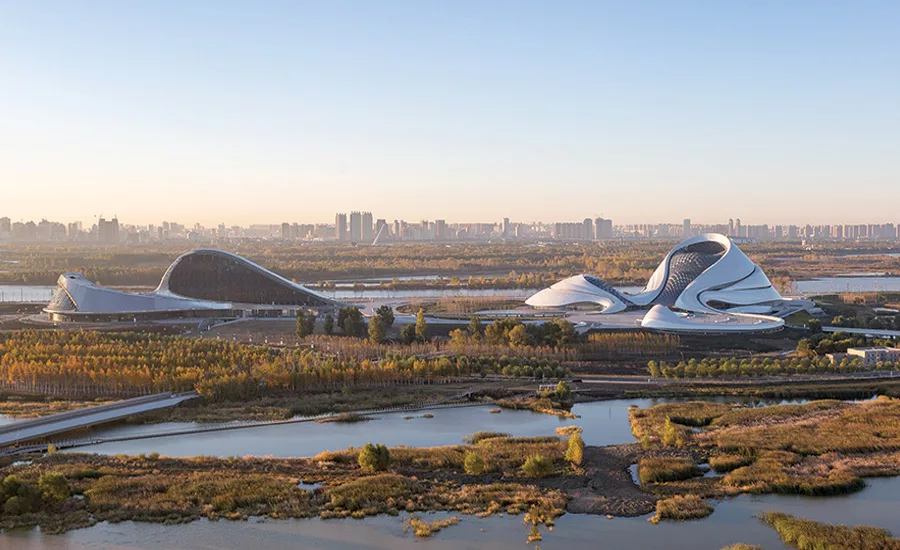
The 850,000-square-foot complex rises from a 444-acre park a 20-minute drive from downtown Harbin. The Opera House, with its two theaters opened in October, while a convention center and hotel, also designed by MAD, is still under construction .
Photo © Adam Mørk

Image courtesy MAD Architects
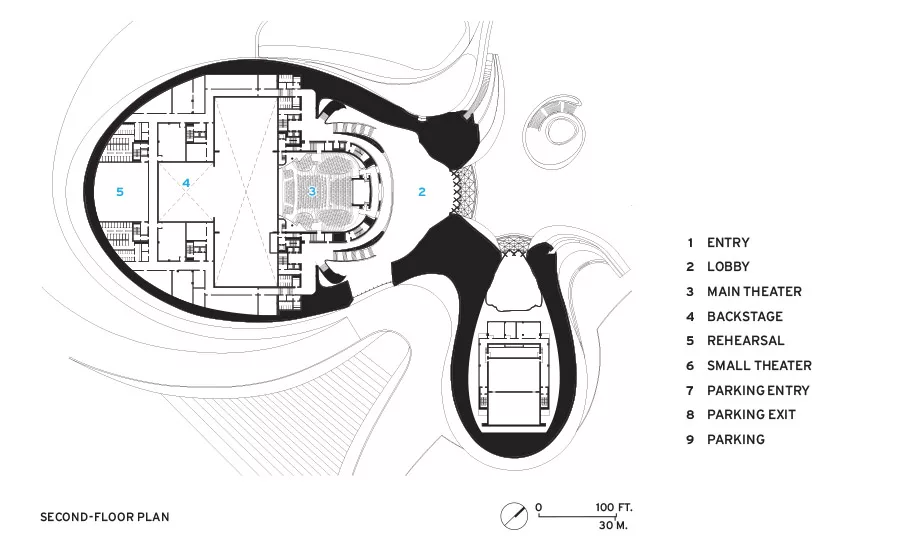
Image courtesy MAD Architects

The Opera House, with its two theaters opened in October, while a convention center and hotel, also designed by MAD, is still under construction
Photo © Adam Mørk
A ramp incised in the side of the building takes visitors to a terrace above the main theater.
Photo © Adam Mørk
The interior facade of the theater is clad with narrow bent pieces of Manchurian ash.
Photo © Adam Mørk

Skylights bring daylight, a precious commodity in this northern part of China, into the main lobby
Photo © Adam Mørk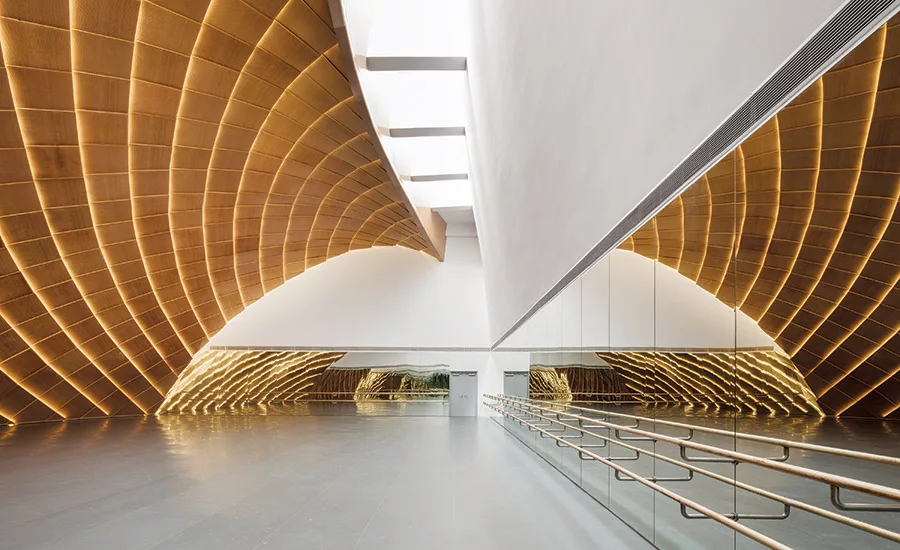
Skylights bring daylight, a precious commodity in this northern part of China, into the main lobby and a rehearsal studio.
Photo © Adam Mørk
A lobby stair combines both warm and cool elements in its design.
Photo © Adam Mørk
The architects orchestrated the interiors to contrast. For example, cool spaces, such as the upper lobby, with its white fiber-reinforced plastic lattice play off those given a visual warmth by undulating wood cladding, like the 1,600-seat main theater (seen here).
Photo © Adam Mørk
The architects orchestrated the interiors to contrast. For example, cool spaces, such as the upper lobby (seen here), with its white fiber-reinforced plastic lattice play off those given a visual warmth by undulating wood cladding, like the 1,600-seat main theater.
Photo © Adam Mørk
Architects & Firms
Harbin, China
People and Products
From the bridge connecting bustling downtown Harbin to bucolic Sun Island, the new Harbin Opera House comes into view, with its impressive sloping forms that suggest the snow-capped mountains found in this northern Chinese region. Emerging from the surrounding wetlands, the building’s double-humped silhouette rises to an apex of 183 feet and curls around mounds of glass panels that appear to burst forth like spikey balloons.
Designed by MAD Architects, which has offices in Beijing and Los Angeles, the 850,000-square-foot theater complex serves as a glittering new icon for a city once known mostly for its winter snow festival. MAD, founded by Yale-trained Ma Yansong in 2004, won the commission for the project in an international competition in 2010. “As a public building, it has to be an open, accessible place,” says Ma. “It has to be dramatic. When people enter it, they need to feel they’re onstage, that they’re performers,” adds Ma, who was chosen last year to design Star Wars producer George Lucas’s Museum of Narrative Art in Chicago. Ma completed his first project in Harbin in 2013, the 656-foot-long China Wood Sculpture Museum.
The new Harbin project—which includes a pair of theaters, dressing rooms, rehearsal halls, and support spaces, as well as a separate conference center and hotel that are still under construction—was envisioned as a “city landmark to showcase Harbin’s own DNA and cultural heritage,” says Liu Zhenbo, the director of the government’s Harbin Songbei District Construction Management unit, which commissioned the project. Built in the 444-acre Sun Island nature park, the opera house opened in October.
Visitors to the project not only can go inside it, they can climb it. A long set of granite steps—open to the general public as well as ticket-buying opera goers—runs up the building’s great curving roof, offering spectacular views of the city’s skyline and the Songhua River. In a nod to treks up China’s sacred mountains, as immortalized in traditional poems and paintings, the walkway snakes up the building, culminating in a rooftop landing. “The building goes from horizontal to vertical,” says the architect. Visitors can’t see the rooftop terrace from the ground, so “it’s like a temple. You go to a public but kind of secret place and have a conversation with the sky.”
MAD worked with engineers at the Beijing Institute of Architectural Design to develop the intricate steel skeleton supporting the building’s mountainous forms. From inside, the opera house feels like a snow cave, with passages of white curved concrete walls and ceilings. Faceted glass skylights—built with a customized system to melt actual snow and direct it into drains—flood the grand lobby with sunlight, precious in China’s northern regions. Polished marble floors equipped with radiant heating make the space comfortable in the winter, when temperatures can drop to 37 degrees below zero Fahrenheit.
From the lobby, visitors see the undulating wood facade of the larger performance venue, clad with bent narrow planks of Manchurian ash. Ma says that he and his team chose the wood—a common material in the area—to evoke the warm interior of a musical instrument.
The large theater, which seats 1,600, has an elevated stage and the usual orchestra pit. The same curved wood found on the theater’s lobby facade wraps around balconies, box seats, walls, and ceilings inside the theater. Wanting audience members in the less expensive upper seats to feel “a little bit special,” Ma ensconced the top tier in leather walls and adorned it with a crystal-encrusted edge lit by LEDs that can change color.
The big theater is designed acoustically to cater to both Western and Chinese operas—the former usually relying on unaided sound projection, while the latter has performers using microphones. (The architects report that the Harbin Symphony Orchestra, founded by Russian émigrés in the early 1900s and reputed to be China’s oldest, recently performed at the venue and found the acoustics to be superb.)
The smaller theater, which fits 400 people, is a rectangular hall with raked seating. Gray wood panels, some perforated, clad the walls to optimize sound. Floor-to-ceiling glazing behind the stage can be closed off by curtains to darken the room and absorb sound.
MAD is currently busy with other ambitious projects in China, the United States, and Europe. It recently completed Huangshan Mountain Village, a large residential complex in Anhui Province, and is working on the Pingtan Art Museum in Fujian Province, a mixed-use residential development in Los Angeles, and a residential renovation project in Rome.
Harbin, the capital of Heilongjiang Province, has a population of 4.5 million and dates back to the late 19th century, when an influx of Polish immigrants arrived to build the Czarist Russia–funded Chinese Eastern Railway, a critical link connecting the Trans-Siberian Railway with China. Today, the city is not only an important commercial and industrial hub, but is one of the country’s most popular tourist destinations, thanks to its extreme winter weather and diverse offerings of performing arts. In the cold months, visitors and locals revel in Harbin’s frozen landscapes and world-renowned ice-sculpture festival. In the summer, the city hosts European-style music programs. Thanks to its history as an outpost of Russian culture, Harbin boasts China’s oldest music academy.
MAD’s bold design for the opera house, says Liu, the client, helps establish Harbin as a place with “its own unique contemporary character,” one that is rugged, powerful, and dynamic. In recent years, Chinese cities have erected magnificent public buildings—airports, museums, performing-arts centers—spending large sums to assert their cultural greatness. It has yet to be seen if they can generate the content and programming to properly activate these buildings. But the architectural swagger already matches the aspirations.
People
Architect:
Personnel in architect's firm who should receive special credit:
Interior designer:
Engineers:
Consultants: General Contractor: Beijing Construction Engineering Group Client: Harbin Songbei District Construction Management Owner: Harbin municipal government Size: 850,000 square feet Cost: withheld Completion date: October 2015 |
Products
Exterior cladding
Roofing
Windows
Doors
Hardware
Interior finishes
Furnishings
Conveyance |
Looking for a reprint of this article?
From high-res PDFs to custom plaques, order your copy today!