Mass Production and the Modern House
From ARCHITECTURAL RECORD, January 1930
During the last hundred and fifty years a great change has taken place in architecture. This change has nothing to do with the questions of superficial esthetics that agitated the architectural world: the quarrels between the classicists and the medievalists or between the traditionalists and the modernists are all meaningless in terms of it. I refer to the process whereby manufacture has step by step taken the place of the art of building, and all the minor processes of construction have shifted from the job itself to the factory.
How far this process has gone everyone is aware who has watched the composition of a building, and who knows how suddenly the whole work would stop if the architect were forced to design or specify with any completeness the hundred different parts, materials, and fixtures he draws from Sweet's Catalog. But what are the implications of this process? What results must it have on the status of the architect and the place of architecture in civilization? What further developments may we look forward to on the present paths: what alternatives suggest themselves?
Some of these questions can be answered: others will lead us to push beyond the current premises upon which the discussion of mass production and architecture is based.
II
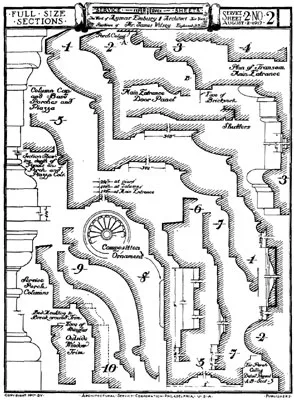
By an ironic accident, the first use of fabricated parts in a building seems to have been ornamental: the plaster mouldings of the eighteenth century were introduced before the Franklin stove: but the age of invention ushered in a whole series of technical devices designed to increase the comfort or the efficiency of the dwelling house, and along with these improvements went a shift from handicraft to machine production. There are country districts in the United States where, until a few years ago, the kitchen sink would have been made of sheet zinc fitted over a box made by the carpenter, or where the ice-box might have been constructed in the same way. In the main, however, the shift was steady and inexorable: steam-heating, gas-lighting, electricity, baths, toilets, refrigerators, to say nothing of radio-connections and garages, have all led to the industrialization of architecture. Plaster, jig-saw, and cast-iron ornament, the first spontaneous gifts of industrialism, all happily diminished; but the technical improvements remained and multiplied.
In the great run of modern building, except in part the country homes of the rich, mass-manufacture has taken the place of local handicraft. The latter has remained in two places: the construction of the physical shell itself, and the assemblage of the individual parts.
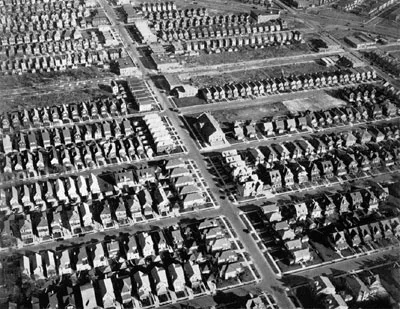
Now, this change was coincident with the withdrawal of the architect from the grand body of building during the early industrial period. The new factories and bridges and railroad stations were largely the work of engineers, while the great mass of private dwellings became the province of the speculative jerry-builder who, with a few stereotyped plans, created the dingy purlieus of all our large cities.
Looking for quick answers on architecture and design topics?
Try Ask RECORD, our new smart AI search tool.
Ask RECORD →
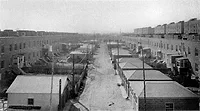
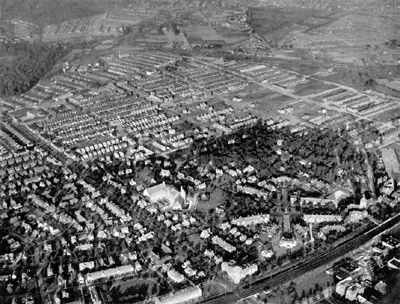
The radical change that had taken place passed almost unnoticed, until during the last fifteen or twenty years the architect was called in to design small houses for industrial villages. He was then confronted with two brute facts: if he designed houses for industrial workers in the fashion that he did for the upper middle classes, it turned out that the costs were so high that only the middle classes could afford to live in them: that was the fate, for example, of Forest Hills, L. I. On the other hand, when he accepted the price limitations laid down by the industrial corporation, or, as in Europe, the municipal housing scheme, he suddenly discovered that he was no longer a free man.
Every variation he wished to introduce which departed from current practice was prohibitive in cost: his design was in fact little more than a composition of standardized patterns and manufactured articles. The elements were no longer under the architect's control; for the carpenter on the job could not construct a kitchen cabinet as well or as cheaply as the factory, nor had he spent so much time in finding out exactly what compartments and divisions the housewife preferred. As for windows, doors, bathroom equipment, the architect either had to accept them as they came from the factory, or he had to do without them altogether.
III
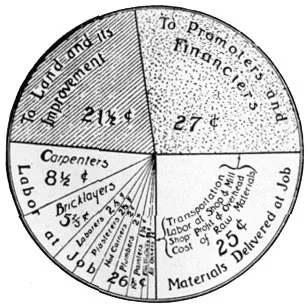
Needless to say, this revolutionary change had come about without any genuine renovation in design, and without any attempt to overcome the difficulties that the increase of manufactured articles brought with it. The chief of these difficulties, as Mr. Henry Wright was perhaps the first to point out, was that the building proper, without being cheaper in its own right, accounted for only forty-five to sixty per cent of the total cost, whereas a hundred years before it had represented, with its decoration and ornament, about ninety per cent of the total cost.
Some accommodation to this condition was made; but the adjustment was a blind and fumbling one: now it came as jerry-building, a general cheapening of materials and workmanship, again it came as smaller rooms or fewer rooms per family, or finally, it came as an abandonment of handicraft on the remaining parts of the building, and the increase of ready-made equipment. Decoration had not so much vanished by itself, for lack of artistic talent, still less because of any doctrinaire prejudice against it: it had rather been absorbed, or at all events transformed into mechanical fixtures. The new costs of finance, mechanical fixtures, utilities, had to be met at some point in the design. Short of a proportional rise in the real income of wage-earners, there was no way of cementing the old requirements and the new in a single building.
In a word, building has shrunk, manufacture has expanded. One cannot suppose that this process will stop short at the shell. Apart from the fact that this has already been partly conquered--as yet, however, with no appreciable saving--in the mail-order wooden house, or in the sheet-iron garage, who doubts that the manufacturers of steel, aluminum or asbestos blocks, if not the large-scale motor manufacturers, looking for a new outlet for a market glutted with cars, will finally produce a light transportable shell, whose sections will be set up easily by unskilled labor?
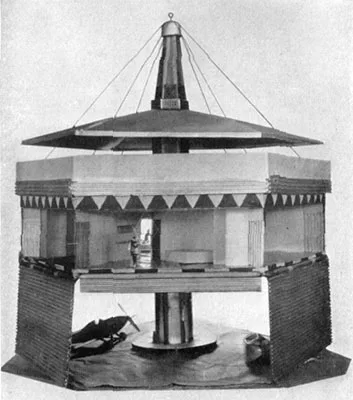
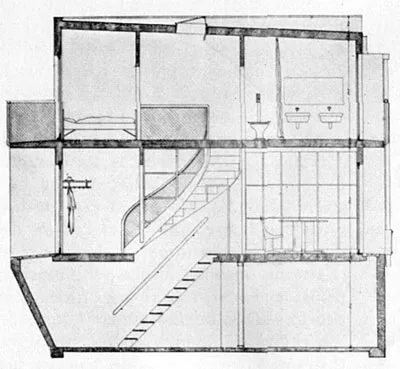
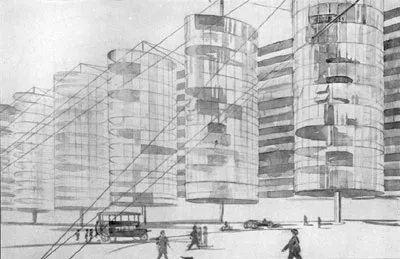
It would not be difficult to describe such a house: indeed, Mr. Buckminster Fuller in Chicago, and the Brothers Rasch in Germany have already gone a step beyond this. The chief difference between the factory-manufactured house and the current product of the jerry-builder in Flatbush or West Philadelphia would be that in the first case the design would possibly bear some living relation to the elements out of which it is composed. The mass-house would probably be placed on a platform, if not on a pedestal, in order to provide garage space and avoid the expensive cellar; the plans would be standardized; the pipes and fittings and fixtures would be integral with the walls and ceilings, joined together by a turn of the wrench; and the use of light insulating materials would both facilitate transportation and permit the design of large windows which would otherwise, in cold weather, make a great drain on the heating system.
What would be the advantages of the completely manufactured house? There are many potential ones. First of all, the mass-house, like the motor car, will be able to call to its design and construction a corps of experts, sanitary engineers, heating engineers, hygienists, to say nothing of professors of domestic science, who will have their minds focussed, not upon solving indifferently an indeterminate number of problems, but upon getting a perfect solution for a fixed and limited problem. These research workers will have the opportunity to deal with fundamental mechanical and biological facts, without the distraction of attempting to compose these facts into a traditional frame, conceived when industry and family life were on an entirely different basis, and when the inventions of the last century were still but vague grandiose dreams in the minds of Utopians like Leonardo and Johann Andreae.
The introduction of this council of experts would undoubtedly hasten the rationalization of the modern house. A dozen standard plans, with all minor deviations ruled out, would probably take the place of the competitive chaos that provides our more traditional forms of monotony and squalor, or, as in the well-to-do suburb, of standardized "variety" and fake elegance. No one would be able to pretend that individuality and personality are achieved by meaningless departures on the drafting board from standard dimensions: once the mechanical requirements were granted, an equally mechanical solution would follow.
The charm of good building, the charm due to the carpenter's or the mason's feeling for his material and site, would disappear; but as compensation there would be the austere clarity of good machinery; and since this charm is already a sentimental memory in most of our building, it is an illusion rather than a reality that would be destroyed. Undoubtedly the result would be "hard"; but such hardness is surely preferable to the spurious "softness" of imitation half-timbers, imitation slates, and imitation fires; and it would constitute a real improvement over the actual quarters in which a great part of the population now live.
There is no need to go here into the various technical improvements that may be possible in the mass-house. It is enough to assume that such matters as artificial cooling and heating, the removal of dust, and the utilization of sunlight would receive competent attention, and it is even possible that entirely untried methods, such as the heating of walls by electric grids, or complete insulation from outside air would be tested, if not incorporated in the mass-house. Such dwellings would represent a real advance from the standpoint of hygiene and constructive soundness; and since a good part of our population needs to be re-housed, its present quarters being unsanitary, crowded, vile, ugly, and entirely out of key with the best features in the modern environment, the mass-house holds out, on the surface, very attractive promises.
Does the architect shrink from the prospect? He had better not. As a profession he has permitted something far worse than the scientifically designed mass-house, namely the unscientific one of the jerry-builder, to appear; and since he has shown as yet no capacity to face or master the real problem of housing, he cannot in all conscience turn away from this spectacle.
Looking for a reprint of this article?
From high-res PDFs to custom plaques, order your copy today!