Berkeley Art Museum and Pacific Film Archive by Diller Scofidio + Renfro
Berkeley, California
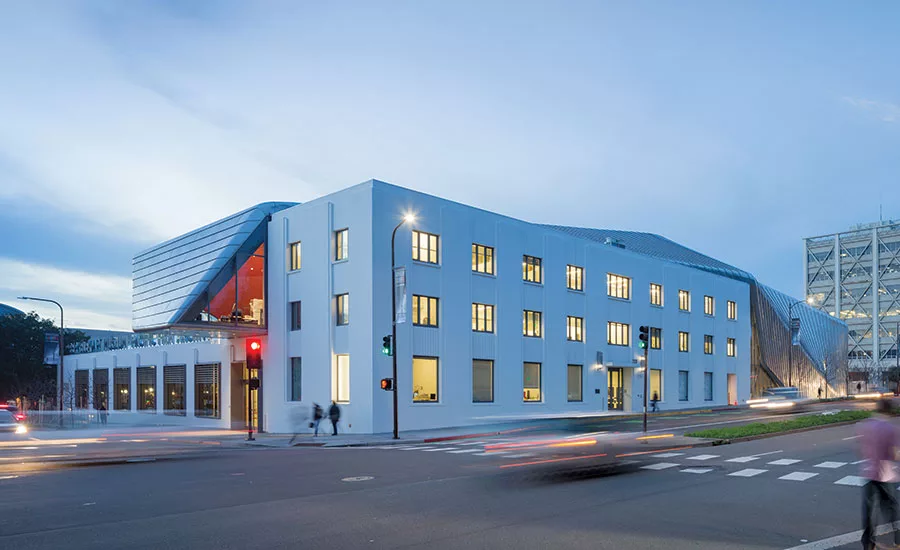
A torqued-steel-clad addition is the centerpiece of the museum’s new home within a restored 1939 printing plant, cantilevering over the museum entry and culminating in a 161⁄2-foot-by-28-foot LED screen at the back of the building.
Photo © Iwan Baan
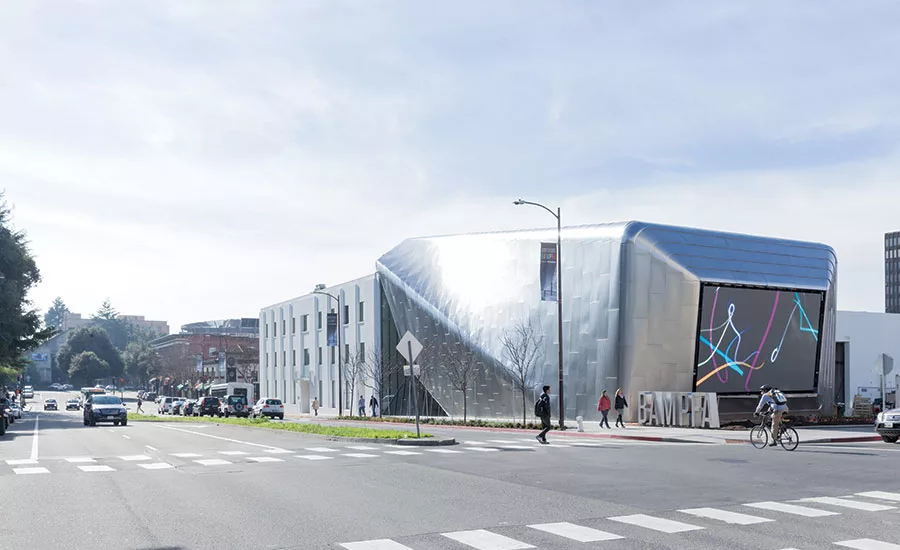
A torqued-steel-clad addition is the centerpiece of the museum’s new home within a restored 1939 printing plant, cantilevering over the museum entry and culminating in a 161⁄2-foot-by-28-foot LED screen at the back of the building.
Photo © Iwan Baan
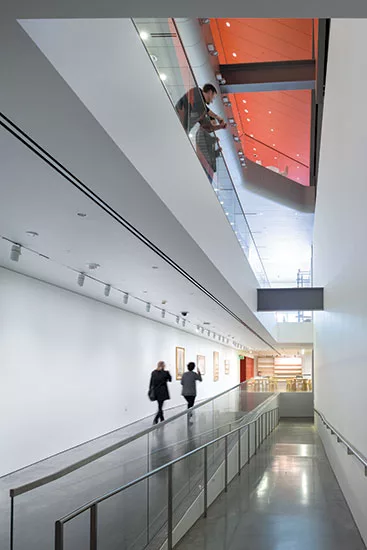
The museum’s café, painted blood red, is the apex of a sweeping vertical space.
Photo © Iwan Baan
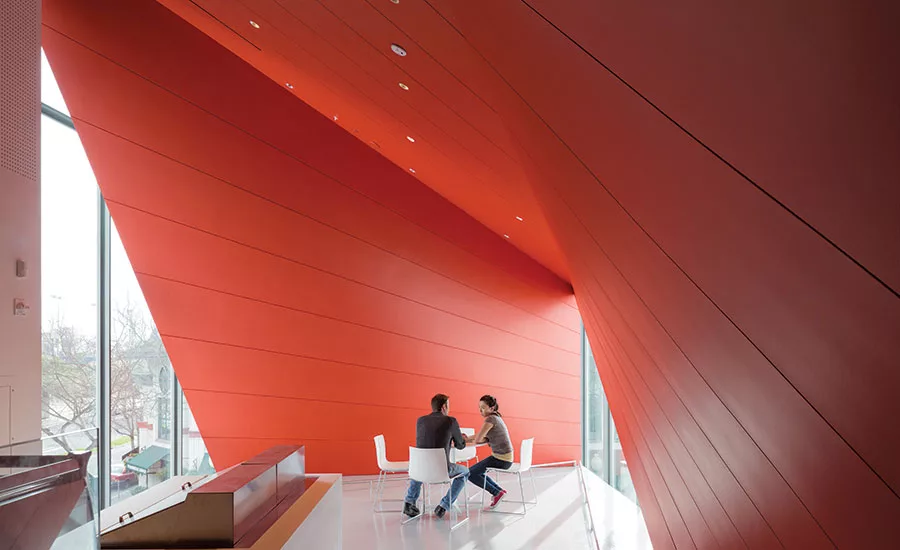
The museum’s café is prominently perched, the apex of a sweeping vertical space with views over the busy street.
Photo © Iwan Baan
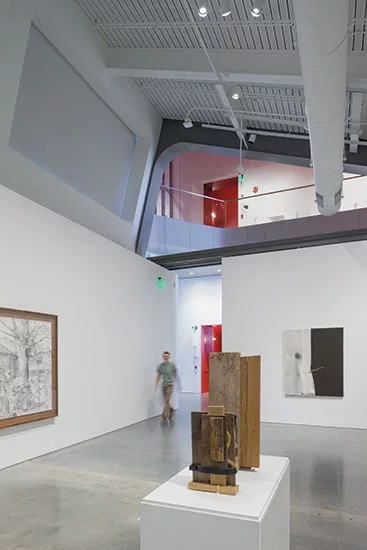
The main galleries soar to 28 feet at the top of the sawtooth roof truss.
Photo © Iwan Baan
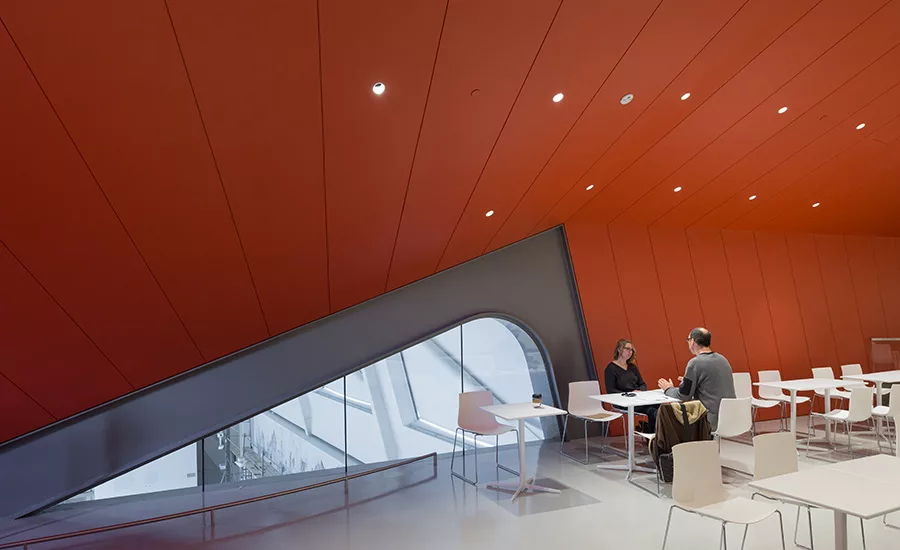
A view of the café.
Photo © Iwan Baan
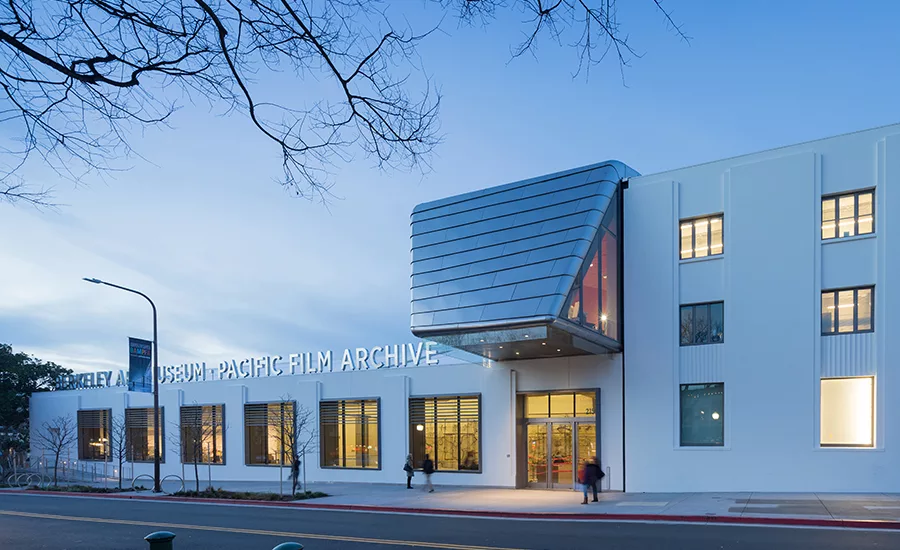
Exterior View.
Photo © Iwan Baan
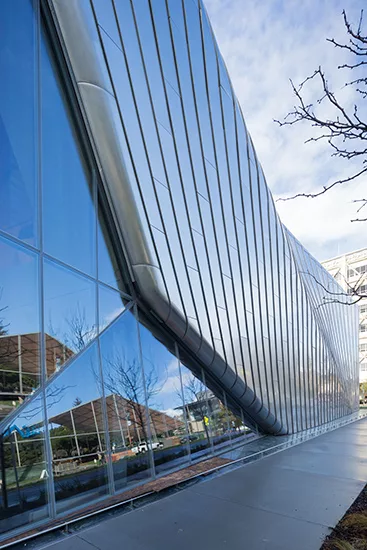
The addition is clad in neatly tailored strips of 18-gauge 316L stainless steel.
Photo © Iwan Baan
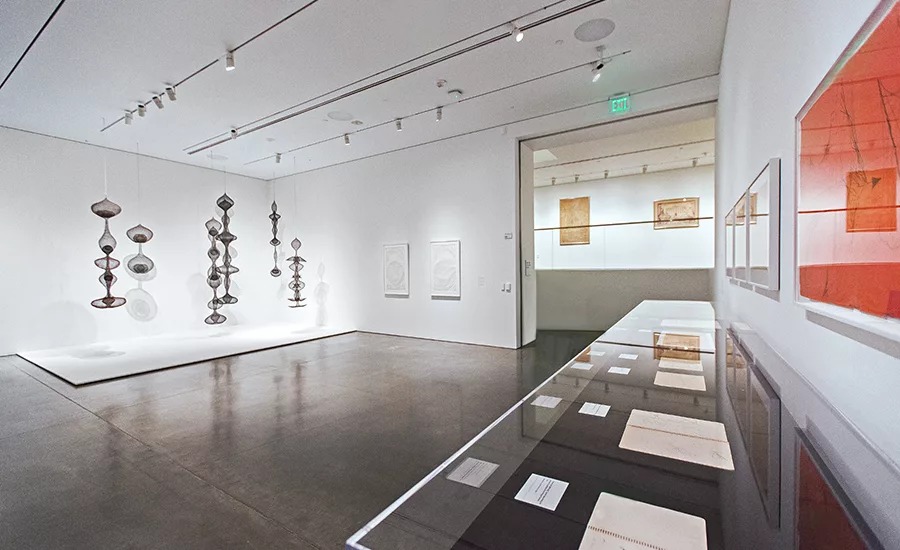
Basement galleries.
Photo © Elizabeth Daniels
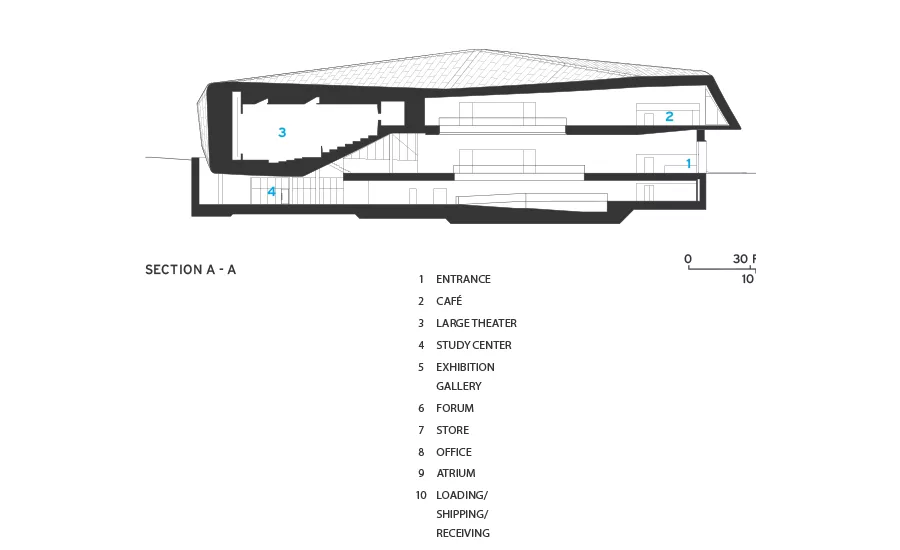
Image courtesy Diller Scofidio + Renfro
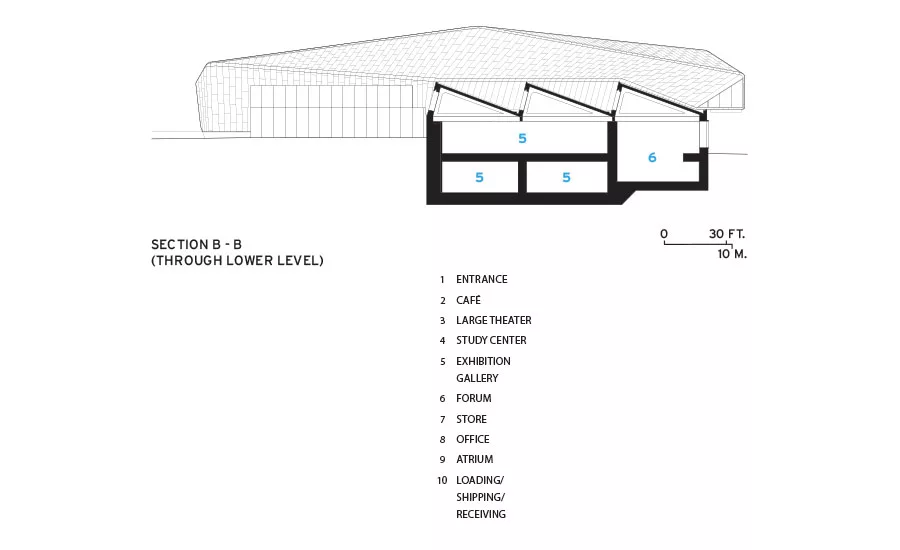
Image courtesy Diller Scofidio + Renfro
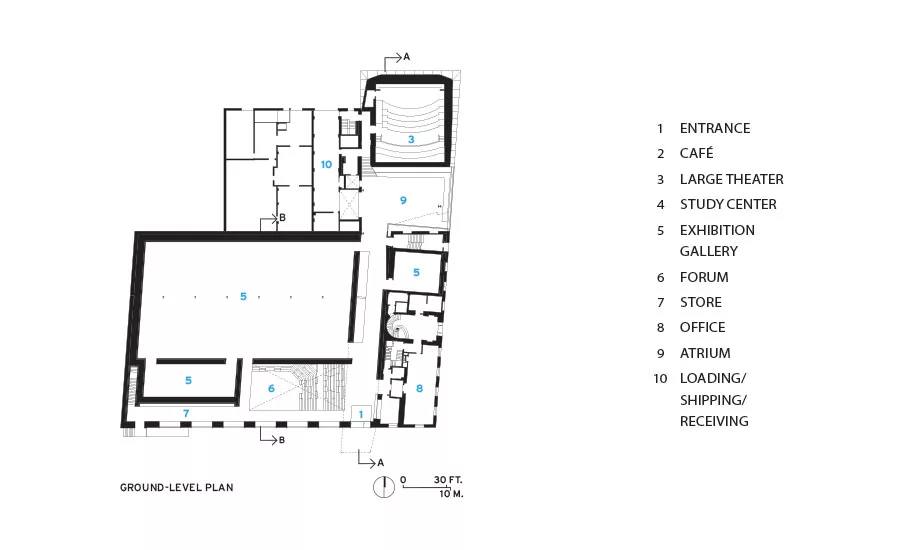
Image courtesy Diller Scofidio + Renfro
Architects & Firms
A decades-long dilemma had plagued the University of California, Berkeley, over what to do about its art museum. The persistent problem—involving whether to tear down and what to build—ultimately involved not one but three buildings, and as many architects. Through no fault of its own, the new Berkeley Art Museum and Pacific Film Archive (BAMPFA), designed by Diller Scofidio + Renfro (DS+R) and opened to the public on January 31, bears the burden of that history.
The old museum—a concrete bunker with terraced, spiraling galleries by Bay Area architect Mario Ciampi—is a rare example of a Brutalist structure that grew to be admired by the public after opening in 1970. A mere 27 years later, however, a campus survey found it noncompliant with current earthquake-safety standards. Since the Ciampi building’s gallery spaces would have been severely compromised by seismic upgrades, according to curators, the university sought an alternative space. The former museum faced talk of demolition and was fitted with exterior bracing, but eventually closed to the public. Now designated a landmark, it sits today without any clear plan for its future.
In the meantime, the university struggled to find an appropriate home elsewhere for its art collection—which includes 19,000 works, from Neolithic ceramics to contemporary photography— and film program. A stunning 2008 proposal by Toyo Ito for a three-story edifice of bent-steel plate with provocatively contoured galleries—and a reported construction cost of $143 million—fell victim to the great recession after years of design development. The university decided to pursue less expensive plans that would retain an industrial building, destined for the wrecking ball in Ito’s scheme, on the same site.
According to DS+R partner-in-charge Charles Renfro, the repurposed printing plant, built in 1939, was “the perfect space for art.” Behind the nondescript stark-white concrete exterior hid an industrial sawtooth roof with north-facing vertical skylights over the high-single-story portion of the building. (The three-story pile at the corner contains offices.)
Keeping that roof, however, precluded any possibility of constructing above it, save for one bay that was removed at the bend of the L-shaped building to insert DS+R’s main intervention, a torqued behemoth, neatly tailored in strips of 18-gauge 316L stainless steel, that cantilevers like a marquee over the entry and lands behind the original building, to house a large theater on the inside and an LED screen on the outside. Its upper-level café, the new building’s most dynamic space, with twisting walls painted blood red, offers panoptic views of the breadth of the museum.
To provide additional galleries, the architects were forced to excavate below the building, which had previously only contained a small basement—what is now the forum. That stepped gathering and performance space sits below the Art Wall, a 60-by-25-foot surface for temporary murals. Both are visible from the generous street-facing windows, which DS+R enlarged from existing glass-blockfilled openings to engage passersby at this heavily trafficked intersection, where the bucolic campus meets the grittier downtown part of Berkeley.
DS+R avoided what could easily have been dreary basement spaces by ramping the galleries and allowing ample daylight to stream into the study center from glass ceilings where the steel-clad addition meets the sidewalk. To get enough height there, though, and to protect against the apparently toxic ink-stained end-grain wood floor of the first story, the slab on grade had to be removed. The cracked concrete roof above it was also discarded— replaced with an insulated acoustical-steel deck—along with the party wall and rear exterior wall.
Looking for quick answers on architecture and design topics?
Try Ask RECORD, our new smart AI search tool.
Ask RECORD →
In fact, not much of the original printing press structure remains. Construction crews salvaged the steel bents of the roof truss, shipping them off-site to be restored. The glass skylights were replaced with insulated glazing units. The desired effect of that translucent clerestory, ideal as it might be for a gallery, was not evident at the opening exhibit, where light-sensitive pieces required most of the skylights’ blackout shades to be drawn. In general, the small and subtle works get lost within the grandeur of the 18- to 28-foot-high space.
Of course, it’s not DS+R’s fault that the galleries are too grandiose for the art on display, or, perhaps, that the total project cost crept up to $112 million. (The museum is unable to specify how much of that went toward construction.) Contrary to popular belief, restoring a building, even one as straightforward as the 1939 structure, can get much more expensive than building from scratch. And satisfying the client’s desire to maintain the original building required the design team to jump through many hoops. Ironically, another of DS+R’s clients, the Museum of Modern Art (MoMA) in New York, infamously deemed those sorts of hoops impractical to save the more architecturally significant American Folk Art Museum building, now razed, for MoMA’s expansion— plans for which have since been dramatically scaled back.
Though the intention was to pursue an economically viable building post Ito, pound for pound, the university may have come up short. At 83,000 square feet—more than half of which were existing—the new BAMPFA is only about two-thirds the size of Ito’s building and 20,000 square feet smaller than even Ciampi’s. And in taking on the renovation of a building that the university didn’t regard highly enough to preserve in the first place, DS+R could not help but find itself behind the eight ball, its modest but still costly intervention certainly unable to live up to the memory of the now beloved Ciampi building or to the excitement over Ito’s bold proposal, which would have been the Pritzker Prize–winning Tokyo architect’s one and only building in the U.S. In the end, after a nearly 20-year saga, we’re left wondering if the choices made for each of these buildings were the right ones and, as DS+R founding partner Elizabeth Diller herself asked in the wake of the Folk Art Museum controversy, “In preservation, what are the limits of adaptive reuse?”
PeopleArchitect: Diller Scofidio + Renfro 601 West 26 Street, Suite 1815 New York, NY 10001 T; 212 260 7971
Personnel in architect's firm who should receive special credit: Partner in Charge: Charles Renfro Co-Project Leaders: Zoe Small, Anthony Saby Project Architect: Michael Samoc
Project Architect Michael Samoc, Charles Curran, Haruka Saito, William Ngo, Mark Gettys (Project Team)
Architect of record: EHDD Architecture 500 Treat Avenue, Suite 201 San Francisco, CA 94110 T: 415 285 9193
Engineers: Civil engineer: BKF Engineers, Walnut Creek, CA Structural Engineer: Forell/Elsesser Engineering, Inc., San Francisco, CA Mechanical Engineer: Stantec, Sherman Oaks, CA Shoring Engineer: Degenkolb Inc., Oakland, CA
Consultants: Facade: Simpson Gumpertz & Heger, Waltham, MA Landscape: Hargreaves Associates, San Francisco, CA Lighting: Tillotson Design Associates New York, NY Acoustical: Jaffe Holden, Norwalk, CT Theatrical/AV: Fisher Dachs Associates, New York, NY; Boyce Nemec, Norwalk, CT
Construction Manager: Plant Construction Company, San Francisco, CA
Photographers: Photos by Iwan Baan Kristina Snyder, Agency Director C. 917-817-8382
Renderer: Diller Scofidio + Renfro
CAD system, project management, or other software used: Digital Project (SSTL/Curtain Wall Envelope) Revit
|
ProductsStructural system Structural Steel Glazier Steel, Hayward, CA Structural Concrete Webcor Builders, Alameda, CA Geotechnical Engineer AMEC Environment & Infrastructure, Oakland, CA
Exterior cladding Facade design/build: McGrath Sheet Metal, Maplewood, MN Custom stainless steel: MG McGrath Sheet Metal, Maplewood MN Metal/glass curtain wall: Custom steel mullion glazing system: Architectural Glass and Aluminum, Livermore, CA
Roofing Sika
Windows Wausau (Administration Building)
Glazing Ranker AMG, Sacramento, CA Glass: Northwestern Industries Skylights (Horizontal): Garibaldi Glass Clerestory: Advanced Glazings
Doors Entrances: Dawson Doors Coiling Door: Barton Overhead Door Inc., Modesto, CA
Interior finishes Paints and stains: Benjamin Moore, Glidden Solid surfacing: Corian Resilient flooring: Dex-O-Tex (epoxy resinous) Special interior finishes unique to this project: Knauf (perforated GWB)
Furnishings Pivot Interiors, San Francisco, CA Fixed seating: Irwin Seating Company Chairs: Arper Tables: Arper
Lighting Gallery lighting: LiteLab |
Looking for a reprint of this article?
From high-res PDFs to custom plaques, order your copy today!