Parametrics and Power
How the social, economic, and political forces that impact architecture are moving to shape the future.
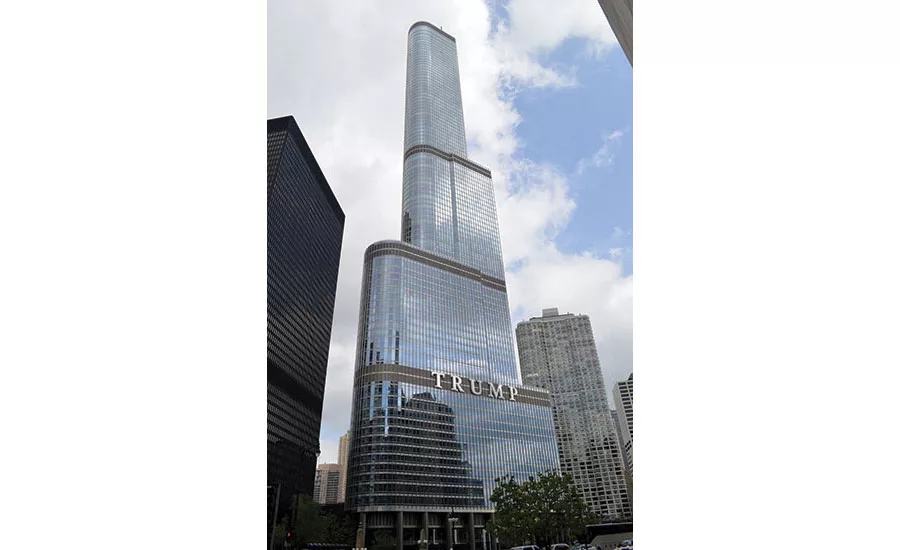
The Trump International Hotel and Tower in Chicago, designed by Adrian Smith when he was with SOM, opened in 2008.
Photo © Matthew Robey
America is having a Frank Capra moment. Not one of those uplifting finales but the scene in It’s A Wonderful Life where George Bailey (builder of affordable housing, savings and loan owner of unimpeachable generosity and ethics, honorer of veterans, monogamy incarnate!) hallucinates (on a trip induced by Clarence, his guardian angel) what might have happened to his beloved Bedford Falls had he never been born and the evil Henry Potter supplanted him as the town’s leading citizen and spirit. It’s a picture of unmitigated darkness, filled with “cocktail bars, casinos, and gentleman’s clubs,” rife with poverty, crime, misery.
Sound familiar? This could be Trump’s America, evoked in his doom-laden convention speech depicting our prospective future, and in the version of the country he has spent so many decades constructing in reality: those cocktail bars, casinos, and clubs. With the help of many of our leading practitioners—from Philip Johnson to Der Scutt to Adrian Smith—Trump has done more building than any politician since Jefferson (even if Trump University is a little more virtual and a little less rigorous than the University of Virginia, and Mar-a-Lago a skosh glitzier than Monticello!).
The candidate is Exhibit A for architecture’s inextricable ties to the social and economic forces that produce it: architecture is always going to the same place as everything else. Ours is not an autonomous discipline operating in a free field. Rather, it’s ever engaged in a deepening struggle to find the terms of its own distinction and necessity, especially now, as the designed environment expands its remit to cover the whole world, and the gap between the body and technology grows increasingly blurry. Building always marks and measures space, equity, and possibility, but it’s losing any clear-enough idea of how to perform as we race toward total urbanization on a planet at the point of asphyxiation.
Civilizations are marked by their priorities, and ours are too given over to prisons, malls, and McMansions and too little to good housing for all, complete and sustainable communities, green energy, rational mobility, structures of succor. Politics programs our architecture. The emblem of Trump’s agenda is a piece of architecture—that absurd pharaonic wall he bruits for the Mexican border. His whole project trumpets control, and his mantra is shared by many an architect: just leave it to me!
Trump’s sensibility is deeply old-fashioned: he makes buildings, things. Far scarier than tacky, grandiose building, however, is a spatial agenda being advanced by famously liberal Silicon Valley: the “smart” city. The phrase creeps me out. I worry that we’re being sold a bill of goods by huge corporations looking to embed sensors in every sidewalk, window, and wall to create “responsive” environments in the name of unsnarling traffic, conserving energy, and keeping megacities going, but which will be used, at best, to continue compiling consumer and behavioral profiles to sell us stuff—and, at worst, to surveille every inch of the earth to call down drone strikes on designated miscreants or raids by ICE on those 11 million “illegals,” based on some biometric fantasy of alien-ness. Data are not neutral. Metadata can be the devil’s work.
We—and our architecture—should be smarter than this, beginning with clearly knowing the limits of our intelligence and who it truly serves. As architectural practice becomes more and more technologized by CAD, BIM, scripting, and parametrics, our possibilities both expand and contract. Like so many other industries fleeing to cheaper pastures, architecture has let outsourcing become the norm. The economic impact is not clear-cut as a global matter (the free trade debate remains unsettled), but the homogenizing effects of single-supplier technology and the standardization of techniques and details augurs the worst effects of globalization—a world of oppressive sameness, in which we’re duped by a fantasy of customization, of difference applied to buildings like tattoos, their screen-blinded inhabitants narcotized by Angry Birds.
I’ve just gotten back from China, always exhilarating and depressing. Thrilling for the massive scale of the construction of clean and spacious apartments and for the tentacles of glistening infrastructure that spread in all directions. Depressing for the monstrous homogeneity, the repression, the cut corners, the dumb worship of consumption, and the toxic environment (my asthma got so bad I had to come home early). While I was there, though, I was on a couple of panels with Patrik Schumacher, the Luther of parametricism, and we came to amiable blows. Avowing the medium to have become the universal style via a risible mock-Darwinian inevitability, his pitch is both heroic and vague. Heroic for its ardent truthiness but vague for its inability to truly distinguish his computational parameters from those that have informed architecture from that first primitive hut and—even more so—vague for the willful refusal to answer the question of just which values should set the process in motion. And this is the origin point of architecture’s inescapable politics: whose parameters trump.
Looking for quick answers on architecture and design topics?
Try Ask RECORD, our new smart AI search tool.
Ask RECORD →
Looking for a reprint of this article?
From high-res PDFs to custom plaques, order your copy today!