Unpacking the Archive: MoMA Exhibition Examines 150 Years of Frank Lloyd Wright
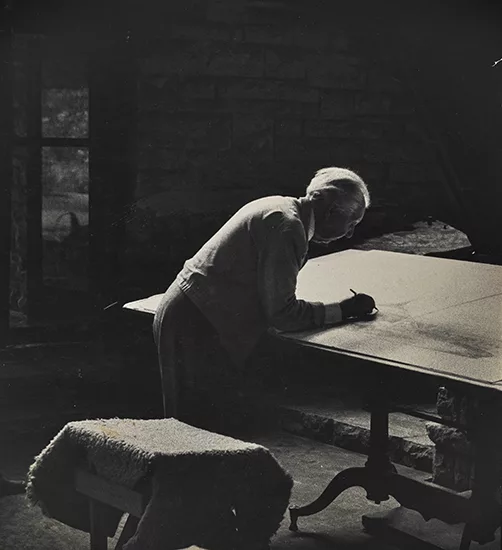
Portrait of Frank Lloyd Wright by an unknown photographer.
Image courtesy The Frank Lloyd Wright Foundation Archives (The Museum of Modern Art | Avery Architectural & Fine Arts Library, Columbia University, New York)
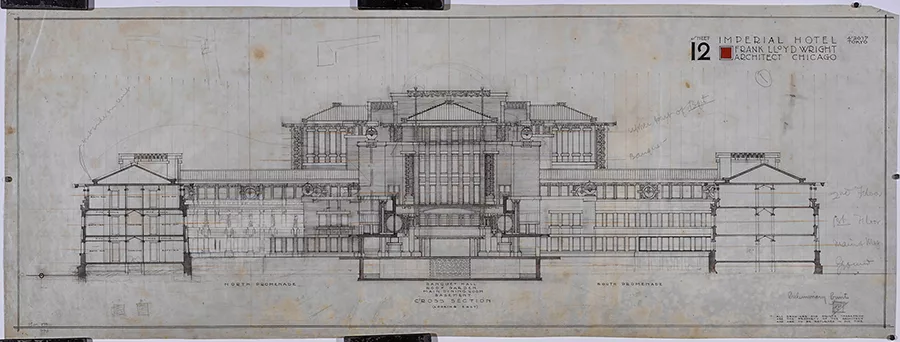
Imperial Hotel, Tokyo. 1913–23. Cross section looking east. Ink, pencil, and colored pencil on drafting cloth, 15 x 40 in. (38.1 x 101.6 cm).
Image courtesy The Frank Lloyd Wright Foundation Archives (The Museum of Modern Art | Avery Architectural & Fine Arts Library, Columbia University, New York)
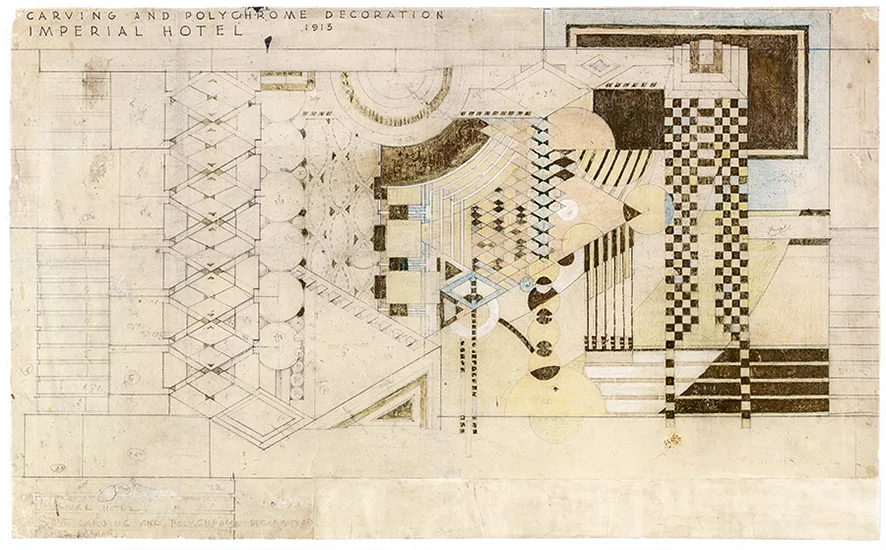
Imperial Hotel, Tokyo. 1913–23. Stone carving and polychrome decorations for the north parlor. Gold paint, pencil, and colored pencil on tracing, 21 7/8 x 35 7/8 in. (55.6 x 91.1 cm).
Image courtesy The Frank Lloyd Wright Foundation Archives (The Museum of Modern Art | Avery Architectural & Fine Arts Library, Columbia University, New York)
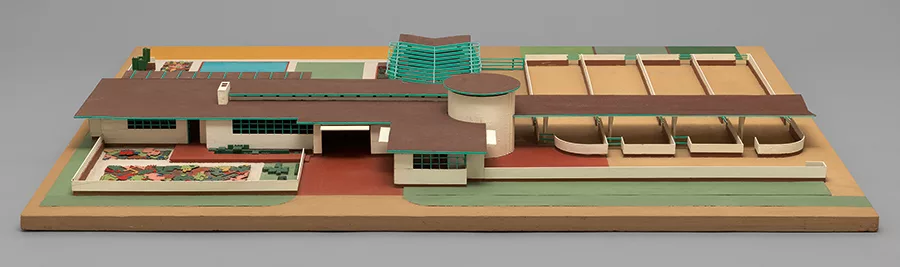
Davidson Little Farms Unit. Project, 1932–33. Model. Painted wood and particle board, 7 3⁄4 x 70 x 54 3⁄4 in. (19.7 x 177.8 x 139.1 cm).
Image courtesy The Frank Lloyd Wright Foundation Archives (The Museum of Modern Art | Avery Architectural & Fine Arts Library, Columbia University, New York)
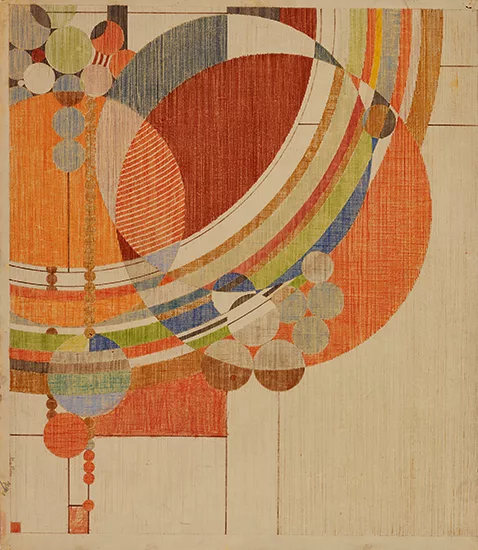
March Balloons. 1955. Drawing based on a c. 1926 design for Liberty magazine. Colored pencil on paper, 28 1/4 x 24 1/2 in. (71.8 x 62.2 cm).
Image courtesy The Frank Lloyd Wright Foundation Archives (The Museum of Modern Art | Avery Architectural & Fine Arts Library, Columbia University, New York)
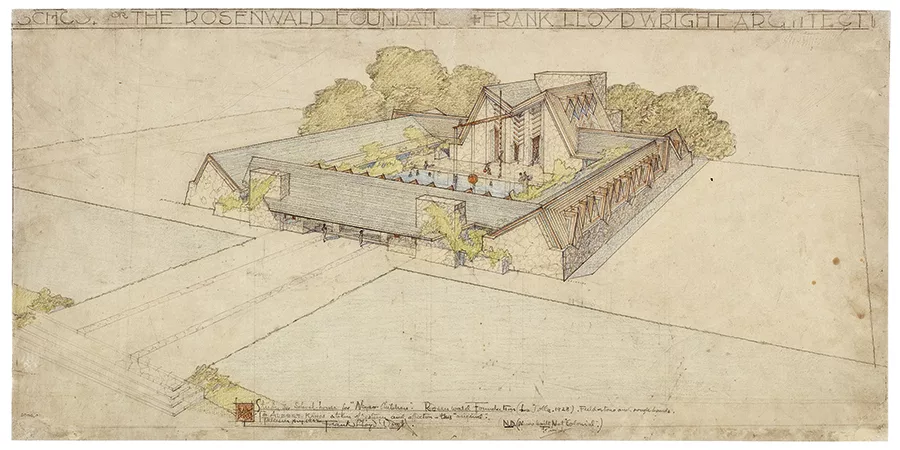
Rosenwald Foundation School, Hampton Normal and Agricultural Institute, Virginia. Project, 1928. Perspective. Pencil and colored pencil on tracing paper, 12 3/4 x 25 7/8ʺ (32.4 x 65.7 cm).
Image courtesy The Frank Lloyd Wright Foundation Archives (The Museum of Modern Art | Avery Architectural & Fine Arts Library, Columbia University, New York)
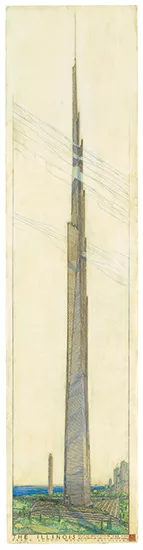
The Mile-High Illinois, Chicago. Project, 1956. Perspective with the Golden Beacon Apartment Building project (1956–57). Pencil, colored pencil, and gold ink on tracing paper, 8 ft. 9 in. x 30 in. (266.7 x 76.2 cm).
Image courtesy The Frank Lloyd Wright Foundation Archives (The Museum of Modern Art | Avery Architectural & Fine Arts Library, Columbia University, New York)
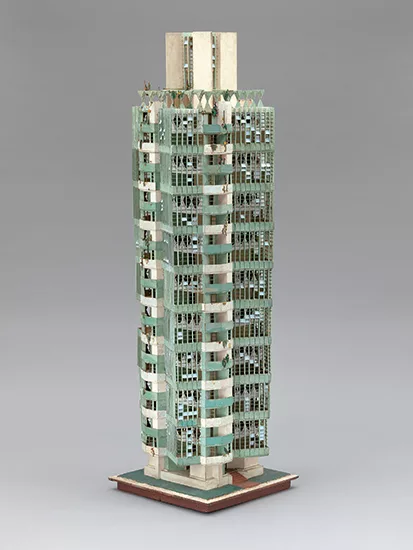
St. Mark’s Tower, New York. Project, 1927–29. Model. Painted wood and cardboard, 53 x 16 x 16ʺ (134.6 x 40.6 x 40.6 cm).
Image courtesy The Frank Lloyd Wright Foundation Archives (The Museum of Modern Art | Avery Architectural & Fine Arts Library, Columbia University, New York)
“This is an anti-retrospective,” says Barry Bergdoll, the curator of Frank Lloyd Wright at 150: Unpacking the Archive, on view until October 1 at New York’s Museum of Modern Art (MoMA). “It doesn’t try to perfectly shape an unfolding career.” Instead, he describes the show’s thematic structure as “eccentric.” And that it is. (Some might call it hard to follow.)
Instead of rolling out a standard repertory of all-time hits—Robie House, Unity Temple, Fallingwater, Johnson’s Wax, Guggenheim Museum—Bergdoll ferreted out lesser known efforts, many of which were unbuilt. Wright the formgiver is still evidence, but so is the protean creative genius as a socially conscious architect, planner, and inventor. The idea to uncover little-known corners and crevices of his staggering body of work came as a result of the archive MoMA and Avery Architectural and Fine Arts Library at Columbia University acquired from the Frank Lloyd Wright Foundation in 2012.
Bergdoll, who organized the show for MoMA with project research assistant Jennifer Gray, explains that choosing among 55,000 drawings, 125,000 photos, and 285 films, along with dozens of models and voluminous correspondence, was arduous. They got it down to some 400 objects on display. But how to present the material? Bergdoll decided to enlist both Wright and many non-Wright scholars as curators, asking each focus on one project plus around thirty items that would help explain its significance. At least 75 percent of the exhibited works were to come from this trove. Parts of the exhibition range from “Reframing the Imperial Hotel” (1923), showing drawings, photos, furniture, and textiles from the legendary Tokyo masterpiece, to Wright’s “ Little Farms Unit,” an experimental proposal of 1932-33 as a response to the plight of the farmers in the Depression, as well as more general topics such as “Ornament,” “Circular Geometries,” and “Drawing in the Studio.”
The variegated mix is informative and intriguing—even though the categories are as unified as apples and oranges, plums and kumquats. One participating scholar is Mabel O. Wilson, a practitioner, Columbia University professor, and author of Negro Building: Black Americans in the World of Fairs and Museums (2012). Wilson chose to explore Wright’s “Rosenwald School,” designed in 1928 as part of a mission of the Rosenwald Foundation to educate African Americans in rural areas. The design was more luxurious than desired by the beneficiary of this proposal, the Hampton Normal and Agricultural Institute (now Hampton University in Virginia), which believed in simplicity and discipline for its student body. The scheme—a flagstone, concrete, and cypress-board structure that included a theater and opened onto a rear courtyard for physical exercise—was never built, even though Darwin D. Martin, a past client of Wright, wanted to pay for it. The work emphasizes Wright’s belief that architecture should reinforce progressive academic ideals for students of any color.
Another portion of the show presents the master’s design-build ideas seen in his Usonian Automatic System Project of the early 1950s. As Matthew Skjonsberg, an architect who studied at Taliesin and is currently a Ph.D. candidate at the Swiss Federal Institute of Technology in Lausanne, shows, Wright retooled the textile concrete block he developed for the Millard and Ennis houses among others in California in the 1920s. This later version allowed do-it-yourself construction where homeowners would build their own dwellings using twelve standard shapes of blocks.
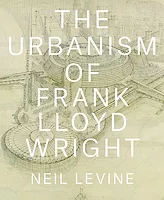
Neil Levine, the eminent Wright historian and Harvard professor, focuses on the “Skyscraper Regulation” project in his section on “Urbanism.” In Wright’s 1926 scheme for a nine-block area in Chicago’s Loop, the architect imaginatively tried to solve city planning problems—a surprising discovery considering his better-known predilection for decentralized growth. Here, Wright raised sidewalks to the second level, permitting traffic circulation at grade. He placed perimeter block apartments around courtyards, with 8-story buildings along the streets and towers rising to a 350-foot-height at the corners.
In a section of the show called “Reading Mile-High,” Bergdoll analyzes the famous proposal for the Mile-High Illinois skyscraper in Chicago, which he included in the inaugural archival MoMA show he curated in of 2014, Frank Lloyd Wright and the City: Density vs. Dispersal. Now Bergdoll exhibits a 1956 drawing Wright dedicated to architects and engineers, listing his favorites at the top of the 100 by 17 ½ inch rendering on tracing paper. One is J. J. Polivka, who executed structural calculations for the needle-like skyscraper, and whose plan sketches on a napkin are displayed.
Crucial to understanding the selections are video interviews with the various curators to underscore their points of view about their selections. (“Urbanism” lacks this necessary component—a loss.) By providing the individual choices as the storyline rather than the chronology of the Wright canon, Bergdoll has created an intriguing exhibition for those who know well the standard fare, but no doubt hard to get if you are a novice. The handsome installation frames the works on display with an understated rigor. The rectilinear galleries in the newly renovated 1939 portion of the museum are painted in muted tones (such as Pale Powder) that give the space an ethereal quality. While newly restored models, such as St. Mark’s Tower (1927-31) in painted wood and cardboard and replicas of Taliesin drafting tables, add a sculptural quality, digitized home movies of the master and his apprentices at work and play give the entirety a lively humanity. This exhibition is not for those uninitiated into the realm of Wright, but it does provide something new for almost everyone, even some who thought they knew it all.
Looking for quick answers on architecture and design topics?
Try Ask RECORD, our new smart AI search tool.
Ask RECORD →
Looking for a reprint of this article?
From high-res PDFs to custom plaques, order your copy today!