Architectural Record
search
cart
facebook twitter linkedin youtube
  • Sign In
  • Subscribe
  • Sign Out
  • My Account
Architectural Record
  • NEWS
    • Latest News
    • Awards
    • Interviews
    • Obituaries
    • Podcasts
      • Design:Ed Podcast
      • Sponsored Podcasts
  • OPINION
    • Book Reviews / Excerpts
    • Exhibition Reviews
    • Forum
  • EXCLUSIVES
    • Videos
    • Design Vanguard
    • Top 300 Firms
    • Sponsored Content
    • Sponsored eBooks
    • From the Archives
  • CONTINUING ED
    • Editorial Continuing Ed
    • CE Center
    • CE Academies
  • PROJECTS
    • Buildings By Type
    • Reuse & Renovation
    • Museums & Arts Centers
    • Colleges & Universities
    • Multifamily Housing
    • Interiors
    • Lighting
    • Kitchen & Bath
  • HOUSES
    • Record Houses
    • House of the Month
    • Featured Houses
  • PRODUCTS
    • Products by Category
    • Record Products of the Year
    • Latest Products
  • EVENTS
    • Dates & Events
    • Record on the Road
    • Innovation Conference
    • Sustainability in Practice
    • Women In Architecture
    • Webinars
    • Ad Excellence Awards
    • Submit an Event
  • CONNECT
    • Ask RECORD AI
    • Newsletters
    • Contact
    • Advertise
    • Editorial Calendar
    • Store
    • Customer Service
  • SUBMIT
    • Submission Guidelines
    • RECORD Competitions
  • MAGAZINE
    • Subscribe
    • My Account
    • Digital Edition
    • Current Issue
    • Firm Pass
    • Historic Archive
Interior DesignAdaptive Reuse and RenovationRecord Interiors

Lightspeed Office by ACDF* Architecture

Montreal
By Josephine Minutillo
Lightspeed Office

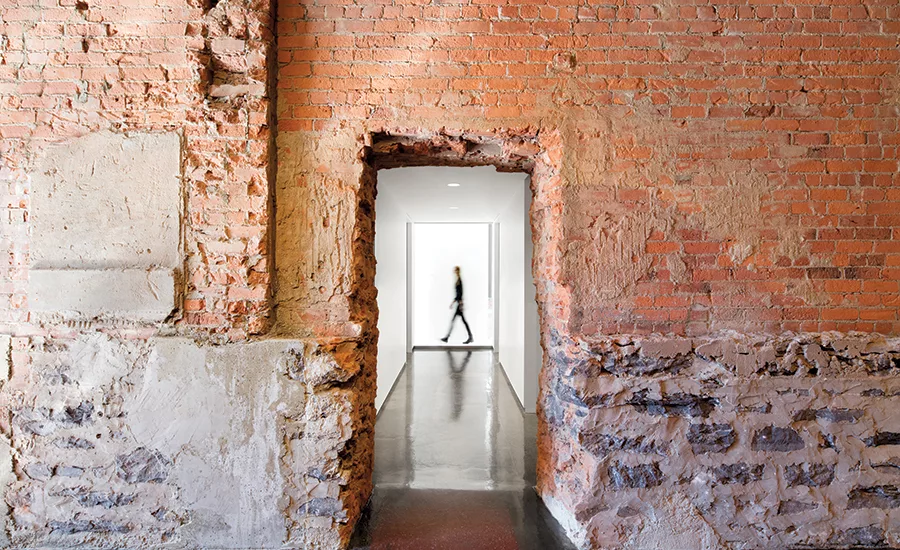
Original walls within the 119-year-old building are nearly 2 feet thick. Some areas are roughly patched with concrete, contrasting with the polished terrazzo floors, also original to the building.

Photo © Adrien Williams

Lightspeed Office

Glossy white floors, walls, and ceilings define much of the office.

Photo © Adrien Williams

Lightspeed Office

Sunny yellows and pale blues mark work zones for specific teams.

Photo © Adrien Williams
Lightspeed Office

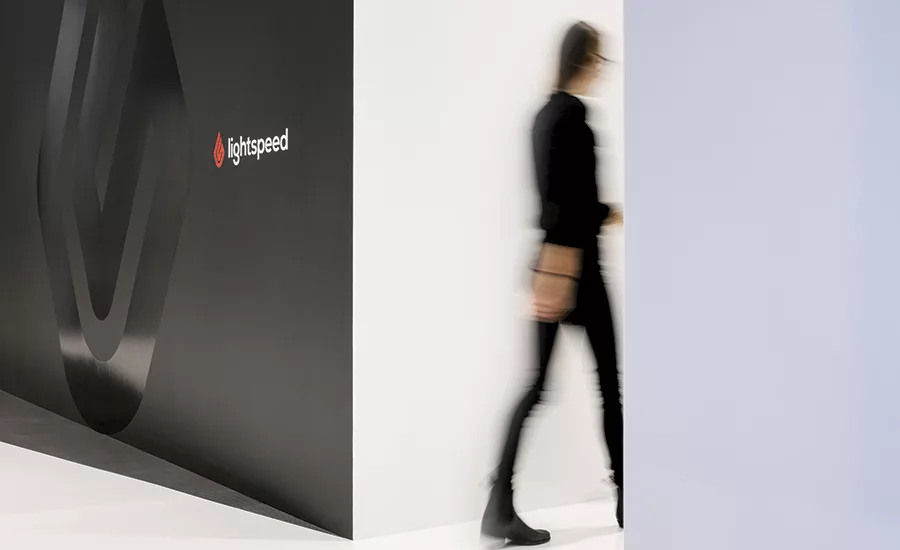
The company logo is discreetly integrated into a wall at the office entrance.

Photo © Adrien Williams

Lightspeed Office

The subtle color palette of the new insertions is juxtaposed with the existing brick.

Photo © Adrien Williams

Lightspeed Office

The subtle color palette of the new insertions is juxtaposed with the existing brick.

Photo © Adrien Williams
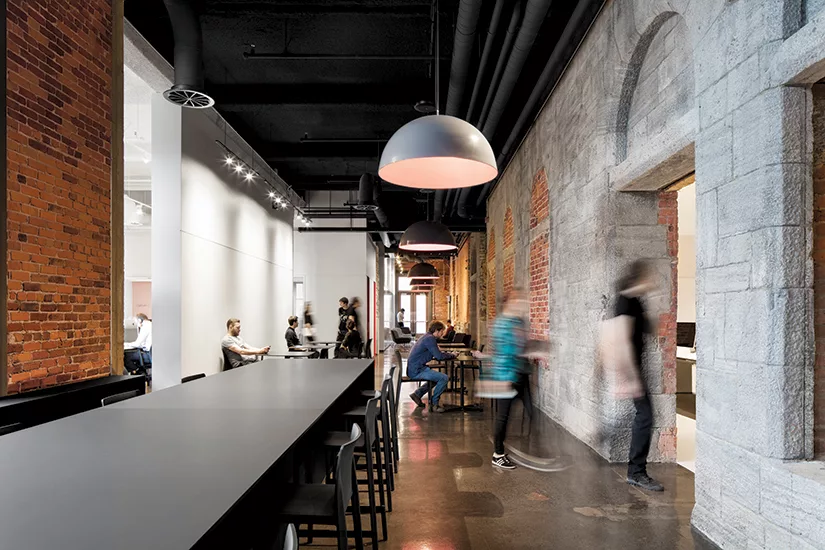
Lightspeed Office

The long kitchen and dining area doubles as a gathering space.

Photo © Adrien Williams
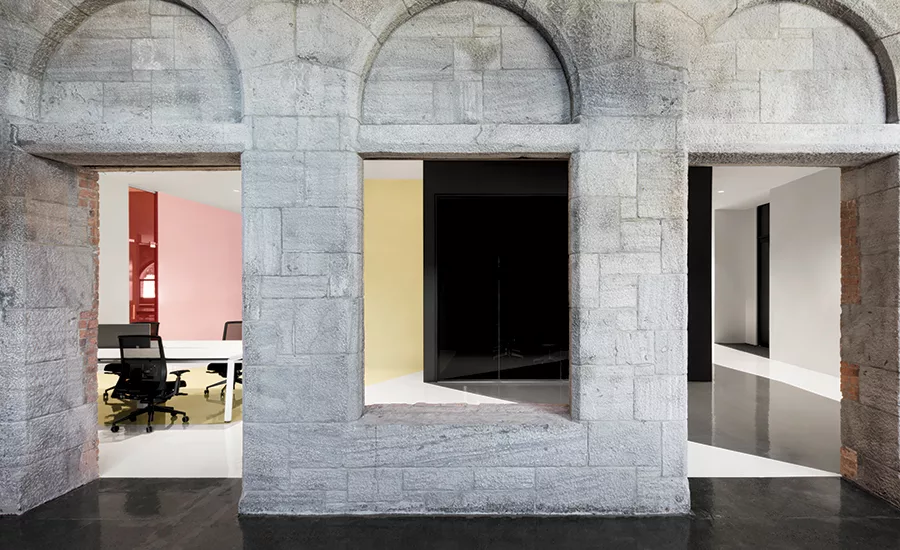
Lightspeed Office

The arched window openings of the building’s limestone base, once exterior, now make up part of the interior.

Photo © Adrien Williams

Lightspeed Office

Image courtesy ACDF

Lightspeed Office
Lightspeed Office
Lightspeed Office
Lightspeed Office
Lightspeed Office
Lightspeed Office
Lightspeed Office
Lightspeed Office
Lightspeed Office
September 1, 2017

Architects & Firms

ACDF* Architecture

Just a few short years ago, Lightspeed was a scrappy start-up with offices inside a Montreal townhouse. When it came time to look for bigger digs, the company enlisted Montreal-based architects ACDF* to help find a new location and transform it into the perfect space for the growing business. The founders of the point-of-sale and e-commerce software provider—whose employees tend to be on the younger side—had one requirement: the new offices needed to have a pool.

That proved almost impossible to pull off, but by the time the team came upon the abandoned Viger Train Station and Hotel by the old port of Montreal, an immense, turreted, château-style structure that had been abandoned for over a decade and recently slated for redevelopment, they happily settled on a “castle” in lieu of a pool.

Additional Content:
Jump to credits & specifications

ACDF* initially renovated the upper floors of the building for the company’s move in 2015. The design strategy was simple—leave as much as possible of the existing structure exposed. “They wanted it to feel as if they were squatters inside the castle,” says ACDF* founder Maxime- Alexis Frappier. Though now landmarked, the condition of the 1898 building was much deteriorated after being gutted and neglected. Its bones, however, were impeccable. Large timber rafters, 20-inch-thick red-brick shear walls, and polished terrazzo floors define the office, which is punctuated by long rows of desks.

But what do you do when a start-up grows up? As the company blossomed into a global one—it now has offices in London, Amsterdam, and New York, among other cities—even more space was required, so it expanded onto the ground floor, in the area once occupied by the former train station. The basic strategy for these offices—destined for its nearly 100 product developers—was the same, but, this time around, ACDF* added some flourishes that give the space an air of sophistication while still working with a very modest budget.

Most noticeably, an alluring palette of sunny yellows, pale pinks, and soft blues extends in diagonals from the floor to the walls to mark work zones and breakout rooms for specific teams. Smaller rooms that serve as phone booths or areas for one or two people to work are painted a deep red.

Overall, the 11,200-square-foot open office space features a glossy white epoxy-coated floor interspersed with the original terrazzo. Enclosed conference rooms are carpeted. At the entrance, microperforated vinyl in various shades of gray and black, sandwiched between two layers of epoxy, extends up a wall as a quiet backdrop for the company logo.

And unlike the way it is upstairs, where ceiling ducts and pipes are exposed, a white gypsum ceiling conceals most of the HVAC in the 15-foot-high, daylight-filled ground-floor space. (LEDs provide all electric lighting, mainly simple spots integrated into the ceiling as well as desk lamps.) Throughout the space, crisp, rectilinear geometries juxtapose with the jagged remnants—cut-through walls and broken-off pilasters—of the original structure, and the rough concrete patchwork that was applied over parts of it.

Some areas of the 119-year-old building, however, remain perfectly intact. Extending through to the inside, the limestone base surrounding the arched windows, for instance, add refinement. In the back of the structure, where the building opened up to the railway tracks, what once was an exterior wall, also limestone, now defines the kitchen and lounge, a corridor-like space set off by a long, black dining table and black ceilings that obscure the ductwork overhead. The alley, as it has come to be known, serves as a relaxed break room, with smaller tables and lounge seating, or as an all-company gathering space that can accommodate up to 300 people.

The product developers moved in this spring, occupying nearly all the seats at the long white desks and adding their notes and doodles on the walls-cum-whiteboards. The fast-paced nature of a start-up means that the office has very quickly achieved a lived-in feel—one that nicely mediates the contrast between the glossy new construction and the beautiful decay.


Credits

Architect:

ACDF Architecture — Maxime-Alexis Frappier, partner in charge


Engineer:

Stantec (mechanical and electrical)


General contractor:

Anjinnov


Specifications

Plastic Laminate

Formica, Abet Laminati, Fenix NTM


Glass doors

C.R. Laurence


Hardware

Rockwood, Sargent, Stanpro


Vinyl wallcoverings

Groupe Lettra


Paints and stains

Sico Paints


Furniture

Haworth, Herman Miller, Softline, Pedrali, Trica


Lighting

Litéline, ConTech

 
KEYWORDS: Montreal

Share This Story

Looking for a reprint of this article?
From high-res PDFs to custom plaques, order your copy today!

Josephine minutillo

Josephine Minutillo is editor in chief of Architectural Record. Trained as an architect, she began writing for RECORD in 2001 while practicing architecture, and has held several positions at the magazine over the past two decades. Her articles have appeared in many international publications. She has been an invited critic at Washington University in St. Louis, The Cooper Union, Columbia GSAPP, Pratt Institute, The City College of New York, and Yale University.
Instagram: @josephineminutillo_

Post a comment to this article

Report Abusive Comment

Subscription Center
  • Create an Account
  • Start a Subscription
  • Manage My Account
  • Sign Up for Newsletters
  • Visit Customer Service
  • Update Preferences

More Videos

Sponsored Content

Sponsored Content is a special paid section where industry companies provide high quality, objective, non-commercial content around topics of interest to the Architectural Record audience. All Sponsored Content is supplied by the advertising company and any opinions expressed in this article are those of the author and not necessarily reflect the views of Architectural Record or its parent company, BNP Media. Interested in participating in our Sponsored Content section? Contact your local rep!

close
  • TAMLYN XtremeTrim Exterior Trim
    Sponsored byTamlyn

    Designing Cleaner Panel Facades: Why Exterior Trim Details Matter

  • Building with Vapor Barriers
    Sponsored byReef Industries, Inc.

    Vapor Barriers Help Control Moisture in Tighter Building Designs

  • Duct Interior with Prodeq System
    Sponsored byHenry, a Carlisle Company

    Designing Resilient Water Containment Systems

DESIGN:ED Podcast
Listen to Architectural Record’s DESIGN:ED Podcast

Events

June 10, 2026

Rethinking Stormwater – The Power of Porous Paving

Credits: 1 AIA LU/HSW; 1 AIBD P-CE; 0.1 ICC CEU

Learn how porous paving systems support stormwater management, reduce heat island effects, and enhance sustainable site design performance.

June 11, 2026

Very Early Warning Fire Detection for Mission-Critical Facilities

Credits: 1 AIA LU/HSW; 1 AIBD P-CE; 0.1 ICC CEU

Examine advanced fire detection strategies that support uptime and enhance safety in data centers and other mission-critical facilities.

View All Submit An Event

Products

2026 Architect's Square Foot Costbook

2026 Architect's Square Foot Costbook

See More Products

Popular Stories

Practice Matters illustration

What’s in a (Firm’s) Name? Thinking About Succession and Legacy

Coronado Bridge

The Architect’s Guide to San Diego

Practice Matters illustration

By the Numbers: Counting America's Architects

Riverdale House by Studio Lau

Riverdale House by Studio Lau

KRESA by DLR

In Kalamazoo, DLR Group Completes a Mass-Timber Hub for Career and Technical Education Programs

Broader Sustainability of CMU - Free Webinar - May 21, 2026

Related Articles

  • Maison sur le Lac

    Maison sur le Lac by ACDF* Architecture

    See More
  • Private Office by Alvisi Kirimoto and CannonDesign

    Private Office by Alvisi Kirimoto and CannonDesign

    See More
  • RA Office

    RA Office by OHLAB

    See More

Related Products

See More Products
  • ribbonarch.jpg

    Ribbon Architecture: Light, Shadow, and Reflection in Architecture

  • 3dthinking.jpg

    3D Thinking in Design and Architecture: From Antiquity to the Future

  • american arch.jpg

    American Architecture: An Illustrated Encyclopedia

See More Products
×

The latest news and information

#1 Source for Architectural Design, News and Products

SUBSCRIBE
  • RESOURCES
    • Advertise
    • Contact Us
    • Submit
    • Store
  • ACCOUNT CENTER
    • Create an Account
    • Start a Subscription
    • Manage My Account
    • Sign Up for Newsletters
    • Visit Customer Service
    • Update Preferences
  • PRIVACY
    • PRIVACY POLICY
    • TERMS & CONDITIONS
    • DO NOT SELL MY PERSONAL INFORMATION
    • PRIVACY REQUEST
    • ACCESSIBILITY
  • SERVICES
    • Marketing Services
    • Reprints
    • Market Research
    • List Rental
    • Survey/Respondent Access
  • STAY CONNECTED
    • Linkedin
    • Facebook
    • Instagram
    • YouTube
    • X (Twitter)

Copyright ©2026. All Rights Reserved BNP Media, Inc. and BNP Media II, LLC.

Design, CMS, Hosting & Web Development :: ePublishing