'Never Built New York' Surveys the City's Impossible Past
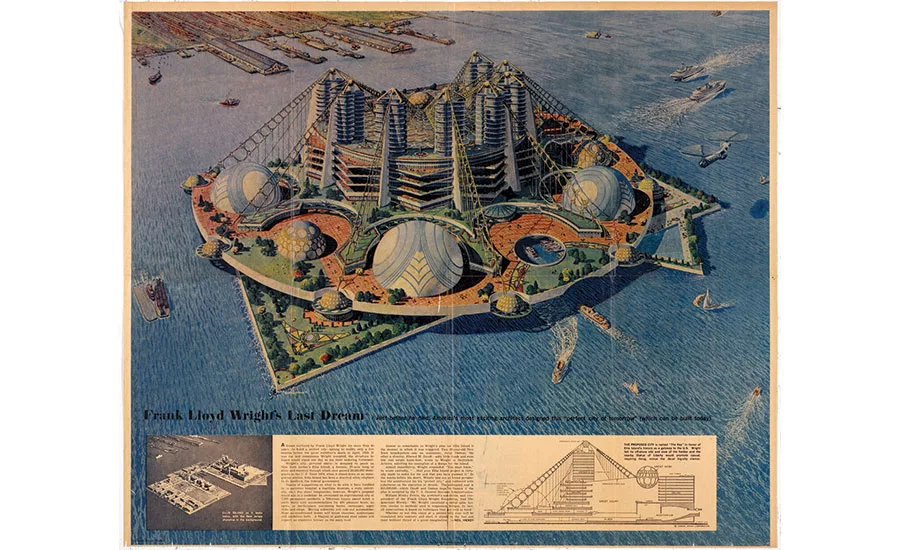
Frank Lloyd Wright’s Key Plan for Ellis Island was the architect’s last design before his death in 1959. Talliesin Associated Architects completed the scheme, which envisioned the decommissioned island as a self-contained city.
Image courtesy The Frank Lloyd Wright Foundation Archives
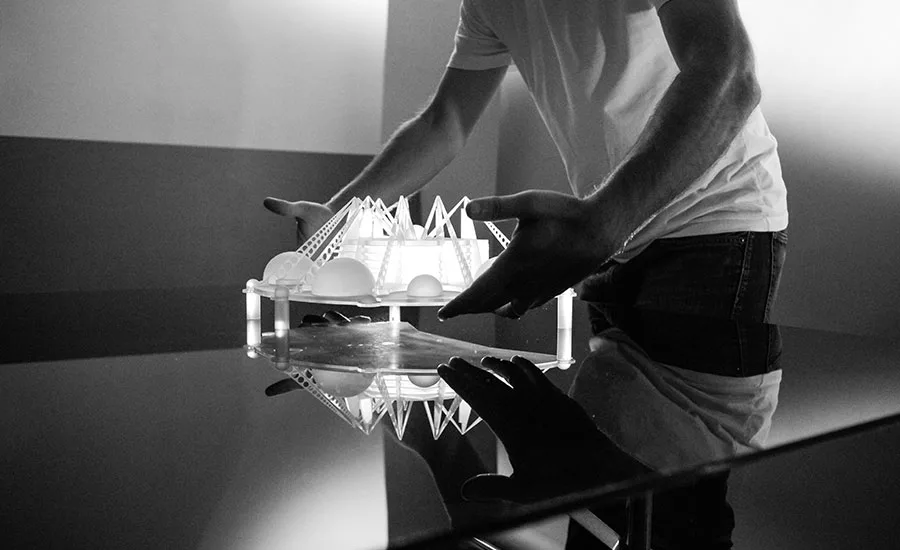
3D model reproduction by Columbia University GSAPP of Key Plan for Ellis Island, 1959, by Frank Lloyd Wright and Taliesin Associated Architects
Image courtesy Columbia University GSAPP
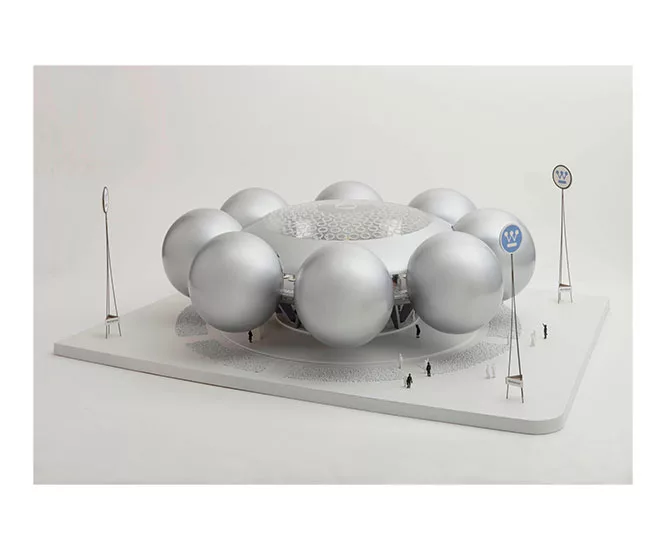
Eliot Noyes, Model of Westinghouse Pavilion for the 1964 New York World's Fair, 1961
Image © Eliot Noyes Industrial Design, courtesy SFMOMA
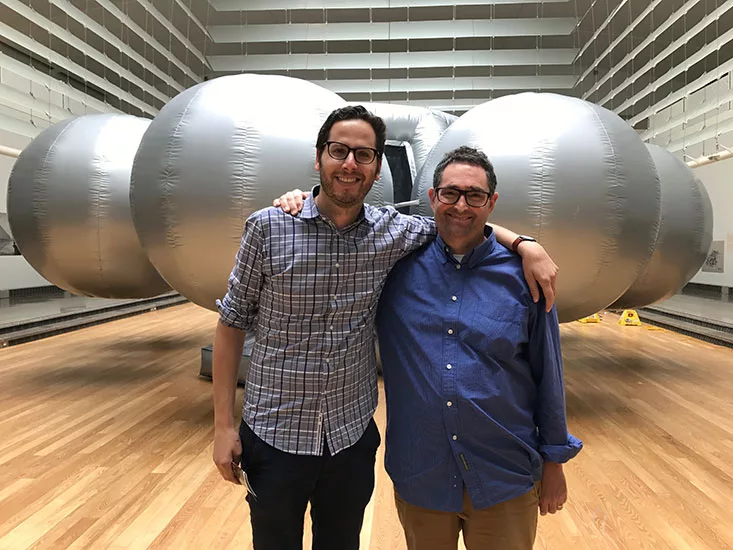
Never Built New York curators Sam Lubell and Greg Goldin in front of the custom Eliot Noyes of Westinghouse Pavilion bounce house
Photo © Architectural Record
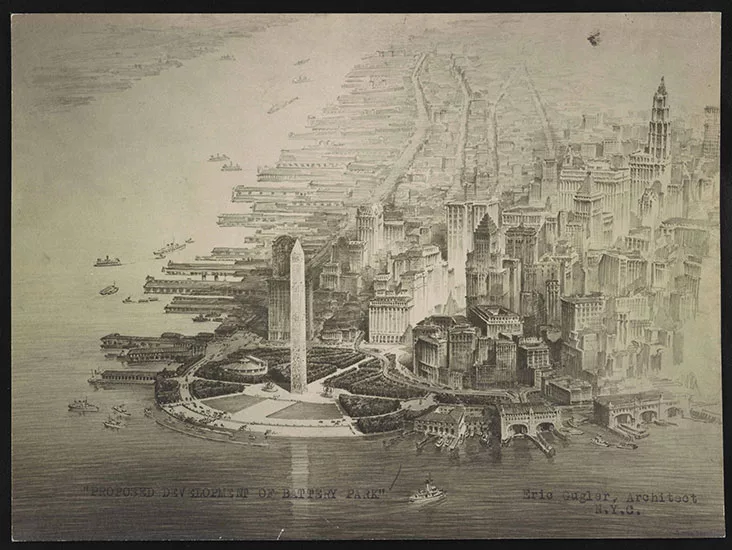
Eric Gugler, Development of Battery Park (bird's eye view showing proposed plan), 1929
Image of gelatin silver print courtesy Library of Congress
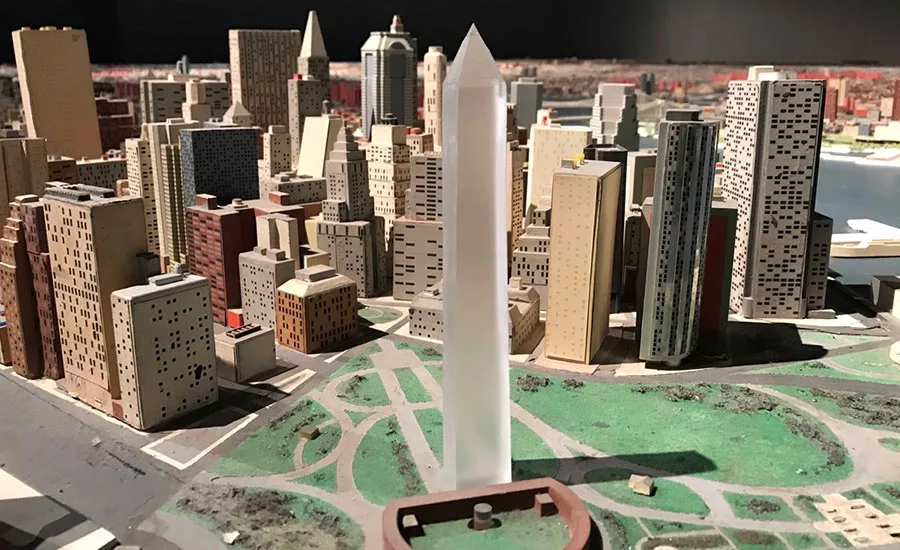
3D model reproduction by Columbia University GSAPP of Eric Gugler’s Obelisk from Proposed Development for Battery Park, 1929
Image courtesy Queens Museum
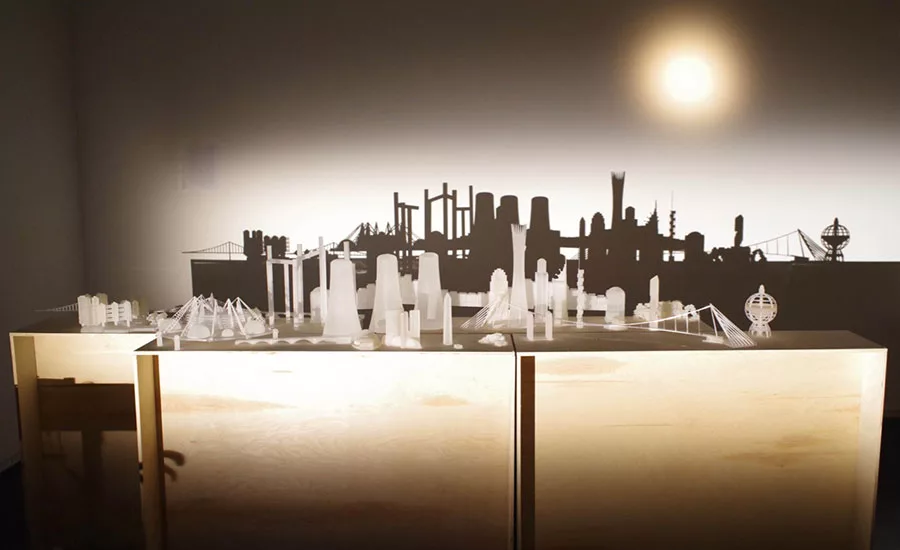
Skyline of Never Built New York 3D Models
Image courtesy Columbia University GSAPP
Strolling through the crowded galleries of Never Built New York (NBNY) at the Queens Museum feels like gazing into a parallel universe: things look familiar, but not quite right. The exhibit offers a glimpse of the different versions of New York that the city could have become—for better or worse. Sam Lubell and Greg Goldin curated the show, which is a companion piece for their earlier endeavor on the West Coast (Never Built Los Angeles, July 28 to October 27, 2013, at the Architecture and Design Museum) and books of the same names. The pair of architecture writers spent the last two years negotiating with universities, museums, and other institutions to assemble some 250 pieces of architectural memorabilia representing more than 80 unbuilt projects.
The exhibition begins in the long and narrow Rubin gallery. The curators, along with exhibition designer Christian Wassman, have displayed objects, renderings, sketches, and models of unbuilt projects around the room, which roughly mirrors the shape of Manhattan, arranged according to their corresponding location on the island. “We wanted it to feel as if you’re in the city,” Lubell told RECORD. Entering the exhibition, at the equivalent of the borough’s southernmost tip, visitors are greeted with drawings of Frank Lloyd Wright’s Key Plan for Ellis Island and Thomas Hasting’s 165-foot-tall National American Indian Memorial, as well as models of Venturi, Scott Brown & Associates’ Whitehall Ferry Terminal, planned for Staten Island, and Moshe Safdie’s Habitat New York. Walking farther in, one encounters Midtown schemes, Uptown plans, and finally concepts for the South Bronx.
The show benefits from the gallery’s high ceilings, which allowed Lubell and Goldin to arrange illustrations of multiple projects planned for the same site on the walls in columns. The effect is a familiar if somewhat chaotic density, augmented by the gallery’s close quarters.
Many of the unbuilt projects on display would have radically altered the DNA of New York—and perhaps none more so than Robert Moses’s six- and 10-lane elevated roadways, against which Jane Jacobs and others lobbied vehemently. The Midtown Expressway would have connected New Jersey to Long Island through the middle of Manhattan, obliterating all the buildings on the south side of 30th Street, while the Lower Manhattan Expressway (LOMEX), planned to run from the Holland Tunnel to the Manhattan and Williamsburg Bridges, would have decimated SoHo and Little Italy, leaving what remained obscured by its literal and figurative shadow. But the drawings of the LOMEX presented at NBNY paint a starkly different picture, with pedestrians enjoying the pleasantly landscaped public areas created beneath the arterial expressway. “Today we would say ‘no way’ to plowing a freeway through a residential neighborhood,” said Goldin, “but this rendering makes you realize that those planners who we think of as nefarious believed that what they were doing had genuine social value.”
The second part of Lubell and Goldin’s show takes place in the panorama room. Conceived by Robert Moses, then director of the corporation running the 1964 World’s Fair held on this site, and built by a team of more than 100 people, the panorama—a 1:1200 scale model of the city spread out over 9,000 square feet—is the crown jewel of the Queens Museum’s permanent collection. For NBNY, scale models illuminated from within have been placed across the miniature city. Joshua Jordan, director of the Fabrication Lab at Columbia University’s Graduate School of Architecture, Planning and Preservation, led students in creating some 50 models, which are further enhanced by a station of virtual reality glasses that allow viewers to see some of these unbuilt works as they would appear if viewed from the city streets today. The company Shimahara Illustration designed the truly memorable visualizations, which are not to be missed.
Finally, in the museum’s central skylit gallery, the curators have arranged concepts for the Queens Museum site in Flushing Meadows-Corona Park. Colorful illustrations and renderings orbit a bounce house–version of Eliot Noyes’s proposed pavilion for Westinghouse Corporation at the 1964 World’s Fair. Large enough for an adult to enter, the central room of the spaceship-like inflatable structure is surrounded by a series of large silver spheres where, in Noyes’s concept, the manufacturing company would have showcased their technology.
Throughout the three segments of the show, the curators succeed in identifying a unifying theme from the myriad concepts—however implausible—represented in NBNY: the architect’s impulse to solve the ills of urban society through design. Goldin pointed to the citywide scale of many of the schemes, which were driven more by designers’ ambitions to improve the built environment than by their egos. “Here,” he said,“we see their attempts—sometimes painted in much too broad strokes—to answer questions that perpetually perplex the city.”
Never Built New York runs through February 18, 2018, at the Queens Museum.
Looking for quick answers on architecture and design topics?
Try Ask RECORD, our new smart AI search tool.
Ask RECORD →
Looking for a reprint of this article?
From high-res PDFs to custom plaques, order your copy today!