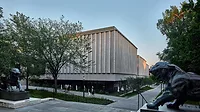
Princeton University Economics and International Programs Building by KPMB Architects
Princeton, New Jersey

Glass conference rooms peek above the 1929 collegiate Gothic building’s original roofline.
Photo © Adrien Williams

The architects added two new atriums. One of them is for the consolidated economics and international-programs departments and looks out on Minoru Yamasaki’s 1965 Scudder Plaza.
Photo © Adrien Williams

In the atrium just off the building’s main entrance, a seminar room is suspended over an inviting, intimate lounge area.
Photo © Adrien Williams
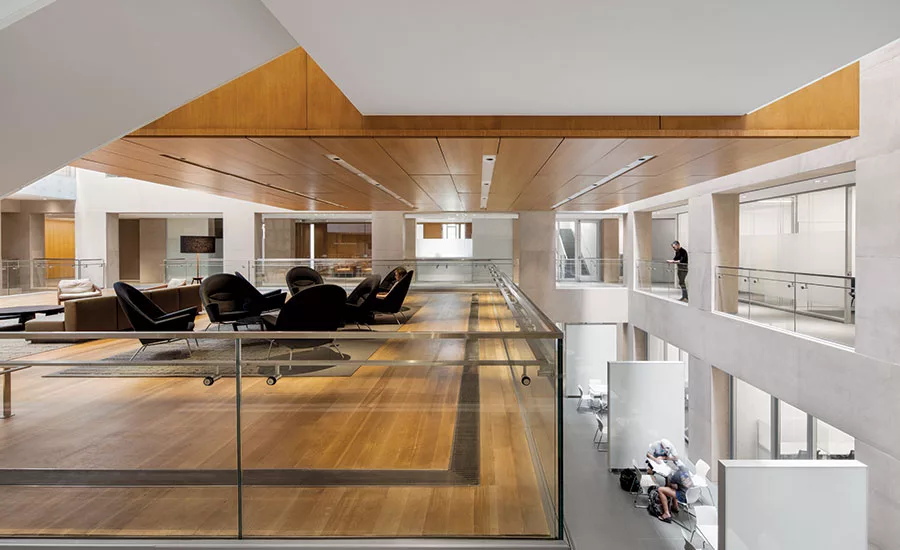
The surrounding hallways have views into the daylight-filled central space.
Photo © Adrien Williams

The architects retained select pieces of the original core, including a wood-paneled library that is now a faculty lounge.
Photo © Adrien Williams
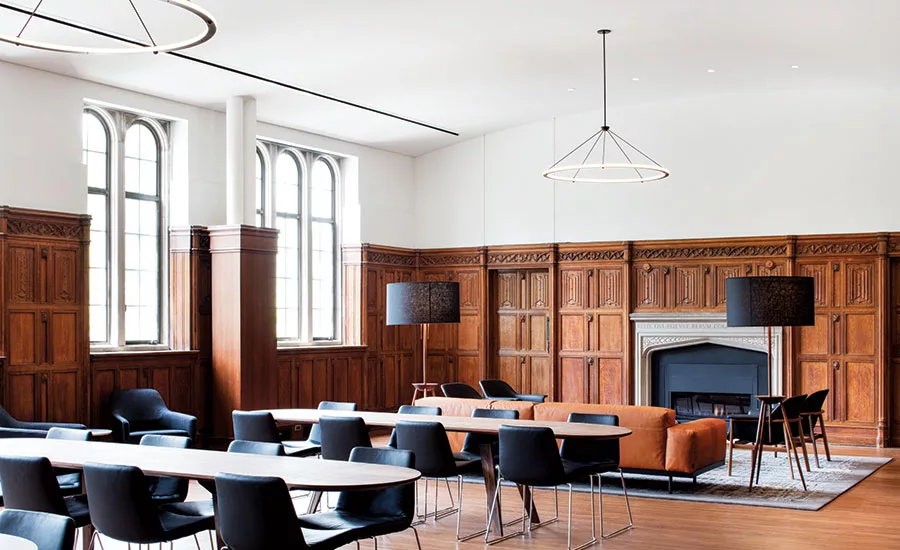
The architects retained select pieces of the original core, including a wood-paneled library that is now a faculty lounge.
Photo © Adrien Williams

In the south atrium, a café serves students, staff, and faculty. Clerestory windows drench the room in daylight.
Photo © Adrien Williams

Image courtesy KPMB Architects

Image courtesy KPMB Architects
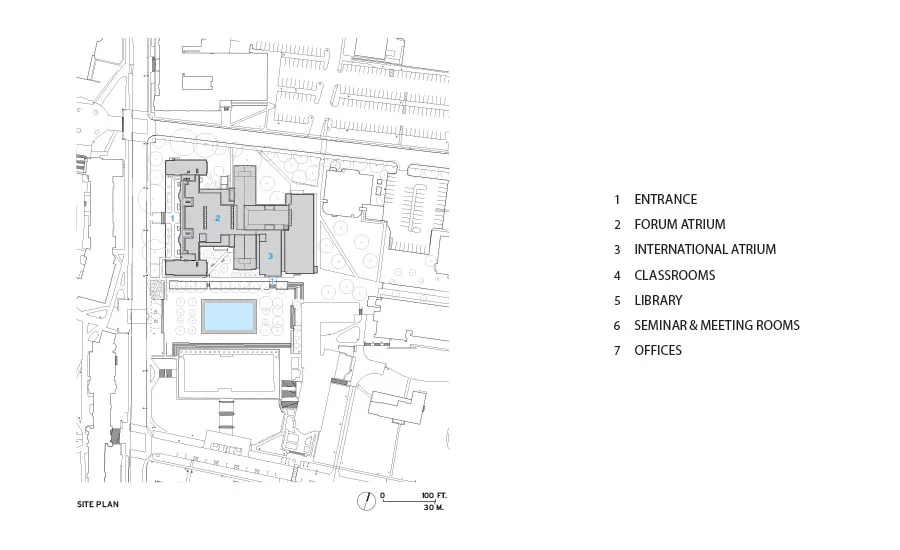
Image courtesy KPMB Architects
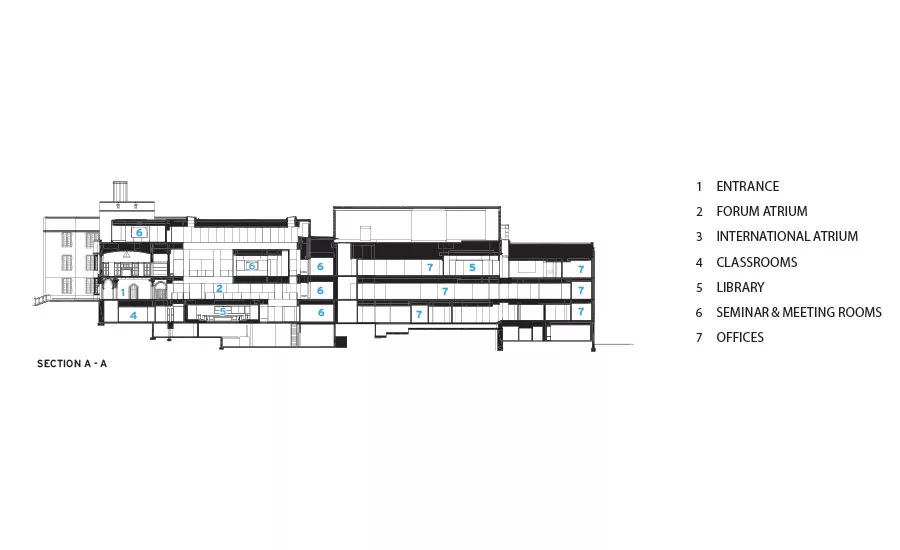
Image courtesy KPMB Architects

Image courtesy KPMB Architects
Architects & Firms
It’s a challenge that many universities face: What to do with lovely, old buildings on campus that have become run-down and outdated? Some schools add jarring additions or try to create a faux period piece with a renovation, while others tear them down and erect bold contemporary structures in their place.
At Princeton University, a campus with a tapestry of collegiate Gothic buildings, as well as major midcentury and contemporary icons, KPMB Architects skirted all these choices and came up with a stunning solution. The Toronto-based firm reinvented the 1929 Frick Chemistry Laboratories, designed by Charles Klauder, by perfectly straddling a line between preserving what made the building special and creating a new core that has everything a student or faculty member could want. Landscape designer Michael Van Valkenburgh’s careful deletions and additions around the building are also critical to the magic, as is his restoration of Beatrix Farrand’s original landscaping. According to university architect Ronald McCoy, the former Frick’s transformation into the conjoined Julis Romo Rabinowitz Building and Louis A. Simpson International Building is the most significant renovation of any Princeton historic building.
Additional Content:
Jump to credits & specifications
The structure, which faces busy Washington Road, now houses Princeton’s economics department, which was scattered around campus, as well as the university’s international programs (the consolidation was the final piece of the puzzle in Princeton’s last master plan from 2006). It also provides a porous boundary between the historic western campus and its contemporary northeastern corner.
KPMB’s strategy for the 200,000-square-foot building was less about precious restoration than celebrating its quirky features while drenching the interior with daylight and lavishing it with careful detailing and a variety of luxurious spaces to work, learn, and hang out. The firm retained the cast-in-place concrete structure with its masonry walls, purple-gray argillite facade, and limestone quoins and arches, but gutted the interior, which had felt like a basement. “Now it has gravitas, but also light and flow and buzz,” says Shirley Blumberg, KPMB’s partner in charge.
Most dramatically, KPMB added two light-filled, anchoring atriums, one just inside the western entrance off Washington Road, serving the economics department, and one to the south—where the Frick’s original H-shaped footprint was given a rectangular addition in 1964—for the international departments. After stepping through the carefully preserved original lobby, with its iron gates by master metalsmith Samuel Yellin (1884–1940), visitors emerge into the first soaring atrium. Dubbed the forum, it is a hushed space, with inviting lounge furniture, underneath a suspended glass-walled seminar room. Offices, classrooms, and more seminar rooms are grouped around the perimeters of the upper three stories, with corridors that overlook the central space.
The architects made a showcase of the dividing line between the 1929 building and the 1964 addition, creating a glass vitrine that brings daylight streaming as far down as the basement levels from new skylights. Glass-walled seminar rooms on the fourth floor have views of the campus and peek up above the building’s original roofline. A quirky, complicated building—that rises one floor higher toward the east—is now cohesive and easy to navigate.
As with the entrance lobby, KPMB preserved the building’s former library, a rich, wood-paneled room, retaining the white oak floors but adding a fireplace and a hidden kitchen. “We saw the microcosm of the whole campus in this building,” says Bruce Kuwabara, KPMB design partner. “It moves from Gothic to more modern.” The south atrium, for example, incorporates walls that were once on the Frick exterior, complete with their arched limestone windows. A small café here has a porcelain-tile floor that matches the bluestone seen around campus. Nearby, the architects removed an unsightly narrow addition from the east elevation to create an inviting new entry off the back of the building, facing Minoru Yamasaki’s iconic Woodrow Wilson school and the Scudder Plaza.
KPMB and Van Valkenburgh have brought a new sense of openness to that plaza, with its sunken, rectangular reflecting pool, which Yamasaki designed in tandem with his slender-columned building. Its neighbors include Stephen Voorhees’s 1951 redbrick Corwin Hall, and Fisher and Bendheim halls, designed by Venturi, Scott Brown and Associates in the 1990s. “At a campus like Princeton’s, where the strategy is connectivity, this bit of Modernism was isolated and inwardlooking and very selfish,” says McCoy. That impenetrability is now gone, thanks to the removal of some of Yamasaki’s plaza walls and KPMB’s new entrances in the former Frick.
Besides the plaza, “Princeton is full of courtyards and quadrangles,” says Kuwabara. “But our atriums are the equivalent.” Given the amount of working, chatting, and even napping in these well-appointed spaces, the students have clearly embraced them. “There’s a word-of-mouth effect among students when a great new space opens up,” says McCoy. “I think it was a surprise to the economists that it would be such an attractor; they are adjusting to the fact that they are on the map of nice places.”
CreditsArchitect: KPMB Architects, 322 King Street West, 3rd Floor, Toronto, Canada, M5V 1J2, +1 416 977 5104, kpmb.com Personnel in architect's firm who should receive special credit: Bruce Kuwabara, OC, OAA, FRAIC, AIA, RIBA (design partner), Shirley Blumberg, CM, OAA, FRAIC, AIA (partner-in-charge), David Jesson, OAA (senior associate), Mark Jaffar (associate), Carolyn Lee (associate), David Smythe (associate), Lynn Pilon (project architect), Gabriel Fain, Annie Pelletier, Ya’el Santopinto, Elizabeth Paden, Victor Garzon, Clementine Chang, Kristina Strecker, Samantha Hart, Rachel Cyr, Dina Sarhane
Engineers Structural, Building Envelope: Thornton Tomasetti Mechanical, Electrical, Fire Protection: Altieri Sebor Wieber LLC Civil: Van Note-Harvey Associates
Consultants Landscape: Michael Van Valkenburgh Associates, Inc. Lighting: Tillotson Design Associates Heritage: Jablonski Builidng Conservation, Inc. Building Code: Phil R. Sherman, P.E. AV and Acoustics: Cerami & Associates Sustainability: Atelier Ten Cost: Vermeulens Signage: Entro Communications Specifications: Brian Ballantyne Elevator: Van Deusen & Assoc.
Artwork: Shahzia Sikander
General contractor: Barr & Barr, Inc, Builders
Photographer: Adrien Williams |
SpecificationsExterior Cladding Masonry: Argillite Stone, Indiana Limestone Metal/glass curtain wall: National Glass & Metal Company, Inc. Moisture barrier: Sarnafil Metal panel: Kingspan, Alucobond
Roofing Built-up roofing: Tremco Incorporated Thermoplastic Waterproofing: Sika Sarnafil
Windows Metal frame: Hope’s Windows, Inc.
Glazing Glass: Viracon, Fry Reglet, Herculite, SaftiFirst, Vitro Architectural Glass, IAC Acoustics Skylights: National Glass & Metal Company, Inc.
Doors Entrances: Hope’s Windows, Inc. Metal doors: Hope’s Windows, Inc. Wood doors: Graham / Patella Woodworking Sliding doors: Faram Holding and Furniture Inc. Fire-control doors, security grilles: Cookson Rolling Grilles Special doors: Modernfold Styles, Inc.
Hardware Locksets: Best Closers: DORMA Exit devices: Von Duprin Pulls: Rockwood Security devices: CACS
Interior Finishes Acoustical ceilings: Armstrong World Industries Suspension grid: Armstrong Demountable partitions: Faram Holding and Furniture Inc. Cabinetwork and custom woodwork: Patella Woodworking Paints and stains: Benjamin Moore Paneling: RPG Diffuser System, Inc. / Patella Woodworking Plastic laminate: Formica Solid surfacing: Cambria / Avonite / Corian Special surfacing: Lightblocks Floor and wall tile: Mosa Resilient flooring: nora Carpet: Interface / Tai Ping Raised flooring: Tate Stone Flooring: Bluestone -Endless Mountain Glass Floor: Greenlite Glass Systems
Furnishings Office furniture: Gunlocke / Teknion Reception furniture: Walter Knoll, Zeitraum, Arflex, Carl Hansen Chairs: Herman Miller, Andreu World, Geiger, Teknion Studio Tables: Davis, Randers, De La Espada, Tacchini, Studiolise
Lighting Selux, USA Illumination, Edison Price Lighting, L.I.M., Artemide, Pennsylvania Globe, Lucifer Lighting, B-K Lighting Dimming system or other lighting controls: Lutron
Conveyance Elevators: GAL
Plumbing Waterclosets: Sloan Lavatory: Custom Corian Faucet: Toto Drinking Fountains: Filtrine Water Dispenser: Quench
Energy Energy management or building automation system: Siemens Building Technologies |
Looking for a reprint of this article?
From high-res PDFs to custom plaques, order your copy today!